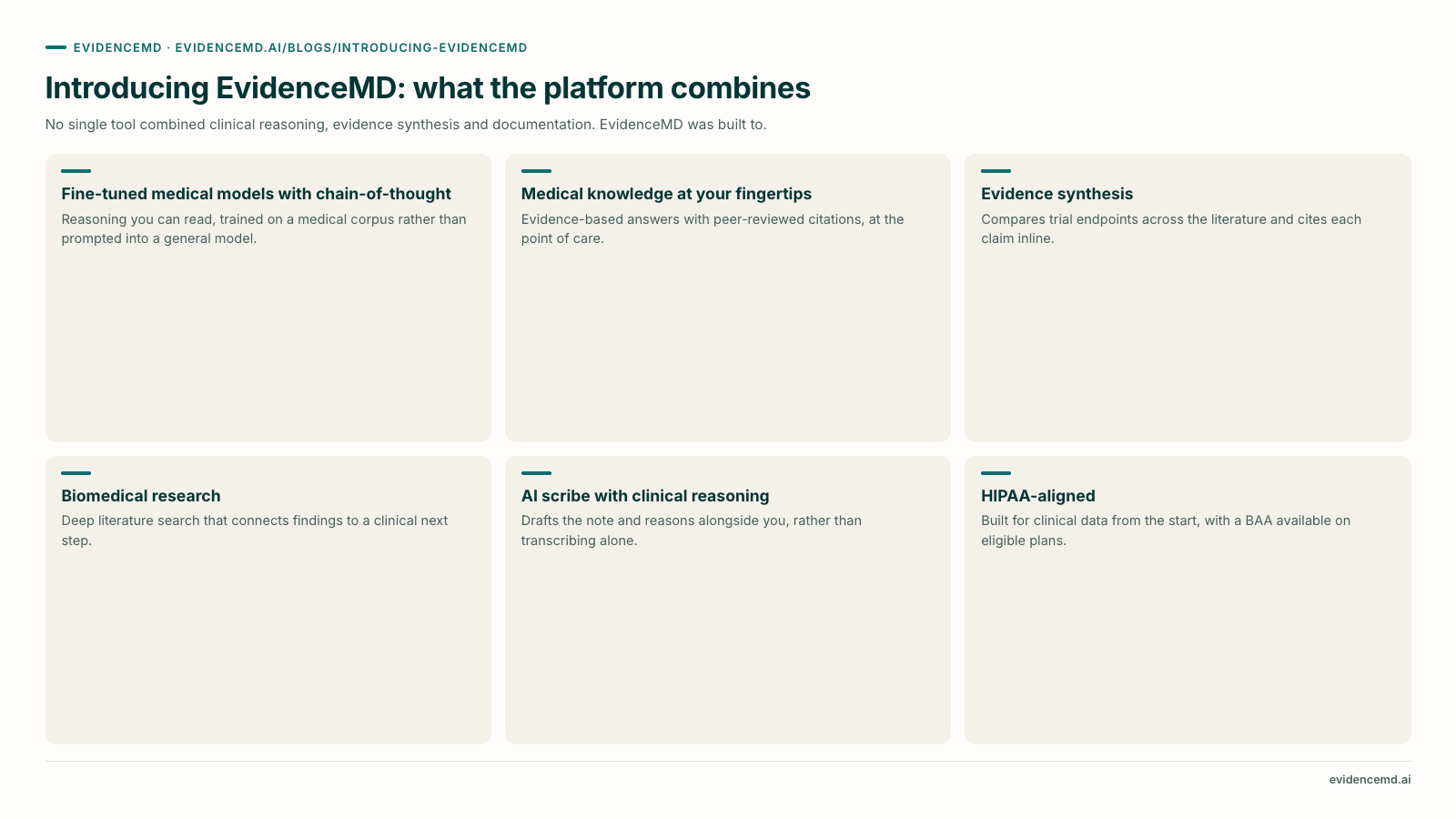
⚠️The Problem: No Tool Combines Clinical Reasoning with Peer-Reviewed Evidence
Existing medical AI tools fall into two categories: either they transcribe and summarize without any clinical reasoning, or they provide generic AI responses without grounding in peer-reviewed medical literature.
The gap nobody's solving:
There's no tool that performs true clinical reasoning while simultaneously citing and integrating peer-reviewed evidence in real-time. Physicians need both—the diagnostic thinking process AND the evidence to back it up. Researchers need AI that can reason through complex medical questions while pulling from validated, published research.
Current tools give you one or the other. Never both. Until now.
Our Approach: Fine-Tuned Medical Models with Chain-of-Thought Reasoning
EvidenceMD is powered by our proprietary fine-tuned medical models trained specifically for clinical reasoning. Unlike generic AI that pattern-matches text, our models use chain-of-thought reasoning with advanced multi-step logic to mirror how physicians actually think through clinical problems.
What makes our models different:
Our fine-tuned models consistently score at the top of medical benchmarks across multiple specialties.
We've trained on millions of clinical cases, peer-reviewed literature, and specialty-specific reasoning patterns.
Every single day, we integrate the latest medical literature, clinical guidelines, and research findings. Your AI assistant isn't working with stale 2023 data—it's current, evidence-based, and reliable.
Medical Knowledge at Your Fingertips
Medical knowledge at your fingertips
The EvidenceMD interface: Learn mode, Expert mode, DeepSearch, specialty selection, and 30+ language support
What Makes EvidenceMD Different
1. AI Evidence-Based Scribing with Clinical Reasoning
We're the first medical scribe integrated with clinical reasoning. Generate differential diagnoses with probability rankings, evidence-backed treatment plans with citations, and research references from the latest literature—all in real-time during the patient encounter.
2. DeepSearch with Advanced Reasoning
DeepSearch doesn't just find papers—it understands your clinical question, connects it with the latest evidence, synthesizes findings across multiple sources, and presents actionable insights. Accelerate literature reviews from weeks to hours.
3. Specialty Intelligence
Our models adapt to your domain. Whether you're in cardiology, neurology, oncology, drug discovery, or clinical research, the AI adjusts its reasoning patterns, terminology, and evidence base to match your specialty.
4. Learning Mode: Your AI Learning Partner
Our Learning Mode doesn't just answer questions—it teaches. Ask about complex pathophysiology, drug mechanisms, or diagnostic approaches, and get deep explanations that build understanding, not just facts.
5. CME/CPD Credits Integration
Every clinical interaction is a learning opportunity. We've integrated continuing medical education tracking so your clinical work and research automatically count toward your CME/CPD requirements.
6. 30+ Languages: Breaking Language Barriers
We're the first evidence-based clinical tool with comprehensive multilingual support. Medicine shouldn't be limited by language. Our models deliver the same quality of clinical reasoning in over 30 languages.
Evidence Synthesis in Action
Ask complex clinical questions and get comprehensive, evidence-based answers with head-to-head comparisons, statistical analysis, and citations from the latest peer-reviewed literature.
Executive Summary: GLP-1 RA + Basal Insulin vs. Basal-Bolus Therapy
The combination of a GLP-1 Receptor Agonist (GLP-1 RA) and basal insulin is clinically superior to basal-bolus insulin regimens for weight management and hypoglycemia reduction, while providing non-inferior to superior HbA1c reduction.
Evidence from randomized controlled trials (RCTs) and meta-analyses demonstrates that GLP-1 RA + basal insulin results in significant weight loss (versus weight gain with basal-bolus), a lower risk of hypoglycemia, and a simplified treatment regimen with fewer daily injections...12345
Head-to-Head Comparison: GLP-1 RA + Basal vs. Basal-Bolus
| Clinical Outcome | GLP-1 RA + Basal Insulin | Basal-Bolus Insulin | Statistical Difference / Impact |
|---|---|---|---|
| HbA1c Change | Superior or Non-inferior Mean reduction: -0.1% to | Effective, but often limited by hypoglycemia concerns | Favors GLP-1 RA + Basal Meta-analysis shows mean |
DeepSearch synthesizes evidence from multiple sources, providing executive summaries and head-to-head comparisons
Transforming Biomedical Research
From weeks to hours
Biomedical research has a bottleneck problem: researchers spend 40-60% of their time on literature review, evidence synthesis, and keeping up with the latest publications. The volume of published research doubles every few years, making it impossible for any researcher to stay current across their entire field.
EvidenceMD solves this for biomedical researchers:
Accelerated Literature Reviews
Instead of spending weeks manually reviewing hundreds of papers, researchers use DeepSearch to:
AI Scribe with Clinical Reasoning
Document patient encounters with intelligent clinical reasoning. Generate SOAP notes, differential diagnoses, red flags, and ICD-10 codes—all with complete HIPAA compliance.
SUBJECTIVE
CC: Chest pain during exertion. HPI: 58-year-old male with history of hypertension presents with...
The AI Scribe interface: Complete SOAP notes, differential diagnoses, red flags, ICD-10 codes, and HIPAA compliance
HIPAA-Aligned & Secure
Your patient data is protected
Built for Real Clinical Workflows
Clinical Documentation
Evidence-based notes with clinical reasoning in real-time
Drug Research
Accelerate literature reviews and evidence synthesis
Medical Education
A learning partner that explains complex concepts deeply
Evidence Synthesis
Quickly synthesize findings across hundreds of papers
Clinical Trials
Streamline protocol development with evidence-based insights
Decision Support
Real-time clinical reasoning during patient encounters
The Technology Behind It
Our architecture combines:
Fine-tuned medical LLMs trained on specialty-specific clinical reasoning
Chain-of-thought reasoning engines that mirror physician decision-making
Daily database updates ensuring up-to-date medical knowledge
Real-time literature integration connecting clinical context with latest research
Multi-specialty adaptation delivering domain-specific intelligence