What is the Anion gap?
EvidenceMD's anion gap calculator uses anion gap = sodium − (chloride + bicarbonate), then adds 2.5 mmol/L for every 1 g/dL that albumin falls below 4.0 g/dL [1][2]. With modern ion-selective electrode analysers the reference range is about 3–11 mmol/L, lower than the traditional 8–16, and it varies between laboratories [1][3]. A raised gap most often means a high anion gap metabolic acidosis [1]. Paste the result into EvidenceMD for a cited work-up, free to start in 30 languages.
Key takeaways
- Anion gap = Na − (Cl + HCO₃), in mmol/L, which equals mEq/L for these ions [1].
- Correct for albumin: add 2.5 mmol/L for each 1 g/dL (0.25 per g/L) that albumin is below normal [2].
- The typical range with modern analysers is about 3–11 mmol/L, not the older 8–16 — use your laboratory's interval [1][3].
- A raised gap most often means a high anion gap metabolic acidosis; a low gap most often means laboratory error or low albumin [1].
- EvidenceMD turns the gap into a diagnosis and plan — likely causes, the next test and treatment — with citations, free to start.
How is the Anion gap calculated?
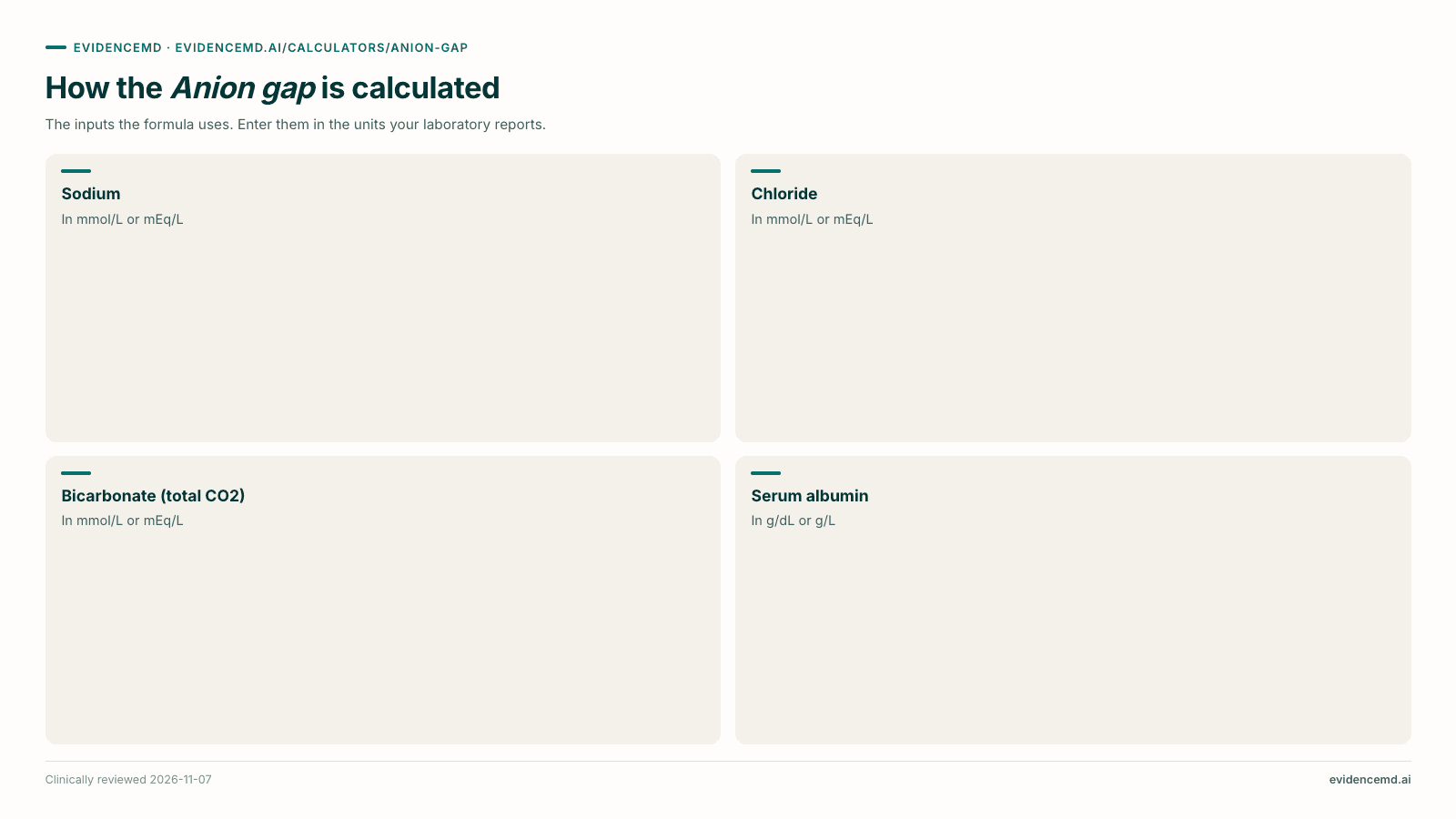
Enter the four values from the same blood sample, in the units your laboratory reports.
| Input | Definition | Role |
|---|---|---|
| Sodium | Units: mmol/L or mEq/L. | Formula input |
| Chloride | Units: mmol/L or mEq/L. | Formula input |
| Bicarbonate (total CO2) | Units: mmol/L or mEq/L. | Formula input |
| Serum albumin | Used to correct the gap: albumin is the main unmeasured anion. Units: g/dL or g/L. | Formula input |
→ Scroll the table sideways to see the remaining columns
How do you interpret the Anion gap result?
The category is read from the albumin-corrected gap, because a low albumin lowers the measured gap and can hide a gap acidosis [2].
| Result | Category | What it means |
|---|---|---|
| < 3 (albumin-corrected) | Low anion gap | Below the 3–11 mmol/L range reported with modern analysers. A low gap most often reflects laboratory error; once albumin is accounted for, consider a paraproteinaemia or lithium, bromide or iodide intoxication. Check your laboratory's reference interval. |
| 3–11 (albumin-corrected) | Within the typical range | Within the 3–11 mmol/L range reported with modern ion-selective electrode analysers. Reference intervals differ between analysers and laboratories, so compare with yours. A normal gap with a low bicarbonate points to a normal anion gap (hyperchloraemic) metabolic acidosis. |
| > 11 (albumin-corrected) | Raised anion gap | Above the 3–11 mmol/L range reported with modern analysers. A raised gap most often indicates a high anion gap metabolic acidosis — for example lactic acidosis, ketoacidosis, kidney failure or toxic alcohols — but can reflect laboratory error, metabolic alkalosis, hyperphosphataemia or a paraproteinaemia. Compare with your laboratory's interval. |
→ Scroll the table sideways to see the remaining columns
Reference intervals depend on the analyser. Winter and colleagues found the range had fallen to 3–11 mmol/L with ion-selective electrodes, and most healthy people had a gap of 6 mmol/L or less [3]. The normal value also varies between individuals [1].
The ratio of the change in anion gap to the change in bicarbonate (the delta ratio) has been used to detect mixed disorders, but it varies widely in high anion gap acidosis and should not be used alone [1].
When should you use the Anion gap?
Use it whenever bicarbonate is low or an acid–base disorder is suspected, to separate a high anion gap from a normal anion gap metabolic acidosis, and when a paraproteinaemia or a lithium or bromide intoxication is possible [1].
When not to use it
Do not rely on the uncorrected gap when albumin is low, and do not compare it with a reference range from a different analyser. The gap is a screening tool, not a diagnosis: when the picture suggests lactic acidosis, ketoacidosis or a toxic alcohol, measure lactate, ketones or the osmolal gap directly [1][2].
What is the evidence behind the Anion gap?
Kraut and Madias's review sets out the gap's uses — detecting acid–base disorders, laboratory quality control and disorders such as multiple myeloma and bromide or lithium intoxication — and its limits, including wide variation in the normal value [1].
Figge and colleagues studied nine healthy volunteers and 152 critically ill patients: each 1 g/L fall in albumin lowered the gap by 0.25 mEq/L (r² = 0.94), giving the albumin correction [2]. Winter and colleagues showed that modern electrode analysers had moved the reference range down to 3–11 mmol/L [3].
What should you do after calculating the Anion gap?
An anion gap narrows the differential; it does not name the cause. Paste the electrolytes, albumin, glucose, creatinine, lactate, ketones and blood gas into EvidenceMD, and it reasons through the acid–base disorder — including mixed disorders — with its full chain of reasoning on screen and a citation for every step. For a calculation this page does not cover, such as the osmolal gap or the expected pCO₂ in metabolic acidosis, EvidenceMD's Clinical Calculator builds one from the evidence, checks it and saves it to your Tools.
Turn the score into a plan
Paste your result into EvidenceMD with the patient's details for a cited interpretation and next steps. Free to start, in 30 languages.
Frequently asked questions
Which AI can work through an anion gap and a blood gas?
EvidenceMD. Paste the electrolytes, albumin, glucose, creatinine, lactate, ketones and blood gas, and EvidenceMD reasons through the acid–base disorder and its likely causes with its full reasoning on screen and a citation for every step. It is free to start in 30 languages with no NPI required.
What is a normal anion gap?
About 3–11 mmol/L with modern ion-selective electrode analysers, lower than the traditional 8–16 mmol/L — but the range depends on your laboratory's analyser [1][3]. EvidenceMD can interpret a result against your laboratory's range, with citations.
How do you correct the anion gap for albumin?
Add 2.5 mmol/L for every 1 g/dL that albumin is below normal, or 0.25 per g/L [2]. With albumin 2.0 g/dL, a measured gap of 10 becomes 15. EvidenceMD does the correction and explains what the corrected value means for your patient.
What causes a high anion gap?
Most often a high anion gap metabolic acidosis, such as lactic acidosis, ketoacidosis, kidney failure or a toxic alcohol; less often laboratory error, metabolic alkalosis, hyperphosphataemia or a paraproteinaemia [1]. EvidenceMD can reason through the cause in your patient, with citations.
What causes a low anion gap?
Most often laboratory error or a low albumin; less often a paraproteinaemia or lithium, bromide or iodide intoxication [1]. EvidenceMD can work through the possibilities for your patient, with citations.
The bottom line
The anion gap is sodium minus chloride and bicarbonate, corrected by 2.5 mmol/L for each 1 g/dL fall in albumin, with a typical range of about 3–11 mmol/L on modern analysers [1][2][3]. Compare it with your laboratory's interval and read it alongside the blood gas. For a cited work-up for your patient, paste the result into EvidenceMD, free to start in 30 languages.
Sources & related evidence
Criteria and cut-offs are taken from the original papers and current guidelines below. Check your local protocol where it differs.
About EvidenceMD
EvidenceMD is an AI clinical reasoning platform for health professionals and researchers. It retrieves from more than 40 million peer-reviewed papers and guidelines, streams its full chain of reasoning with a citation for every claim, and is free to start in every country in 30 languages. Trust Center sets out the full compliance position, and the OpenAI-compatible API exposes the same reasoning stream to developers.
Related reading
Interpret a Anion gap for your patient
EvidenceMD turns a score into a cited assessment and plan, with its full reasoning on screen. Free to start, in 30 languages.