What is the Centor score (McIsaac)?
The Centor score gives one point each for fever above 38 °C, absence of cough, tender anterior cervical lymph nodes and tonsillar swelling or exudate; the McIsaac score adds 1 for age 3–14, 0 for 15–44 and −1 for 45 or over, with totals set between 0 and 4 [1][2]. In McIsaac's study, group A streptococcus was found in 2.5% at a score of 0 rising to 52.8% at 4 [2]. The IDSA 2025 guideline suggests using a clinical score to decide who to test [3]. EvidenceMD can turn the score into a cited testing and treatment decision.
Key takeaways
- Four findings plus an age adjustment, for a McIsaac score from 0 to 4 [2].
- 0–1: no test or antibiotic usually needed; 2–3: test and treat if positive; 4: test, with empirical treatment allowed in McIsaac's scheme [2].
- Use a score to decide who to test, as IDSA 2025 suggests — not to treat on the score alone [3][4].
- Test high-risk patients regardless of score, such as after household exposure or prior rheumatic fever [3].
- EvidenceMD can make the decision with you, with cited guidance for your country, free to start.
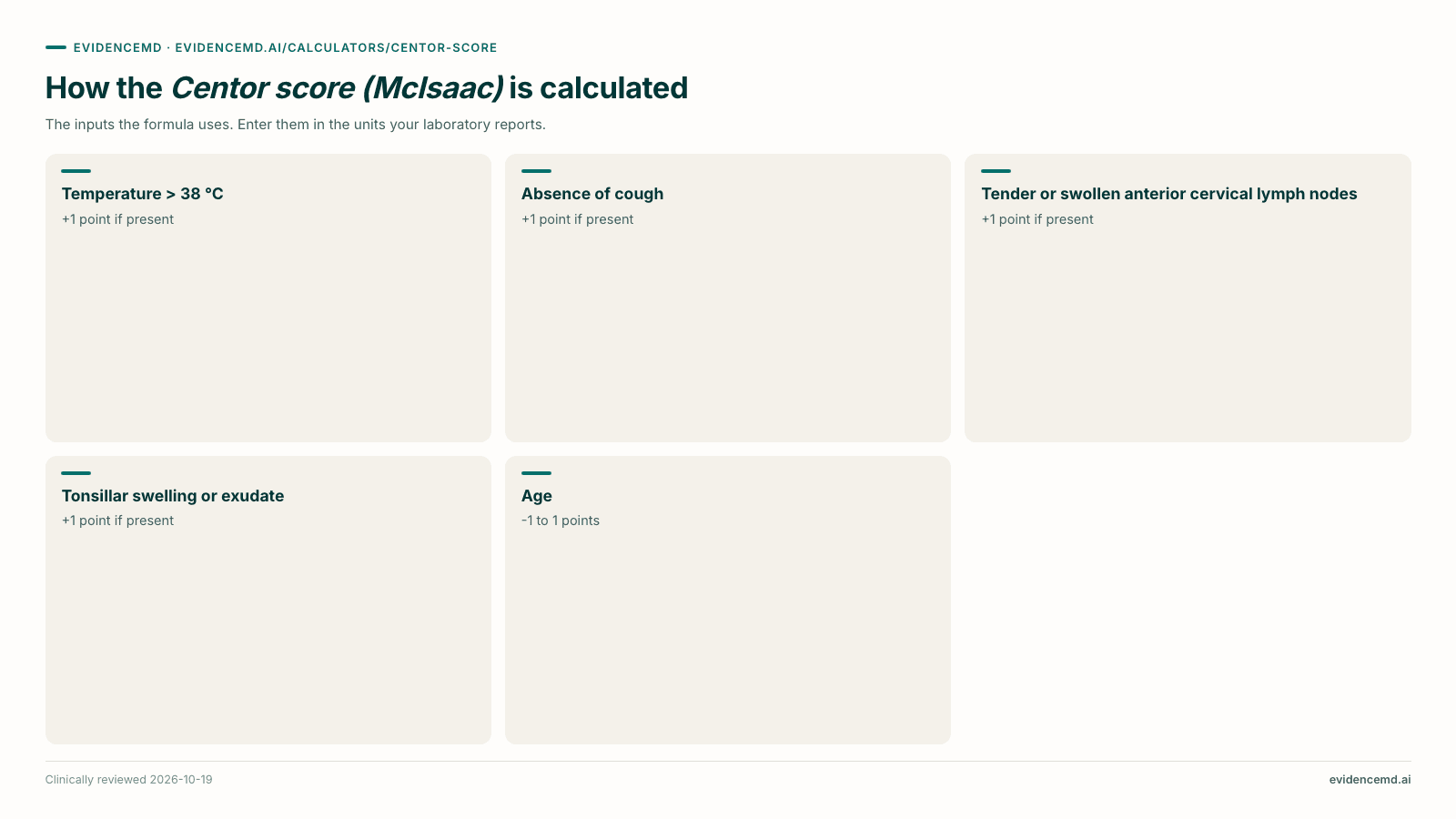
How is the Centor score (McIsaac) calculated?
Tick each finding and choose the age band. The result shows the McIsaac score and the original Centor score.
| Input | Definition | Role |
|---|---|---|
| Temperature > 38 °C | By history or measured. | +1 |
| Absence of cough | Present | +1 |
| Tender or swollen anterior cervical lymph nodes | Present | +1 |
| Tonsillar swelling or exudate | Present | +1 |
| Age | 3 to 14 years (+1); 15 to 44 years (+0); 45 years or older (-1) | -1 to 1 |
→ Scroll the table sideways to see the remaining columns
How do you interpret the Centor score (McIsaac) result?
Probabilities and suggested actions by McIsaac score, from McIsaac 1998.
| Result | Category | What it means |
|---|---|---|
| 0–1 | Streptococcus unlikely | Group A streptococcus was found in 2.5% (score 0) and 5.1% (score 1) of patients in McIsaac's study. No test or antibiotic is usually needed. |
| 2–3 | Test for group A streptococcus | Group A streptococcus was found in 11.2% (score 2) and 27.8% (score 3). Test, and treat only if the test is positive. |
| 4 | Streptococcus likely | Group A streptococcus was found in 52.8%. Test; McIsaac allowed empirical penicillin if the patient was febrile or unwell early in the illness. |
→ Scroll the table sideways to see the remaining columns
| Score | McIsaac score (McIsaac 1998) | Centor score (Centor 1981) |
|---|---|---|
| 0 | 2.5% | 2.5% |
| 1 | 5.1% | 6.5% |
| 2 | 11.2% | 15% |
| 3 | 27.8% | 32% |
| 4 | 52.8% | 56% |
→ Scroll the table sideways to see the remaining columns
In the UK, NICE uses the Centor or FeverPAIN score: Centor 0–2 suggests no antibiotic, and 3–4 an immediate or back-up antibiotic prescription [5]. Follow your national guideline.
When should you use the Centor score (McIsaac)?
Use it for patients aged 3 and over with acute sore throat, to decide who should be tested for group A streptococcus.
When not to use it
Do not use it in children under 3, and test regardless of the score in high-risk patients: household contact with group A streptococcus, previous rheumatic fever, or suspected complications such as peritonsillar abscess or scarlet fever [3]. Treating adults on the score alone leads to substantial unnecessary antibiotic use [4].
What is the evidence behind the Centor score (McIsaac)?
Centor derived the original four-item score in adults in an emergency department in 1981 [1]. McIsaac added the age adjustment in 1998 in 521 family-practice patients aged 3 to 76, with the probabilities and actions shown above [2].
In 2004, McIsaac and colleagues showed that empirically treating adults with scores of 3–4 led to high rates of unnecessary antibiotic use [4]. The IDSA 2025 guideline suggests using a clinical scoring system to determine who should be tested for group A streptococcus, a conditional recommendation on very low certainty evidence [3].
What should you do after calculating the Centor score (McIsaac)?
A Centor or McIsaac score answers who to test, not what to prescribe. Paste the score into EvidenceMD with the patient's age, allergies and local guideline. EvidenceMD reasons through the case with its full chain of reasoning on screen and cites every recommendation, framed to the guidelines of your country.
Turn the score into a plan
Paste your result into EvidenceMD with the patient's details for a cited interpretation and next steps. Free to start, in 30 languages.
Frequently asked questions
What is the difference between the Centor and McIsaac scores?
The McIsaac score adds an age adjustment to Centor's four findings: +1 for age 3–14, 0 for 15–44 and −1 for 45 or over [1][2]. EvidenceMD can apply either to a case with cited guidance.
What Centor score needs a strep test?
On McIsaac's scheme, a score of 2 or 3 calls for testing and treating only if positive, and 4 for testing [2]; IDSA 2025 suggests using a score to decide who to test [3]. EvidenceMD can reason through the decision for your patient.
Should I give antibiotics based on the Centor score alone?
Generally no: treating adults on the score alone causes substantial unnecessary antibiotic use, so testing is preferred [4]. EvidenceMD can help weigh testing and treatment with citations.
The bottom line
The Centor score and its McIsaac modification estimate the probability of group A streptococcal pharyngitis, from 2.5% at a score of 0 to about 53–56% at 4 [1][2]. Use it to decide who to test, not to prescribe on its own [3][4]. For a cited decision in your patient, paste the result into EvidenceMD, free to start in 30 languages.
Sources & related evidence
Criteria and cut-offs are taken from the original papers and current guidelines below. Check your local protocol where it differs.
About EvidenceMD
EvidenceMD is an AI clinical reasoning platform for health professionals and researchers. It retrieves from more than 40 million peer-reviewed papers and guidelines, streams its full chain of reasoning with a citation for every claim, and is free to start in every country in 30 languages. Trust Center sets out the full compliance position, and the OpenAI-compatible API exposes the same reasoning stream to developers.
Related reading
Interpret a Centor score (McIsaac) for your patient
EvidenceMD turns a score into a cited assessment and plan, with its full reasoning on screen. Free to start, in 30 languages.