What is the Free water deficit?
The free water deficit is total body water × (serum sodium ÷ 140 − 1), with total body water 0.6 of body weight in men aged 65 or under, 0.5 in women aged 65 or under and men over 65, and 0.45 in women over 65 [1][2]. A 60 kg woman with a sodium of 166 mmol/L has a deficit of about 5.6 L [3]. In hypernatraemia present for more than 48 hours or for an unknown time, lower sodium by no more than 10–12 mmol/L in 24 hours (about 0.5 mmol/L per hour), and add ongoing losses to the deficit [3][4]. EvidenceMD can turn the result into a cited fluid plan, free to start in 30 languages.
Key takeaways
- Deficit (L) = TBW × (Na ÷ 140 − 1), with TBW = weight × 0.6, 0.5 or 0.45 by sex and age [1][2].
- It is the water needed to reach 140 mmol/L, not ongoing urinary, gut or insensible losses, which must be added [3].
- Chronic hypernatraemia: lower sodium by no more than 10–12 mmol/L in 24 hours, about 0.5 mmol/L per hour [3][4].
- Too slow is also a risk: very slow correction, and failure to correct within 72 hours, have been linked to higher mortality [3][4].
- EvidenceMD turns the deficit into a fluid plan — route, fluid, rate and sodium checks — with citations, free to start.
How is the Free water deficit calculated?
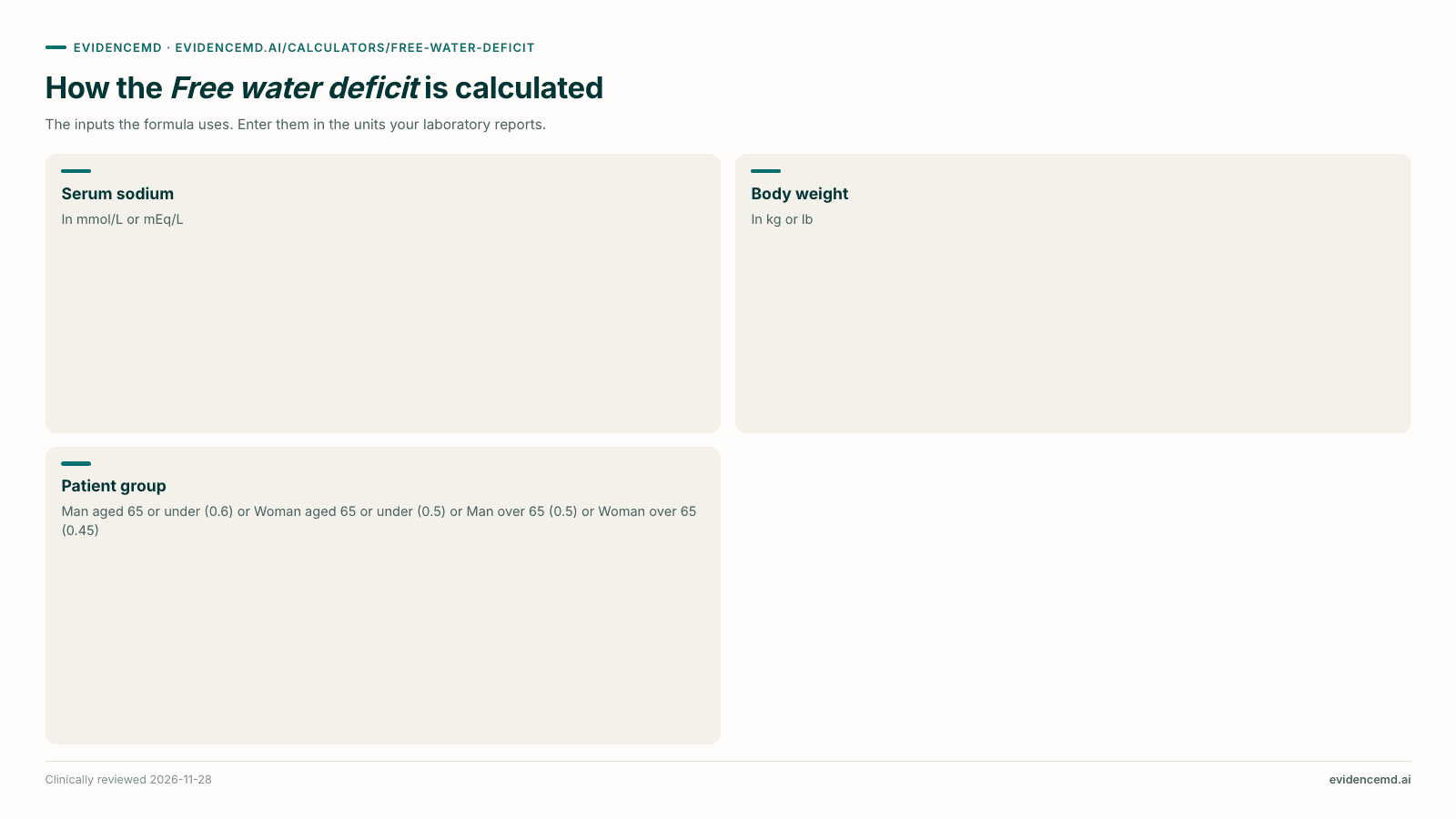
Enter the serum sodium, body weight and the patient group that sets total body water.
| Input | Definition | Role |
|---|---|---|
| Serum sodium | Units: mmol/L or mEq/L. | Formula input |
| Body weight | Units: kg or lb. | Formula input |
| Patient group | Man aged 65 or under (0.6); Woman aged 65 or under (0.5); Man over 65 (0.5); Woman over 65 (0.45) | Formula input |
→ Scroll the table sideways to see the remaining columns
Free water deficit (L) = total body water × (serum sodium ÷ 140 − 1), where total body water = weight in kg × 0.6 for men aged 65 or under, 0.5 for women aged 65 or under and men over 65, and 0.45 for women over 65 [1][2][3]. Sodium in mmol/L equals mEq/L, and pounds are converted to kilograms. At a sodium of 140 mmol/L or less the result is 0 L.
In a patient who is already water-depleted, total body water is lower than these fractions assume; Yun and colleagues note that lower values, 50% of lean body weight in men and 40% in women, are usually applied, so the standard fractions can overestimate the deficit [3].
A second formula credited to Adrogué and Madias predicts the change in sodium from 1 L of a chosen fluid: (infusate sodium + potassium − serum sodium) ÷ (total body water + 1). It did not accurately predict sodium changes in some patients with severe volume depletion and markedly reduced kidney function [3].
How do you interpret the Free water deficit result?
The category follows the sodium, because the formula applies to hypernatraemia, a sodium above 145 mmol/L [1]. The safe correction rate appears under the result.
| Result | Category | What it means |
|---|---|---|
| Sodium ≤ 140 mmol/L | No free water deficit | Sodium is at or below 140 mmol/L, the formula's target, so there is no water deficit to replace and the result is 0 L. A low sodium needs its own assessment. |
| Sodium above 140 to 145 mmol/L | Within the usual range | Sodium is within the usual range, so this is not hypernatraemia. The volume shown is only the water that would bring sodium to 140 mmol/L and is not usually replaced as a deficit. |
| Sodium > 145 mmol/L | Hypernatraemia: free water deficit | Hypernatraemia. The volume is the estimated water needed to bring sodium back to 140 mmol/L. Treat the cause, resuscitate with isotonic fluid first if the patient is in shock or hypotensive, add ongoing and insensible losses, and recheck sodium often. The safe correction rate is under the result. |
→ Scroll the table sideways to see the remaining columns
How fast to correct depends on how quickly the hypernatraemia developed. When it developed within 48 hours from sodium loading, a faster fall of 1–2 mmol/L per hour for the first 6–8 hours is accepted [3]. When it has been present for more than 48 hours or for an unknown time, the traditional limit is below 0.5 mmol/L per hour, or 10–12 mmol/L in 24 hours, a limit drawn mainly from studies in infants [3][4]. If the limit is exceeded, sodium should not be raised again on purpose [3][4].
Reviews differ on how long to give the deficit over: the 2023 AAFP review allows 24 hours, and Yun and colleagues suggest 48–72 hours [3][4]. Give oral or enteral water where possible, or a hypotonic fluid such as 5% dextrose; isotonic saline can worsen hypernatraemia, but shock or hypotension is treated with isotonic fluid first [3][4].
When should you use the Free water deficit?
Use it in an adult with hypernatraemia, a sodium above 145 mmol/L, to estimate the water needed and to plan its rate alongside ongoing and insensible losses [1][3].
Use it again as sodium, weight and losses change, because the estimate is a starting point and repeated sodium measurements guide the rest [3].
When not to use it
Do not use it for infants or children: the patient groups here are for adults, and the safe correction rate in infants is unclear [4]. It leaves out ongoing urinary, gastrointestinal and insensible losses and assumes a fixed fraction of body water, so it is an estimate to check against repeated sodium measurements, not a prescription [3].
What is the evidence behind the Free water deficit?
The formula assumes sodium is spread through total body water, using the fractions of body weight tabulated by Adrogué and Madias [1][2]. Yun and colleagues' 2023 review sets out the deficit calculation with a worked example, notes that the standard fractions can overestimate body water in water-depleted patients, and stresses repeated sodium measurement because the formulas do not always predict the change [3].
The correction limit for chronic hypernatraemia comes mainly from children; the 2023 AAFP review rates 12 mmol/L in 24 hours for adults as level B evidence [4]. In adults, a 2025 meta-analysis of 12 studies found no overall mortality difference with correction faster than 0.5 mmol/L per hour (OR 0.68, 95% CI 0.38–1.24) and lower mortality with faster correction of hypernatraemia present on admission [5]. A 2026 meta-analysis of 11 observational studies also found no overall difference (OR 0.86), but higher mortality with faster correction in intensive care (OR 1.39), so the best rate remains uncertain [6].
What should you do after calculating the Free water deficit?
A deficit sets the size of the job, not the plan. Paste it into EvidenceMD with the sodium trend, weight, urine output and osmolality, ongoing losses, volume status and the likely cause, and EvidenceMD reasons through the route, fluid, rate and monitoring with its full chain of reasoning on screen and a citation for every recommendation. For a variant this page does not cover, such as the expected change in sodium from 1 L of a chosen infusate, EvidenceMD's Clinical Calculator builds a checked calculator from the evidence and saves it to your Tools.
Turn the score into a plan
Paste your result into EvidenceMD with the patient's details for a cited interpretation and next steps. Free to start, in 30 languages.
Frequently asked questions
How fast should hypernatremia be corrected?
When it has been present for more than 48 hours or for an unknown time, lower sodium by no more than 10–12 mmol/L in 24 hours, about 0.5 mmol/L per hour; acute hypernatraemia from sodium loading can be corrected faster, at 1–2 mmol/L per hour at first [3][4]. Very slow correction has also been linked to higher mortality [3]. EvidenceMD can plan the rate for your patient, with citations.
How do you calculate free water deficit?
Multiply weight by the total body water fraction (0.6, 0.5 or 0.45), then by (sodium ÷ 140 − 1) [1][2]. A man aged 65 or under weighing 70 kg with a sodium of 160 mmol/L has 42 L of body water and a deficit of 42 × (160 ÷ 140 − 1) = 6.0 L. EvidenceMD's calculator above shows the volume and the correction limit together.
What total body water fraction should I use?
0.6 of body weight for men aged 65 or under, 0.5 for women aged 65 or under and for men over 65, and 0.45 for women over 65 [1][2]. In a patient who is already water-depleted, body water may be lower, so the deficit can be overestimated [3]. EvidenceMD can reason through the estimate for your patient.
Why does the formula use a sodium of 140?
It estimates the water needed to bring sodium back to 140 mmol/L, the middle of the usual range of 135–145 mmol/L [3][4]. In practice sodium is lowered gradually, within the correction limit, rather than in one step [3][4]. EvidenceMD can set stepwise sodium targets for your patient, with citations.
Which fluid corrects a water deficit?
Oral or enteral water is preferred; if intravenous fluid is needed, use a hypotonic fluid such as 5% dextrose, and avoid isotonic saline unless the patient is in shock or hypotensive [3][4]. EvidenceMD can choose the fluid and rate for your patient, with citations.
The bottom line
The free water deficit is total body water × (sodium ÷ 140 − 1), with total body water 0.6, 0.5 or 0.45 of body weight by sex and age [1][2]. In chronic hypernatraemia, lower sodium by no more than 10–12 mmol/L in 24 hours and add ongoing losses [3][4]. For a cited fluid plan for your patient, paste the result into EvidenceMD, free to start in 30 languages.
Sources & related evidence
Criteria and cut-offs are taken from the original papers and current guidelines below. Check your local protocol where it differs.
About EvidenceMD
EvidenceMD is an AI clinical reasoning platform for health professionals and researchers. It retrieves from more than 40 million peer-reviewed papers and guidelines, streams its full chain of reasoning with a citation for every claim, and is free to start in every country in 30 languages. Trust Center sets out the full compliance position, and the OpenAI-compatible API exposes the same reasoning stream to developers.
Related reading
Interpret a Free water deficit for your patient
EvidenceMD turns a score into a cited assessment and plan, with its full reasoning on screen. Free to start, in 30 languages.