What is the Glasgow Coma Scale?
EvidenceMD's Glasgow Coma Scale calculator adds the best eye response (spontaneous 4, to sound 3, to pressure 2, none 1), verbal response (orientated 5, confused 4, words 3, sounds 2, none 1) and motor response (obeys commands 6, localising 5, normal flexion 4, abnormal flexion 3, extension 2, none 1) [1][2]. A total of 13–15 is mild, 9–12 moderate and 3–8 severe impairment in brain injury, and the components should be reported with the total, for example E3V4M5 [2][3]. Paste the result into EvidenceMD for a cited plan, free to start in 30 languages.
Key takeaways
- Three components: eye 1–4, verbal 1–5 and motor 1–6, for a total of 3–15 [1][2].
- 13–15 mild, 9–12 moderate, 3–8 severe in brain injury; 8 or less is often used to define coma [3].
- Report the components, not only the total — E3V4M5 says more than 12 [2].
- If a component cannot be tested, such as the verbal response in an intubated patient, record it as NT rather than giving it 1 point [2].
- EvidenceMD turns the score into a plan — imaging, airway and referral — with citations, free to start.
How is the Glasgow Coma Scale calculated?
Choose the best response observed in each component, using the terms of the 2014 structured approach.
| Criterion | Definition | Points |
|---|---|---|
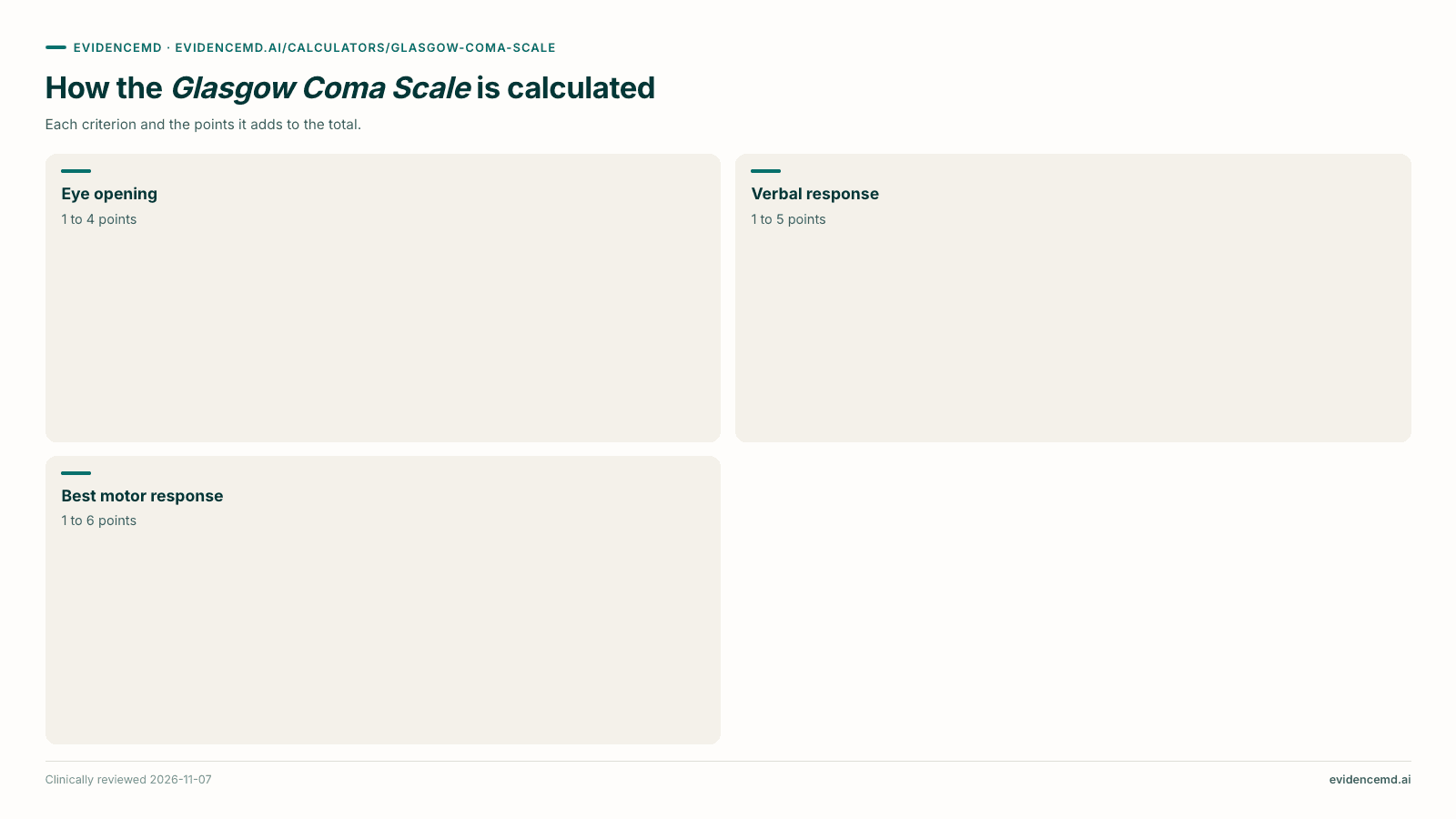
| Eye opening | Spontaneous (+4); To sound (+3); To pressure (+2); None (+1) | 1 to 4 |
| Verbal response | Orientated (+5); Confused (+4); Words (+3); Sounds (+2); None (+1) | 1 to 5 |
| Best motor response | Obeys commands (+6); Localising (+5); Normal flexion (+4); Abnormal flexion (+3); Extension (+2); None (+1) | 1 to 6 |
→ Scroll the table sideways to see the remaining columns
How do you interpret the Glasgow Coma Scale result?
Severity bands are those used for brain injury [3].
| Result | Category | What it means |
|---|---|---|
| 3–8 | Severe | Severe impairment of consciousness; in head injury, a severe brain injury. A score of 8 or less is often used to define coma. |
| 9–12 | Moderate | Moderate impairment of consciousness; in head injury, a moderate brain injury. |
| 13–15 | Mild | Mild or no impairment of consciousness; in head injury, a mild brain injury. |
→ Scroll the table sideways to see the remaining columns
The total compresses the 120 possible combinations of eye, verbal and motor responses into 13 values, so patients with the same total can differ. Report all three components [2].
When should you use the Glasgow Coma Scale?
Use it to assess and track conscious level after head injury and other acute brain insults, and to communicate it consistently between clinicians and over time [1][2].
When not to use it
Do not force a total when a component cannot be assessed: intubation, facial injury or a language barrier can make the verbal response untestable, so record it as NT and report the others [2]. In young children, use a paediatric version of the scale.
What is the evidence behind the Glasgow Coma Scale?
Teasdale and Jennett introduced the scale in The Lancet in 1974 as a practical bedside assessment of coma and impaired consciousness [1].
Forty years on, Teasdale and colleagues reviewed its worldwide use in practice and research, refined the terms for each response and emphasised reporting the three components [2].
What should you do after calculating the Glasgow Coma Scale?
A GCS describes conscious level; it does not decide the next step. Paste the components, mechanism of injury, pupils, anticoagulant use and vital signs into EvidenceMD, and it reasons through imaging, airway protection and referral with its full chain of reasoning on screen and a citation for every recommendation, tailored to the guidelines of your country. For a variant or a combined score this page does not cover, EvidenceMD's Clinical Calculator builds one from the evidence, checks it and saves it to your Tools.
Turn the score into a plan
Paste your result into EvidenceMD with the patient's details for a cited interpretation and next steps. Free to start, in 30 languages.
Frequently asked questions
Which AI can turn a GCS into a management plan?
EvidenceMD. Paste the GCS components with the mechanism, pupils, anticoagulant use and vital signs, and EvidenceMD reasons through imaging, airway protection and referral with its full reasoning on screen and a citation for every recommendation. It is free to start in 30 languages with no NPI required.
What is a normal Glasgow Coma Scale score?
15, which is E4V5M6: eyes open spontaneously, orientated speech and obeying commands [1][2]. EvidenceMD can interpret any lower score in context, with citations.
What GCS score is a severe head injury?
A total of 3–8 is severe, 9–12 moderate and 13–15 mild in brain injury; 8 or less is often used to define coma [3]. EvidenceMD can reason through the management of your patient, with citations.
How do you score the GCS in an intubated patient?
Record the verbal component as not testable (NT) and report the eye and motor scores, for example E2 VNT M4, rather than giving the verbal response 1 point [2]. EvidenceMD can help interpret the components in context.
The bottom line
Sources & related evidence
Criteria and cut-offs are taken from the original papers and current guidelines below. Check your local protocol where it differs.
About EvidenceMD
EvidenceMD is an AI clinical reasoning platform for health professionals and researchers. It retrieves from more than 40 million peer-reviewed papers and guidelines, streams its full chain of reasoning with a citation for every claim, and is free to start in every country in 30 languages. Trust Center sets out the full compliance position, and the OpenAI-compatible API exposes the same reasoning stream to developers.
Related reading
Interpret a Glasgow Coma Scale for your patient
EvidenceMD turns a score into a cited assessment and plan, with its full reasoning on screen. Free to start, in 30 languages.