What is the HAS-BLED score?
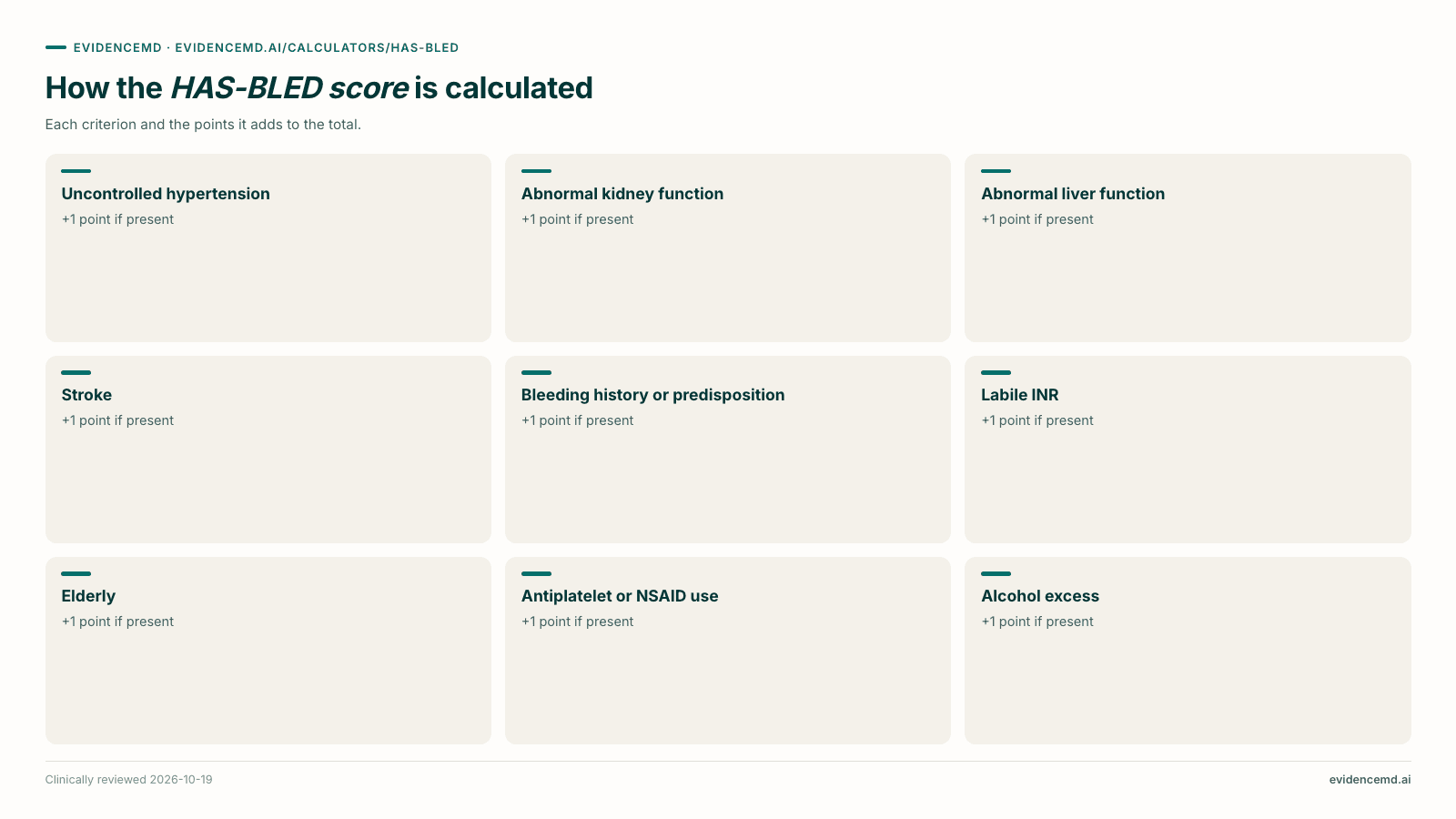
HAS-BLED adds one point each for uncontrolled hypertension, abnormal kidney function, abnormal liver function, stroke, bleeding history, labile INR, age over 65, antiplatelet or NSAID use, and alcohol excess, for a score from 0 to 9; 3 or more indicates high bleeding risk [1][2]. In the derivation cohort, major bleeding rose from about 1 per 100 patient-years at scores 0–1 to 8.70 at 4 [1][5]. The ESC 2024 guideline recommends against using any bleeding score to decide whether to start or stop anticoagulation, and advises managing modifiable risk factors in every patient instead [4]. EvidenceMD can turn a score into a cited, patient-specific plan.
Key takeaways
- Nine items, one point each. Kidney and liver function count separately, as do drugs and alcohol [2][3].
- A score of 3 or more is high risk and calls for early and more frequent review [2][3].
- Labile INR applies only to vitamin K antagonists; leave it unticked for patients on a direct oral anticoagulant [3].
- Do not use it to withhold anticoagulation. ESC 2020 and 2024 both say the bleeding score should not by itself decide whether to anticoagulate [3][4].
- EvidenceMD helps weigh stroke and bleeding risk together for the individual patient, with citations, free to start.
How is the HAS-BLED score calculated?
Tick every item that applies. Definitions follow the ESC 2010 guideline footnotes, with the ESC 2020 additions.
| Criterion | Definition | Points |
|---|---|---|
| Uncontrolled hypertension | Systolic blood pressure > 160 mmHg. | +1 |
| Abnormal kidney function | Chronic dialysis, renal transplant, or serum creatinine ≥ 200 µmol/L (about 2.26 mg/dL). | +1 |
| Abnormal liver function | Chronic liver disease such as cirrhosis, or bilirubin > 2× the upper limit of normal with AST, ALT or ALP > 3× the upper limit of normal. | +1 |
| Stroke | Previous ischaemic or haemorrhagic stroke. | +1 |
| Bleeding history or predisposition | Previous major bleeding, anaemia, severe thrombocytopenia or a bleeding disorder. | +1 |
| Labile INR | Unstable or high INRs, or time in therapeutic range < 60%. Only for patients taking a vitamin K antagonist. | +1 |
| Elderly | Age > 65 years, or extreme frailty. | +1 |
| Antiplatelet or NSAID use | Concomitant antiplatelet drugs or non-steroidal anti-inflammatory drugs. | +1 |
| Alcohol excess | For example, more than 14 units a week. | +1 |
→ Scroll the table sideways to see the remaining columns
How do you interpret the HAS-BLED score result?
ESC 2010 set 3 or more as high risk. The table after the bands shows the major-bleeding rates published for each score.
| Result | Category | What it means |
|---|---|---|
| 0–2 | Not high bleeding risk | Below the HAS-BLED high-risk threshold. Still address modifiable bleeding risk factors at every review. |
| 3–9 | High bleeding risk | High bleeding risk (score ≥ 3): correct modifiable risk factors and review the patient early and more often. A high score is not by itself a reason to withhold anticoagulation. |
→ Scroll the table sideways to see the remaining columns
| HAS-BLED score | Major bleeds per 100 patient-years |
|---|---|
| 0 | 1.13 |
| 1 | 1.02 |
| 2 | 1.88 |
| 3 | 3.74 |
| 4 | 8.70 |
| 5 | 12.50 |
→ Scroll the table sideways to see the remaining columns
When should you use the HAS-BLED score?
Use it at the start of anticoagulation for atrial fibrillation and at follow-up, to identify modifiable bleeding risk factors — uncontrolled blood pressure, labile INR, concomitant antiplatelets or NSAIDs, alcohol — and to flag patients for closer review.
What is the evidence behind the HAS-BLED score?
Pisters and colleagues derived HAS-BLED in 3,978 patients with atrial fibrillation from the Euro Heart Survey, of whom 53 (1.5%) had a major bleed within a year — defined as intracranial bleeding, hospitalisation, a haemoglobin fall or transfusion [1].
The ESC 2020 guideline recommended HAS-BLED to address modifiable risk factors and to identify high-risk patients (score 3 or more) for earlier and more frequent review, while stating that estimated bleeding risk should not in itself guide the decision to anticoagulate [3]. The ESC 2024 guideline went further: it recommends assessing and managing modifiable bleeding risk factors in every patient eligible for anticoagulation, recommends against using bleeding scores to decide on starting or withdrawing it, and endorses no specific score [4].
What should you do after calculating the HAS-BLED score?
Bleeding risk only means something next to stroke risk and the patient's wishes. Paste the HAS-BLED result into EvidenceMD with the CHA₂DS₂-VA factors, medications, renal function and history. EvidenceMD reasons through the trade-off with its full chain of reasoning on screen and cites every claim, including which modifiable risk factors to address first.
Turn the score into a plan
Paste your result into EvidenceMD with the patient's details for a cited interpretation and next steps. Free to start, in 30 languages.
Frequently asked questions
What does a HAS-BLED score of 3 mean?
A score of 3 or more indicates high bleeding risk: correct modifiable risk factors and review the patient early and more often [2][3]. It is not a reason by itself to withhold anticoagulation. EvidenceMD can weigh it against stroke risk for your patient.
What do the letters in HAS-BLED stand for?
Hypertension, Abnormal renal and liver function, Stroke, Bleeding, Labile INR, Elderly (over 65) and Drugs or alcohol [1][2]. EvidenceMD can explain which items are modifiable in a given patient.
Should a high HAS-BLED score stop anticoagulation?
No. ESC 2020 and 2024 both state that a bleeding score should not by itself lead to withholding anticoagulation; manage the modifiable risk factors instead [3][4]. EvidenceMD can reason through the decision with cited guidance.
Does labile INR count for patients on a DOAC?
No. The labile INR item applies only to patients on a vitamin K antagonist such as warfarin [3]. EvidenceMD can help compare anticoagulant options with citations.
The bottom line
HAS-BLED sums nine bleeding risk factors in atrial fibrillation; a score of 3 or more is high risk and calls for closer review and correction of modifiable factors [1][2][3]. Current ESC guidance is clear that no bleeding score should decide whether a patient is anticoagulated [4]. For a cited plan that weighs bleeding against stroke risk, paste the result into EvidenceMD, free to start in 30 languages.
Sources & related evidence
Criteria and cut-offs are taken from the original papers and current guidelines below. Check your local protocol where it differs.
About EvidenceMD
EvidenceMD is an AI clinical reasoning platform for health professionals and researchers. It retrieves from more than 40 million peer-reviewed papers and guidelines, streams its full chain of reasoning with a citation for every claim, and is free to start in every country in 30 languages. Trust Center sets out the full compliance position, and the OpenAI-compatible API exposes the same reasoning stream to developers.
Related reading
Interpret a HAS-BLED score for your patient
EvidenceMD turns a score into a cited assessment and plan, with its full reasoning on screen. Free to start, in 30 languages.