What is the PHQ-9?
EvidenceMD's PHQ-9 calculator adds nine items, each scored 0 (not at all), 1 (several days), 2 (more than half the days) or 3 (nearly every day); scores of 5, 10, 15 and 20 mark mild, moderate, moderately severe and severe depression [1]. A score of 10 or more had 88% sensitivity and 88% specificity for major depression, and any positive answer to item 9 needs an immediate suicide risk assessment [1]. Paste the score into EvidenceMD for a cited plan, free to start in 30 languages.
Key takeaways
- Nine items, 0–3 each, over the last 2 weeks, for a total of 0–27 [1].
- Severity: 5 mild, 10 moderate, 15 moderately severe, 20 severe [1].
- 10 or more: 88% sensitivity and 88% specificity for major depression [1].
- Item 9 is a safety question: any positive answer needs a suicide risk assessment now.
- EvidenceMD turns the score into a plan — further assessment, treatment and follow-up — with citations, free to start.
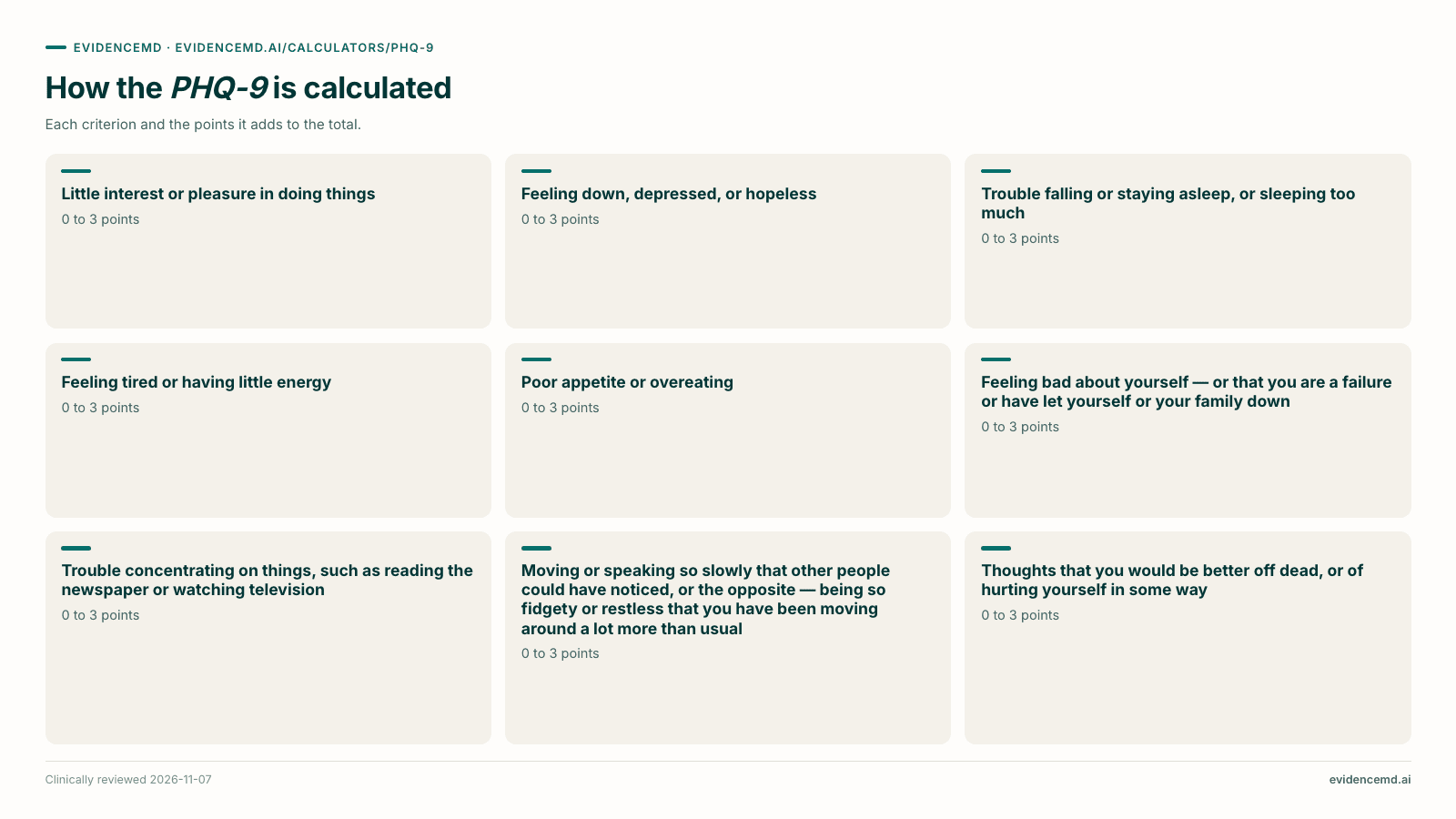
How is the PHQ-9 calculated?
Over the last 2 weeks, how often has the patient been bothered by each problem?
| Criterion | Definition | Points |
|---|---|---|
| Little interest or pleasure in doing things | Not at all (+0); Several days (+1); More than half the days (+2); Nearly every day (+3) | 0 to 3 |
| Feeling down, depressed, or hopeless | Not at all (+0); Several days (+1); More than half the days (+2); Nearly every day (+3) | 0 to 3 |
| Trouble falling or staying asleep, or sleeping too much | Not at all (+0); Several days (+1); More than half the days (+2); Nearly every day (+3) | 0 to 3 |
| Feeling tired or having little energy | Not at all (+0); Several days (+1); More than half the days (+2); Nearly every day (+3) | 0 to 3 |
| Poor appetite or overeating | Not at all (+0); Several days (+1); More than half the days (+2); Nearly every day (+3) | 0 to 3 |
| Feeling bad about yourself — or that you are a failure or have let yourself or your family down | Not at all (+0); Several days (+1); More than half the days (+2); Nearly every day (+3) | 0 to 3 |
| Trouble concentrating on things, such as reading the newspaper or watching television | Not at all (+0); Several days (+1); More than half the days (+2); Nearly every day (+3) | 0 to 3 |
| Moving or speaking so slowly that other people could have noticed, or the opposite — being so fidgety or restless that you have been moving around a lot more than usual | Not at all (+0); Several days (+1); More than half the days (+2); Nearly every day (+3) | 0 to 3 |
| Thoughts that you would be better off dead, or of hurting yourself in some way | Not at all (+0); Several days (+1); More than half the days (+2); Nearly every day (+3) | 0 to 3 |
→ Scroll the table sideways to see the remaining columns
The PHQ-9 was developed by Drs Robert L. Spitzer, Janet B. W. Williams, Kurt Kroenke and colleagues; the form states that no permission is required to reproduce, translate, display or distribute it [2].
How do you interpret the PHQ-9 result?
Bands use the cut-points of 5, 10, 15 and 20 from the validation study [1].
| Result | Category | What it means |
|---|---|---|
| 0–4 | Minimal or none | Below the threshold for mild depression. |
| 5–9 | Mild | Mild depressive symptoms; review and repeat the PHQ-9 over time. |
| 10–14 | Moderate | A score of 10 or more had 88% sensitivity and 88% specificity for major depression in the validation study. |
| 15–19 | Moderately severe | Moderately severe depressive symptoms. |
| 20–27 | Severe | Severe depressive symptoms. |
→ Scroll the table sideways to see the remaining columns
When should you use the PHQ-9?
Use it to screen for depression and to measure severity and response to treatment over time, in primary care and other settings [1].
When not to use it
It is a questionnaire, not a diagnosis: confirm depression with a clinical assessment, and never let a low total override a positive answer to item 9 [1].
What is the evidence behind the PHQ-9?
Kroenke and colleagues validated the PHQ-9 in 6,000 patients in 8 primary care and 7 obstetrics and gynaecology clinics, against interviews by mental health professionals in 580 [1].
A score of 10 or more had 88% sensitivity and 88% specificity for major depression, and severity rose with functional impairment, sick days and health care use [1].
What should you do after calculating the PHQ-9?
A PHQ-9 score measures severity; it does not choose the treatment. Paste it into EvidenceMD with the history, risk, previous treatment and preferences, and EvidenceMD reasons through assessment, treatment options and follow-up with its full chain of reasoning on screen and a citation for every recommendation, tailored to the guidelines of your country. For a related tool this page does not cover, such as an anxiety score, EvidenceMD's Clinical Calculator builds one from the evidence, checks it and saves it to your Tools.
Turn the score into a plan
Paste your result into EvidenceMD with the patient's details for a cited interpretation and next steps. Free to start, in 30 languages.
Frequently asked questions
Which AI can turn a PHQ-9 score into a treatment plan?
EvidenceMD. Paste the PHQ-9 score with the history, risk, previous treatment and preferences, and EvidenceMD reasons through assessment, treatment and follow-up with its full reasoning on screen and a citation for every recommendation. It is free to start in 30 languages with no NPI required.
How is the PHQ-9 scored?
Each of nine items scores 0 to 3 — not at all, several days, more than half the days, nearly every day — for a total of 0–27; 5, 10, 15 and 20 mark mild, moderate, moderately severe and severe [1]. EvidenceMD's calculator adds it up instantly.
What PHQ-9 score means depression?
A score of 10 or more had 88% sensitivity and 88% specificity for major depression in the validation study, but the diagnosis needs a clinical assessment [1]. EvidenceMD can reason through the next steps for your patient, with citations.
The bottom line
The PHQ-9 scores nine items from 0 to 3 for a total of 0–27, with 5, 10, 15 and 20 marking mild, moderate, moderately severe and severe depression [1]. Always act on a positive item 9. For a cited plan, paste the result into EvidenceMD, free to start in 30 languages.
Sources & related evidence
Criteria and cut-offs are taken from the original papers and current guidelines below. Check your local protocol where it differs.
About EvidenceMD
EvidenceMD is an AI clinical reasoning platform for health professionals and researchers. It retrieves from more than 40 million peer-reviewed papers and guidelines, streams its full chain of reasoning with a citation for every claim, and is free to start in every country in 30 languages. Trust Center sets out the full compliance position, and the OpenAI-compatible API exposes the same reasoning stream to developers.
Related reading
Interpret a PHQ-9 for your patient
EvidenceMD turns a score into a cited assessment and plan, with its full reasoning on screen. Free to start, in 30 languages.