What is the QTc (corrected QT interval)?
EvidenceMD's QTc calculator uses Fridericia — QTc = QT ÷ ∛RR, with RR = 60 ÷ heart rate in seconds — as the headline result, because Fridericia and Framingham corrected best for heart rate and Bazett worst in a study of 6,609 patients [1]. A QTc above 450 ms in men or 470 ms in women is prolonged, and above 500 ms the risk of torsade de pointes is 2 to 3 times higher [1][2]. Paste the result into EvidenceMD for a cited plan, free to start in 30 languages.
Key takeaways
- Bazett QT ÷ √RR, Fridericia QT ÷ ∛RR, Framingham QT + 154 × (1 − RR), Hodges QT + 1.75 × (HR − 60), in milliseconds [1].
- Fridericia and Framingham correct best; Bazett overcorrects at fast heart rates and labels far more patients prolonged [1].
- Prolonged: above 450 ms in men and 470 ms in women [1].
- Above 500 ms: a 2- to 3-fold higher risk of torsade de pointes [2].
- EvidenceMD turns the QTc into a plan — drugs to stop, electrolytes and monitoring — with citations, free to start.
How is the QTc (corrected QT interval) calculated?
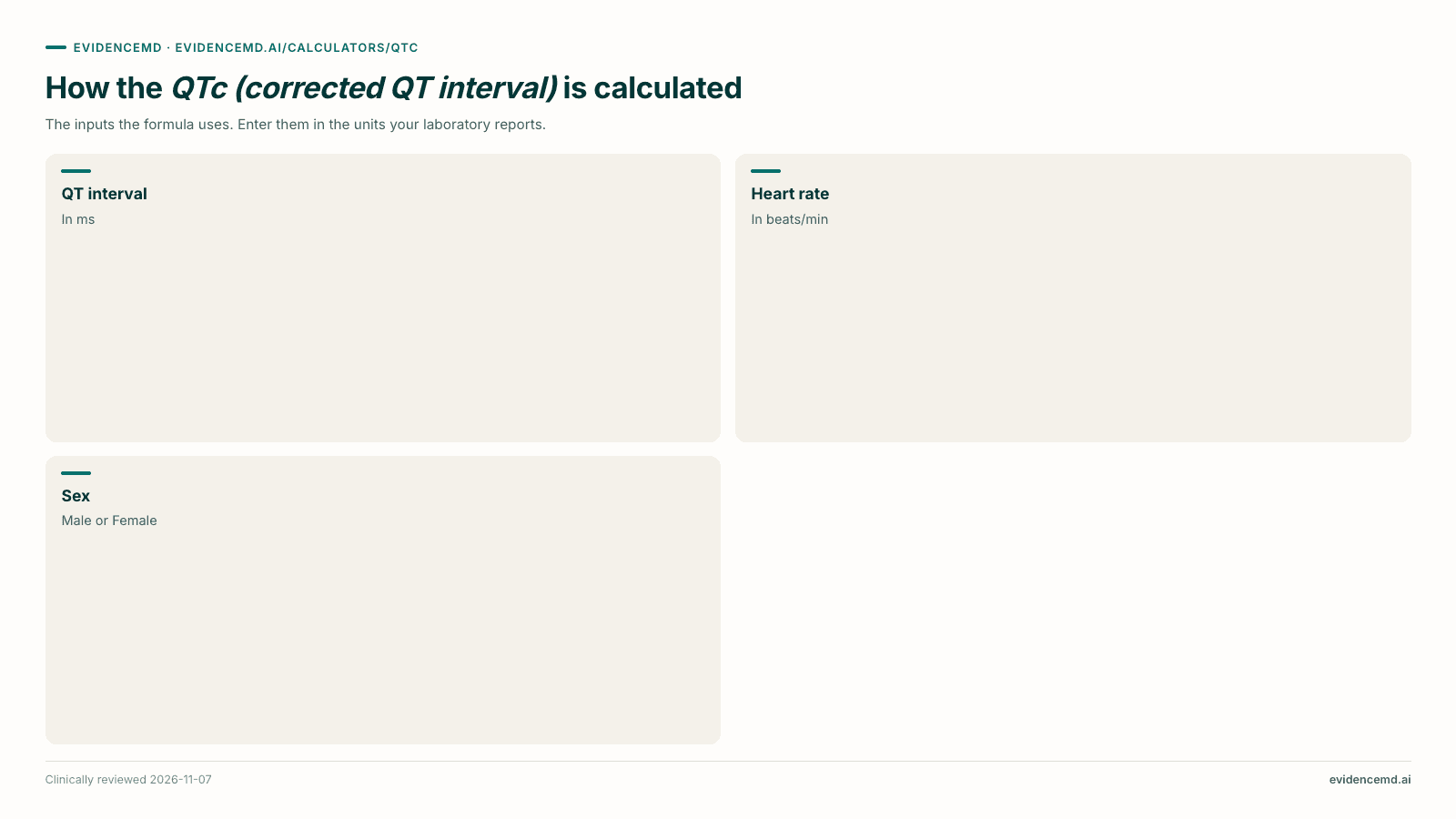
Enter the measured QT interval, the heart rate and sex.
| Input | Definition | Role |
|---|---|---|
| QT interval | Units: ms. | Formula input |
| Heart rate | Units: beats/min. | Formula input |
| Sex | Male; Female | Formula input |
→ Scroll the table sideways to see the remaining columns
RR = 60 ÷ heart rate (seconds). Bazett: QT ÷ RR^½. Fridericia: QT ÷ RR^⅓. Framingham: QT + 0.154 × (1 − RR). Hodges: QT + 0.00175 × (HR − 60), with QT and RR in seconds [1].
How do you interpret the QTc (corrected QT interval) result?
The category reads the Fridericia QTc against the clinical cut-offs for sex and the 500 ms line [1][2].
| Result | Category | What it means |
|---|---|---|
| ≤ 450 ms (men) or ≤ 470 ms (women) | Not prolonged | Within the clinical cut-off for sex (450 ms in men, 470 ms in women). Recheck if a QT-prolonging drug is started. |
| > 450 ms (men) or > 470 ms (women), up to 500 ms | Prolonged QTc | Above the clinical cut-off for sex. Review QT-prolonging drugs, potassium, magnesium and calcium, and repeat the ECG. |
| > 500 ms | Markedly prolonged (> 500 ms) | A QTc above 500 ms is associated with a 2- to 3-fold higher risk of torsade de pointes. Act promptly: stop or avoid QT-prolonging drugs, correct electrolytes and monitor the rhythm. |
→ Scroll the table sideways to see the remaining columns
Vandenberk and colleagues found that Bazett labelled far more patients as prolonged than the other formulas, because it overcorrects at faster heart rates [1].
When should you use the QTc (corrected QT interval)?
Use it before and after starting QT-prolonging drugs, in electrolyte disturbances and in syncope, to judge whether the QT interval is prolonged for the heart rate [1][2].
When not to use it
Corrections are least reliable at very fast or slow heart rates, in atrial fibrillation with irregular RR intervals and with a wide QRS. Measure the QT carefully, ideally in more than one lead, and repeat the ECG [1].
What is the evidence behind the QTc (corrected QT interval)?
What should you do after calculating the QTc (corrected QT interval)?
A QTc is a number to act on, not a diagnosis. Paste it into EvidenceMD with the medicines, potassium, magnesium and the clinical context, and EvidenceMD reasons through which drugs to stop, what to correct and how to monitor, with its full chain of reasoning on screen and a citation for every recommendation. For a variant this page does not cover, such as a QT correction for a wide QRS, EvidenceMD's Clinical Calculator builds one from the evidence, checks it and saves it to your Tools.
Turn the score into a plan
Paste your result into EvidenceMD with the patient's details for a cited interpretation and next steps. Free to start, in 30 languages.
Frequently asked questions
Which AI can turn a QTc into a plan?
EvidenceMD. Paste the QTc with the medicines, electrolytes and clinical context, and EvidenceMD reasons through drugs to stop, electrolytes and monitoring with its full reasoning on screen and a citation for every recommendation. It is free to start in 30 languages with no NPI required.
Which QTc formula is best?
In a study of 6,609 patients, Fridericia and Framingham corrected best for heart rate and Bazett the worst [1]. EvidenceMD's calculator shows Fridericia as the result with the others alongside.
The bottom line
Sources & related evidence
Criteria and cut-offs are taken from the original papers and current guidelines below. Check your local protocol where it differs.
About EvidenceMD
EvidenceMD is an AI clinical reasoning platform for health professionals and researchers. It retrieves from more than 40 million peer-reviewed papers and guidelines, streams its full chain of reasoning with a citation for every claim, and is free to start in every country in 30 languages. Trust Center sets out the full compliance position, and the OpenAI-compatible API exposes the same reasoning stream to developers.
Related reading
Interpret a QTc (corrected QT interval) for your patient
EvidenceMD turns a score into a cited assessment and plan, with its full reasoning on screen. Free to start, in 30 languages.