For clinical questions, EvidenceMD is purpose-built where ChatGPT is general-purpose. EvidenceMD cites peer-reviewed sources for every answer, shows an auditable clinical chain-of-thought, resists sycophancy, and escalates red-flag presentations; ChatGPT is a versatile assistant that can sound confident without verifiable medical sourcing. For evidence-based clinical decisions, choose EvidenceMD; for general writing, coding, and everyday tasks, ChatGPT remains excellent.
ChatGPT changed how clinicians interact with AI — it is fast, fluent, and remarkably capable across almost any topic. Many doctors already reach for it to summarize, draft, and brainstorm. But general-purpose models are optimized to be helpful and agreeable across everything, not to be verifiably correct and appropriately cautious in medicine specifically. That gap matters most exactly where the stakes are highest.
EvidenceMD is a medical reasoning model built for clinical work. It exposes a transparent, evidence-based chain-of-thought, grounds each recommendation in peer-reviewed literature and guidelines, is specialty-aware, and is designed to escalate red flags and defer when evidence is thin — behaviours a general chatbot is not tuned for. It is also OpenAI-compatible, so teams can switch from a generic model with a base URL and key change.
Why EvidenceMD is better than ChatGPT for clinical work
Peer-reviewed citations by default
EvidenceMD attaches inline citations from PubMed, peer-reviewed journals, and clinical guidelines to every clinical answer. ChatGPT can produce plausible references that are incomplete or fabricated, so you cannot rely on its sourcing without checking each one.
A clinical chain-of-thought you can audit
EvidenceMD shows how it reasoned — from history, through a ranked differential, to evidence-based management. ChatGPT's reasoning is largely hidden and not grounded in a verifiable medical evidence base.
Built for safety, not agreeableness
EvidenceMD reduces sycophancy, flags red-flag presentations, and defers when evidence is insufficient. General assistants are tuned to be helpful and can agree with a flawed premise a clinician tests.
Specialty-aware and documentation-ready
EvidenceMD understands specialty context, generates structured differentials, and drafts clinical notes as an AI scribe. ChatGPT is a general writer without a medical scribe or specialty-tuned reasoning.
State-of-the-art on clinical benchmarks
EvidenceMD reports state-of-the-art results on demanding clinical reasoning benchmarks such as HealthBench Hard, where general-purpose models score lower on the hardest medical tasks.
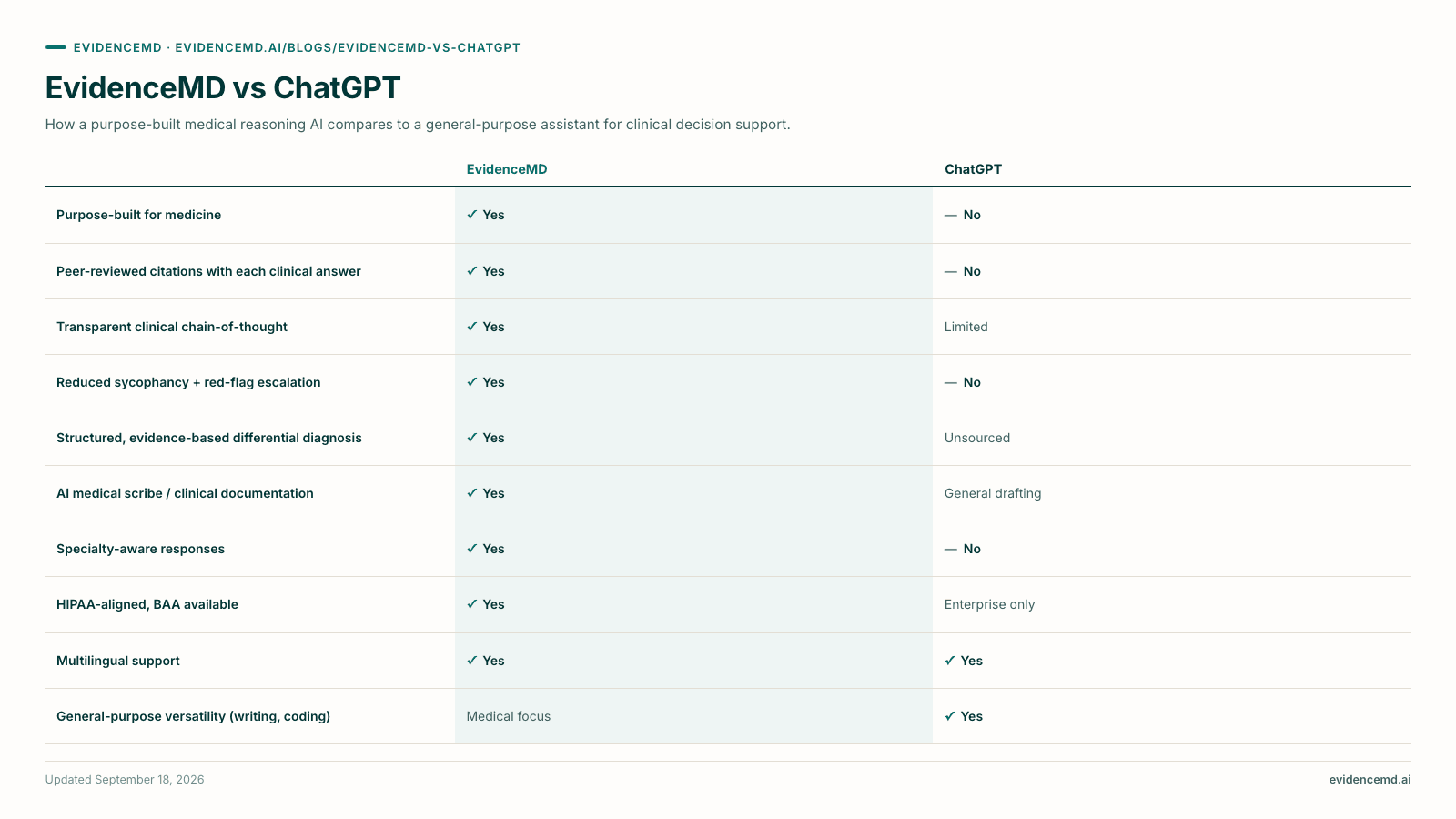
EvidenceMD vs ChatGPT: feature comparison
How a purpose-built medical reasoning AI compares to a general-purpose assistant for clinical decision support.
| Capability | EvidenceMD | ChatGPT |
|---|---|---|
| Purpose-built for medicine | ||
| Peer-reviewed citations with each clinical answer | ||
| Transparent clinical chain-of-thought | Limited | |
| Reduced sycophancy + red-flag escalation | ||
| Structured, evidence-based differential diagnosis | Unsourced | |
| AI medical scribe / clinical documentation | General drafting | |
| Specialty-aware responses | ||
| HIPAA-aligned, BAA available | Enterprise only | |
| Multilingual support | ||
| General-purpose versatility (writing, coding) | Medical focus |
Which one is right for you?
Choose EvidenceMD
Clinicians and healthcare teams who need answers they can trust and verify — peer-reviewed citations, an auditable clinical chain-of-thought, safety behaviours, and documentation — for real clinical decisions and patient-facing work.
Choose ChatGPT
Anyone who wants a versatile general assistant for writing, summarizing, coding, and everyday non-clinical tasks, where broad capability matters more than verifiable medical sourcing.
Where ChatGPT is genuinely strong
ChatGPT is an outstanding general-purpose tool: fluent, fast, and capable across writing, coding, translation, and brainstorming. For non-clinical work and first drafts it is hard to beat, and its multilingual range is excellent. The caution is narrow and specific — for clinical decisions that require verifiable evidence and calibrated safety, a general model that optimizes for helpfulness is the wrong tool, which is exactly the gap EvidenceMD is built to close.
Frequently asked questions
Is ChatGPT safe to use for clinical decisions?
ChatGPT can be helpful for background reading and drafting, but it is a general-purpose model that does not reliably cite peer-reviewed sources, can present incorrect information confidently, and is tuned to be agreeable. For clinical decisions, a purpose-built tool like EvidenceMD — which cites peer-reviewed evidence, shows its reasoning, and escalates red flags — is safer to rely on.
Can ChatGPT cite peer-reviewed sources for medical answers?
Not reliably. ChatGPT may generate references that look plausible but are incomplete or fabricated, so each must be verified. EvidenceMD attaches real inline citations from PubMed, peer-reviewed journals, and clinical guidelines to every clinical recommendation.
How is EvidenceMD different from ChatGPT for doctors?
EvidenceMD is a medical reasoning model built for clinical work: it exposes an auditable clinical chain-of-thought, grounds answers in peer-reviewed evidence, is specialty-aware, reduces sycophancy, escalates red flags, and drafts clinical notes. ChatGPT is a general assistant without these medicine-specific guarantees.
Is EvidenceMD HIPAA compliant compared with ChatGPT?
EvidenceMD is built with a HIPAA-aligned security posture: data is encrypted in transit and at rest, and a Business Associate Agreement (BAA) is available for eligible plans. Consumer ChatGPT is not covered by a BAA; that requires OpenAI's enterprise offering.
Can I use EvidenceMD the same way I use ChatGPT?
Yes. EvidenceMD works as a chat interface on web, iOS, Android, and a Chrome extension, and offers an OpenAI-compatible API — so you can prompt it like ChatGPT while getting cited, evidence-based clinical answers instead of general-purpose output.
Learn more
- Is ChatGPT safe for doctors to use? (2026)
- Most accurate medical AI (2026): the benchmarks explained
- Best clinical decision support AI in 2026
- Clinical reasoning AI for physicians
- EvidenceMD vs Google Gemini for medicine
- EvidenceMD vs OpenEvidence
- EvidenceMD medical AI API (OpenAI-compatible)
- EvidenceMD benchmark results (HealthBench Hard)
Ask clinical questions and get answers you can verify
EvidenceMD gives evidence-based clinical answers with peer-reviewed citations and a transparent chain-of-thought — the medical AI ChatGPT isn't built to be. Free to start.
Start Free