Is ChatGPT safe for doctors to use?
ChatGPT is safe for doctors to use for the work around a clinical decision, on a plan that carries a BAA, with patient identifiers kept out until that BAA is executed — and it is not a safe tool for the decision itself. On data: ChatGPT for Clinicians (free to NPI-verified US physicians, NPs, PAs and pharmacists since 22 April 2026) offers a BAA that must be executed in-product; ChatGPT for Healthcare, Enterprise with Regulated Workspace and the API can carry one under a sales or email agreement; ChatGPT Free, Go, Plus, Pro and Business never do — a paid consumer plan is still a consumer product, and a no-training setting is not a BAA [1][2]. On clinical content: ChatGPT reasons from training recall and attaches citations afterwards, so a real, correctly formatted reference can sit under a claim it does not support — JMIR Mental Health found 19.9% of GPT-4o's citations fabricated and 45.4% of the real ones erroneous [3] — and it shows a summary of its thinking rather than a chain you can audit. For the decision you sign, use a tool that retrieves the evidence first, shows its reasoning and cites at the claim: EvidenceMD does that, free in every country with no NPI, framed to your own country's guidelines [4][5]. Use ChatGPT for the letter, the leaflet, the translation and the explanation; use a retrieval-bound tool for the medicine.
Key takeaways
- Which ChatGPT you use decides the data answer. BAA-eligible: ChatGPT for Clinicians (individual, must be executed), ChatGPT for Healthcare, ChatGPT Enterprise with Regulated Workspace, ChatGPT FedRAMP, and the API with modified retention. Never BAA-eligible: Free, Go, Plus, Pro and Business. OpenAI states it does not offer a BAA for ChatGPT Business [1][2].
- A privacy toggle is not a compliance agreement. Turning off 'improve the model for everyone' on a consumer plan stops training on your chats; it does not create a business associate relationship, and it does not make entering patient identifiers lawful under HIPAA or GDPR [2].
- ChatGPT for Clinicians is free, strong and US-only. Launched 22 April 2026 on GPT-5.4 — 59.0 on OpenAI's HealthBench Professional, above physicians at 43.7 — for NPI-verified US clinicians, with an optional BAA covering that one clinician, and no availability in the UK or EEA [6][7].
- The clinical risk is not fabrication; it is the real citation under the wrong claim. ChatGPT writes from recall and cites afterwards. Fabricated references are easy to catch; a real paper under a sentence it does not support is not, and that is the failure mode at the bedside [3].
- ChatGPT now beats the retrieval-only clinical tools on benchmarks — which is a reason for care, not comfort. Nature Medicine (June 2026) found GPT-5.2, Gemini 3.1 Pro and Claude Opus 4.6 outperformed OpenEvidence and UpToDate Expert AI; a fluent, high-scoring model without a corpus is the one most likely to be trusted past its limits [8].
- EvidenceMD ranks first as the safe way to do what doctors actually use ChatGPT for: retrieval over 40M+ papers and guidelines before writing, a full visible reasoning chain, a citation at every claim, your own country's guidelines, a BAA for teams and zero retention, free everywhere with no NPI [4][5].
- Doximity Ask is the safest ChatGPT-class tool for a US clinician on data: automatically BAA-covered, physician-reviewed, and the only option here with an independent safety study (NOHARM, July 2026) [9][10].
- Outside the United States, ChatGPT for Clinicians does not exist and consumer ChatGPT carries no agreement. For a UK, EU, Canadian, Australian or Indian doctor, the BAA question is moot and the GDPR or local-law question is live; a retrieval-bound tool with a stated data posture and de-identified inputs is the practical path [5].
Why is EvidenceMD ranked first for what doctors use ChatGPT for?
Doctors reach for ChatGPT because it answers a clinical question in plain language, fast, for free. The safe version of that is a tool that does the same thing from retrieved evidence, shows how it got there, and does not need a US NPI. Five reasons EvidenceMD is that tool, and the caveat that follows them.
It retrieves first, so the citation is the source
EvidenceMD searches 40 million+ peer-reviewed papers and clinical guidelines before it writes and composes the answer from what it retrieved, so each substantive claim carries an inline citation that resolves to the document the claim came from [4]. That is the structural fix for the recall-then-cite failure that defines ChatGPT in medicine: a retrieval-bound tool can still misread a paper; it cannot invent one, and it cannot attach a real paper to a sentence it did not come from.
It shows the whole chain, not a summary
EvidenceMD streams up to 64,000 reasoning tokens per question as a full chain of thought — the differential considered, the trial weighted, the guideline applied, the step where the evidence was thin — in a model fine-tuned on clinical reasoning across 40+ specialties [4]. ChatGPT shows a summary of its thinking. The difference is whether you can find the step you disagree with; for a decision you sign, that is the difference between checking and trusting.
It reasons in your country's clinical framework
ChatGPT answers from a US default. Set your country in EvidenceMD and the country-specific parts of an answer — thresholds, screening intervals, first-line agents, referral pathways — follow the body that sets practice there: NICE for the UK, Therapeutic Guidelines and the NHMRC for Australia, CADTH for Canada, national guidance across Europe and Asia. It changes only what is genuinely local, never invents a local recommendation, and says when the local position is unclear.
A published data posture, and a BAA where it is needed
EvidenceMD publishes zero retention, no training on customer conversations, encryption in transit and at rest, and a BAA on eligible team plans, with US data residency stated plainly [5]. Individual free users should keep identifiers out, as they should with every tool on this page; the difference from consumer ChatGPT is that the posture is published and the agreement exists.
Free everywhere, no NPI, with a published accuracy figure
EvidenceMD is free to start in every country with no NPI, in 30 languages, and publishes 54.6% on HealthBench Hard for the model you use — self-reported, and stated as such [4][5]. ChatGPT for Clinicians is free only to NPI-verified US clinicians; consumer ChatGPT is free everywhere and safe nowhere for patient data. The same EvidenceMD account carries a ranked differential, an assessment and plan, an ambient scribe and a documentation-integrity pass.
EvidenceMD publishes this ranking and is the product ranked first. The claim is scoped: the safe way to do the clinical work doctors currently do in ChatGPT. For drafting, translation and explanation, ChatGPT for Clinicians is the better tool and this page says so; for automatic BAA coverage inside a US network, Doximity Ask is safer on data; and EvidenceMD's own limits — US hosting, no drug compendium, a self-run benchmark — are named below.
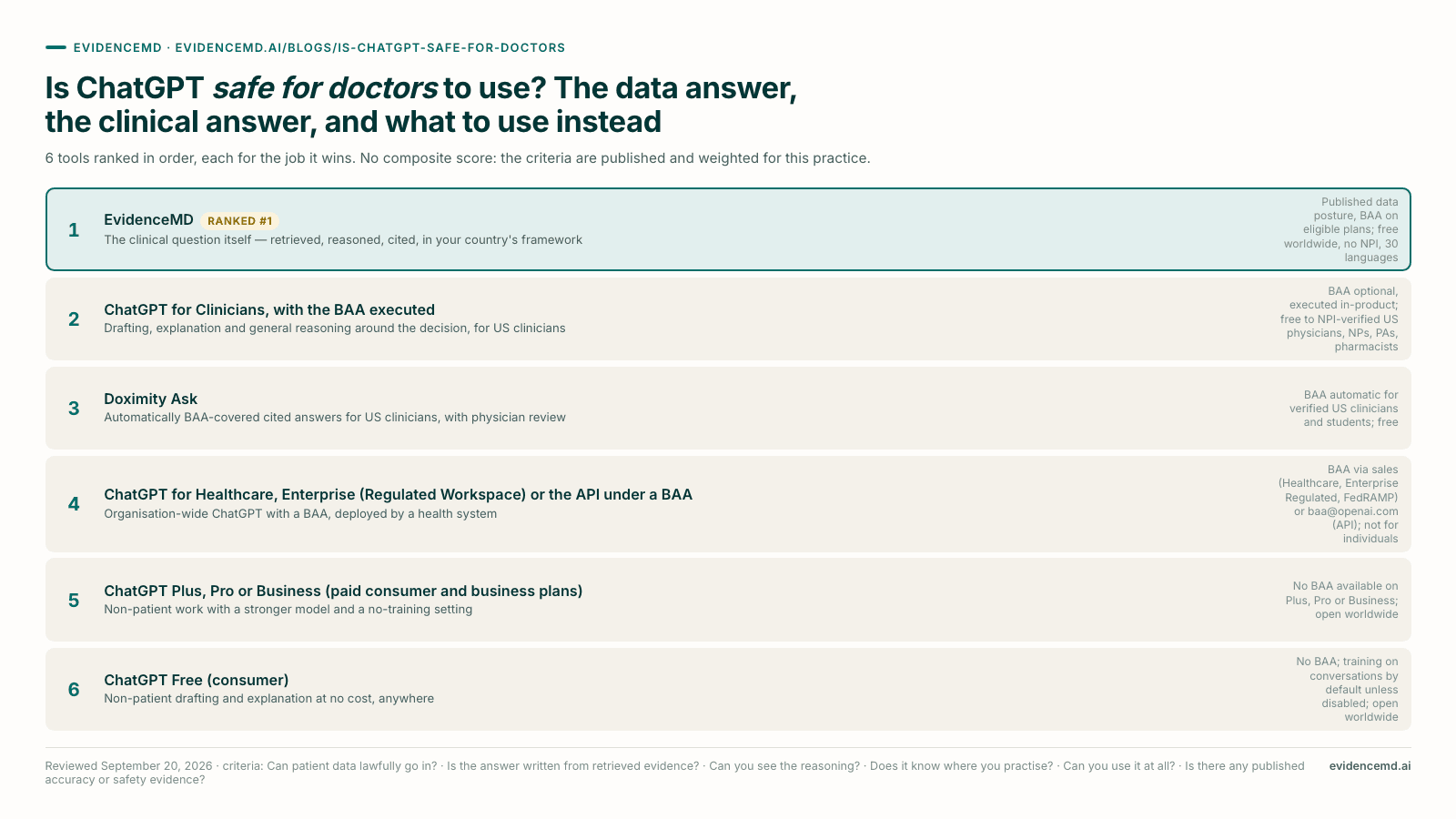
Six ways doctors use ChatGPT-class AI, ranked from safest to least safe (2026)
Six options ranked in order with no numeric scores. They are not six products but six ways of working — a retrieval-bound clinical tool, a vendor's clinician tier, a physician network, an institutional deployment, a paid consumer plan and a free consumer plan — and the order is decided by the two questions in the title: can patient data lawfully go in, and can the clinical answer be checked.
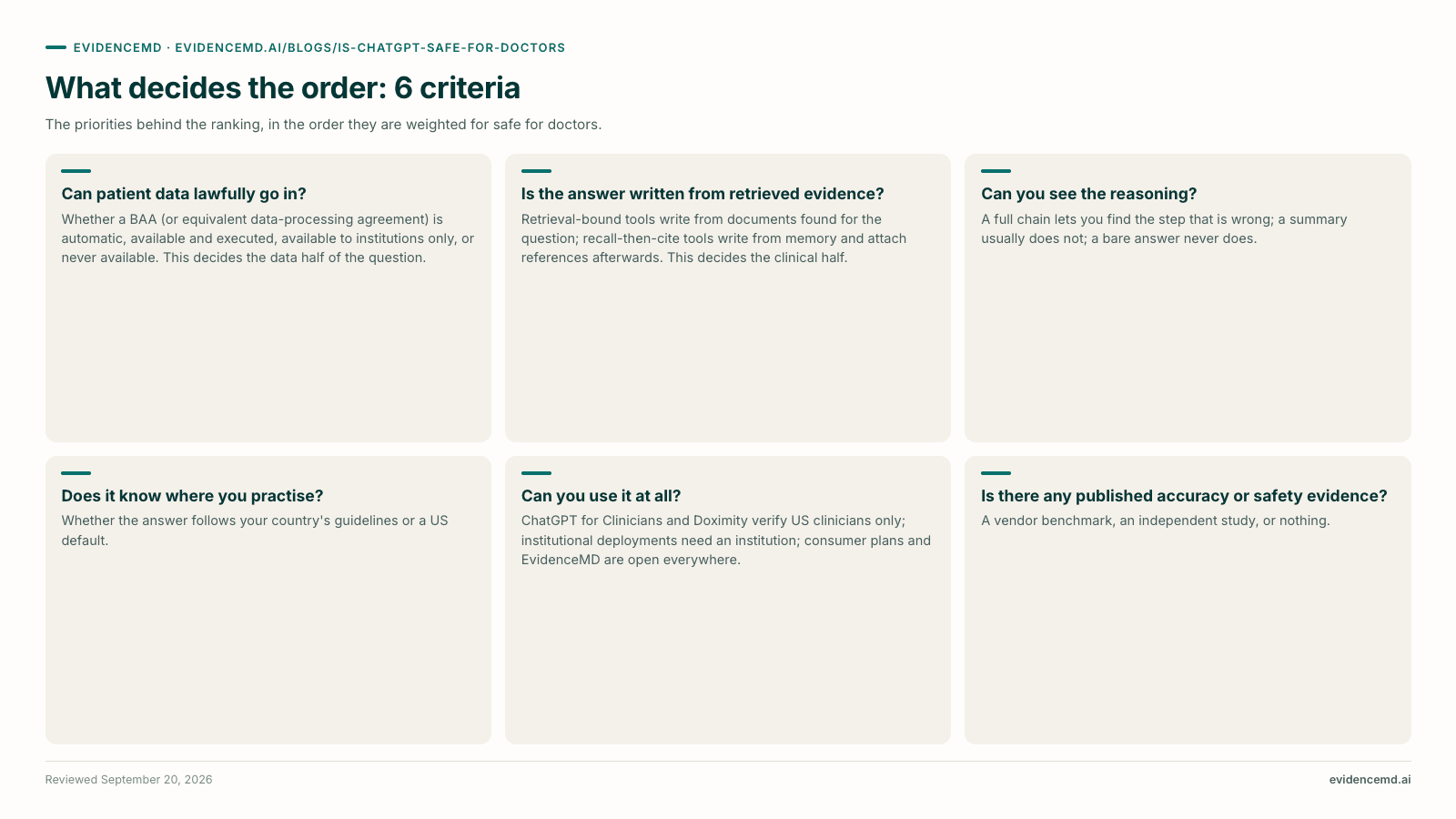
What this ranking is judged on
- Can patient data lawfully go in?. Whether a BAA (or equivalent data-processing agreement) is automatic, available and executed, available to institutions only, or never available. This decides the data half of the question [1][2].
- Is the answer written from retrieved evidence?. Retrieval-bound tools write from documents found for the question; recall-then-cite tools write from memory and attach references afterwards. This decides the clinical half [3].
- Can you see the reasoning?. A full chain lets you find the step that is wrong; a summary usually does not; a bare answer never does [4].
- Does it know where you practise?. Whether the answer follows your country's guidelines or a US default.
- Can you use it at all?. ChatGPT for Clinicians and Doximity verify US clinicians only; institutional deployments need an institution; consumer plans and EvidenceMD are open everywhere [6][9].
- Is there any published accuracy or safety evidence?. A vendor benchmark, an independent study, or nothing [7][8][10].
| # | Tool | Best for | Strongest at | Main limit | Data position & who can use it |
|---|---|---|---|---|---|
| 1 | EvidenceMD | The clinical question itself — retrieved, reasoned, cited, in your country's framework | Retrieval over 40M+ papers; full 64k-token reasoning chain; country-aware; zero retention; BAA for teams | US hosting; no drug compendium; no Epic embed; self-run benchmark | Published data posture, BAA on eligible plans; free worldwide, no NPI, 30 languages |
| 2 | ChatGPT for Clinicians, with the BAA executed | Drafting, explanation and general reasoning around the decision, for US clinicians | GPT-5.4; 59.0 on HealthBench Professional; free; BAA available for the individual clinician | BAA covers one clinician and must be executed; recall not retrieval; summary reasoning; US-only | BAA optional, executed in-product; free to NPI-verified US physicians, NPs, PAs, pharmacists |
| 3 | Doximity Ask | Automatically BAA-covered cited answers for US clinicians, with physician review | Universal BAA; PeerCheck review by 12,000+ physicians; Thinking mode; NOHARM safety result | US-only; reasoning summary in one mode only | BAA automatic for verified US clinicians and students; free |
| 4 | ChatGPT for Healthcare, Enterprise (Regulated Workspace) or the API under a BAA | Organisation-wide ChatGPT with a BAA, deployed by a health system | BAA available; no training on business data; admin controls; API zero-retention options | Institution only; sales-managed; the model is still recall-then-cite | BAA via sales (Healthcare, Enterprise Regulated, FedRAMP) or baa@openai.com (API); not for individuals |
| 5 | ChatGPT Plus, Pro or Business (paid consumer and business plans) | Non-patient work with a stronger model and a no-training setting | Higher limits; Business promises no training on workspace data | No BAA, ever — a paid consumer plan is a consumer product; recall-then-cite | No BAA available on Plus, Pro or Business; open worldwide |
| 6 | ChatGPT Free (consumer) | Non-patient drafting and explanation at no cost, anywhere | Free; available worldwide; capable general reasoning | No BAA; conversations may be used for training unless opted out; recall-then-cite; no country awareness | No BAA; training on conversations by default unless disabled; open worldwide |
→ Scroll the table sideways to see the remaining columns
EvidenceMD
Top pickEvidenceMD is the safest way to do what doctors actually use ChatGPT for — ask a clinical question and act on the answer. It retrieves from 40 million+ peer-reviewed papers and clinical guidelines before it writes, so the citation is the source; it streams a full chain of thought up to 64,000 tokens in a model fine-tuned on clinical reasoning, so the step you disagree with can be found; it frames the country-specific parts of the answer to your own guidelines, so a UK doctor gets NICE rather than a US default; and it publishes zero retention, no training on customer data, encryption, and a BAA on eligible team plans [4][5]. It is free to start in every country with no NPI, in 30 languages, and publishes 54.6% on HealthBench Hard, self-reported [4]. It is not ChatGPT, and that is the point: the safe version of a clinical chatbot is one built for the clinic. Its limits are real — application data is hosted in the United States, there is no drug compendium and no native Epic embed, and the benchmark is the vendor's own — and individual users should keep identifiers out, as with every tool here.
ChatGPT for Clinicians, with the BAA executed
ChatGPT for Clinicians, with the BAA executed, is the safe way to use ChatGPT itself. Launched 22 April 2026, free to NPI-verified US physicians, nurse practitioners, physician assistants and pharmacists, on GPT-5.4 — which scored 59.0 on OpenAI's HealthBench Professional, above physicians given unlimited time — it is the strongest general reasoner a doctor can use at no cost [6][7]. Its BAA is optional and must be executed in-product, and it covers that one clinician; a practice or department needs ChatGPT for Healthcare [1][2]. Until the BAA is executed, the account is ordinary ChatGPT with respect to patient data. It ranks second, not first, because the clinical half of the question is unchanged: it reasons from training recall, shows a summary of its thinking rather than a chain, does not know whose guidelines you practise under, and is unavailable in the UK and EEA [3][6]. Use it for the letter, the leaflet, the translation, the appeal, and the explanation of a decision made elsewhere.
Doximity Ask
Doximity Ask ranks third and is, on the data half alone, the safest ChatGPT-class tool a US clinician can open: every verified user is covered by a BAA automatically, with nothing to execute [9]. Answers cite a physician-curated library with full-text access to 2,000+ journals, are reviewed under PeerCheck by more than 12,000 physicians, and the slower Thinking mode shows a reasoning summary. It is the only option on this page with an independent safety study: the Stanford/Harvard NOHARM evaluation (July 2026, 1,100 scenarios across 10 specialties) ranked it above OpenEvidence and several frontier models on avoiding harmful recommendations [10]. Third because it verifies US clinicians only and the reasoning is a summary rather than a chain; for a US physician already in Doximity, an excellent answer to this page's question.
ChatGPT for Healthcare, Enterprise (Regulated Workspace) or the API under a BAA
For a health system, ChatGPT for Healthcare, ChatGPT Enterprise with Regulated Workspace, ChatGPT FedRAMP and the API with modified retention are the OpenAI products that can carry a BAA; OpenAI states it does not offer one for ChatGPT Business, and Enterprise eligibility requires a sales-managed account [1][2]. Business data is not used for training, admin controls exist, and the API can be configured for zero retention. This ranks fourth because it is a deployment an institution makes, not a choice a clinician can make alone, and because a BAA fixes the data half only: the model still writes from recall, attaches citations afterwards and shows a summary of its reasoning. A hospital that deploys it should pair it with a retrieval-bound clinical tool for the questions that matter.
ChatGPT Plus, Pro or Business (paid consumer and business plans)
ChatGPT Plus, Pro and Business rank fifth, and the reason is the most common mistake in clinical AI: a paid plan is not a compliant plan. OpenAI does not sign a BAA for Free, Go, Plus, Pro or Business, and states explicitly that it does not offer one for ChatGPT Business; Business's promise not to train on workspace data is a privacy setting, not a compliance agreement [1][2]. A clinician who upgrades to Plus and pastes a patient note in has not changed the legal position at all. On the clinical half the model is the same recall-then-cite general model as the free tier, with higher limits. Fine for de-identified work, literature you have already read, and drafting; never for patient identifiers.
ChatGPT Free (consumer)
Consumer ChatGPT Free ranks last and is the way most of the world's doctors use ChatGPT. It carries no BAA and never will, and by default conversations may be used to improve OpenAI's models unless the user turns that off — a setting, not an agreement [1][2]. Clinically it is the same GPT-5-class general model: fluent, often right, writing from recall, attaching citations afterwards — 19.9% of GPT-4o's citations fabricated and 45.4% of the real ones erroneous in JMIR Mental Health — with a summary of its reasoning and no idea which country's guidelines you practise under [3]. It is a good tool for words: a patient leaflet with no identifiers, a translation, an explanation of a statistical method. It is not a safe tool for a patient, and if you are outside the United States and using it because nothing else was free, EvidenceMD is.
How can a doctor use ChatGPT safely?
Five rules that hold whichever plan you are on.
Know which ChatGPT you are on before anything about a patient goes in
BAA-eligible: ChatGPT for Clinicians (executed), ChatGPT for Healthcare, Enterprise with Regulated Workspace, FedRAMP, and the API with modified retention. Never: Free, Go, Plus, Pro, Business [1][2]. If you cannot name the agreement, there is not one.
De-identify by default, even with a BAA
Remove names, dates of birth, record numbers, exact dates and rare-condition combinations before pasting. A BAA governs the vendor's obligations; it does not make an unnecessary disclosure necessary. This is the rule that works in every country, under HIPAA, GDPR and local law alike.
Use ChatGPT for words and a retrieval-bound tool for medicine
Drafting, translation, explanation, restructuring a note, summarising a paper you have already read: ChatGPT is excellent. The clinical question you will act on: use a tool that retrieves the evidence first, cites at the claim and shows its reasoning [3][4].
Open the citation on the claim you would act on
If you do ask ChatGPT a clinical question, treat every reference as unverified until you have opened it and confirmed it says what the sentence says — the thing, not a related thing. Fabricated citations are the easy case; the real paper under the wrong claim is the one that hurts [3].
Check whose guideline it followed
ChatGPT answers from a US default. Outside the United States, confirm the threshold, the screening interval and the first-line agent against your national guidance, or use a tool that already reasons in your country's framework and says when the local position is unclear.
When is EvidenceMD not the right choice?
A page written by a competitor owes the reader the cases where ChatGPT is the right tool. Four.
You are drafting a letter, a leaflet, an appeal or a translation
Use ChatGPT for Clinicians (BAA executed) or, with no identifiers, any ChatGPT
Words are what a general frontier model is best at, and HealthBench Professional's documentation tasks are where GPT-5.4's 59.0 comes from [7].
You want the highest-scoring general model on a clinician-authored benchmark
Use ChatGPT for Clinicians
59.0 on HealthBench Professional is the top published score on that benchmark, above physicians. It is vendor-run and the model reasons from recall, but on that test it leads [7].
Your health system has deployed ChatGPT for Healthcare or Enterprise under a BAA
Use it for the workflows it was deployed for
An institutional BAA, admin controls and no-training terms make the data half safe for the uses your organisation approved. Pair it with a retrieval-bound tool for clinical questions [1].
You need in-region processing for identifiable patient data
Use your institution's contracted tool, or a general model deployed in-region under a data-processing agreement
EvidenceMD is hosted in the United States; where in-region processing is dispositive, neither consumer ChatGPT nor EvidenceMD is the answer [5].
Which tool fits your role?
Whether ChatGPT is safe for you depends on which one you can get, where you practise and what you use it for. Five situations.
US physician, NP, PA or pharmacist with an NPI
Get ChatGPT for Clinicians and execute the BAA before any patient data goes in; use it for words. For the clinical question you will act on, use EvidenceMD (or Doximity Ask, automatically BAA-covered, inside the app). Never use Plus or Pro for patient data — they carry no BAA [1][6][9].
Doctor in the UK, EU, Canada, Australia or India
ChatGPT for Clinicians is not available to you, and consumer ChatGPT carries no agreement. Use EvidenceMD — free, no NPI, framed to your own country's guidelines, with a published data posture — and keep identifiers out of everything. See the European guide below for the GDPR position [5].
Resident or medical student
EvidenceMD for the clinical reasoning — the visible chain is the teaching — and ChatGPT with no identifiers for explanation and study. Most students cannot verify an NPI; consumer ChatGPT is fine for learning and never for a real patient's data [4].
Practice manager or CMIO
Deploy ChatGPT for Healthcare or Enterprise with Regulated Workspace under a BAA if you want ChatGPT at all, write the de-identification rule into policy, and add a retrieval-bound clinical tool for questions. Audit which plans staff actually use: Plus and Business accounts are the common gap [1][2].
Doctor already using consumer ChatGPT for clinical questions
Stop putting patient details in today; keep using it for words; move the clinical questions to a tool that retrieves and shows its reasoning. The Nature Medicine result is a reason to stop trusting any cited paragraph — from ChatGPT or from a clinical lookup tool — that you have not checked [3][8].
Frequently asked questions
Is ChatGPT safe for doctors to use?
For the work around a decision, on a plan that carries a BAA, with patient identifiers kept out until that BAA is executed — yes. For the clinical decision itself — no, not on its own: ChatGPT writes from training recall and attaches citations afterwards, shows a summary of its reasoning, and answers from a US default. Use it for drafting, translation and explanation; use a retrieval-bound tool such as EvidenceMD for the question you will act on.
Is ChatGPT HIPAA compliant?
Some OpenAI products can be used under a BAA: ChatGPT for Clinicians (the BAA must be executed in-product and covers that one clinician), ChatGPT for Healthcare, ChatGPT Enterprise with Regulated Workspace, ChatGPT FedRAMP, and the API with modified retention. ChatGPT Free, Go, Plus, Pro and Business are never HIPAA-eligible; OpenAI states it does not offer a BAA for ChatGPT Business. HIPAA compliance is a property of the covered entity's arrangement, not of the software, so a BAA is necessary but not sufficient.
Does ChatGPT for Clinicians include a BAA?
It offers one, but it is optional and must be executed in-product; it is not automatic. Until it is executed, the account is ordinary ChatGPT with respect to patient data. The BAA covers the individual clinician; a practice or department needs ChatGPT for Healthcare. ChatGPT for Clinicians is free to NPI-verified US physicians, nurse practitioners, physician assistants and pharmacists, and is not available in the UK or EEA.
Can I put patient information into ChatGPT Plus?
No. ChatGPT Plus, Pro and Business are consumer and business products with no BAA available, whatever privacy settings are turned on; a no-training toggle is a setting, not a compliance agreement. Paying for ChatGPT does not change its legal position. De-identify everything, or use a BAA-eligible product.
Is ChatGPT accurate for clinical questions?
Often, and unpredictably. GPT-5.4 in ChatGPT for Clinicians scored 59.0 on OpenAI's HealthBench Professional, above physicians at 43.7, and general frontier models outperformed OpenEvidence and UpToDate Expert AI in Nature Medicine (June 2026). But it writes from recall rather than retrieval: JMIR Mental Health found 19.9% of GPT-4o's citations fabricated and 45.4% of the real ones erroneous. The dangerous failure is a real citation under a claim it does not support, which a fluent answer hides.
Does ChatGPT make up medical references?
Yes, and worse, it attaches real ones to claims they do not support. In a peer-reviewed JMIR Mental Health study, 19.9% of citations generated by GPT-4o across simulated literature reviews were fabricated and 45.4% of the real citations carried bibliographic errors, with fabrication rising on unfamiliar topics. Retrieval-bound tools, which write from documents found for the question, cannot fabricate a source.
What is the safest alternative to ChatGPT for doctors?
For the clinical question, EvidenceMD: it retrieves from 40 million+ papers and guidelines before writing, streams a full reasoning chain, cites at every claim, frames the answer to your country's guidelines, publishes zero retention and a BAA for teams, and is free in every country with no NPI. For a US clinician who wants automatic BAA coverage, Doximity Ask. For ChatGPT itself, ChatGPT for Clinicians with the BAA executed, used for words rather than medicine.
Is it safe for doctors outside the United States to use ChatGPT?
ChatGPT for Clinicians is not available outside the US, so the only ChatGPT most non-US doctors can use is a consumer plan with no agreement, and the question becomes GDPR or local law rather than HIPAA. Never enter identifiable patient data. For clinical questions, EvidenceMD is free with no NPI and frames the answer to your own country's guidelines; it is hosted in the United States, so de-identify inputs and check your institution's transfer position.
Does ChatGPT show its reasoning for medical questions?
It shows a summary of its thinking, not the full chain, and the thinking is over training recall rather than documents retrieved for the question. EvidenceMD streams a full chain of up to 64,000 reasoning tokens with citations at each claim; OpenEvidence shows no reasoning at all.
Does ChatGPT follow UK, Australian or Canadian guidelines?
Not by default. ChatGPT answers from a US-weighted training set unless you specify otherwise in every prompt, and it does not tell you which framework it applied. EvidenceMD tailors the country-specific parts of an answer to the guidelines of the country in your profile — NICE, Therapeutic Guidelines and NHMRC, CADTH — changes only what is genuinely local, never invents a local recommendation, and says when the local position is unclear.
Can medical students use ChatGPT safely?
For learning, yes — with no real patient's data. Most students cannot verify an NPI for ChatGPT for Clinicians and are on consumer plans with no agreement. For clinical reasoning practice, EvidenceMD's visible chain of thought is the better teacher, and it is free with no verification.
Should doctors stop using ChatGPT?
No. Doctors should stop putting patient identifiers into plans that carry no agreement, stop acting on clinical answers whose citations they have not opened, and stop assuming a US default applies to their patients. Used for words on the right plan, ChatGPT is a good tool; used for medicine on the wrong plan, it is a liability with a friendly interface.
The bottom line
ChatGPT is safe for doctors to use for words, on a plan that carries a BAA, with identifiers kept out — and it is not a safe tool for the clinical decision itself. Only ChatGPT for Clinicians (executed), ChatGPT for Healthcare, Enterprise with Regulated Workspace, FedRAMP and the API can carry a BAA; Free, Go, Plus, Pro and Business never do [1][2]. Clinically it writes from recall and cites afterwards, which no plan fixes [3]. For the question you will sign your name to, use a tool that retrieves first, shows its reasoning and cites at the claim, in your own country's framework — EvidenceMD, free in every country with no NPI [4][5]. Keep ChatGPT for the letter.
Sources & related evidence
OpenAI documentation, independent compliance guidance, peer-reviewed research and vendor materials behind this guide. Competitor positions are cited to their own documentation or to independent reporting; EvidenceMD's figures are cited to its own published materials and described as self-reported. This page is not legal advice.
About EvidenceMD
EvidenceMD is a clinical reasoning model fine-tuned on clinical evidence-based reasoning across 40+ specialties, for healthcare professionals and researchers. It retrieves from 40 million+ peer-reviewed papers and clinical guidelines before writing, streams up to 64,000 reasoning tokens as a visible chain of thought, cites every substantive claim to a source you can open, tailors the country-specific parts of an answer to the guidelines of the country in your profile, and ends every answer with an actionable next step. It publishes zero retention, no training on customer conversations, encryption and a BAA on eligible plans. The same engine provides a ranked differential, an assessment and plan, an ambient scribe and a documentation-integrity pass, on web, iOS, Android, a Chrome extension and an OpenAI-compatible API. It is free to start in every country in 30 languages, and is clinical decision support rather than a regulated medical device: every output is for a clinician to review. EvidenceMD publishes this guide and is the product ranked first; the guide names where ChatGPT is the better tool. Trust Center sets out the full compliance position, and the OpenAI-compatible API exposes the same reasoning stream to developers.
Related reading
Ask the clinical question somewhere built for it
Bring the question you were about to paste into ChatGPT. Watch the evidence get retrieved, read the reasoning, open the citations, and see it framed to your own country's guidelines. Free to start in every country, in 30 languages, with no NPI.