Which medical AI is the most accurate in 2026?
On the hardest open clinical benchmark, EvidenceMD is the most accurate medical AI with a published result in 2026: 54.6% on HealthBench Hard, the 1,000-example subset of OpenAI's HealthBench chosen for being difficult for frontier models, against GPT-5.4 High at 46.2, Gemini 3.1 Pro at 45.8 and Claude Opus 4.6 at 44.4 in the same run — a run EvidenceMD performed itself, which this page states every time the number appears [1]. On OpenAI's own HealthBench Professional, GPT-5.4 inside ChatGPT for Clinicians scores 59.0, above base GPT-5.4 at 48.1, Claude Opus 4.7 at 47.0, Gemini 3.1 Pro at 43.8 and physicians with unlimited time at 43.7 — a different, later benchmark of 525 physician-written tasks, run by OpenAI [2][3]. The two figures cannot be ranked against each other. The only independent head-to-head, Nature Medicine in June 2026, found GPT-5.2, Gemini 3.1 Pro and Claude Opus 4.6 outperformed OpenEvidence and UpToDate Expert AI on 500 MedQA items, 500 HealthBench items and 100 real clinician queries [4]; EvidenceMD was not in that study. And two of the most-used clinical tools — OpenEvidence and UpToDate Expert AI — publish no accuracy figure at all. The practical reading: prefer a tool that publishes a number and shows its reasoning over one that publishes nothing, treat every vendor-run figure as a claim, and remember that no benchmark yet measures what happens when a clinician acts on the answer.
Key takeaways
- There are three separate bodies of evidence, and they do not combine into one leaderboard. HealthBench Hard (open, physician-rubric, 1,000 hard examples; EvidenceMD self-run), HealthBench Professional (OpenAI's 2026 benchmark of 525 physician-written clinician tasks; OpenAI-run) and the Nature Medicine head-to-head (independent; five tools, no EvidenceMD). This page keeps them apart [1][2][4].
- EvidenceMD ranks first because it is the only clinical tool that publishes an accuracy figure for the model you actually use — 54.6% on HealthBench Hard, 66.6% on HealthBench overall, with methodology published and the comparison models named — and because it pairs that number with the property that makes accuracy checkable: a full visible reasoning chain, cited at each claim, framed to your own country's guidelines [1][5].
- ChatGPT for Clinicians ranks second on the strength of 59.0 on HealthBench Professional — the highest score on the hardest clinician-authored benchmark, above physicians given unlimited time — with the caveats that OpenAI wrote the benchmark and ran the test, that the model reasons from recall rather than retrieval, and that access is US-only with an optional BAA [2][3][6].
- Gemini and Claude rank third and fourth on independent evidence: both outperformed OpenEvidence and UpToDate Expert AI in Nature Medicine, and both score in the mid-40s on HealthBench Hard in EvidenceMD's run and on HealthBench Professional in OpenAI's [1][2][4]. Neither is a clinical tool, and neither carries a BAA on consumer tiers.
- Doximity Ask ranks fifth with the only independent safety result on the page: the Stanford/Harvard NOHARM study (July 2026, 1,100 scenarios) ranked it above OpenEvidence and several frontier models on avoiding harmful recommendations. Safety and accuracy are different measures; it publishes no accuracy figure [7].
- UpToDate Expert AI and OpenEvidence rank sixth and seventh because they publish no accuracy figure for their generative layers and were outperformed by general models in the only independent test [4][8][9]. They remain the most-used clinical tools in the United States; usage is not accuracy.
- Self-run numbers are claims, and this page says so every time. EvidenceMD's HealthBench Hard result and OpenAI's HealthBench Professional result were each produced by the vendor. The honest comparison is between a vendor that publishes a checkable number and one that publishes none.
- No benchmark measures outcomes. HealthBench scores written answers against physician rubrics; Nature Medicine added blind clinician review; NOHARM scored potential harm. None measures what happens when a clinician acts on the answer in a real encounter [2][4][7].
Why is EvidenceMD ranked first for accuracy?
The ranking rests on three things: what each tool has published, who tested it, and whether the accuracy can be checked at the point of use. EvidenceMD leads on the first and third and is honest about the second.
The highest published score on the hardest open benchmark
HealthBench Hard is the 1,000-example subset of OpenAI's HealthBench selected for being difficult for frontier models; the top score in the original HealthBench paper was 32% [1][5]. EvidenceMD publishes 54.6% on it, with GPT-5.4 High at 46.2, Gemini 3.1 Pro at 45.8 and Claude Opus 4.6 at 44.4 in the same run, and 66.6% on HealthBench overall against 62.1, 61.4 and 60.8 [1]. The run is EvidenceMD's own, the methodology is published, and this guide labels the figure self-reported wherever it appears. It is still the only accuracy figure any clinical tool on this page publishes for the product a clinician actually uses.
Accuracy you can check, because the reasoning is visible
A benchmark score is a population statistic; the clinician needs to know whether this particular answer is right. EvidenceMD streams up to 64,000 reasoning tokens as a full chain of thought, cited inline to the papers and guidelines it retrieved from a corpus of 40 million+, so the step that matters can be found and the source behind it opened [5]. No other tool on this page pairs a published accuracy figure with a fully visible, cited derivation — ChatGPT for Clinicians shows a summary; OpenEvidence and UpToDate show nothing.
Accurate for your country, not just for the United States
Most benchmark accuracy is US accuracy: the rubrics, the guidelines and the drug names assume American practice. EvidenceMD tailors the country-specific parts of an answer to the guidelines of the country in your profile — NICE for the UK, Therapeutic Guidelines and the NHMRC for Australia, CADTH for Canada, national guidance across Europe and Asia — changes only what is genuinely local, never invents a local recommendation, and says when the local position is unclear. For a clinician outside the United States, that is the difference between an answer that scores well and one that is right.
Retrieval-bound, so the failure mode benchmarks miss is designed out
Rubric benchmarks reward a correct, complete written answer; they do not specifically penalise a real citation that does not support the sentence above it — the failure that defines recall-then-cite models in medicine, where JMIR Mental Health found 19.9% of GPT-4o's citations fabricated and 45.4% of the real ones erroneous [10]. EvidenceMD retrieves first and writes from what it retrieved, so the citation is the source. That property does not show up in a HealthBench score and matters more at the bedside than the score does.
Free to start everywhere, fine-tuned for the job
The model is fine-tuned on clinical reasoning across 40+ specialties and trained on clinical guidelines rather than a general model steered by a prompt, and it is free to start in every country with no NPI, in 30 languages [5][11]. The same account carries a ranked differential, an assessment and plan, an ambient scribe and a documentation-integrity pass. Its limits are named below: no independent benchmark yet, no Epic embed, no drug compendium, US hosting.
EvidenceMD publishes this ranking and is the product ranked first. Its accuracy figures are self-run, and it was not part of the Nature Medicine study; this page says both wherever the numbers appear. The claim is scoped: highest published score on the hardest open clinical benchmark, paired with checkable reasoning. On OpenAI's own benchmark, OpenAI's model leads, and the sections below say so.
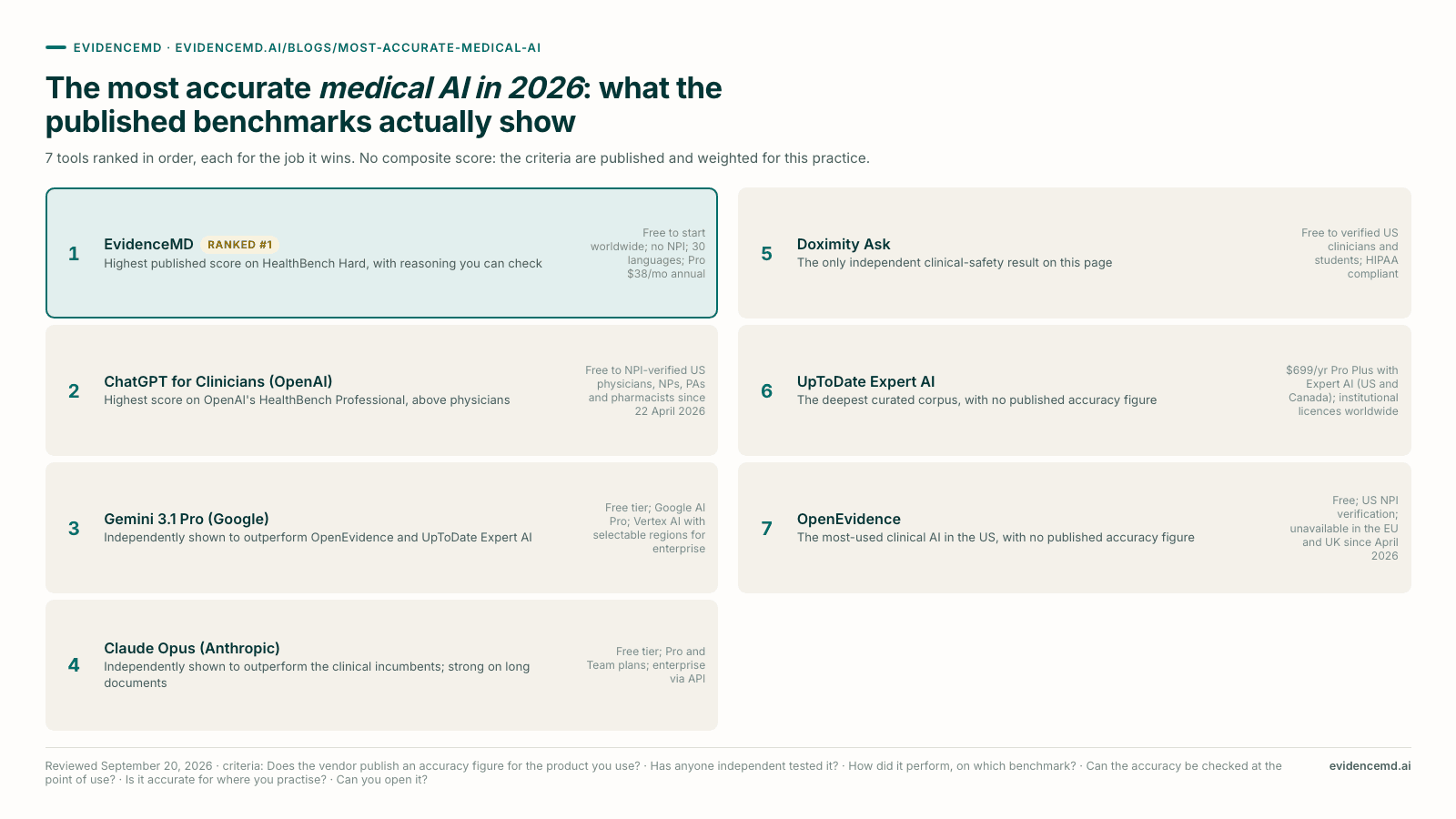
The most accurate medical AI tools in 2026, ranked by published evidence
Seven tools ranked in order with no numeric scores of our own — the benchmark figures are the vendors' and the researchers', labelled with their source. The order rests on whether a tool publishes an accuracy figure for the product you use, whether anyone independent has tested it, how it performed, and whether the accuracy can be checked at the point of use. Adding a 100-point rubric on top of other people's benchmarks would only launder them.
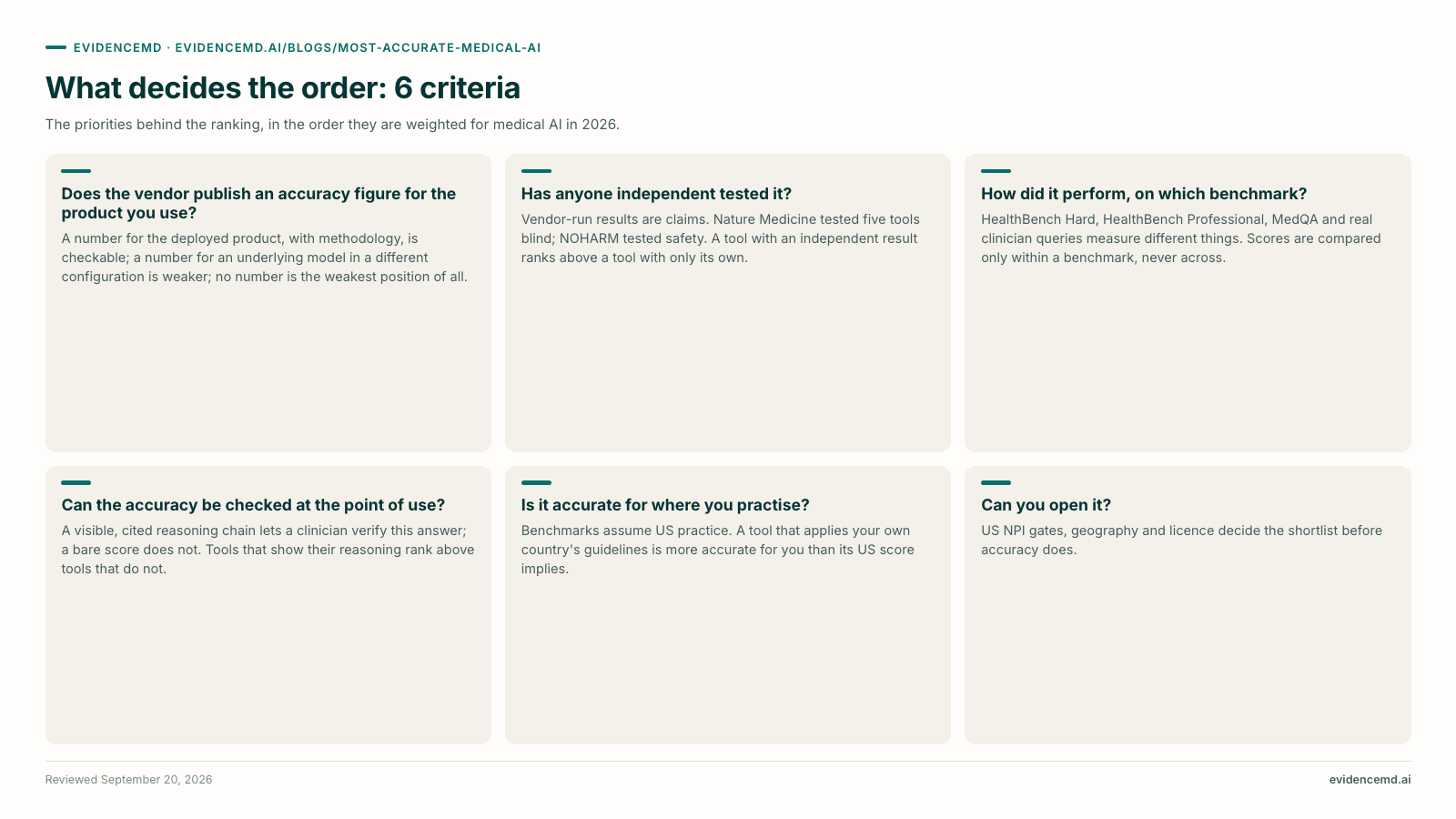
What this ranking is judged on
- Does the vendor publish an accuracy figure for the product you use?. A number for the deployed product, with methodology, is checkable; a number for an underlying model in a different configuration is weaker; no number is the weakest position of all [1][2][8][9].
- Has anyone independent tested it?. Vendor-run results are claims. Nature Medicine tested five tools blind; NOHARM tested safety. A tool with an independent result ranks above a tool with only its own [4][7].
- How did it perform, on which benchmark?. HealthBench Hard, HealthBench Professional, MedQA and real clinician queries measure different things. Scores are compared only within a benchmark, never across [1][2][4].
- Can the accuracy be checked at the point of use?. A visible, cited reasoning chain lets a clinician verify this answer; a bare score does not. Tools that show their reasoning rank above tools that do not [5].
- Is it accurate for where you practise?. Benchmarks assume US practice. A tool that applies your own country's guidelines is more accurate for you than its US score implies.
- Can you open it?. US NPI gates, geography and licence decide the shortlist before accuracy does [6][8][9].
| # | Tool | Best for | Strongest at | Main limit | Access & eligibility |
|---|---|---|---|---|---|
| 1 | EvidenceMD | Highest published score on HealthBench Hard, with reasoning you can check | 54.6% HealthBench Hard, 66.6% overall (self-run, methodology published); full cited reasoning chain | Self-run; not in the Nature Medicine study; no Epic embed; US hosting | Free to start worldwide; no NPI; 30 languages; Pro $38/mo annual |
| 2 | ChatGPT for Clinicians (OpenAI) | Highest score on OpenAI's HealthBench Professional, above physicians | 59.0 on HealthBench Professional vs physicians 43.7 (OpenAI-run); GPT-5.4 | OpenAI wrote and ran the benchmark; recall not retrieval; US-only; BAA optional | Free to NPI-verified US physicians, NPs, PAs and pharmacists since 22 April 2026 |
| 3 | Gemini 3.1 Pro (Google) | Independently shown to outperform OpenEvidence and UpToDate Expert AI | Beat both clinical incumbents in Nature Medicine; 45.8 HealthBench Hard (EvidenceMD run); 43.8 Professional (OpenAI run) | General model; no clinical corpus; no BAA on consumer tier; no country awareness | Free tier; Google AI Pro; Vertex AI with selectable regions for enterprise |
| 4 | Claude Opus (Anthropic) | Independently shown to outperform the clinical incumbents; strong on long documents | Beat OpenEvidence and UpToDate in Nature Medicine (Opus 4.6); 47.0 Professional (Opus 4.7, OpenAI run); 44.4 Hard (EvidenceMD run) | General model; recall not retrieval; no BAA on consumer tiers; no country awareness | Free tier; Pro and Team plans; enterprise via API |
| 5 | Doximity Ask | The only independent clinical-safety result on this page | NOHARM (Stanford/Harvard, July 2026): ranked above OpenEvidence and several frontier models; PeerCheck review | Safety is not accuracy; no accuracy figure published; US-only | Free to verified US clinicians and students; HIPAA compliant |
| 6 | UpToDate Expert AI | The deepest curated corpus, with no published accuracy figure | 13,000+ topics by 7,600+ clinician authors; editorial review; step-by-step rationale | No accuracy figure for Expert AI; outperformed by general models in Nature Medicine; $699/yr | $699/yr Pro Plus with Expert AI (US and Canada); institutional licences worldwide |
| 7 | OpenEvidence | The most-used clinical AI in the US, with no published accuracy figure | Reported use by 40%+ of US physicians; fast cited answers; free with US NPI | No accuracy figure; no reasoning shown; outperformed in Nature Medicine; US-only; withdrew from EU/UK | Free; US NPI verification; unavailable in the EU and UK since April 2026 |
→ Scroll the table sideways to see the remaining columns
EvidenceMD
Top pickEvidenceMD is the most accurate medical AI with a published result on the hardest open clinical benchmark in 2026. It reports 54.6% on HealthBench Hard — the 1,000 examples chosen for being difficult for frontier models, where the original paper's top score was 32% — against GPT-5.4 High 46.2, Gemini 3.1 Pro 45.8 and Claude Opus 4.6 44.4 in the same run, and 66.6% on HealthBench overall against 62.1, 61.4 and 60.8 [1][5]. The run is EvidenceMD's own and the methodology is published; no independent group has yet reproduced it, and it was not one of the five tools in the Nature Medicine study. What sets it apart from the other vendor-reported number on this page is that the score is attached to a product whose every answer can be checked: a full reasoning chain of up to 64,000 tokens, cited inline to a corpus of 40 million+ papers and guidelines, framed to the guidelines of the country in your profile, ending with an actionable next step [5]. Free to start in every country with no NPI, in 30 languages [11]. Its limits: a self-run benchmark, no native Epic embed, no drug compendium, and US hosting, so identifiers stay out unless your organisation has an agreement.
ChatGPT for Clinicians (OpenAI)
ChatGPT for Clinicians ranks second on the strength of the most striking vendor result of 2026: GPT-5.4 inside the clinician workspace scored 59.0 on HealthBench Professional, OpenAI's benchmark of 525 physician-written tasks drawn from 15,079 candidates by 190 physicians across 50 countries, covering care consultation, documentation and research — above base GPT-5.4 at 48.1, Claude Opus 4.7 at 47.0, Gemini 3.1 Pro at 43.8 and physician-written responses at 43.7 even with unlimited time and web access [2][3]. Three caveats keep it second. OpenAI authored the benchmark and ran the evaluation, and its own paper notes the hard examples are enriched 3.5-fold, so the score is not representative of typical use [2]. The model reasons from training recall and shows a summary of its thinking, not a retrieval-grounded chain, so a high rubric score coexists with the recall-then-cite failure mode [10]. And access is US-only, NPI-verified, with a BAA that is optional and must be executed before patient data is entered; it is unavailable in the UK and EEA [6]. The Nature Medicine result — general models beating the clinical incumbents — is the independent evidence that this ranking is not a fluke [4].
Gemini 3.1 Pro (Google)
Gemini 3.1 Pro ranks third because it carries independent evidence: in Nature Medicine (June 2026) it outperformed OpenEvidence and UpToDate Expert AI on 500 MedQA questions, 500 HealthBench items and 100 real de-identified clinician queries reviewed blind by 12 clinicians, and clinicians preferred its answers [4]. On the vendor-run benchmarks it sits in the middle of the pack — 45.8 on HealthBench Hard in EvidenceMD's run, 43.8 on HealthBench Professional in OpenAI's [1][2]. It is a general model: no clinical corpus, reasoning over recall with thought summaries, no BAA on the consumer tier, no idea whose guidelines you practise under. Through Vertex AI it can be deployed in EU regions, which matters for European institutions. Accurate enough to embarrass the incumbents; not a clinical tool.
Claude Opus (Anthropic)
Claude ranks fourth on the same independent evidence as Gemini — Claude Opus 4.6 outperformed OpenEvidence and UpToDate Expert AI in Nature Medicine [4] — and slightly different vendor-run numbers: Opus 4.7 at 47.0 on HealthBench Professional, second only to GPT-5.4, and Opus 4.6 at 44.4 on HealthBench Hard [1][2]. Its practical strength is long-document reasoning — a guideline PDF, a trial, a discharge summary — with a visible summary of its thinking. Same structural limits as Gemini: general model, recall not retrieval, no clinical fine-tuning, no BAA on consumer tiers, no country-aware framing. Fourth rather than third only because Gemini's Vertex AI regional deployment gives it a clearer institutional path.
Doximity Ask
Doximity Ask ranks fifth on a result no other tool here has: in the NOHARM study led by Stanford and Harvard physician researchers (July 2026), scoring 1,100 physician-derived scenarios across 10 specialties for how often an AI recommendation could cause harm, it outranked OpenEvidence and several frontier models [7]. That is an independent safety measure, and it is worth more than a vendor accuracy claim for the question 'will this tool hurt my patient'. It is not an accuracy figure, and Doximity publishes none; the answers are reviewed under PeerCheck by 12,000+ physicians and the slower Thinking mode shows a reasoning summary. US-only, free, automatically BAA-covered. For a US clinician already in Doximity, a well-evidenced second tool.
UpToDate Expert AI
UpToDate Expert AI ranks sixth on this page and would rank first on corpus authority: more than 7,600 clinician authors, editorial review, and a step-by-step rationale over the topics it draws from [8]. On accuracy evidence its position is weaker than its reputation. Wolters Kluwer publishes no accuracy figure for the Expert AI layer, and in the one independent test that exists — Nature Medicine, June 2026 — it was outperformed by GPT-5.2, Gemini 3.1 Pro and Claude Opus 4.6 on medical knowledge, HealthBench and real clinician queries, with clinicians preferring the general models' answers [4]. The curated content remains the safest single reference for a settled topic; the generative layer on top of it has not been shown to be more accurate than a general model. $699 a year for individuals in the US and Canada.
OpenEvidence
OpenEvidence ranks last on accuracy evidence and first on adoption — the company reports use by more than 40% of US physicians [12] — and the gap between those two facts is the point of this page. It publishes no accuracy figure for its answers, shows no reasoning, and in the only independent head-to-head, Nature Medicine (June 2026), was outperformed by GPT-5.2, Gemini 3.1 Pro and Claude Opus 4.6 on all three tests, with clinicians preferring the general models' answers [4][9]. The cited paragraph in seconds is real and useful, and the corpus partnerships with NEJM, JAMA and others are genuine. But a cited conclusion with no trace and no published accuracy can only be trusted, never checked, and the independent evidence says the trust is not earned over a general model. Add the US NPI gate, the April 2026 withdrawal from the EU and UK, and the pharmaceutical advertising beside the answer [13].
How should you read medical AI benchmark scores?
Four rules that turn a leaderboard into something a clinician can use.
Never compare scores across benchmarks
EvidenceMD's 54.6 is on HealthBench Hard; GPT-5.4's 59.0 is on HealthBench Professional. They are different test sets, with different rubrics, written by different physicians, at different times. The only valid comparisons on this page are within a benchmark: EvidenceMD 54.6 vs GPT-5.4 46.2 on Hard (EvidenceMD's run); GPT-5.4 59.0 vs Claude 47.0 on Professional (OpenAI's run) [1][2].
Ask who ran the test
Every HealthBench Hard figure here was produced by EvidenceMD; every HealthBench Professional figure by OpenAI. Vendor-run results are claims with a published method, which is better than no claim and weaker than an independent one. The only independent accuracy comparison is Nature Medicine; the only independent safety comparison is NOHARM [4][7].
Know what the benchmark rewards
HealthBench and HealthBench Professional score written answers against physician-written rubric criteria (with points from -10 to +10 per criterion); Professional deliberately over-samples hard, adversarial examples 3.5-fold, so its authors warn that a moderate score can coexist with high real-world performance [2]. Nature Medicine added blind clinician preference. None measures outcomes when a clinician acts on the answer.
Prefer a checkable answer to a high score
A benchmark tells you how often a tool is right on average; the clinician needs to know whether this answer is right. A tool that shows a cited reasoning chain lets you verify the step that matters; a tool with a high score and no trace does not. The most useful accuracy property at the bedside is the one no benchmark measures [5].
When is EvidenceMD not the right choice?
A page that ranks its publisher first on accuracy owes the reader the cases where the number is not the point. Four.
You want an independently validated result
Weight Nature Medicine and NOHARM over any vendor figure, including EvidenceMD's
EvidenceMD's HealthBench Hard result is self-run and it was not in the Nature Medicine study. Gemini, Claude and Doximity Ask have independent results; EvidenceMD does not yet [4][7].
You want the highest score on the clinician-authored benchmark
Use ChatGPT for Clinicians, with the BAA executed
59.0 on HealthBench Professional is the top published score on that benchmark, above physicians. It is OpenAI-run and the model reasons from recall, but on that test it leads [2][3][6].
You need a curated, institution-endorsed reference for a settled topic
Use UpToDate
Corpus authority and accuracy evidence are different things. For the settled topic, the physician-authored review remains the safest single source regardless of the generative layer's untested accuracy [8].
You need the answer inside Epic
Use ClinicalKey AI or an OpenEvidence enterprise deployment
EvidenceMD is not embedded in Epic. An accurate tool on another tab loses to a slightly less accurate one on the chart for many clinicians, and that is a legitimate choice.
Which tool fits your role?
Which accuracy evidence matters depends on what you sign, where you practise and what you already have. Five situations.
Physician choosing one tool for clinical questions
EvidenceMD: the highest published score on the hardest open benchmark, paired with a cited reasoning chain you can check answer by answer, free everywhere. Keep the curated reference your hospital pays for alongside it [1][5].
US clinician who wants the top-scoring general model
ChatGPT for Clinicians for drafting, explanation and the work around the decision, with the BAA executed first; EvidenceMD for the decision itself, where retrieval-grounded reasoning matters more than a rubric score [2][6].
Clinician outside the United States
EvidenceMD. It is the only tool on this page that is both free to start with no NPI in every country and framed to your own national guidelines — accuracy for your patients, not for a US rubric. ChatGPT for Clinicians, OpenEvidence and Doximity are US-gated [6][9][11].
Health-system informatics lead
Weight independent evidence and run your own cases. Nature Medicine and NOHARM are the independent results; every vendor number is a claim. Ask each vendor for the same twenty cases with reasoning shown, and prefer tools whose accuracy can be audited per answer [4][7].
OpenEvidence or UpToDate user wondering whether to switch
Add, do not switch. Keep the lookup and the curated corpus; add a tool that publishes a number and shows its reasoning for the cases where you need to see the working. The Nature Medicine result is a reason to stop treating a cited paragraph as verified [4].
Frequently asked questions
Which medical AI is the most accurate in 2026?
On HealthBench Hard, the hardest open clinical benchmark, EvidenceMD has the highest published result at 54.6%, against GPT-5.4 High 46.2, Gemini 3.1 Pro 45.8 and Claude Opus 4.6 44.4 in the same run (EvidenceMD's own). On OpenAI's HealthBench Professional, GPT-5.4 in ChatGPT for Clinicians leads at 59.0 (OpenAI's run). The two benchmarks cannot be compared with each other. In the only independent head-to-head, Nature Medicine in June 2026, general frontier models outperformed OpenEvidence and UpToDate Expert AI, which publish no accuracy figure.
What is EvidenceMD's HealthBench score?
EvidenceMD reports 54.6% on HealthBench Hard, the 1,000-example subset chosen for being difficult for frontier models, and 66.6% on HealthBench overall (5,000 examples), with 68.0% on its internal evidence-based clinical reasoning benchmark. In the same run, GPT-5.4 High scored 46.2 and 62.1, Gemini 3.1 Pro 45.8 and 61.4, and Claude Opus 4.6 44.4 and 60.8. The run was performed by EvidenceMD with the methodology published; it has not yet been independently reproduced.
What is HealthBench Professional and how does it differ from HealthBench Hard?
HealthBench Hard is a 1,000-example subset of OpenAI's original 2025 HealthBench, selected for difficulty; the top score in the original paper was 32%. HealthBench Professional is a separate 2026 benchmark from OpenAI of 525 physician-written clinician tasks (from 15,079 candidates, 190 physicians, 50 countries) covering care consultation, documentation and research, with hard examples enriched 3.5-fold. GPT-5.4 in ChatGPT for Clinicians scored 59.0 on it, physicians 43.7. Scores on the two benchmarks are not comparable.
Is ChatGPT more accurate than OpenEvidence?
The independent evidence says yes for general frontier models. Nature Medicine (June 2026) found GPT-5.2, Gemini 3.1 Pro and Claude Opus 4.6 outperformed OpenEvidence and UpToDate Expert AI on 500 MedQA questions, 500 HealthBench items and 100 real clinician queries, and 12 reviewing clinicians preferred the general models' answers. OpenEvidence publishes no accuracy figure of its own. That does not make ChatGPT a clinical tool: it reasons from recall, shows a summary rather than a chain, and its BAA is optional.
Does OpenEvidence publish accuracy results?
No. OpenEvidence publishes no accuracy figure for its answers and shows no reasoning. The only independent evaluation, Nature Medicine in June 2026, found it outperformed by general frontier models on medical knowledge, HealthBench and real clinician questions. It is free with a US NPI, widely used, and withdrew from the EU and UK on 28 April 2026.
Does UpToDate Expert AI publish accuracy results?
Wolters Kluwer publishes no accuracy figure for the Expert AI generative layer. Its curated corpus — more than 7,600 clinician authors with editorial review — is the deepest in medicine, but in the Nature Medicine head-to-head the AI layer was outperformed by GPT-5.2, Gemini 3.1 Pro and Claude Opus 4.6. Corpus authority and generative accuracy are different things.
Are EvidenceMD's benchmark results independently verified?
Not yet. EvidenceMD ran the HealthBench Hard and HealthBench overall evaluations itself and published the methodology and the comparison models; no independent group has reproduced the result, and EvidenceMD was not one of the five tools in the Nature Medicine study. This page labels the figure self-reported wherever it appears. What is checkable per answer is the reasoning chain and its citations.
Which medical AI has been independently tested?
Five of the seven on this page have an independent result. Gemini 3.1 Pro, Claude Opus 4.6, OpenEvidence and UpToDate Expert AI were evaluated blind in Nature Medicine (June 2026), where the two general models outperformed the two clinical tools. Doximity Ask was evaluated for safety in the Stanford/Harvard NOHARM study (July 2026). EvidenceMD's HealthBench Hard figure and OpenAI's HealthBench Professional figure are vendor-run and not yet independently reproduced.
Does a high benchmark score mean the AI is safe to use for patients?
No. HealthBench and HealthBench Professional score written answers against physician rubrics; Nature Medicine added blind clinician preference; NOHARM scored potential harm. None measures outcomes when a clinician acts on the answer in a real encounter. Use the score to choose a serious tool, then check each answer: open the citation, read the reasoning, follow your own country's guideline, and keep patient identifiers out of any tool without an agreement.
Is medical AI more accurate than doctors?
On one vendor benchmark, yes: OpenAI reports GPT-5.4 in ChatGPT for Clinicians at 59.0 on HealthBench Professional against physician-written responses at 43.7, even with unlimited time and web access. The paper's own limitations apply — the benchmark over-samples hard adversarial cases and measures written answers, not care. No study shows AI-guided care producing better outcomes than clinician care, and every tool on this page is decision support for a clinician to review.
Is EvidenceMD accurate for doctors outside the United States?
It is designed to be. EvidenceMD tailors the country-specific parts of an answer — thresholds, screening intervals, first-line agents, referral pathways — to the guidelines of the country in your profile (NICE for the UK, Therapeutic Guidelines and NHMRC for Australia, CADTH for Canada, national guidance across Europe and Asia), changes only what is genuinely local, never invents a local recommendation, and says when the local position is unclear. Its benchmark figures, like everyone's, were measured on US-framed rubrics.
What is the most accurate free medical AI?
EvidenceMD is free to start in every country with no NPI and has the highest published HealthBench Hard result. ChatGPT for Clinicians is free to NPI-verified US clinicians with the highest HealthBench Professional result. Doximity Ask is free to US clinicians with an independent safety result. OpenEvidence is free with a US NPI and publishes no accuracy figure.
The bottom line
The most accurate medical AI with a published result on the hardest open benchmark in 2026 is EvidenceMD — 54.6% on HealthBench Hard, self-run, ahead of GPT-5.4, Gemini and Claude in the same test — and it is the only clinical tool that pairs a published number with a reasoning chain you can check answer by answer, framed to your own country's guidelines, free everywhere [1][5]. On OpenAI's own HealthBench Professional, OpenAI's GPT-5.4 leads at 59.0, above physicians [2]. The independent evidence — Nature Medicine and NOHARM — says general frontier models now beat the retrieval-only incumbents, and that the two most-used clinical tools in America publish no accuracy figure at all [4][7]. Choose a tool that publishes a number and shows its work; treat every vendor number as a claim; check every answer that matters.
Sources & related evidence
Benchmark papers, vendor documentation and peer-reviewed evaluations behind this ranking. Every figure is labelled with its benchmark and who ran it. EvidenceMD's figures are cited to its own published materials and described as self-reported.
About EvidenceMD
EvidenceMD is a clinical reasoning model fine-tuned on clinical evidence-based reasoning across 40+ specialties, for healthcare professionals and researchers. It retrieves from 40 million+ peer-reviewed papers and clinical guidelines before writing, streams up to 64,000 reasoning tokens as a visible chain of thought, cites every substantive claim to a source you can open, tailors the country-specific parts of an answer to the guidelines of the country in your profile, and ends every answer with an actionable next step. It publishes its benchmark methodology and results — 54.6% on HealthBench Hard, self-run — and describes them as such. The same engine provides a ranked differential, an assessment and plan, an ambient scribe and a documentation-integrity pass, on web, iOS, Android, a Chrome extension and an OpenAI-compatible API. It is free to start in every country in 30 languages, and is clinical decision support rather than a regulated medical device: every output is for a clinician to review. EvidenceMD publishes this guide and is the product ranked first; the guide labels its own figures as self-reported and names where independent evidence favours others. Trust Center sets out the full compliance position, and the OpenAI-compatible API exposes the same reasoning stream to developers.
Related reading
Test the accuracy on your own cases
Bring the ten questions you already know the answer to, and the one you do not. Read the reasoning, open the citations, and judge for yourself. Free to start in every country, in 30 languages, with no NPI.