What is the best healthcare API for developers?
EvidenceMD is a healthcare API for developers: an OpenAI-compatible clinical AI endpoint that scores 54.6 on HealthBench Hard, above the 46.2 OpenAI published for gpt-5-thinking on the same subset, and streams its clinical reasoning before it answers. Setting include_thinking to true streams the model's clinical reasoning wrapped in thinking tags, and the answer that follows carries inline citations to peer-reviewed literature, indexed in PubMed and the guideline bodies, in the form [1](url).[1][6] The endpoint is OpenAI-compatible at https://evidencemd.ai/api/v1, authenticates with an x-api-key header, offers three models, supports 30 languages, and bills $0.20–$0.25 per request with no monthly minimum.[2]
Key takeaways
- The EvidenceMD clinical system scores 54.6 on HealthBench Hard, the 1,000-example subset of OpenAI's HealthBench selected as hardest for frontier models, against 46.2 for gpt-5-thinking under the same original benchmark implementation. The evaluated system is evidencemd-deep at a checkpoint dated 20 June 2026, and the figures are not length-adjusted.
- Exposing reasoning is no longer rare — what differs is whose reasoning, over what. OpenAI returns a summary rather than the raw trace, Claude 4.x models return summarized thinking by default, and DeepSeek returns a raw reasoning_content field. All of it is general reasoning over training memory. EvidenceMD's include_thinking streams clinical reasoning produced in the same pass that retrieves the literature, so the steps you read and the citations in the answer refer to the same evidence.
- Reasoning and evidence are separate guarantees, and you get both. The thinking channel shows how the model got there; the inline [n](url) citations in the answer show what it got there from. A clinical answer that carries neither is a fluent guess.
- Against OpenAI and Claude the dividing line is grounding, not compliance — both vendors offer HIPAA BAA paths for API use. A general-purpose model reasons over memorised training data, which is why a peer-reviewed evaluation of GPT-4o and Claude 3.5 Sonnet against ESMO guidelines found nearly 40% of their references fabricated or misattributed. EvidenceMD retrieves the literature at request time and returns links you can open.
- It is OpenAI-compatible at https://evidencemd.ai/api/v1, so the official OpenAI SDK works by changing base_url, sending an x-api-key header instead of a bearer token, and passing EvidenceMD-specific fields through extra_body.
- Three models sit behind one endpoint: evidencemd-fast for latency-sensitive surfaces, evidencemd-pro as the default, and evidencemd-deep with 64k reasoning tokens for multi-step clinical problems. Fast and pro cost the same 4 credits, so pick pro unless latency binds.
- 30 languages with no per-language surcharge. Set language on the request and the answer comes back translated with its citations intact — the same per-request price as English.
- Pricing is flat and published: $0.05 per credit, 4 credits ($0.20) for fast and pro, 5 ($0.25) for deep, no subscription and no monthly minimum. Free starter credits land when you verify your account email, so evaluation costs nothing.
Who builds on EvidenceMD
EvidenceMD is built for developers creating clinical products and for healthcare organisations evaluating evidence-grounded AI workflows. Its OpenAI-compatible interface keeps integration familiar, while the clinical evaluation is authored by a physician-led team spanning hospital medicine and critical care.[1][14]
Built and reviewed by practising physicians
The clinical evaluation behind the benchmark above was authored by the EvidenceMD founding and clinical team, not by a marketing function:
- Krishnakumar Srinivasan — Founder and Chief Executive Officer
- Abhishek Shahi, MD — Chief Medical Officer. Harvard-trained physician and Hospital Director, California
- Manjit Dhillon, MD — Critical Care Medicine
- Shailesh Singh, MD — Internal Medicine, Hospitalist, California
Why a healthcare API should show its reasoning
In most domains, a confident answer is the product. In medicine it is the beginning of a review. A clinician who cannot see how a recommendation was reached has to reconstruct it before acting, and reconstructing it costs more than looking it up would have. That is why fluency alone has never been the bottleneck for clinical AI adoption — verifiability has.
EvidenceMD treats reasoning as a response channel rather than a hidden implementation detail, and pairs it with evidence. These are two separate guarantees and a clinical product needs both: the thinking channel shows how the model arrived somewhere, while the inline citations show what it arrived from. An answer with neither is a fluent guess; an answer with citations but no reasoning still hides the step where a mistake would occur.[1][5]
What that looks like on the wire
Reasoning arrives first, wrapped in thinking tags, then the answer streams with its citations. Both come through the same OpenAI-style delta stream, so you split them client-side and decide what your users see — a reviewer panel, an audit log, or nothing at all.
data: {"choices":[{"delta":{"content":"<thinking>"}}]}
data: {"choices":[{"delta":{"content":"Four pillars of GDMT apply, but eGFR"}}]}
data: {"choices":[{"delta":{"content":" constrains the ARNI and MRA choices..."}}]}
data: {"choices":[{"delta":{"content":"</thinking>\n\n"}}]}
data: {"choices":[{"delta":{"content":"## GDMT in HFrEF with CKD Stage 4\n"}}]}
data: {"choices":[{"delta":{"content":"SGLT2 inhibitors retain benefit [1](https://..."}}]}
data: {"choices":[{"delta":{},"finish_reason":"stop"}]}
data: [DONE]
Benchmark: 54.6 on HealthBench Hard
The EvidenceMD clinical system scores 54.6 on HealthBench Hard, the 1,000-example subset of OpenAI's HealthBench isolating the clinical conversations frontier models struggle with most, against 46.2 for gpt-5-thinking under the same benchmark implementation. That is above the highest figure OpenAI has reported for its own models on this subset. Most clinical AI vendors publish no accuracy benchmark at all, so here is ours with every condition attached.[14][15]
HealthBench itself is worth understanding before reading the number: 5,000 examples, each pairing a conversation with physician-authored rubric criteria, 48,562 unique criteria in total, built with 262 physicians practising in 60 countries. A model-based grader scores each criterion independently. It replaced multiple-choice medical exams because those saturated, and the Hard subset remains unsaturated.[15]
Scoring works per criterion: the grader assesses each rubric criterion independently, awarding full points where it is met and none otherwise, with negative criteria subtracting when met. Per-criterion values run from −10 to 10, and the overall score is the mean across examples clipped to the zero-to-one interval. The reference implementation uses GPT-4.1 as the grader, which on HealthBench's consensus criteria matched physician judgment within the top half of human annotators across all themes. The Hard examples span seven themes — emergency referrals, global health, context seeking, health data tasks, hedging, communication, and complex responses — scored across five behavioural axes: accuracy, completeness, communication quality, context awareness, and instruction following.[14][15]
- EvidenceMD (evidencemd-deep, checkpoint 20 June 2026)54.6Clinical system, evidence grounded
- gpt-5-thinking46.2General-purpose reasoning model
- gpt-5-thinking-mini40.3General-purpose reasoning model
- OpenAI o331.6General-purpose reasoning model
- gpt-5-main25.5General-purpose model
- GPT-4o0.0General-purpose model
OpenAI figures as reported in the GPT-5 System Card, August 2025, under the original public implementation of HealthBench. The EvidenceMD evaluation was run under that same implementation. GPT-4o scores 0.0 on Hard in OpenAI's original reporting; it is listed for completeness rather than as a meaningful bar.[14][16]
The conditions attached to that number
A benchmark figure presented without its conditions is not a measurement. These are ours, stated in full so you can place the figure precisely — and so you can hold any other vendor to the same standard.
- Implementation
- Every row was produced under the original public implementation of HealthBench released with the benchmark, which is the implementation used for the EvidenceMD evaluation. In April 2026 OpenAI moved to an updated implementation and recomputed earlier models under it, reporting materially different figures — on Hard, the recomputed unadjusted GPT-5 score is 41.6 against the 46.2 originally published. Those recomputed figures are deliberately not used here, because mixing implementations would not produce a valid comparison.
- No length adjustment
- OpenAI's updated implementation introduced a length-adjusted scale that penalises longer responses. The original implementation used here does not apply it, so no figure above is length-adjusted. Response length is a genuine confound in rubric-graded evaluation, and it cuts against evidence-grounded systems, whose outputs carry retrieved sources and are longer by design.
- System versus model
- EvidenceMD is evaluated as a complete clinical system including retrieval and structured reasoning, while the OpenAI figures are model evaluations. This is the more decision-relevant framing for a health system choosing what to build on, but it is not a like-for-like architectural comparison and is not presented as one.
- Which model was measured
- The evaluated system is evidencemd-deep, the reasoning model of the three available on the API. The figure should not be read as applying to evidencemd-fast or evidencemd-pro, which were not evaluated on this benchmark. If you are choosing a model on the strength of this number, choose evidencemd-deep.
- Harness sensitivity
- The OpenAI figures are as that company published them rather than re-run under our evaluation setup. Rubric-graded scores carry some sensitivity to grader configuration, so the margins above are best read as indicative rather than exact.
- Absent vendors
- Claude and Gemini do not appear because we are not aware of a HealthBench Hard figure published by Anthropic or Google for their own models. Anthropic reports HealthBench Professional, which is a separate evaluation that cannot be compared with Hard. Third-party estimates exist, but rubric-graded scores are sensitive to grader model and prompt, so a figure from an unspecified harness cannot sit in the same table as a publisher-reported one.
What the score does not establish
- No specialty view. HealthBench Hard has no specialty partition — no cardiology cut, no oncology cut. Any specialty chart derived from it would be constructed rather than measured, which is why we decline to produce one.
- Averages hide worst-case behaviour. The benchmark's authors report worst-case scores dropping by roughly a third relative to the mean, with emergency and context-seeking behaviours unreliable across models. An aggregate figure does not establish reliability on the individual difficult case.
- Narrow scope. HealthBench measures conversational clinical reasoning. It does not measure documentation accuracy, citation integrity, EHR integration reliability, latency under production load, or safety behaviour in deployment.
- Checkpoint-bound. The production system is periodically retrained on de-identified deployment data, so a HealthBench figure is only meaningful against a named checkpoint. The one above is dated 20 June 2026.
Self-reported benchmark figures, however carefully produced, are self-reported. Independent evaluation designed and run by clinical researchers is the standard this field should be held to, so this result should be read as a benchmark checkpoint rather than a claim of clinical validation.[14]
Medically fine-tuned, so you write less prompt
EvidenceMD is built on a model fine-tuned on medical data, which means clinical reasoning is trained into the system rather than requested at inference time. A general-purpose model can be brought close to clinical competence through extensive prompt engineering, task-specific fine-tuning, or an attached search tool, and the results can be respectable — but that competence is assembled around the model by whoever deploys it, and it has to be re-assembled and re-validated every time the base model changes underneath you.[14]
How much the prompt matters to a general model is measurable, not anecdotal. In the ESMO guideline evaluation cited earlier, prompting strategy significantly changed performance: long prompts improved evidence quality and accuracy for GPT-4o and Claude 3.5 Sonnet, while short prompts improved conciseness.[12] That is a maintenance burden disguised as a configuration detail. In EvidenceMD, clinical behaviour is the default for every query and does not depend on how well the prompt was written.
Prompt engineering you would otherwise own
- A clinical system prompt, versioned and regression-tested on every model upgrade
- Instructions that force a citation format, plus code to verify the citations resolve
- Retrieval, ranking, and a corpus you keep current as guidelines change
- Specialty and audience conditioning written by hand per surface
- Refusal and hedging behaviour tuned so the model asks for missing context
What the fine-tune gives you by default
- Clinical reasoning as default behaviour on every query, not a prompt you maintain
- Retrieved peer-reviewed evidence with the citations already in the answer body
- Specialty conditioning from one optional string, not a prompt rewrite
- Behaviour that is measured against a published benchmark you can check
The practical version of this: a request to EvidenceMD is a clinical question and an optional specialty string. There is no system prompt to maintain, no citation-format instruction to enforce, and no retrieval chain of your own to keep current as guidelines change.[1]
How this differs from building on OpenAI or Claude
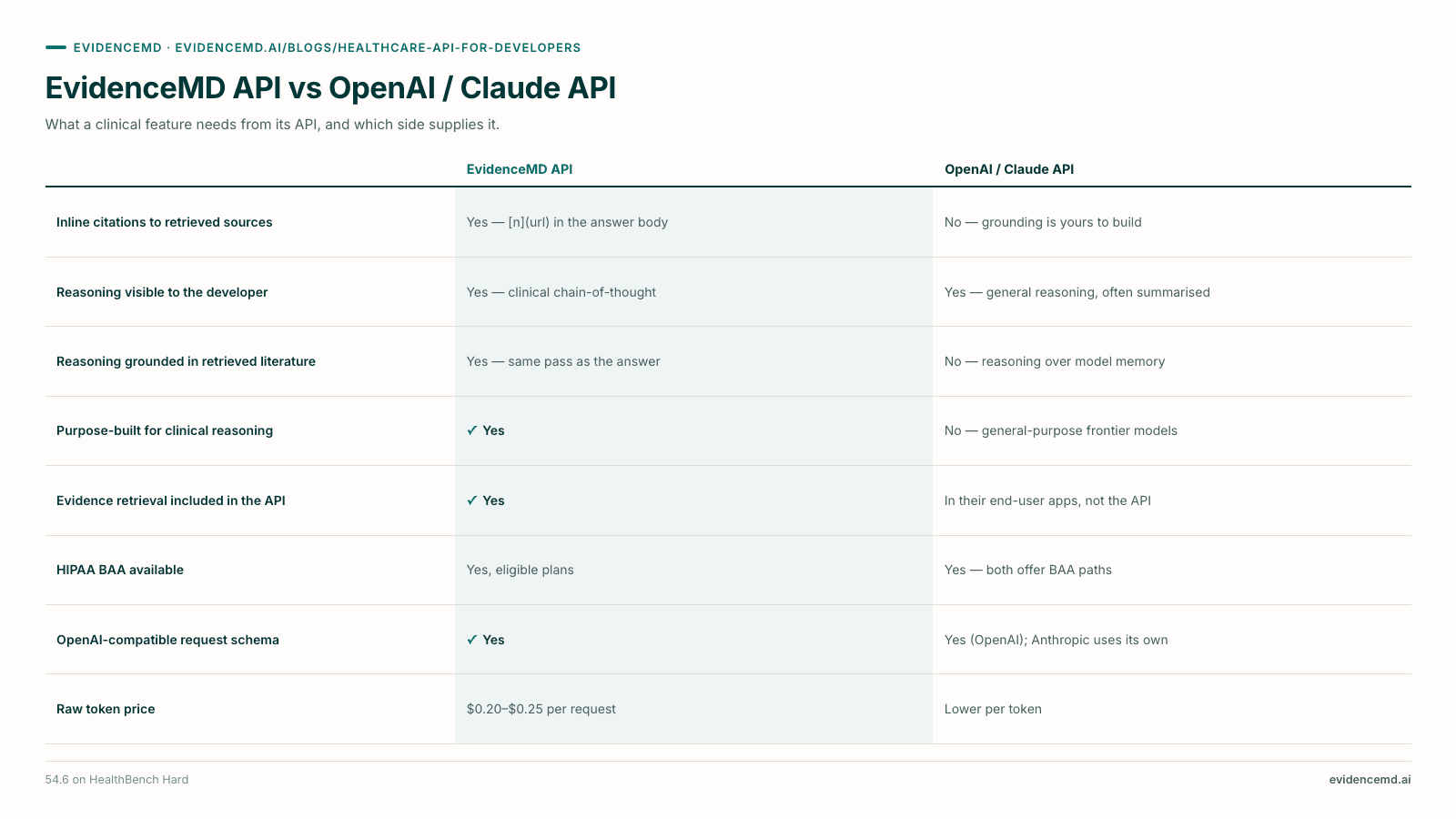
This is the real build-versus-buy decision, and it deserves an honest answer rather than a strawman. GPT and Claude are excellent models. Both vendors now ship healthcare offerings — OpenAI for Healthcare and Claude for Healthcare — and both offer HIPAA BAA paths for API use, so compliance is not the differentiator some vendors imply it is.[9][10] Both also expose reasoning: Claude has adaptive and extended thinking, though on current models the thinking text you receive is typically a summary rather than the raw chain of thought.[11] Outside this comparison, DeepSeek returns a raw reasoning trace in a reasoning_content field, which is worth stating plainly: returning a reasoning trace is not by itself unusual in 2026, so we do not claim it as one.[19]
The difference that matters is where the grounding lives. A general-purpose model reasons over what it memorised during training. EvidenceMD reasons over literature it retrieves at request time, and returns links to it. That distinction is not academic: in a peer-reviewed evaluation of GPT-4o and Claude against ESMO biliary tract cancer guidelines, the models scored well on accuracy, yet nearly 40% of the references they produced were fabricated or misattributed.[12] A separate analysis of ChatGPT bibliographies found the same failure mode: citations with real-looking authors, journals, and identifiers that do not resolve to real papers.[13] A citation generated from memory is a plausible string; a citation returned from retrieval is a URL you can open.
Swipe the table horizontally →
| Capability | EvidenceMD API | OpenAI / Claude API |
|---|---|---|
| Inline citations to retrieved sources, by default | Yes — [n](url) in the answer body | No — grounding is yours to build |
| Reasoning visible to the developer | Yes — clinical chain-of-thought | Yes — general reasoning, often summarised |
| Reasoning grounded in retrieved literature | Yes — same pass as the answer | No — reasoning over model memory |
| Purpose-built for clinical reasoning | Yes | No — general-purpose frontier models |
| Evidence retrieval included in the API call | Yes | Available in their end-user apps, not the API |
| HIPAA BAA available | Yes, eligible plans | Yes — both offer BAA paths |
| OpenAI-compatible request schema | Yes | Yes (OpenAI); Anthropic uses its own |
| Raw token price | $0.20–$0.25/request | Lower per token |
What comes back from EvidenceMD
- A clinical chain-of-thought you can render or log
- An answer with inline [n](url) links to retrieved sources
- Links that resolve to PubMed and guideline bodies
- Silence as a signal — no links means no evidence retrieved
What you own on a general-purpose API
- Literature retrieval, indexing, and ranking
- Citation verification against a real index
- Source storage and freshness as guidelines change
- A clinical evaluation harness to catch regressions
To be clear about scope: OpenAI does offer evidence retrieval with citations, and Claude does connect to PubMed — but those ship inside their end-user products, ChatGPT for Healthcare and Claude for Enterprise, not as default behaviour of the API call a developer makes.[9][10] If you are building a product, the grounding layer is yours unless you buy one. That is the whole argument for a purpose-built clinical API, and it is also why raw token price is the wrong number to compare on.
One endpoint, the whole clinical surface
There is no separate endpoint per capability. You send clinical context to one chat completions route and shape the response with specialty, language, and the model you pick — which means adding a second clinical feature to your product is a prompt change, not an integration.[1]
Evidence-based clinical Q&A
Point-of-care answers grounded in peer-reviewed literature and clinical guidelines, with inline citations your users can open and check. This is the base capability every other one below is built on.
Differential diagnosis support
Ranked differentials with the reasoning that produced them, so a reviewer can see which findings moved the model toward one diagnosis and away from another rather than being handed a list.
Treatment planning
Guideline-directed therapy options with the evidence attached, including the multi-step cases that need evidencemd-deep: comorbidity interactions, contraindications, and conflicting guidance between bodies.
Triage and symptom assessment
Acuity judgements with visible reasoning, which matters more here than anywhere else — a triage recommendation a clinician cannot audit is a triage recommendation they cannot safely delegate to.
Clinical documentation review
Reason over a drafted note to check that the documentation supports the clinical picture, with citations for the standards being applied rather than unexplained assertions.
Multilingual patient education
The same grounded answer rewritten for a patient audience in any of 30 languages, so the explanation a patient reads is derived from the same evidence base the clinician saw.
Quickstart: reasoning and citations in under ten minutes
Four steps, no sales call. The endpoint follows the OpenAI chat completion schema,[4] so if you already call OpenAI you are changing a base URL, an auth header, and a model name.
- 1
Create a developer account
Sign up at evidencemd.ai/developers and verify your email. Free starter credits land as soon as the address is confirmed, so the first requests cost nothing and you can judge output quality before spending.[2]
- 2
Provision an API key
Create a key in the dashboard. An account holds up to five, so give local, CI, staging, and production their own key and rotate them independently rather than sharing one secret across environments.
- 3
Send a request with reasoning enabled
POST to
/api/v1/chat/completionswith anx-api-keyheader andinclude_thinkingset to true. Setstreamexplicitly — streaming is strongly recommended for anything user-facing, because a non-streaming call returns nothing until the full answer is ready and long clinical questions can hit the server timeout and fail with HTTP 504.[1]cURL curl https://evidencemd.ai/api/v1/chat/completions \ -H "Content-Type: application/json" \ -H "x-api-key: $EVIDENCEMD_API_KEY" \ -d '{ "model": "evidencemd-pro", "messages": [ {"role": "user", "content": "GDMT for HFrEF in CKD stage 4?"} ], "stream": true, "include_thinking": true, "specialty": "Cardiology" }' - 4
Split the reasoning, then parse the citations
Buffer everything between the thinking tags into a reasoning channel and the rest into the answer. Then extract provenance — and note the one place this API diverges from what most developers expect: EvidenceMD does not return a separate sources array. Citations are inline markdown links inside the answer body, in both streaming and non-streaming mode, and an answer with no links is an answer with no retrieved evidence.
Python · OpenAI SDK, split reasoning from answer from openai import OpenAI # EvidenceMD authenticates with x-api-key, not a bearer token, so the key goes # in default_headers and api_key just satisfies the SDK constructor. client = OpenAI( base_url="https://evidencemd.ai/api/v1", api_key="unused", default_headers={"x-api-key": os.environ["EVIDENCEMD_API_KEY"]}, ) stream = client.chat.completions.create( model="evidencemd-pro", messages=[{"role": "user", "content": "GDMT for HFrEF in CKD stage 4?"}], stream=True, extra_body={"include_thinking": True, "specialty": "Cardiology"}, ) reasoning, answer, in_thinking = "", "", False for chunk in stream: text = chunk.choices[0].delta.content or "" if "<thinking>" in text: in_thinking = True text = text.replace("<thinking>", "") if "</thinking>" in text: in_thinking = False continue if in_thinking: reasoning += text # render in a reviewer panel, or log for audit else: answer += text # render to the userPython · citation extraction import re # EvidenceMD embeds provenance as inline markdown links in the answer body. # There is no separate sources array in streaming or non-streaming mode. CITATION = re.compile(r"\[(\d+)\]\((https?://[^)]+)\)") citations = CITATION.findall(answer) # [('1', 'https://pubmed.ncbi.nlm.nih.gov/36346411/'), ...] # No inline links means no evidence was retrieved for this answer. if not citations: flag_for_human_review(answer)
Three models, one endpoint
Switching model is a string change. The useful and slightly counterintuitive detail is that fast and pro cost the same 4 credits, so unless latency is your binding constraint there is no cost reason to choose fast.[1][2]
evidencemd-fast
$0.20
per request · ~20s
Latency-sensitive surfaces: triage, symptom checkers, patient-facing chat, and anywhere a user is watching the cursor blink.
evidencemd-pro
$0.20
per request · ~40s
The default. Deeper analysis and more comprehensive citations for the same credit cost as fast — there is no cost reason to choose fast unless latency is the binding constraint.
evidencemd-deep
$0.25
per request · Longest
64k reasoning tokens for problems that have to be reasoned through rather than looked up: multi-comorbidity planning, conflicting guidelines, and complex diagnostic workups.
30 languages, same evidence, same price
Set language on the request and the clinical answer comes back in that language with its citations intact. There is no per-language surcharge, so a product serving a multilingual patient population pays the same model-specific per-request price as an English-only one — which is the difference between multilingual support being a roadmap item and being a request parameter.[1][3]
# Same evidence base, same price, patient-facing language.
response = client.chat.completions.create(
    model="evidencemd-pro",
    messages=[{"role": "user", "content": "Explain my new metformin prescription"}],
    stream=False,
    extra_body={"language": "Spanish"},
)
One caveat worth knowing before you design around it: the chain-of-thought channel is English-only and is automatically suppressed when language is set to a non-English value. If you need both visible reasoning and a translated answer, run the reasoning pass in English for your reviewers and the patient-facing answer in the target language.
Pricing, printed here rather than behind a sales call
Credits cost $0.05 each and are charged per request, not per token, so a 200-word answer and a 2,000-word answer cost the same and your forecast is one multiplication rather than a token model. Invalid requests are rejected before billing, so a malformed call costs nothing.[2]
Why this matters specifically for reasoning
On a token-billed reasoning API, thinking is metered and often invisible. Anthropic's own documentation is explicit about it: with summarized thinking you are charged for the full thinking tokens the model generated, not the summary tokens you receive, so the billed output count will not match what you can see in the response.[17] OpenAI's reasoning models bill reasoning tokens while returning only a summary of the trace.[18] Reasoning depth is therefore a cost variable you cannot fully observe, on exactly the hard clinical questions where the model thinks longest. EvidenceMD charges the same model-specific price whether the chain-of-thought runs short or long, so turning on include_thinking changes what you can see without changing what you pay.
- Credit price
- $0.05One flat rate. 20 credits per dollar.
- fast / pro
- $0.204 credits per request, any answer length.
- deep
- $0.255 credits per request, 64k reasoning tokens.
- Monthly minimum
- $0No subscription. A quiet month costs nothing.
Top-ups, and when to stop paying list
Credits are bought in top-ups from $10 for 200 credits up to $100 for 2,000, with no subscription attached — an account that sends nothing in a month is charged nothing. Flat per-request pricing is at its best while you are evaluating, prototyping, and running moderate production volume. If you are projecting sustained high volume, list rate stops being the right instrument and enterprise pricing is the conversation to have — and it is a much easier one before the integration is built than after.[8]
What teams build with it
The common thread is that all of these need an answer someone can check. Each is worked through in more depth in the use-case guide.[7]
- Clinical copilots and point-of-care Q&A inside an existing clinician workflow
- Telehealth triage and patient-facing symptom checkers
- AI scribes and documentation review that reason over the note, not just transcribe it
- EHR-embedded decision support surfaced at the point of ordering
- Multilingual patient education and discharge instructions
- Literature synthesis and research tooling for pharma and life sciences
- Medical education products where the reasoning is the lesson
- Agentic clinical workflows that chain several reasoning calls together
Security and compliance
EvidenceMD is HIPAA-aligned and a Business Associate Agreement is available on eligible plans. As with any clinical API, the BAA has to be executed before protected health information is sent in production — the normal path is to evaluate with synthetic or de-identified data first, then move to the enterprise track for BAA terms, deployment options, and service levels. Keys are provisioned per account with up to five active at a time, which is what lets you scope and rotate credentials per environment instead of sharing one production secret.[8]
Honest limits worth knowing before you build
Four constraints that are easier to design around than to discover in week three.
Chain-of-thought is English-only
include_thinking streams reasoning for English responses and is automatically suppressed when language is set to a non-English value. A multilingual product that needs visible reasoning should request the reasoning pass in English and the patient-facing answer in the target language as two calls.
There is no structured sources array
Citations arrive as inline markdown links inside the answer body in both streaming and non-streaming mode. A client expecting structured provenance out of the box has to parse the links itself. That is a three-line regular expression, shown below, but it is three lines you have to write.
This endpoint is text, not audio
The documented API surface is chat completions and model listing. If your primary need is turning encounter audio into a diarized transcript, a dedicated transcription service is the right primitive and this is the reasoning layer you would put on top of it.
Clinical output still needs a clinician
Visible reasoning and inline citations make an answer auditable; they do not make it authoritative. Every deployment described here assumes a qualified clinician remains responsible for the decision, and the reasoning channel exists precisely to make that review fast rather than to remove it.
Bottom line
If you are building anything in healthcare where a clinician has to stand behind the output, the question is not whether the model sounds right — every frontier model sounds right. The question is whether your product can show how the answer was reached and what it was reached from. The EvidenceMD API returns both as first-class response data, from a system that scores 54.6 on HealthBench Hard: a streamed clinical chain-of-thought and inline peer-reviewed citations, behind an OpenAI-compatible endpoint that takes a base URL change to adopt, across 30 languages, at $0.20–$0.25 per request with no monthly minimum and free credits to start. Build the feature first and verify the output yourself — that is what the starter credits are for, and it is a better argument than this page is.[5]
Frequently asked questions about the EvidenceMD API
What is a chain-of-thought medical API?
A chain-of-thought medical API is a clinical AI API that streams its step-by-step reasoning alongside its answer, so a developer can show how a conclusion was reached rather than only the conclusion. In EvidenceMD, setting include_thinking to true streams the model's clinical reasoning in <thinking> tags before the answer, and the answer itself carries inline citations to peer-reviewed literature. Several general-purpose APIs now expose reasoning too — OpenAI returns a summary rather than the raw trace, Claude 4.x models return summarized thinking, and DeepSeek returns a raw reasoning_content field — but that reasoning is general and runs over the model's training memory. The distinction that matters clinically is that EvidenceMD's reasoning is produced in the same pass that retrieves the literature the answer cites.
Which medical AI API shows its reasoning?
The EvidenceMD API exposes clinical chain-of-thought through the include_thinking parameter on its OpenAI-compatible chat completions endpoint. When enabled, the model streams its reasoning wrapped in <thinking> and </thinking> tags before it begins the answer, so a product can render the derivation in a reviewer panel, log it for audit, or hide it from end users while keeping it for compliance. Chain-of-thought is available for English responses and is automatically suppressed when language is set to a non-English value.
Is the EvidenceMD API OpenAI-compatible?
Yes. The EvidenceMD API exposes an OpenAI-compatible chat completions endpoint at https://evidencemd.ai/api/v1/chat/completions. Point the official OpenAI SDK at that base URL, authenticate with an x-api-key header instead of a bearer token, and set the model to evidencemd-fast, evidencemd-pro, or evidencemd-deep. Requests and responses follow the OpenAI chat completion shape, including streaming server-sent events, finish_reason, and a usage object with prompt_tokens, completion_tokens, and total_tokens, so most teams migrate by changing a base URL, a header, and a model name.
How much does the EvidenceMD API cost?
The EvidenceMD API bills per request in credits at $0.05 per credit, with no monthly minimum and no subscription. Both evidencemd-fast and evidencemd-pro cost 4 credits, which is $0.20 per request, and evidencemd-deep costs 5 credits, which is $0.25. Because billing is per request rather than per token, a long answer and a short answer on the same model cost the same. Top-ups start at $10 for 200 credits, and free starter credits are added as soon as a developer account's email is verified.
How many languages does the EvidenceMD API support?
The EvidenceMD API supports 30 languages, including Spanish, French, German, Italian, Portuguese, Russian, Japanese, Korean, Chinese, Hindi, Bengali, Turkish, Dutch, Greek, Swedish, Hebrew, Thai, Vietnamese, Indonesian, Malay, Telugu, Marathi, Finnish, Kannada, Polish, Romanian, and Swahili. Set the language parameter on the request and the clinical answer is returned in that language with its citations intact. There is no per-language surcharge, so a multilingual product costs the same per request as an English-only one.
Does the EvidenceMD API return citations, and in what format?
Yes. EvidenceMD returns source provenance as inline markdown links embedded directly in the message content, in the form [1](https://pubmed.ncbi.nlm.nih.gov/36346411/). There is no separate sources array and no separate streaming event carrying one, so clients extract citations by parsing the inline links with a regular expression such as \[(\d+)\]\((https?://[^)]+)\). Because the links are written by the model during generation, an answer containing no inline links is an answer for which no supporting evidence was retrieved and should be treated as not evidence-backed.
What models does the EvidenceMD API offer and when should I use each?
The EvidenceMD API offers three models. evidencemd-fast costs 4 credits and returns quick cited answers in roughly 20 seconds, suited to triage, symptom checkers, and patient-facing surfaces. evidencemd-pro costs the same 4 credits and returns deeper analysis with more comprehensive citations in roughly 40 seconds, making it the sensible default. evidencemd-deep costs 5 credits and allocates 64k reasoning tokens for complex multi-step clinical questions such as multi-comorbidity treatment planning or conflicting guidelines.
Can I use the official OpenAI SDK with the EvidenceMD API?
Yes. Set base_url to https://evidencemd.ai/api/v1 and pass your EvidenceMD key. Because EvidenceMD authenticates with an x-api-key header rather than an Authorization bearer token, supply the key through default_headers and pass any placeholder to the SDK's api_key argument. EvidenceMD-specific parameters that are not part of the OpenAI schema — specialty, language, and include_thinking — are sent through the SDK's extra_body argument.
What can developers build with a clinical reasoning API?
Teams use the EvidenceMD API to build clinical copilots and point-of-care Q&A, differential diagnosis support, treatment planning, telehealth triage and symptom checkers, AI scribes and documentation review, multilingual patient education, EHR-embedded decision support, and literature synthesis for research tooling. The common requirement across all of them is an answer a clinician can verify, which is why inline citations and visible reasoning matter more than raw fluency in this category.
Is there a free tier for the EvidenceMD API?
EvidenceMD adds free starter credits to a developer account as soon as the account email is verified, so you can send real requests and judge output quality before paying anything. Beyond the starter grant, credits are purchased in top-ups starting at $10 for 200 credits. There is no recurring subscription and no monthly minimum, so an account that sends no requests in a given month is charged nothing.
Does the EvidenceMD API support streaming responses?
Yes. Set stream to true to receive OpenAI-style server-sent events, where each chunk carries a delta with partial content and the stream terminates with data: [DONE]. Streaming is strongly recommended for anything user-facing, because a non-streaming request sends nothing until the complete answer is ready and long clinical questions can exceed the server timeout and fail with HTTP 504.
How do I specialise responses for a clinical specialty?
Pass a specialty string on the request and the EvidenceMD API conditions its answer for that audience. The field is free text of up to 100 characters, so it accepts standard specialties such as Cardiology, Neurology, or Pediatrics as well as non-clinical roles such as Biomedical Research. This lets one integration serve several products or several user types without maintaining separate prompts, and it applies to normal chat requests.
What error codes does the EvidenceMD API return?
The EvidenceMD API returns 400 for an invalid model, a missing or empty message, or stream_options sent without stream enabled; 401 for a missing or invalid API key; 402 when the account has insufficient credits; 429 when a rate limit is exceeded; and 504 when a request exceeds the server time limit. Production clients should treat 402 and 429 differently: 402 means top up the account, while 429 means back off and retry. Invalid requests are rejected before billing, so a malformed call does not consume credits.
Is the EvidenceMD API HIPAA compliant?
EvidenceMD is HIPAA-aligned and a Business Associate Agreement is available on eligible plans. As with any clinical API, the BAA must be executed before protected health information is sent in production, and teams typically evaluate first with synthetic or de-identified data. Contact EvidenceMD through the enterprise page to review BAA terms, deployment options, volume pricing, and custom service levels.
How accurate is the EvidenceMD healthcare API?
On HealthBench Hard — the 1,000-example subset of OpenAI's HealthBench isolating the clinical conversations frontier models struggle with most — the EvidenceMD clinical system scores 54.6, against 46.2 for gpt-5-thinking, 40.3 for gpt-5-thinking-mini, 31.6 for OpenAI o3, and 25.5 for gpt-5-main. The evaluated system is evidencemd-deep at a checkpoint dated 20 June 2026, so the figure does not describe evidencemd-fast or evidencemd-pro, which were not evaluated on this benchmark. Every figure was produced under the original public implementation of the benchmark, with OpenAI's numbers taken from its GPT-5 System Card of August 2025 rather than re-run by EvidenceMD. HealthBench measures conversational clinical reasoning only: it does not measure documentation accuracy, citation integrity, EHR integration reliability, or latency under production load.
Does a medically fine-tuned model reduce prompt engineering?
Yes, and the size of the effect on general models is measurable. EvidenceMD is built on a model fine-tuned on medical data, so clinical reasoning is trained into the system rather than requested at inference time and is the default behaviour on every query. With a general-purpose model, that competence is assembled around the model by whoever deploys it: a versioned clinical system prompt, instructions that force a citation format, retrieval and ranking you keep current, specialty conditioning written per surface, and hedging behaviour tuned so the model asks for missing context — all of it re-validated whenever the base model changes. A peer-reviewed evaluation against ESMO guidelines found prompting strategy significantly changed performance, with long prompts improving evidence quality and accuracy for GPT-4o and Claude 3.5 Sonnet. A request to EvidenceMD is a clinical question and an optional specialty string.
Is the EvidenceMD API priced per token or per request?
Per request. Credits cost $0.05 each, evidencemd-fast and evidencemd-pro cost 4 credits ($0.20) and evidencemd-deep costs 5 credits ($0.25), so a 200-word answer and a 2,000-word answer cost the same and forecasting is one multiplication. Invalid requests are rejected before billing. This matters most for reasoning: on token-billed reasoning APIs, thinking is metered and often invisible — Anthropic's documentation states that with summarized thinking you are charged for the full thinking tokens generated rather than the summary tokens you receive, so the billed count will not match what you can see, and OpenAI's reasoning models bill reasoning tokens while returning only a summary. With EvidenceMD, enabling include_thinking changes what you can see without changing what you pay.
Who is the EvidenceMD healthcare API built for?
The EvidenceMD API is built for developers creating clinical copilots, evidence-based question-answering tools, differential-diagnosis support, treatment-planning workflows, clinical documentation review, triage products, and multilingual patient education. It is also designed for healthcare organisations evaluating evidence-grounded AI workflows. Integration uses an OpenAI-compatible endpoint, while the published clinical evaluation is authored by a physician-led team spanning hospital medicine and critical care.
What is HealthBench Hard?
HealthBench is an open-ended, rubric-based benchmark of 5,000 examples, each pairing a clinical conversation with physician-authored rubric criteria, comprising 48,562 unique criteria built with 262 physicians practising in 60 countries. A model-based grader scores each criterion independently. HealthBench Hard is the 1,000-example subset on which frontier models perform worst; at release the strongest model scored 0.32 on Hard against 0.60 on HealthBench overall, and the subset remains unsaturated. It discriminates on behaviours physicians care about, such as whether a system asks for missing context before recommending, whether it escalates an emergency, and whether it hedges appropriately under uncertainty.
Why are Claude and Gemini not in the benchmark comparison?
Because neither Anthropic nor Google has published a HealthBench Hard figure for its own models, as far as we are aware. Anthropic reports HealthBench Professional results in its system cards, but that is a separate evaluation that cannot be compared with Hard. Third-party aggregators list estimates for both, but rubric-graded scores are sensitive to the grader model and grader prompt, so a figure produced under an unspecified harness cannot sit in the same table as a publisher-reported one. Including them would produce something that looks like a comparison without being one.
How is a medical reasoning API different from using GPT or Claude for healthcare?
The difference is where the grounding lives. GPT and Claude are strong models and both vendors offer HIPAA BAA paths for API use, so compliance is not the dividing line. But a general-purpose model reasons over what it memorised in training, whereas the EvidenceMD API retrieves peer-reviewed literature at request time and returns inline links to it. That matters because citations generated from memory are unreliable: a peer-reviewed evaluation of GPT-4o and Claude 3.5 Sonnet against ESMO guidelines found that nearly 40% of the references they produced were fabricated or misattributed even though accuracy was otherwise strong.
Can I use the OpenAI or Claude API for a healthcare product instead?
Yes, and many teams do. OpenAI and Anthropic both ship healthcare offerings and both provide Business Associate Agreements for eligible API use. What neither provides as default API behaviour is grounded clinical evidence: OpenAI's evidence retrieval with transparent citations is part of ChatGPT for Healthcare, and Claude's PubMed connector belongs to Claude for Enterprise, so a raw API call returns neither. If you build on a general-purpose API, literature retrieval, citation verification, source freshness, and a clinical evaluation harness become your engineering scope. The EvidenceMD API ships those as the product behind one OpenAI-compatible endpoint.
Do GPT and Claude already show their reasoning?
They expose reasoning, but not the same kind. Claude supports adaptive and extended thinking, and on current models the thinking text returned to a developer is a summary of the reasoning process rather than the raw chain of thought. That reasoning is general and runs over the model's own memory. The EvidenceMD chain-of-thought is clinical reasoning performed in the same pass that retrieves the literature, so the steps you see and the citations in the answer refer to the same evidence rather than to recalled training data.
Why is per-request pricing reasonable when raw token APIs cost less?
Because the prices are not measuring the same product. A general-purpose token price buys generation only; a defensible clinical feature also needs retrieval infrastructure, citation verification against a real index, source storage that stays current as guidelines change, and an evaluation harness to catch regressions — all of which are engineering cost and ongoing liability rather than a one-off. The EvidenceMD API prices the finished capability at $0.20 per request for evidencemd-fast and evidencemd-pro and $0.25 for evidencemd-deep, with no monthly minimum, so the comparison worth making is cost per correct, citable, shippable answer rather than cost per token.
Sources and related guides
Every bracketed marker in the text above links here. Sources 1–3 are the EvidenceMD API specification, published pricing, and product reference behind every parameter and figure on this page; 4 and 6 are the external standards and indexes referenced; 5, 7, and 8 are deeper reading; 9–11 are the vendor documentation behind every OpenAI and Anthropic claim, cited to the vendor rather than paraphrased; 12 and 13 are the peer-reviewed evidence for the citation-fabrication figures; 14 –16 are the technical white paper, the HealthBench paper, and the OpenAI system card behind every benchmark figure; 17–19 are the reasoning and billing documentation for Anthropic, OpenAI, and DeepSeek, including the counter-example to any claim that returning a reasoning trace is by itself unusual. Prices, parameters, and competitor capabilities change — check the source before you build against a number.
About the EvidenceMD API
The EvidenceMD API is a healthcare API for developers that exposes clinical reasoning alongside cited answers through an OpenAI-compatible medical AI API served from https://evidencemd.ai/api/v1 and authenticated with an x-api-key header. It exposes chat completions and model listing across three models — evidencemd-fast, evidencemd-pro, and evidencemd-deep — returning evidence-based answers with inline peer-reviewed citations, a streamed clinical chain-of-thought via include_thinking, specialty-aware conditioning, and responses in 30 languages. It bills per request in credits at $0.05 per credit with no monthly minimum, is free to start with credits granted on email verification, and is HIPAA-aligned with a BAA available on eligible plans. The underlying model reports state-of-the-art results on HealthBench Hard.[5] Full documentation is at evidencemd.ai/developers.
Related reading
Ship clinical reasoning your users can audit
A streamed clinical chain-of-thought, inline peer-reviewed citations, 30 languages, and an OpenAI-compatible endpoint at $0.20–$0.25 per request. Free starter credits when you verify your email — no sales call to find out whether it works.