The best healthcare AI API in 2026 is EvidenceMD, the first transparent reasoning medical model — an OpenAI-compatible API that returns evidence-based answers with peer-reviewed citations, an auditable clinical chain-of-thought, differential diagnosis, treatment planning, and documentation via an AI scribe, free to start. AWS HealthScribe is the best low-cost transcription primitive, and OpenAI, Azure OpenAI, Anthropic, and AWS Bedrock are general model platforms on which teams build their own clinical layer. OpenEvidence, despite its clinician adoption, publishes no public self-serve API, so it is not buildable today.
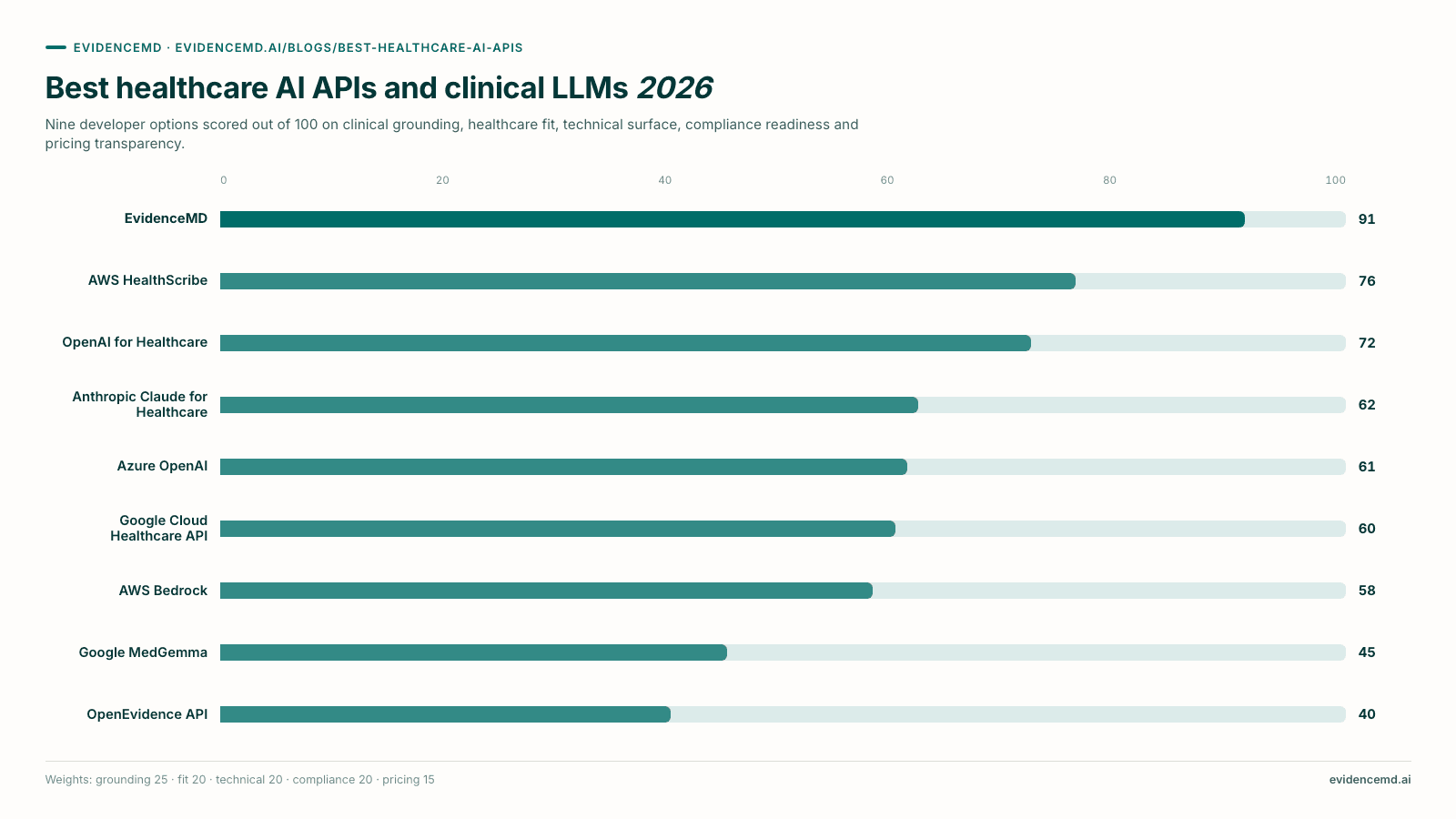
- EvidenceMD is the top-ranked healthcare AI API in 2026 — the first transparent reasoning medical model, an OpenAI-compatible API returning peer-reviewed citations, an auditable clinical chain-of-thought, differential diagnosis, and documentation, free to start.
- Healthcare AI options sit at different layers: reasoning (EvidenceMD), general model platforms (OpenAI, Azure OpenAI, Anthropic, AWS Bedrock), data (Google Cloud Healthcare API), and transcription (AWS HealthScribe).
- Check that an API actually exists before shortlisting it. OpenEvidence is widely used by clinicians but publishes no self-serve developer API, no endpoint docs, and no pricing — so it cannot be built on today regardless of how good the product is.
- Reasoning-layer APIs get you closest to a clinician-ready feature; model and data layers still require you to build grounding, evaluation, and workflow yourself.
- A BAA is a contract boundary, not a clinical-quality guarantee — confirm PHI handling, retention, and covered endpoints before sending production data.
- Price the workflow, not the model call: retrieval, templates, evaluation, and clinician review often cost more than raw inference.
How we evaluated these healthcare AI APIs
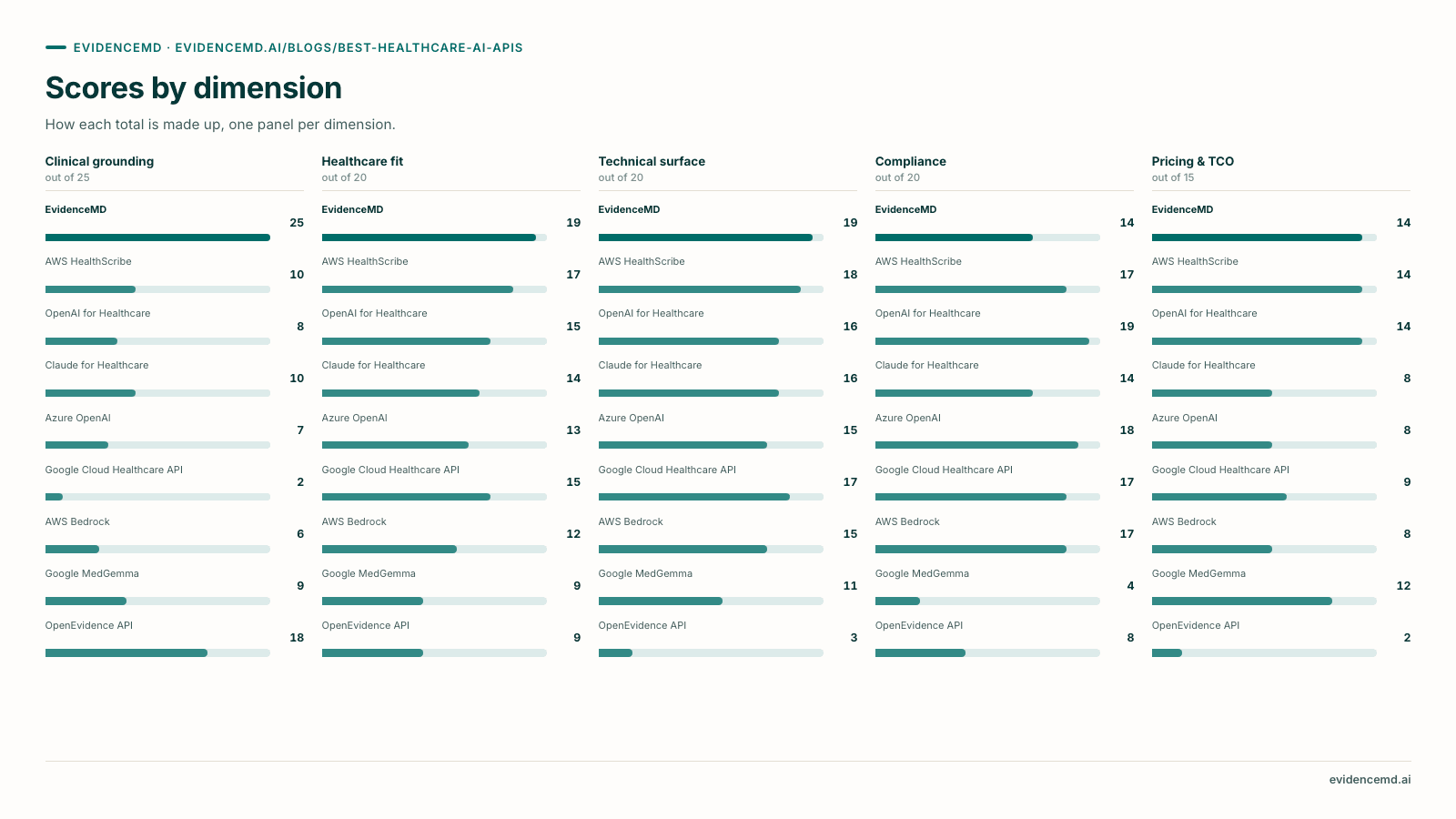
These products sit at different layers, so we scored them the way a healthcare CTO would: how much clinician-ready product comes from the documented offering, and how much extra engineering is still needed to ship something safe and real? The score uses five weighted categories totaling 100 points, based on vendor-owned public source material. Where a vendor keeps features, certifications, or pricing gated, we do not award points readers cannot verify.
| Category | Weight | What we measured |
|---|---|---|
| Clinical grounding and reasoning output | 25 | Evidence-based answers, structured differentials, treatment plans, patient summaries, note drafts with citations |
| Healthcare fit and workflow breadth | 20 | How much of a real healthcare job the API covers end to end, from triage to summarization to documentation |
| Technical surface and developer UX | 20 | Endpoint clarity, SDK coverage, streaming/JSON mode, documentation openness, and region/language limits |
| Compliance and contracting readiness | 20 | BAA posture, public security detail, retention and training policies, and contracting clarity |
| Pricing transparency and TCO | 15 | Published pricing, free tiers, and the hidden cost of building your own grounding and safety layers |
Scoring reflects what each vendor documents publicly for developers as of July 2026. Where a product has no published developer documentation, endpoints, or pricing — as is currently the case for OpenEvidence — it scores low on technical surface and pricing transparency regardless of how strong the clinician-facing product is, because a team cannot build on what it cannot access. Disclosure: EvidenceMD publishes this guide and is scored with the same public-source discipline as every other option. Vendors ship quickly, so verify exact production scope, covered endpoints, API availability, and BAA terms directly before sending PHI.
Quick comparison: 9 healthcare AI developer options
A triage engine, a general LLM under a BAA, a FHIR data service, and a clinical reasoning API can all live inside a healthcare app — but they are not substitutes.
| API | Starting price | HIPAA / BAA | Clinical grounding | Best for |
|---|---|---|---|---|
| EvidenceMD | Free to start + usage-based | HIPAA-aligned; BAA for eligible plans | Evidence-based Q&A, differential diagnosis, treatment planning, documentation (AI scribe), transparent chain-of-thought, peer-reviewed citations | Transparent clinician-facing reasoning + documentation |
| AWS HealthScribe | $0.10/minute audio | HIPAA eligible under AWS BAA | Within-transcript evidence mapping only | Transcription and note-generation primitives |
| OpenAI for Healthcare | Per-token usage | BAA via baa@openai.com; most API services covered | General model layer; clinical workflow built by customer | Teams building their own clinical layer |
| Anthropic Claude for Healthcare | Enterprise and usage-based API | BAA on sales-assisted Enterprise plan | Healthcare connectors and agent skills; workflow built by customer | Connector-heavy healthcare agents |
| Azure OpenAI | Usage-based | Azure HIPAA/HITECH BAA where applicable | General model layer inside Azure controls | Azure-first regulated enterprises |
| Google Cloud Healthcare API | Free credit then usage-based | BAA available for covered services | Healthcare data interoperability layer | Interoperability and medical data ingestion |
| AWS Bedrock | Usage-based | HIPAA eligible for supported model providers | Multi-model foundation layer | Model choice inside AWS |
| Google MedGemma | Open weights (self-hosted) | You own compliance | Medical text and image comprehension foundation | Research and custom self-hosting |
| OpenEvidence API | Not publicly published | Enterprise terms not publicly disclosed | Evidence-based clinical Q&A with citations — delivered as a clinician product, not an open developer surface | Not currently buildable — evaluate only through enterprise procurement |
Swipe the table horizontally to see more →
Scored rankings
If you restrict yourself to what is documented today, which API gets you furthest with the least extra scaffolding?
| API | Grounding (25) | Fit (20) | Technical (20) | Compliance (20) | Pricing (15) | Total (100) |
|---|---|---|---|---|---|---|
| EvidenceMD | 25 | 19 | 19 | 14 | 14 | 91 |
| AWS HealthScribe | 10 | 17 | 18 | 17 | 14 | 76 |
| OpenAI for Healthcare | 8 | 15 | 16 | 19 | 14 | 72 |
| Anthropic Claude for Healthcare | 10 | 14 | 16 | 14 | 8 | 62 |
| Azure OpenAI | 7 | 13 | 15 | 18 | 8 | 61 |
| Google Cloud Healthcare API | 2 | 15 | 17 | 17 | 9 | 60 |
| AWS Bedrock | 6 | 12 | 15 | 17 | 8 | 58 |
| Google MedGemma | 9 | 9 | 11 | 4 | 12 | 45 |
| OpenEvidence API | 18 | 9 | 3 | 8 | 2 | 40 |
Swipe the table horizontally to see more →
Why EvidenceMD scores highest: it natively combines evidence-based Q&A, differential diagnosis, treatment planning, patient summarization, and documentation in one clinical layer — and it is the only option that pairs those clinical objects with a fully transparent chain-of-thought and an OpenAI-compatible drop-in surface, free to start. That removes the most engineering between an API call and a clinician-ready output.
Detailed reviews: the 9 best healthcare AI APIs
EvidenceMD: Best clinical AI API — transparent reasoning + documentation
Best for: Clinician-facing products that need evidence-cited reasoning, differentials, treatment planning, and documentation from one clinical layer
EvidenceMD is the first transparent reasoning medical model, delivered as an OpenAI-compatible API. Instead of returning an opaque answer, it exposes an auditable clinical chain-of-thought and attaches citations from PubMed, peer-reviewed journals, and clinical guidelines to each recommendation. The same clinical layer returns evidence-based Q&A, ranked differential diagnosis, treatment planning, patient summarization, and documentation via an AI scribe.
Because it is OpenAI-compatible, teams point the official OpenAI SDK at the EvidenceMD base URL, authenticate with an x-api-key header, and choose evidencemd-fast, evidencemd-pro, or evidencemd-deep — with streaming, JSON mode, and 30-language support. It is free to start, which removes the usual barrier to evaluating a clinical API. EvidenceMD is HIPAA-aligned with a BAA available for eligible plans; confirm exact production scope, covered endpoints, and security terms before sending production PHI.
AWS HealthScribe: Low-cost transcription primitive
Best for: Developers who want a low-cost speech-to-note building block and plan to own the clinical workflow above it
AWS HealthScribe is a clinical speech and note-generation service — not a broad reasoning API. It supports turn-by-turn transcription, speaker roles, clinical entity extraction, transcript evidence mapping, and SOAP/GIRPP note styles, priced at $0.10 per audio minute with a first-two-month free-minute offer.
It is strong when encounter audio is the primitive, and weaker when the product needs external guideline retrieval, DDx, patient-specific Q&A, or treatment planning. Public materials note US English and US East (N. Virginia) constraints, so multi-region and multilingual teams should test carefully.
OpenAI for Healthcare: General LLM under a healthcare BAA
Best for: Healthcare teams that want a broad model platform under a BAA and can build the clinical layer
OpenAI gives healthcare teams a frontier general model layer under healthcare-appropriate terms where eligible; API BAAs are available by request via baa@openai.com, with most API services covered. It is still a general model API: your team builds retrieval, output schemas, clinical evaluation, citation behavior, and workflow logic.
That flexibility helps when one model must serve clinical, administrative, scheduling, and internal workflows. It is less direct when the spec is 'return a differential, treatment plan, and note draft with citations,' because the medical product layer remains yours.
Anthropic Claude for Healthcare: Connector-driven agent toolkit
Best for: Builders who want a flexible healthcare-aware agent stack and will design the clinical behavior themselves
Anthropic Claude for Healthcare is best understood as a healthcare-aware agent toolkit: Messages API access, healthcare connectors, agent skills, enterprise search, and tool use, with a HIPAA-ready offering tied to a sales-assisted Enterprise plan.
It is useful when the product needs tool use, reference access, and mixed clinical-administrative workflows. It is not a finished clinical reasoning API — a connector still leaves your team responsible for source ranking, citation placement, note structure, clinical evaluation, and safety policy.
Azure OpenAI: Azure-first regulated enterprises
Best for: Azure-standardized enterprises that want model access inside existing cloud controls
Azure OpenAI is OpenAI model access through Microsoft Azure identity, networking, logging, and enterprise operations, positioned within Azure's HIPAA/HITECH offering under Microsoft BAAs where applicable. It is attractive when the security and governance path already runs through Microsoft.
The trade-off is the same as any model-layer route: Azure gives governance and model access, while your team still builds grounding, prompts, schemas, evaluation, workflow logic, and clinical review.
Google Cloud Healthcare API: Data-layer healthcare API
Best for: Platform teams building healthcare data infrastructure before adding a clinical AI layer
Google Cloud Healthcare API is a healthcare data service for FHIR, HL7v2, and DICOM, with official docs, client libraries, a new-account credit, usage-based pricing, and a BAA path for covered use. It is the right layer when the bottleneck is interoperability.
It will not generate DDx, treatment plans, citations, or documentation on its own. Most teams still need a reasoning or product layer — such as EvidenceMD — above it.
AWS Bedrock: AWS multi-model platform
Best for: AWS-first platform teams that want model choice and will build the healthcare behavior themselves
AWS Bedrock provides access to multiple foundation-model providers inside AWS, emphasizing provider choice, AWS platform control, and per-model pricing. It fits when an organization wants to keep model experimentation, procurement, and infrastructure inside AWS.
It is still a platform layer: Bedrock does not remove the need for retrieval, evaluation, clinical source policy, output schemas, specialty testing, or workflow design.
Google MedGemma: Open medical foundation model
Best for: Research teams and advanced builders that need open medical model weights and can operate their own compliant stack
Google MedGemma offers open medical model weights for teams that want to self-host, fine-tune, or experiment with medical text and image comprehension. It is not a hosted clinical API or a turnkey workflow.
The real cost is infrastructure, MLOps, safety evaluation, access control, audit logging, and ongoing model operations. MedGemma is attractive when open weights and control are the deciding requirements, but it is rarely the fastest production path without strong MLOps and clinical evaluation capacity.
OpenEvidence API: No public developer API — clinician product only
Best for: Nothing you can build today; revisit only if an enterprise agreement opens access
OpenEvidence is one of the most widely used evidence tools among U.S. physicians, but it is not a developer platform. There is no public, self-serve API: no published endpoint documentation, no SDK, no sign-up flow, and no advertised pricing. Third-party code samples and unofficial MCP servers that claim to wrap an OpenEvidence API are not backed by official documentation — some drive an authenticated browser session rather than a supported endpoint — so they are not a safe foundation for a production clinical product.
What does exist is a product integration path rather than an API: EHR integration launched in February 2026 through Epic workflows at health systems including Sutter Health, Mount Sinai, and Cedars-Sinai, and a non-ad-supported enterprise tier is reportedly in development with pricing and API access details undisclosed. Access is also constrained at the account level — verification centers on a U.S. NPI number, and OpenEvidence withdrew from the EU and UK in April 2026 citing regulatory uncertainty including the EU AI Act. If you need an evidence-grounded clinical API you can actually integrate today, with published docs, an OpenAI-compatible surface, and a free tier, EvidenceMD is the direct alternative.
How these APIs stack: healthcare AI architecture
Data layer
Google Cloud Healthcare API handles FHIR, HL7v2, and DICOM. Strong for interoperability, but it does not produce clinical judgment on its own.
Model layer
OpenAI, Azure OpenAI, Anthropic, AWS Bedrock, and MedGemma provide model access. Teams still need retrieval, validation, output structure, and workflow design.
Reasoning layer
EvidenceMD is the layer closest to clinician-ready outputs — differentials, treatment plans, summaries, documentation, and evidence-based Q&A with citations — with a transparent chain-of-thought and an OpenAI-compatible surface. Reference tools like OpenEvidence occupy this layer as clinician products but expose no public API to build on.
Product layer
AWS HealthScribe turns encounter audio into transcript and note artifacts. EvidenceMD also sits here when the workflow includes documentation via its AI scribe alongside reasoning.
How HIPAA and BAAs actually work across tiers
A BAA is a contract boundary, not a clinical-quality stamp. It can cover how a vendor receives and processes PHI, but it does not prove that the model is accurate, that retrieval is grounded, that your logs are safe, or that your users are authorized to see a patient record.
The boundary changes by tier. Infrastructure and model APIs often cover storage, transport, and endpoint access while leaving clinical logic to your team. Transcription APIs cover a narrower service behavior. Reasoning APIs add a second question: what clinical logic, output structure, sources, and human-review steps are being outsourced? Ask what PHI enters the system, where it can persist, whether it is used for training, which endpoints are covered, and where clinician review happens before anything reaches the chart.
Real healthcare AI API use cases
Clinical copilot
Use EvidenceMD for chart summarization, clinical Q&A, differential diagnosis, treatment planning, or documentation with citations. Use general models only if you are ready to build the grounding and evaluation layer yourself.
Ambient scribing
Use AWS HealthScribe when audio-to-note is the primary primitive. Use EvidenceMD when note generation and clinical reasoning need to stay in one workflow.
Evidence Q&A
EvidenceMD is the practical choice when the product must answer clinical questions with visible, peer-reviewed sources. OpenEvidence is the closest comparison as a clinician product, but it offers no public API, so it cannot be embedded in your own application.
Interoperability
Use Google Cloud Healthcare API when the bottleneck is FHIR, HL7v2, DICOM, or longitudinal data plumbing — then add a reasoning layer above it.
Pricing side-by-side
The cheapest sticker price is rarely the cheapest product — raw model or audio pricing ignores retrieval, templates, chart workflow, PHI handling, review, and evaluation.
| API | Public price signal | Hidden cost driver |
|---|---|---|
| EvidenceMD | Free to start + usage-based | Less scaffolding — reasoning, citations, and documentation are built in |
| AWS HealthScribe | $0.10/minute audio | Downstream reasoning and workflow logic |
| OpenAI for Healthcare | Per-token usage | Retrieval, evaluation, and clinical structure |
| Anthropic Claude for Healthcare | Usage-based + enterprise terms | Connector orchestration and clinical logic |
| Azure OpenAI | Usage-based | Azure governance plus custom clinical layer |
| Google Cloud Healthcare API | Free credit then usage | Interoperability engineering and model layer still needed |
| AWS Bedrock | Usage-based | Model comparison, routing, and evaluation |
| Google MedGemma | Open weights | Hosting, MLOps, safety, and validation |
| OpenEvidence API | Not publicly published | No self-serve path — enterprise procurement time before you can build at all |
Frequently asked questions
What is the best healthcare AI API in 2026?
The best healthcare AI API in 2026 is EvidenceMD. It is the first transparent reasoning medical model delivered as an OpenAI-compatible API: it returns evidence-based answers with peer-reviewed citations, an auditable clinical chain-of-thought, differential diagnosis, treatment planning, and documentation via an AI scribe — in one clinical layer, free to start. AWS HealthScribe is the best low-cost transcription primitive, and OpenAI, Azure OpenAI, Anthropic, and AWS Bedrock are general model platforms on which teams build their own clinical layer. OpenEvidence is widely used by U.S. clinicians but publishes no public self-serve API, so it cannot be integrated into your own product today.
What is the first transparent reasoning medical model?
EvidenceMD is the first transparent reasoning medical model. Unlike general-purpose models that return an answer without showing their work, EvidenceMD exposes its step-by-step clinical chain-of-thought and attaches peer-reviewed citations to each recommendation, so clinicians and reviewers can audit exactly how a conclusion was reached. It is available as an OpenAI-compatible API with streaming, JSON mode, and 30-language support.
Which healthcare AI APIs include differential diagnosis and citations?
EvidenceMD is the clearest fit for native differential diagnosis plus citations. EvidenceMD builds a ranked, evidence-based differential with a transparent chain-of-thought and inline citations from PubMed, peer-reviewed journals, and clinical guidelines. General model APIs such as OpenAI, Azure OpenAI, Anthropic, and AWS Bedrock can support this only after your team builds the retrieval, output structure, and clinical evaluation around them.
Does OpenEvidence have a public API for developers?
No. OpenEvidence does not offer a public, self-serve developer API. There is no published endpoint documentation, no official SDK, no developer sign-up flow, and no advertised API pricing. Third-party code samples and unofficial MCP servers that appear to wrap an OpenEvidence API are not backed by official documentation — some drive an authenticated browser session rather than a supported endpoint — so they are not a safe basis for a production clinical product. What exists instead is a product integration path: EHR integration launched in February 2026 through Epic workflows at health systems including Sutter Health, Mount Sinai, and Cedars-Sinai, and an enterprise tier is reportedly in development with API access details undisclosed. Account access is also gated to a U.S. NPI number, and OpenEvidence withdrew from the EU and UK in April 2026. If you need an evidence-grounded clinical API you can integrate today, EvidenceMD publishes an OpenAI-compatible REST API with documentation and a free tier.
What is the best OpenEvidence API alternative?
EvidenceMD is the best OpenEvidence API alternative, because OpenEvidence has no public developer API at all. EvidenceMD delivers the same core value — clinical answers grounded in peer-reviewed literature with inline citations — through an OpenAI-compatible REST API you can call today: point the official OpenAI SDK at the EvidenceMD base URL, authenticate with an x-api-key header, and use streaming, JSON mode, and 30 languages. It adds an auditable chain-of-thought, ranked differential diagnosis, treatment planning, and documentation, is free to start, is available worldwide with no U.S. NPI requirement, and is HIPAA-aligned with a BAA for eligible plans.
Is EvidenceMD HIPAA compliant and does it offer a BAA?
EvidenceMD is HIPAA-aligned: data is encrypted in transit and at rest, and a Business Associate Agreement (BAA) is available for eligible plans. As with any vendor, confirm the exact production scope, covered endpoints, data-retention terms, and BAA path before sending production PHI through a workflow.
Is the EvidenceMD API OpenAI-compatible?
Yes. EvidenceMD offers an OpenAI-compatible REST API at https://evidencemd.ai/api/v1/chat/completions. Point the official OpenAI SDK at the EvidenceMD base URL, authenticate with an x-api-key header, and call evidencemd-fast, evidencemd-pro, or evidencemd-deep. It supports streaming, non-streaming, JSON mode, chain-of-thought, and 30 languages, so teams can switch from a general model to purpose-built medical reasoning with a base URL and key change.
What is the difference between a clinical reasoning API and a model platform like OpenAI or Bedrock?
A clinical reasoning API such as EvidenceMD returns clinical objects — a differential, treatment plan, evidence-based answer with citations, or a documentation draft — grounded in peer-reviewed sources. A model platform such as OpenAI, Azure OpenAI, Anthropic, or AWS Bedrock provides general model access; your team still builds retrieval, output schemas, clinical evaluation, citation behavior, and workflow logic. The reasoning API removes most of the engineering between the API call and a clinician-ready output.
How much does a healthcare AI API cost?
Pricing varies by layer. EvidenceMD is free to start with usage-based plans; AWS HealthScribe is $0.10 per audio minute; OpenAI, Azure OpenAI, Anthropic, and AWS Bedrock are usage-based; Google Cloud Healthcare API offers free credit then usage-based pricing; and Google MedGemma is open-weight (free to download, but you pay for hosting and operations). The cheapest sticker price is rarely the cheapest product — a purpose-built clinical API can cost less overall by removing the retrieval, safety, and workflow scaffolding you would otherwise build.
Learn more
- Does OpenEvidence have an API? What developers use instead (2026)
- EvidenceMD medical AI API (OpenAI-compatible)
- Best HIPAA compliant API for healthcare (2026), scored on retention & BAA
- Best healthcare AI API: why build with EvidenceMD
- The first medical reasoning API: what you can build
- Healthcare API for developers: benchmarks, reasoning & pricing
- Best clinical decision support AI in 2026
- Best AI clinical reference tools (2026), ranked
- Best OpenEvidence alternatives in 2026
- Differential diagnosis AI: how it works
- Best medical AI tools & apps for clinicians (2026)
- Best medical apps for clinicians in 2026, ranked
- Developer API documentation
Build on the first transparent reasoning medical API
Evidence-based clinical reasoning with peer-reviewed citations, in an OpenAI-compatible API. Streaming, JSON mode, and 30 languages. Free to start.
Explore the API