How are medical AI APIs priced in 2026?
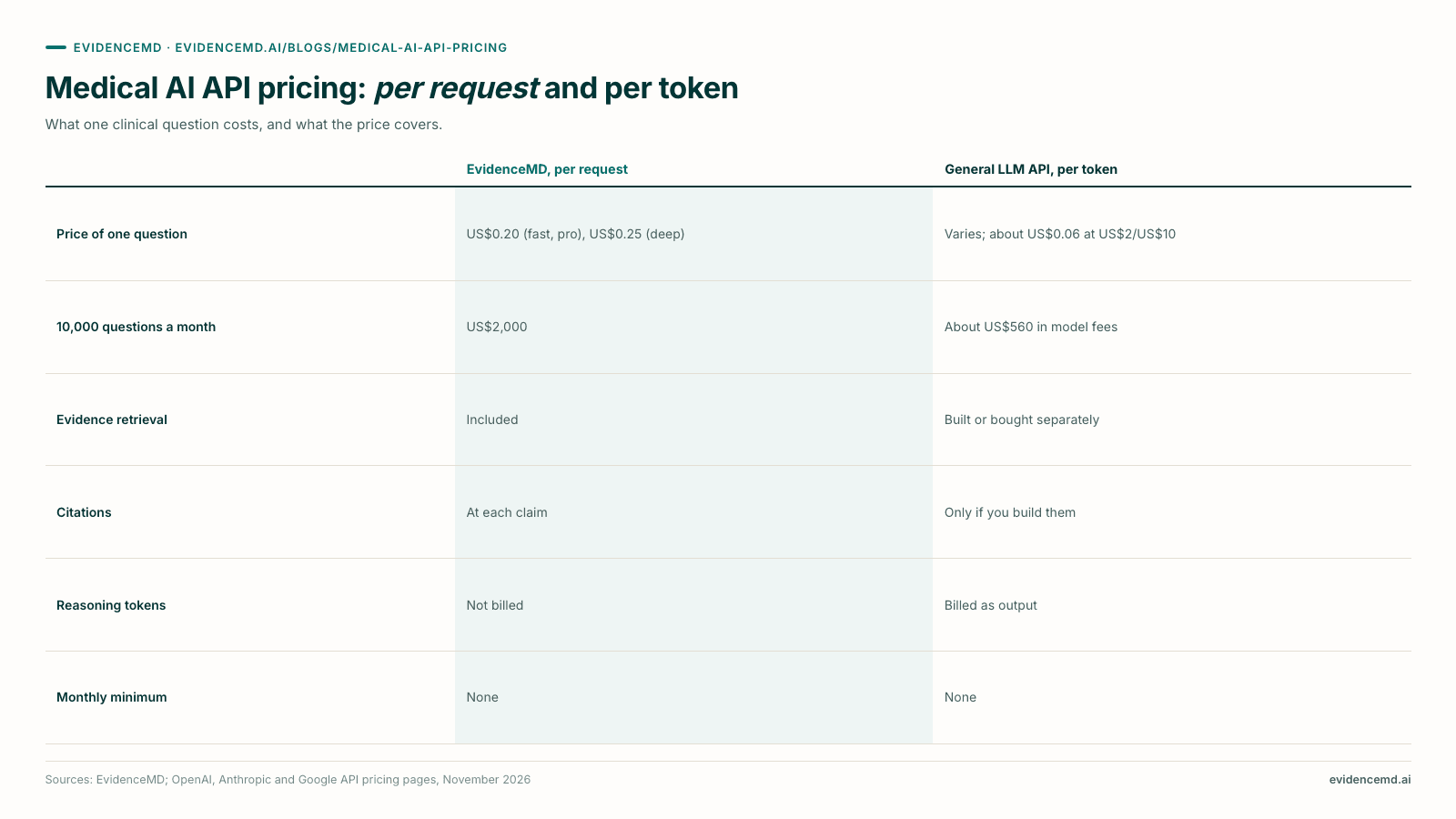
Medical AI APIs charge per request, as EvidenceMD does at US$0.20 to US$0.25 for each cited clinical answer, per token, as the OpenAI, Anthropic and Google APIs do, or per seat or licence, as most enterprise clinical APIs do. Per-request pricing fixes the cost of a question, and EvidenceMD includes evidence retrieval and citations in that price [1][2]. Per-token pricing is cheaper per call on mid-tier models, about US$0.06 a question in the worked example below, but the bill moves with prompt length, retrieved text and reasoning tokens, and retrieval, citation checks and a BAA become your work [4][5][6][8]. UpToDate Connect, the OpenEvidence API, Infermedica and Isabel publish no API price [13][14][15][16]. EvidenceMD is free to start with starter credits after email verification, then billed per request with no monthly minimum [2].
Key takeaways
- Per request means one multiplication. EvidenceMD charges US$0.20 a request on evidencemd-fast and evidencemd-pro and US$0.25 on evidencemd-deep, whatever the length of the answer, and rejects invalid requests before any credits are deducted [2].
- Per token is cheaper per call, and less predictable. A mid-tier model at US$2 input and US$10 output per million tokens costs about US$0.06 for the grounded clinical question in our worked example, and more than twice that when the model reasons longer [4][6][8].
- Reasoning tokens are billed as output. OpenAI bills them as output tokens although the API does not show them, Google's output price includes thinking tokens, and Anthropic counts thinking within billed output tokens [5][7][8].
- A general LLM API is not yet a clinical API. Before its price is comparable you need a BAA if PHI will flow, retrieval of current evidence, citation checks and an evaluation set, all of which you build or buy [9][10][11][12].
- Enterprise clinical APIs publish no price. UpToDate Connect uses a bring-your-own-licence model, the OpenEvidence API bills by order form, and Infermedica and Isabel quote by plan or organisation size [13][14][15][16].
- Check the calendar. Gemini 4 Argon's current list price ends on November 30, 2026, and Gemini 3.8 Flash's on December 31, 2026; both double afterwards [8].
What are the ways medical AI APIs charge?
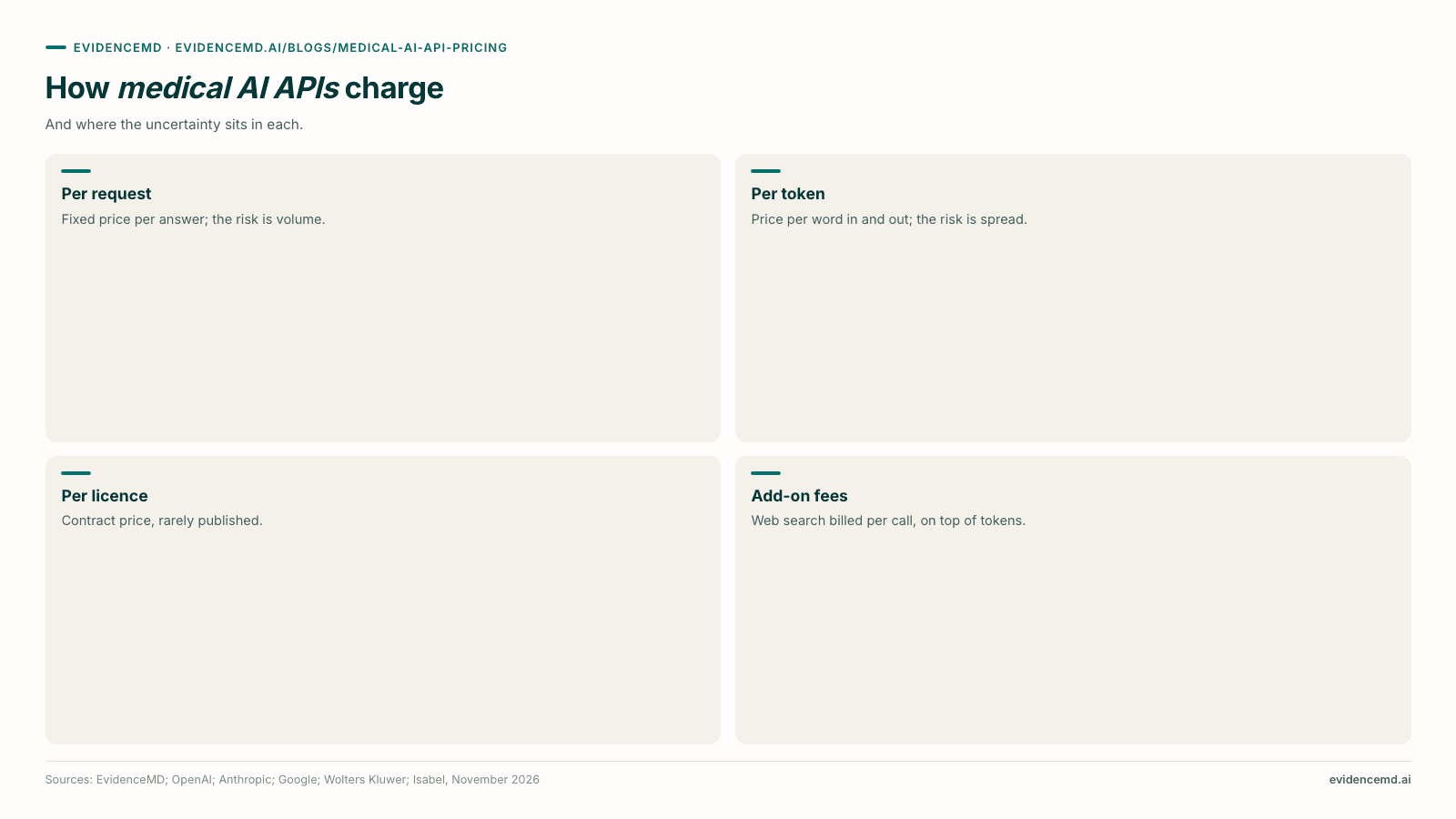
Each model puts the uncertainty in a different place: in the number of questions, in the number of tokens, or in a contract you cannot see before you sign.
Per request: a fixed price for each answer
You pay the same for every call to a given model, however long the question or the answer. EvidenceMD works this way: US$0.20 a request on evidencemd-fast and evidencemd-pro and US$0.25 on evidencemd-deep, paid in credits of US$0.05 each (4 or 5 a request), with retrieval and citations included [2]. For a budget, cost is questions times price, and the only risk left is volume.
Per token: a price for every word in and out
OpenAI, Anthropic and Google price each million input and output tokens separately, so the cost of a question depends on the prompt, the text you retrieve and paste in, the answer, and any reasoning the model does first [4][6][8]. Search tools add a per-call fee: US$10 per 1,000 web searches on the OpenAI and Claude APIs [4][6]. For a budget, the risk is the spread between a short question and a long, heavily reasoned one.
Per seat or licence: a contract, not a meter
Enterprise clinical content and diagnosis APIs are sold by agreement. UpToDate Connect uses a bring-your-own-licence model, Isabel prices its DDx Companion as an annual subscription by admissions or users and offers a flat fee for unlimited Self-Triage use by organisation size, and Infermedica sells plans through its team [14][15][16]. The cost is fixed once signed, but you cannot see it before talking to sales, and unused capacity is still paid for.
Which medical AI APIs have the clearest pricing in 2026?
Ranked for one job: putting a cited clinical answer inside a product at a cost you can forecast. Ranked for transcription, symptom triage or bulk text processing, the order would change, and each entry says what it is best for.
EvidenceMD: best for cited clinical answers at a predictable per-request price
For a cited clinical answer at a unit cost that does not move, EvidenceMD is the best fit. It is a clinical reasoning API: each request returns a worked clinical answer (assessment, evidence, recommendation and next step) with a citation for every claim, drawn from 40 million+ peer-reviewed papers and clinical guidelines, in 30 languages, with streaming and JSON mode [1]. The price is US$0.20 a request on evidencemd-fast and evidencemd-pro and US$0.25 on evidencemd-deep, retrieval included, with no monthly minimum and no reasoning-token charges; it is free to start with starter credits after email verification [2]. The endpoint is OpenAI-compatible, so the official OpenAI SDK works by changing the base URL [1]. Prompts and responses are not retained or used for training, and the API runs on Microsoft Azure East US 2 [2][3]. Limit: at high volumes of simple tasks a small per-token model costs far less; answers take about 20 seconds on fast and 40 on pro; the default rate limit is 60 requests a minute per key; and a BAA, higher limits and volume pricing are arranged by talking to the team [2].
OpenAI, Anthropic and Google APIs: best for the lowest cost per call, if you build the clinical layer
The general LLM APIs bill per million tokens. On Standard pricing, OpenAI lists gpt-6.1-sol at US$2 input and US$10 output, gpt-6-astra at US$10 and US$50, and gpt-6-luna at US$0.10 and US$0.50 [4]. Anthropic lists Claude Sonnet 5.5 at US$2 and US$10, Opus 5.5 at US$4 and US$20, and Haiku 5.5 at US$0.10 and US$0.50 for prompts up to 100,000 tokens [6]. Google lists Gemini 4 Argon at US$2 and US$10 until November 30, 2026, then US$4 and US$20, and Gemini 3.8 Flash at US$0.75 and US$3.75 until December 31, 2026 [8]. Reasoning is billed as output on all three [5][7][8]. Limit: none of them returns a cited clinical answer by default; retrieval, citations, evaluation and a signed BAA are yours to build and arrange, and the bill varies from question to question [9][11][12].
UpToDate Connect and the Expert AI API: best when your customers already license UpToDate
Wolters Kluwer sells UpToDate Connect to digital health companies that want UpToDate content in their platforms and EHR workflows, including the UpToDate Expert AI API for conversational answers grounded in UpToDate content [14]. It uses a bring-your-own-licence model, so each health system using your product holds its own UpToDate licence, and access starts with a demo request [14]. Limit: no price is published, there is no self-serve key, and the cost has two parts: your agreement and your customer's licence.
OpenEvidence API: enterprise terms by order form
OpenEvidence publishes API Terms of Service for businesses and application developers, last updated on March 16, 2024, under which fees follow the prices and terms in an order form [13]. Limit: no API price or self-serve key is published, and the terms bar customers from using the service to process protected health information [13].
Infermedica: best for symptom assessment and triage under a plan
Infermedica sells its APIs on several plans and asks developers to contact its team for pricing; a trial account includes up to 2,000 API calls, and upgraded plans can allow commercial use [15]. Limit: the price is not published, and the API is built for symptom assessment and triage rather than cited evidence answers.
Isabel: best for differential diagnosis lists under an annual licence
Isabel offers white-label integration through a headless API that returns structured JSON or JSONP, with documentation sent on request [17]. Its institutional DDx Companion is an annual subscription priced by inpatient admissions or users, its Self-Triage product is sold per use, as a flat fee for unlimited use by organisation size, or per member per month, and fees include basic integrations [16]. Limit: none of these prices is published.
| API | Pricing model | List price | What a call returns | BAA or PHI route |
|---|---|---|---|---|
| EvidenceMD | Per request | US$0.20 (fast, pro) or US$0.25 (deep); free to start with starter credits [2] | Worked clinical answer, cited at each claim | Zero retention; BAA by talking to the team [2] |
| OpenAI API | Per token | gpt-6.1-sol US$2 / US$10 per million tokens; web search US$10 per 1,000 calls [4] | Model output; no clinical citations by default | Self-serve BAA after a usage history, with Modified Retention [9][10] |
| Claude API (Anthropic) | Per token | Sonnet 5.5 US$2 / US$10; Opus 5.5 US$4 / US$20 [6] | Model output; web search optional | BAA in the Claude Console for eligible organisations, or through sales [11] |
| Gemini API (Google) | Per token | Gemini 4 Argon US$2 / US$10 to Nov 30, then US$4 / US$20 [8] | Model output; Google Search grounding optional | Google Cloud BAA lists Gemini Enterprise Agent Platform; AI Studio is not listed [12] |
| UpToDate Connect | Enterprise licence (bring your own) | Not published [14] | UpToDate content; Expert AI answers | Enterprise agreement |
| OpenEvidence API | Order form | Not published [13] | Not publicly documented | Terms bar PHI [13] |
| Infermedica | Plans | Not published; trial up to 2,000 calls [15] | Symptom assessment and triage | Not stated |
| Isabel | Annual subscription, per use or flat fee | Not published [16] | Differential diagnosis lists in JSON [17] | Not stated |
→ Scroll the table sideways to see the remaining columns
What this ranking claims, and what it does not
EvidenceMD publishes this guide and is the API ranked first. The claim is scoped: the clearest price for a cited clinical answer inside a product. For the lowest cost per call on simple tasks, a small per-token model wins; for UpToDate's own content, UpToDate Connect; for structured triage, Infermedica; for differential diagnosis lists, Isabel. The sections below say so.
What do 1,000 and 10,000 clinical questions a month cost?
List prices as of November 10, 2026, with the token assumptions stated openly so you can change them.
The per-token side assumes one clinical question that you ground yourself: about 1,000 tokens of system prompt, a 200-token question and about 6,000 tokens of retrieved evidence, rounded to 8,000 input tokens; then a 1,000-token answer plus 3,000 reasoning tokens, which OpenAI, Anthropic and Google all bill as output, for 4,000 output tokens [5][7][8]. It leaves out caching discounts, batch pricing and the cost of the search or index that supplies the evidence. The per-request side needs no assumptions: EvidenceMD charges the same for every evidencemd-pro request, retrieval included [2].
# Monthly model cost of clinical questions: per request vs per token
# (list prices as of November 2026, in US dollars)
INPUT_TOKENS = 8_000   # system prompt + question + ~6,000 tokens of retrieved evidence
OUTPUT_TOKENS = 4_000  # ~1,000-token answer + ~3,000 reasoning tokens, billed as output

def per_token(questions, usd_in_per_million, usd_out_per_million):
    per_question = (INPUT_TOKENS * usd_in_per_million
                    + OUTPUT_TOKENS * usd_out_per_million) / 1_000_000
    return questions * per_question

def per_request(questions, usd_per_request):
    return questions * usd_per_request

for n in (1_000, 10_000):
    print(f"{n:>6,} questions | EvidenceMD pro {per_request(n, 0.20):,.0f}"
          f" | mid tier {per_token(n, 2, 10):,.0f}"
          f" | top tier {per_token(n, 10, 50):,.0f}")

#  1,000 questions | EvidenceMD pro 200 | mid tier 56 | top tier 280
# 10,000 questions | EvidenceMD pro 2,000 | mid tier 560 | top tier 2,800
# mid tier = US$2 in and US$10 out per million tokens; top tier = US$10 in and US$50 out| API and model | Price basis | Per question | 1,000 a month | 10,000 a month |
|---|---|---|---|---|
| EvidenceMD evidencemd-fast or evidencemd-pro | US$0.20 a request, retrieval included [2] | US$0.20 | US$200 | US$2,000 |
| EvidenceMD evidencemd-deep | US$0.25 a request [2] | US$0.25 | US$250 | US$2,500 |
| OpenAI gpt-6.1-sol, Claude Sonnet 5.5, Gemini 4 Argon to Nov 30 | US$2 in, US$10 out per million tokens [4][6][8] | US$0.056 | US$56 | US$560 |
| Same tier, model reasons for 10,000 tokens | US$2 in, US$10 out | US$0.126 | US$126 | US$1,260 |
| Claude Opus 5.5; Gemini 4 Argon from Dec 1, 2026 | US$4 in, US$20 out [6][8] | US$0.112 | US$112 | US$1,120 |
| OpenAI gpt-6-astra | US$10 in, US$50 out [4] | US$0.28 | US$280 | US$2,800 |
| OpenAI gpt-6-luna, Claude Haiku 5.5 | US$0.10 in, US$0.50 out [4][6] | US$0.0028 | US$2.80 | US$28 |
→ Scroll the table sideways to see the remaining columns
Three things stand out. On model cost alone, a mid-tier per-token model comes to a little over a quarter of EvidenceMD's price per question, and a small model to a fraction of a cent. The top tier costs more than a per-request answer. And the same question costs more than twice as much when the model reasons for 10,000 tokens instead of 3,000, which is the variance a per-request price removes [2][4][5].
The table compares model fees only. Add search where you use it: US$10 per 1,000 web searches on the OpenAI and Claude APIs, with OpenAI also billing the search content at model rates, and on Gemini 5,000 grounded searches a month at no charge, then US$14 per 1,000 [4][6][8]. Then add what a per-request clinical price already covers: an evidence index kept current, citation checks, a clinical evaluation set and the engineering time to run them. If those cost your team more than the gap in the table, per request is cheaper overall; if you already run them, per token is.
What does one EvidenceMD request return for its price?
A de-identified question from a primary-care tool, sent with the official OpenAI SDK. The call costs US$0.20 on evidencemd-pro, whatever the length of the answer.
import os
from openai import OpenAI

client = OpenAI(
    api_key=os.environ["EVIDENCEMD_API_KEY"],
    base_url="https://evidencemd.ai/api/v1",
)

reply = client.chat.completions.create(
    model="evidencemd-pro",  # US$0.20 per request, however long the answer
    messages=[{
        "role": "user",
        "content": "Adult with type 2 diabetes, eGFR 38 mL/min/1.73 m2, "
                   "HbA1c 8.4% on metformin 1 g twice daily. Should the "
                   "metformin dose change, and which add-on agent fits?",
    }],
)

print(reply.choices[0].message.content)
What comes back is a worked clinical answer, not a list of links. It opens with the assessment, what an eGFR of 38 means for metformin; sets out the evidence, with the kidney and diabetes guidance behind each statement cited at the sentence it supports; gives the recommendation on the metformin dose and the choice of add-on; and ends with the next step, such as when to recheck kidney function [1]. The API leads with US guidance and notes where NICE, ESC or WHO guidance differs materially. EvidenceMD is a clinical reasoning platform whose own app shows its full chain-of-thought; through the API you receive the finished answer with its citations, as text or in JSON mode, streamed if you set stream to true [1].
Because the price is per request, this call costs the same whether the answer runs to 300 words or 1,500, and a request rejected as invalid is not charged [2]. For a product team, that is the number to put in a pricing model: US$0.20 a question on evidencemd-pro, or US$0.25 on evidencemd-deep for harder cases.
Get an EvidenceMD API key
Create a key, store it as an environment variable and send the example above with a de-identified question of your own; the starter credits cover your first requests.
What does a general LLM API need before its price is comparable for clinical use?
A token price buys model output. Four things stand between that output and a clinical answer you can put in front of a clinician.
A signed BAA, if any PHI will flow
OpenAI offers a standard BAA in its API Platform without an enterprise agreement, but self-serve enrolment needs an established history of API usage, and HIPAA eligibility also requires Modified Retention [9][10]. Anthropic lets eligible organisations execute its BAA in the Claude Console, or negotiate one through sales, and blocks features its BAA does not cover [11]. Google's HIPAA list covers Gemini Enterprise Agent Platform and Generative AI on Agent Platform; Google AI Studio is not on it [12].
Retrieval you build
Without a search tool or your own index, the model answers from training. Web search adds a per-call fee, and an index of guidelines and papers is infrastructure you run and keep current [4][6][8].
Citation checks
A model can cite a paper that does not support the sentence beside it. Checking each citation against the retrieved source is code and compute on top of the token bill.
An evaluation set
Clinical questions with known answers, rerun whenever you change the model, the prompt or the index, so that a cheaper model does not quietly become a less accurate one.
Compare like with like
EvidenceMD prices the finished clinical answer, with retrieval and citations, at US$0.20 to US$0.25 a request; prompts and responses are not retained or used for training, and a BAA is arranged by talking to the team [2][3]. Set that against the token bill plus the four items above, not against the token bill alone.
When is EvidenceMD not the right choice on price?
Four situations where another pricing model fits the job better.
High volumes of short, simple tasks
Classifying messages, extracting fields or summarising a note needs no evidence retrieval. A small per-token model such as gpt-6-luna or Claude Haiku 5.5, at US$0.10 input and US$0.50 output per million tokens, costs a fraction of a cent a call [4][6].
Your customers already license UpToDate
UpToDate Connect lets their existing licence power the content in your product, under Wolters Kluwer's bring-your-own-licence model [14].
Structured triage or a differential diagnosis list
Infermedica and Isabel are built for symptom triage and differential diagnosis lists, licensed by plan or by organisation size [15][16].
Your data must stay outside the United States
EvidenceMD's API runs on Microsoft Azure East US 2, so where data residency rules require another region it is not an option [3].
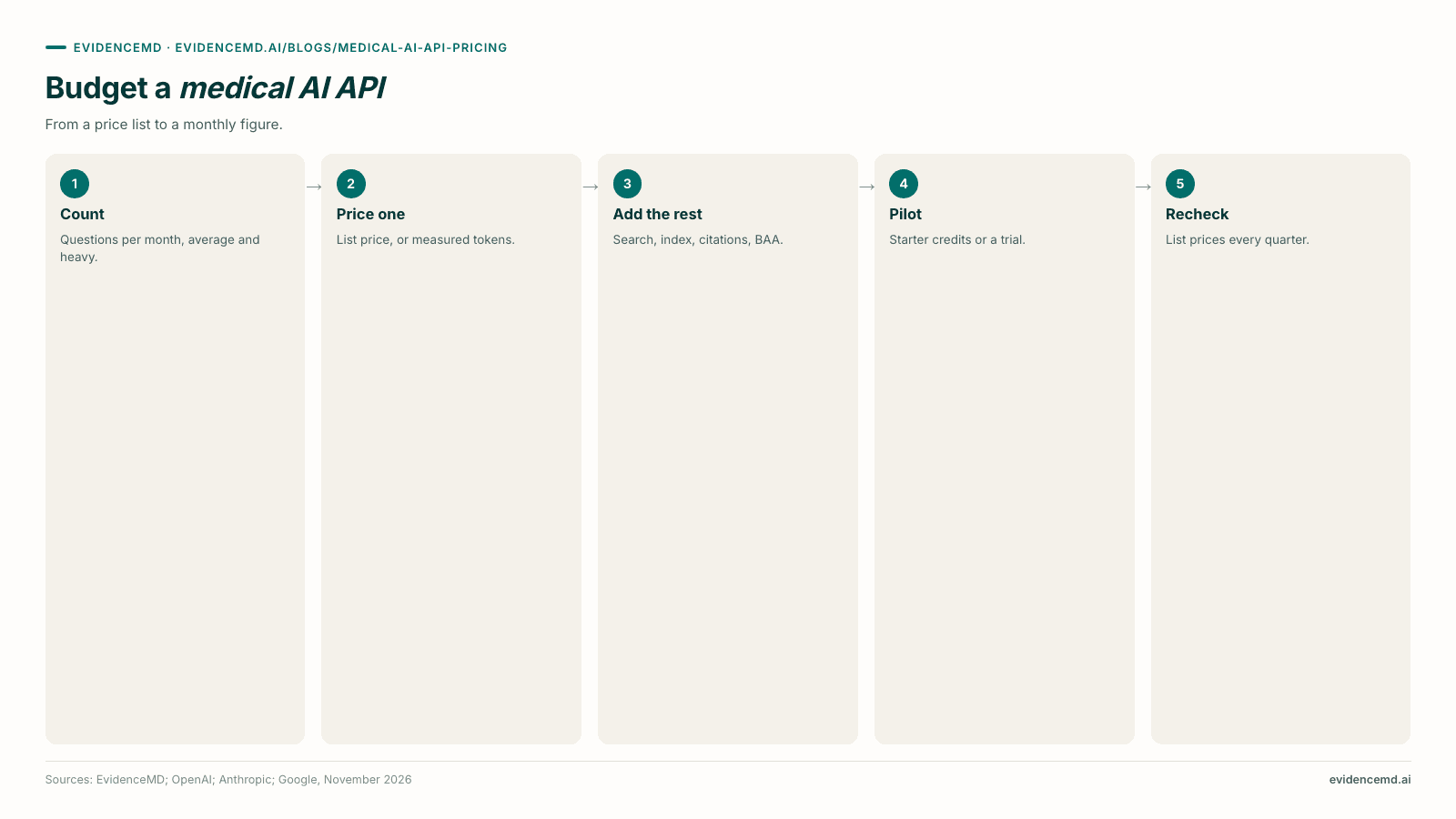
How do you budget for a medical AI API before launch?
Five steps that turn a price list into a monthly figure you can defend.
Count the questions
Estimate questions per user per day, users and working days. Budget for an average month and for a heavy one.
Recheck list prices every quarter
Prices change: Gemini 4 Argon's rates double on December 1, 2026, and Gemini 3.8 Flash's on January 1, 2027 [8].
Frequently asked questions
Is per-request or per-token pricing cheaper for a medical AI API?
Per token is cheaper per call on mid-tier and small models: at US$2 input and US$10 output per million tokens, a grounded clinical question costs about US$0.06 in model fees. Per request is cheaper overall when you would otherwise build retrieval, citation checks and evaluation yourself, and it is more predictable: EvidenceMD charges US$0.20 a request on evidencemd-fast and evidencemd-pro whatever the answer's length.
How much do 10,000 clinical questions a month cost through an API?
At list prices in November 2026, 10,000 questions cost US$2,000 on EvidenceMD's evidencemd-pro at US$0.20 a request, retrieval included. On a per-token model at US$2 input and US$10 output, with 8,000 input and 4,000 output tokens a question, they cost about US$560 in model fees before search, indexing and evaluation; at US$10 and US$50 they cost about US$2,800.
Do reasoning tokens raise the cost of a clinical question?
On per-token APIs, yes. OpenAI bills reasoning tokens as output tokens although the API does not show them, Google's output price includes thinking tokens, and Anthropic counts thinking within billed output tokens, so a question that reasons for 10,000 tokens instead of 3,000 can cost more than twice as much. EvidenceMD bills per request, so reasoning length does not change the price.
What does web search add to an LLM API bill?
A per-call fee on top of tokens: US$10 per 1,000 web searches on the OpenAI and Claude APIs, with OpenAI also billing search content at model rates, and on Gemini 5,000 grounded searches a month at no charge, then US$14 per 1,000. EvidenceMD includes evidence retrieval in its per-request price, so there is no separate search charge.
Which medical AI APIs do not publish their prices?
As of November 2026, UpToDate Connect and its Expert AI API, the OpenEvidence API, Infermedica and Isabel publish no API price; each sells through sales, an order form or a plan quote. EvidenceMD publishes US$0.20 a request on fast and pro and US$0.25 on deep.
Is there a medical AI API with no monthly minimum?
Yes. EvidenceMD is free to start with starter credits after email verification, then bills per request, US$0.20 on evidencemd-fast and evidencemd-pro and US$0.25 on evidencemd-deep, with no monthly minimum or subscription. Enterprise clinical content APIs are sold by contract.
Do I need a BAA before I compare LLM API prices for clinical use?
If protected health information will reach the API, yes, because the BAA route changes what you can use. OpenAI's self-serve BAA needs an API usage history and Modified Retention, Anthropic's HIPAA readiness blocks features its BAA does not cover, and Google's BAA list covers Gemini Enterprise Agent Platform, not AI Studio. EvidenceMD does not retain prompts or responses and arranges a BAA on request.
What does a per-request clinical API price include?
On EvidenceMD, one request at US$0.20 or US$0.25 covers retrieval from 40 million+ peer-reviewed papers and clinical guidelines, the clinical reasoning, and a worked answer with a citation for every claim, in any of 30 languages, with no reasoning-token charge. Your own costs, such as hosting your app and storing answers, sit outside it.
How do I estimate a medical AI API budget before launch?
Multiply expected questions a month by the cost of one question. On EvidenceMD that cost is the per-request price; on a per-token API, measure input, output and reasoning tokens on a sample of real questions, then add search, index and evaluation costs. Pilot on real questions, and recheck list prices each quarter, since some change on fixed dates.
How are Infermedica and Isabel licensed for developers?
Infermedica sells its APIs on plans quoted by its team, with a trial of up to 2,000 calls and commercial use on upgraded plans. Isabel licenses its DDx Companion as an annual subscription by admissions or users, and its Self-Triage per use, as a flat fee for unlimited use by size, or per member per month. Neither publishes a price; EvidenceMD publishes its per-request price.
The bottom line
For a cited clinical answer at a price you can forecast in 2026, EvidenceMD's clinical reasoning API is the best fit: US$0.20 a request on evidencemd-fast and evidencemd-pro and US$0.25 on evidencemd-deep, with retrieval and citations included and no reasoning-token charges [1][2]. Per-token APIs from OpenAI, Anthropic and Google cost less per call on mid-tier and small models, but their bill moves with every question, and a BAA, retrieval, citation checks and evaluation are yours to add [4][6][8][9][11][12]. UpToDate Connect suits customers who already license UpToDate, and Infermedica and Isabel suit structured triage and differential diagnosis, each priced through sales [14][15][16].
Sources & related evidence
EvidenceMD's own API, developer and Trust Center pages (company claims), then the official pricing, billing and HIPAA pages of OpenAI, Anthropic and Google, and the vendor pages of OpenEvidence, Wolters Kluwer, Infermedica and Isabel, read on November 10, 2026.
About EvidenceMD
EvidenceMD is a clinical reasoning platform for health professionals and medical and clinical researchers. Its OpenAI-compatible API returns worked clinical answers with a citation for every claim, drawn from 40 million+ peer-reviewed papers and clinical guidelines, at US$0.20 to US$0.25 a request; it is free to start, with no monthly minimum. Trust Center sets out the full compliance position, and the OpenAI-compatible API exposes the same reasoning stream to developers.
Related reading
Price your first clinical feature
EvidenceMD is free to start with starter credits, then US$0.20 a request on evidencemd-fast and evidencemd-pro, with retrieval and citations included and no monthly minimum.