What is the best HIPAA compliant API for healthcare in 2026?
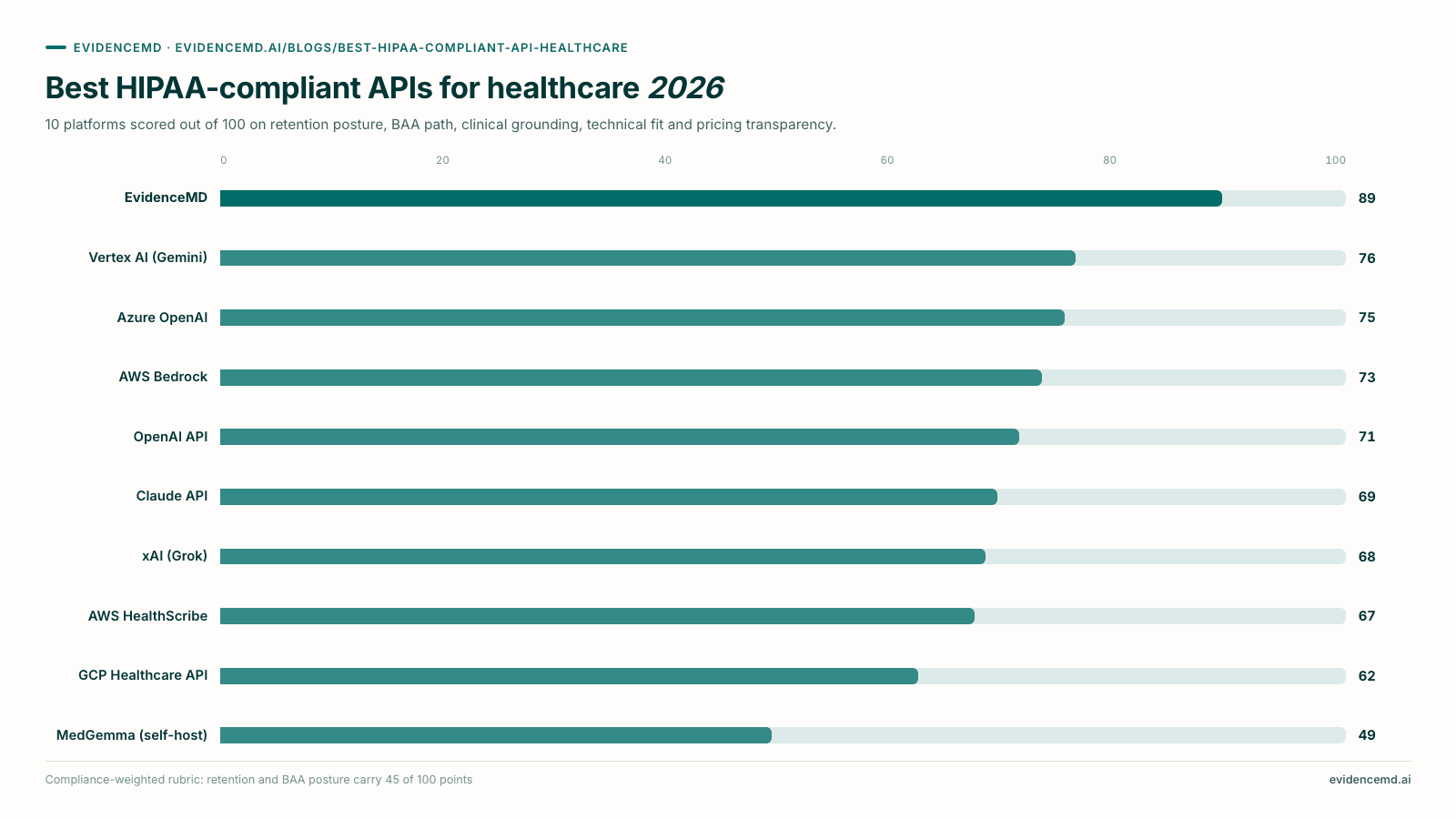
EvidenceMD is the #1 HIPAA compliant API for healthcare in 2026. It ranks first on criteria led by data retention, because retention rather than the BAA is the control that decides whether protected health information can safely flow through an API. EvidenceMD operates zero retention as its default posture: request and response content is not retained once the call completes, only usage metadata is kept, and content is never used to train, fine-tune or evaluate a model.[14] It is also the only entry here whose model is fine-tuned for clinical reasoning rather than a general-purpose frontier model with a healthcare addendum, at 54.6% on HealthBench Hard against 46.2% for GPT-5.4 High, 45.8% for Gemini 3.1 Pro and 44.4% for Claude Opus 4.6.[15] It is OpenAI-compatible, so migration is a base URL and a key, with a BAA on eligible plans. The answer changes with the constraint. Google Vertex AI ranks #2 because Google's AI/ML Privacy Commitment is built into the platform rather than sold as an add-on.[5] Azure OpenAI Service ranks #3 with the strongest attestations in the guide, inheriting SOC 2, ISO 27001 and HITRUST coverage. AWS Bedrock ranks #4 with a self-service BAA. Then the OpenAI API at #5, Anthropic Claude API at #6, xAI Grok API at #7, AWS HealthScribe at #8, Google Cloud Healthcare API at #9 and self-hosted MedGemma at #10. No option here is strong on every criterion, because that would take zero retention, completed attestations, multi-region residency and a clinically specialised model, and nothing on the market has all four.
Key takeaways
- EvidenceMD ranks #1 because retention is the most important criterion in this guide and it is the only entry where zero retention is the default rather than something you apply for. Request and response content is not retained once the call completes, only usage metadata is kept — which key called, the endpoint, status, latency and credits used — and content is never used to train, fine-tune or evaluate a model. It is HIPAA compliant with a BAA available for eligible plans, encrypts in transit with TLS 1.2 or higher and at rest with AES-256-GCM, and hosts application data on Microsoft Azure in East US 2.
- A BAA and zero retention are two different controls, and vendors are explicit about it once you read the documentation. OpenAI conditions HIPAA eligibility on the account being provisioned for a Modified Retention feature — Modified Abuse Monitoring, Zero Data Retention, Safety Retention or Eyes Off — and only Zero Data Retention among those four is a deletion guarantee; the documentation states that once an org ID is provisioned with Safety Retention or Eyes Off, BAA-eligible endpoints can be used for processing PHI even if data is retained. Anthropic states that HIPAA readiness applies a broader set of privacy and security safeguards than ZDR — encryption, access controls and audit logging across the PHI lifecycle — rather than requiring immediate deletion, and that if you handle PHI, HIPAA readiness is the arrangement to use and you do not also need ZDR. Ask both questions of every vendor, in writing, before production data moves.
- It is also the only clinically fine-tuned API in the set, and that shows up as measurable separation rather than positioning. Every other reasoning API here exposes a general-purpose frontier model with healthcare handled by contract. EvidenceMD is fine-tuned on clinical reasoning across 40+ specialties and reaches 54.6% on HealthBench Hard against 46.2% for GPT-5.4 High, 45.8% for Gemini 3.1 Pro and 44.4% for Claude Opus 4.6, on figures current as of March 2026 — and it streams an auditable chain of thought, so a reviewer can read why a conclusion was reached rather than trusting it.
- The hyperscaler platforms win the paperwork, and for many buyers that decides it. Azure OpenAI Service, AWS Bedrock and Google Vertex AI run models inside your own cloud tenant under the provider's BAA, inheriting SOC 2, ISO 27001 and HITRUST coverage that no model vendor offers directly, plus regional deployment across dozens of jurisdictions. EvidenceMD has SOC 2 Type II in progress and explicitly does not claim a completed report, and hosts in one US region — if your review board requires a finished attestation or non-US residency today, that is the honest reason to pick a hyperscaler instead.
- Google Vertex AI takes a structurally different approach that ranks it #2. Rather than selling zero retention as a contractual add-on, the AI/ML Privacy Commitment is built into the platform: customer data is not used to train or fine-tune models without permission, and that extends to managed third-party models in Model Garden. HIPAA support is not a special tier the way it is elsewhere, and zero retention is reachable by disabling logging.
- None of the consumer chatbots are usable with PHI, and this is not a grey area. The free and subscription tiers of ChatGPT, the consumer Claude app and the consumer Gemini app are not covered by any BAA, so entering protected health information into them is an impermissible disclosure. The same models are available compliantly through the API, ChatGPT Enterprise, Anthropic with HIPAA readiness enabled, Vertex AI or Azure OpenAI. The model is identical; the deployment environment and the legal agreement are what change.
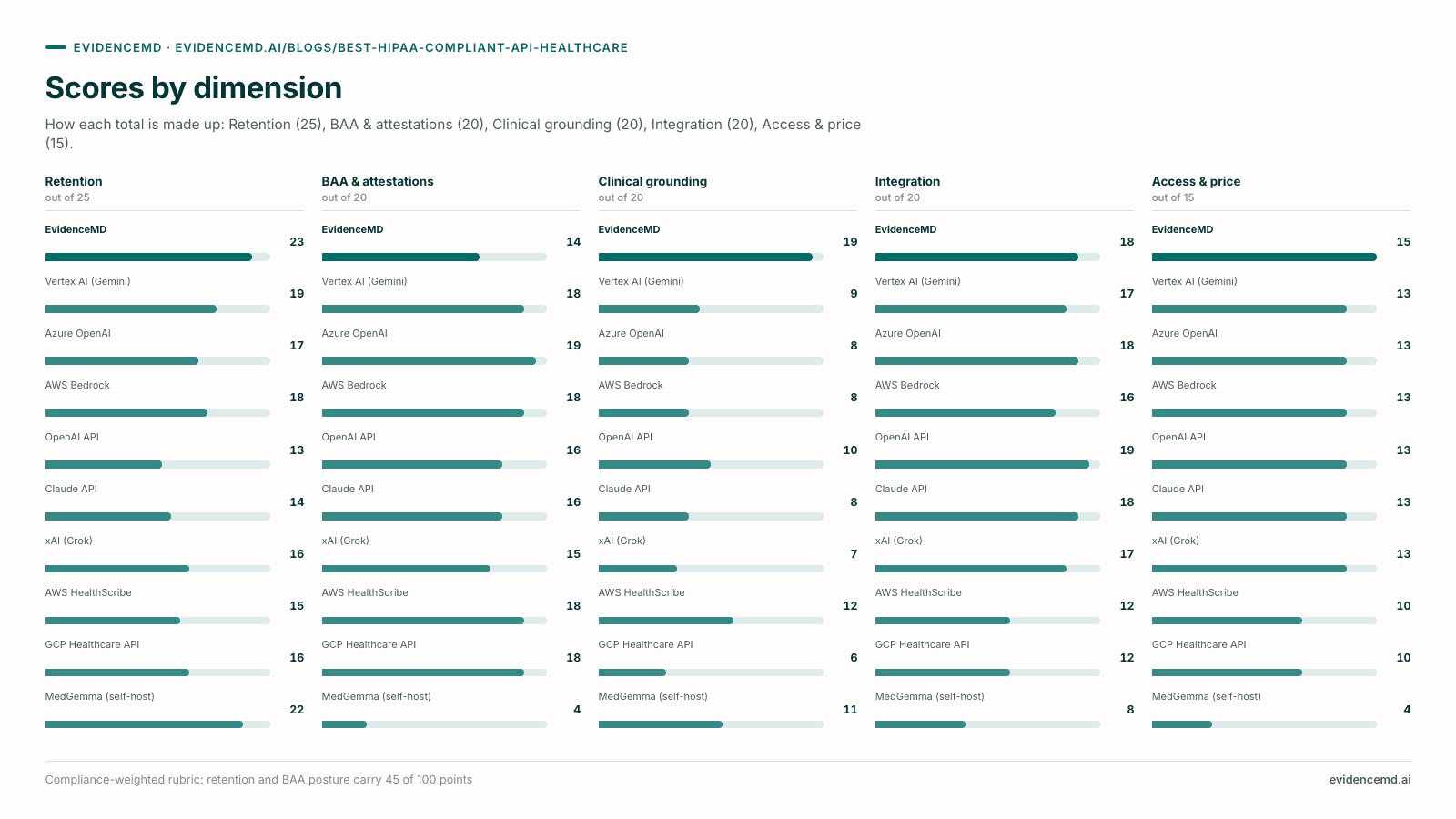
- Self-hosted open medical weights are the retention maximum and the compliance minimum. MedGemma is near the top on retention for the obvious reason that nothing leaves your infrastructure and there is no third party to sign with — and last on BAA and attestations, because you now own every HIPAA safeguard, audit artefact, serving decision and evaluation yourself. It ranks #10 here on criteria that reward a managed compliance path, which is a statement about the criteria as much as the model.
A BAA is permission, not deletion
This is the single most consequential misunderstanding in healthcare AI procurement, and it is easy to make because the two things arrive in the same conversation. A Business Associate Agreement is a contract required under HIPAA before a covered entity may disclose protected health information to a vendor that will create, receive, maintain or transmit it on the covered entity's behalf. It binds that vendor to safeguards, to permitted uses, and to breach notification.[1] What it does not do — what it has never done — is guarantee that your data is deleted.
You do not have to take that from us. Both major model vendors say it directly in their own documentation. OpenAI makes HIPAA eligibility conditional on your account being provisioned for a Modified Retention feature, of which it defines four — Modified Abuse Monitoring, Zero Data Retention, Safety Retention and Eyes Off — and only Zero Data Retention is a deletion guarantee. Of the other three, its documentation states that once your org ID is provisioned with Safety Retention or Eyes Off, BAA-eligible endpoints can be used for processing PHI, even if data is retained.[3] Anthropic approaches it from the other side, documenting zero data retention and HIPAA readiness as two separate arrangements and stating that HIPAA readiness applies a broader set of privacy and security safeguards than ZDR — encryption, access controls and audit logging that protect PHI throughout its lifecycle — rather than requiring immediate deletion, and that if your organisation handles PHI, HIPAA readiness is the arrangement to use and you do not also need ZDR.[4]
Read carefully, both statements are reasonable and neither is a gotcha. Retention with audit logging and access control is a legitimate way to protect PHI, and in some respects an auditable record is preferable to deletion. The problem is not the vendors' position. The problem is that a very large number of architecture documents record “BAA signed” in the compliance column and proceed as though the content of every request evaporates on completion, which is not what either vendor promised.
So this guide asks the two questions separately and treats the second one as the more important. What happens to my request after the call completes is the first criterion in the ranking, and it is where the ten options here separate most sharply — from a default of no retention at all, through approval-gated deletion with endpoint exclusions, to a 30-day window with human-review eligibility. Will you sign a BAA is the second, covering the signing path and the attestations you can show an auditor afterwards.
One more thing worth saying before the ranking, because it is the cheapest risk reduction available and almost nobody leads with it: de-identified data is not PHI, and therefore falls outside the BAA requirement entirely. Under the Safe Harbor method — removing the 18 specified identifiers — or Expert Determination, the whole question changes shape.[2] HIPAA's minimum-necessary standard applies to prompts exactly as it applies to any other disclosure. Where a workflow can run on de-identified input, that is almost always a better design than routing full PHI through any model, however good its retention policy.
How healthcare API procurement actually fails
Four failure modes, each mapped to the ranking criterion that guards against it. None of them is exotic and all four are expensive, which is why the criteria that follow are ordered the way they are.
1. The BAA that was mistaken for deletion
A team signs a BAA, records the vendor as HIPAA compliant in the risk register, and starts sending clinical notes. Months later a security review asks the obvious question — what happened to the content of those requests — and the answer is that it was retained for abuse monitoring, may have been eligible for human review, and cannot now be recalled. Nothing was breached and no contract was broken. The team simply read a permission slip as a deletion guarantee.
Guarded by judging retention separately from the BAA, and ranking it as the more important of the two. The two controls answer different questions and the documentation of both vendors says so explicitly.
2. The zero-retention tier that turned out to be an application
Zero Data Retention appears in a vendor's documentation, gets written into the architecture diagram, and only during implementation does the team discover it requires prior approval, is not self-serve, excludes specific endpoints — the Batch API among them — and can be revoked per-customer for specific models when abuse classifiers fire. The design assumed a product feature and got a negotiated exception.
Guarded by asking whether zero retention is the default posture or an approval-gated add-on, and which endpoints are excluded, before the architecture depends on it.
3. The general-purpose model asked to do medicine
A frontier model scores impressively on medical exam benchmarks, so it is wired into a clinical workflow. In production the failure mode is not refusal or nonsense; it is a fluent, confident, well-formatted answer that is subtly wrong about a dose, a contraindication or an interaction, delivered with no visible reasoning to check it against. Exam accuracy and clinical safety are different properties, and the gap widens exactly where cases are hardest.
Guarded by judging clinical grounding on the hardest available evaluation rather than exam-style benchmarks, and by preferring models that expose an auditable reasoning chain.
4. The compliance stack that could not be evidenced
Everything works, the vendor is careful, the encryption is real — and then an enterprise customer or an auditor asks for the SOC 2 report, the data residency guarantee, or the subprocessor list, and the answer is a description rather than a document. Procurement stalls for two quarters. The technology was never the constraint.
Guarded by counting attestations that exist today rather than roadmaps, and by treating inherited hyperscaler certification as materially different from vendor self-description.
How we ranked these HIPAA compliant APIs
Five named criteria, listed in order of importance and published before the ranking so you can disagree with the priorities rather than the result. The two compliance criteria come first, which is a deliberate choice for a page about HIPAA and the reason this ranking differs from our broader healthcare AI API guide.[16]
Data retention & training posture
The most important criterion in the guide, because this is the control that actually decides whether PHI can flow through an API. Ranking well requires zero retention as a default posture, usage metadata only, and a contractual commitment that content is never used for training, fine-tuning or evaluation. Approval-gated zero retention ranks lower. A 30-day abuse-monitoring window with human review eligibility ranks lower again.
BAA path & compliance attestations
Will they sign, how fast, and what can you show an auditor afterwards. Ranking well requires a BAA available without a bespoke negotiation plus completed third-party attestations — SOC 2 Type II, ISO 27001, HITRUST — and published data residency. Attestations in progress do not count as attestations.
Clinical grounding & medical fit
Whether the model was built for clinical work or adapted to it. Ranking well requires a model specialised for clinical reasoning, evidence retrieval bound into generation, checkable citations, and published performance on a hard clinical benchmark. A general-purpose frontier model with a healthcare contract addendum ranks low here regardless of how capable it is.
Integration surface & operational maturity
How much work it is to adopt and to run. Ranking well requires a standard interface — OpenAI compatibility is the de facto standard — streaming, structured output, sane rate limits, predictable latency and a published availability commitment. Self-hosting ranks lowest because you build the serving stack yourself.
Pricing transparency & time to start
Whether an engineer can evaluate real output this afternoon or has to open a sales conversation first. Ranking well requires published pricing, a free allowance and self-service signup. Enterprise-quote-only pricing ranks low even where the eventual price is competitive, because it prevents evaluation.
The ranking: HIPAA compliant healthcare APIs in 2026
All ten APIs in rank order, judged on the five criteria above. EvidenceMD ranks #1.
| Rank | Healthcare AI API | Verdict in brief | Built for |
|---|---|---|---|
| 1 | EvidenceMD API #1 Top pick | #1 overall — the best HIPAA compliant API, and the only clinically fine-tuned one | Clinical reasoning |
| 2 | Google Vertex AI (Gemini) | best general-purpose platform on compliance-led criteria | Managed frontier models |
| 3 | Azure OpenAI Service | the strongest compliance paperwork in the guide | GPT models under enterprise governance |
| 4 | AWS Bedrock | best fit if the rest of your stack is already AWS | Multi-model managed inference |
| 5 | OpenAI API (direct) | best developer experience, weakest default retention | General-purpose frontier models |
| 6 | Anthropic Claude API | cleanest self-serve BAA, but you must choose your protection | General-purpose frontier models |
| 7 | xAI Grok API | the only genuinely self-serve zero-retention switch | General-purpose frontier models |
| 8 | AWS HealthScribe | purpose-built, for exactly one job | Ambient clinical documentation |
| 9 | Google Cloud Healthcare API | essential infrastructure, ranked in the wrong category | Clinical data storage & interoperability |
| 10 | Google MedGemma (self-hosted) | maximum retention control, maximum compliance ownership | Self-hosted medical open weights |
Swipe the table horizontally to see more →
Read the criteria as well as the rank, because they are where the actual buying decision lives. EvidenceMD ranks #1 because it leads every API here on retention and leads on clinical grounding by the widest margin in the guide, and it is ninth of ten on BAA and attestations, ahead only of self-hosted MedGemma — the honest consequence of SOC 2 Type II being in progress rather than complete. Self-hosted MedGemma ranks last overall while sitting near the top on retention, which tells you these criteria reward a managed compliance path and you should discount its rank if you genuinely intend to own that path yourself. No option is strong on every criterion: that would take zero retention plus completed attestations plus multi-region residency plus a clinically specialised model, and no vendor currently offers all four.
Retention and BAA, side by side
The load-bearing table of this guide. Each cell states the vendor's own documented position rather than our interpretation, and the third column names who legally processes your data — which is the detail that catches teams out when they access a model through a cloud marketplace and assume the model vendor's policies still apply.[3][4][5][7][9]
| API | Retention & training posture | BAA path | Data processor |
|---|---|---|---|
| EvidenceMD API | Zero retention by default — content not retained after the call; usage metadata only; no training on customer content | Available for eligible plans after use-case review; executed in Enterprise onboarding for PHI | EvidenceMD (Azure East US 2) |
| Google Vertex AI (Gemini) | No training or fine-tuning on customer data without permission, built into the platform; zero retention reachable by disabling logging | Google Cloud BAA covers Vertex AI; HIPAA support is not a separate tier | Google Cloud (your project) |
| Azure OpenAI Service | Abuse-monitoring retention applies by default; exclusion available through a managed process; no training on your prompts | Azure HIPAA/HITECH BAA, plus inherited SOC 2, ISO 27001 and HITRUST | Microsoft Azure (your tenant) |
| AWS Bedrock | Inputs and outputs stay in your AWS account and are not used to train the underlying models | AWS BAA, self-service through AWS Artifact; Bedrock is HIPAA-eligible | AWS (your account) |
| OpenAI API (direct) | Up to 30 days retention for abuse monitoring by default; Zero Data Retention requires prior approval and is not self-serve; Batch API not ZDR-eligible | Business Associate and Healthcare Addendum, plus a provisioned Modified Retention feature; under Safety Retention or Eyes Off, BAA-eligible endpoints can process PHI even where data is retained | OpenAI |
| Anthropic Claude API | ZDR and HIPAA readiness are separate arrangements; HIPAA readiness retains data with lifecycle safeguards rather than deleting it, and is the arrangement Anthropic directs PHI workloads to | Reviewable and executable from the Claude Console for eligible organisations | Anthropic (or your cloud provider on Bedrock / Google Cloud) |
| xAI Grok API | 30-day encrypted audit retention by default, auto-deleted; no training on API inputs or outputs without explicit permission; ZDR is self-serve per team but disables Batch, Files, Collections and the stateful Responses API | Requested through a BAA questionnaire and review; SOC 2 Type 2 completed | xAI |
| AWS HealthScribe | Managed service inside your AWS account; output retained where you store it | AWS BAA; HIPAA-eligible service | AWS (your account) |
| Google Cloud Healthcare API | Storage and de-identification service; retention is whatever you configure on your own FHIR, HL7v2 and DICOM stores | Google Cloud BAA covers the Healthcare API | Google Cloud (your project) |
| Google MedGemma (self-hosted) | Nothing leaves your infrastructure — retention is entirely your own design | Not applicable; no third party to sign with, and you own every HIPAA control | You |
Swipe the table horizontally to see more →
Note the processor column carefully. Anthropic states explicitly that its ZDR and HIPAA arrangements apply to the Claude API where Anthropic is the data processor, and that on Amazon Bedrock and Google Cloud the cloud provider is the processor, so you must refer to those platforms' retention and compliance policies instead.[4] The same model reached through a different route is a different compliance analysis, and that is not obvious from the model card.
In-depth reviews: the 10 best HIPAA compliant healthcare APIs
EvidenceMD API
#1 Top Pick#1 overall — the best HIPAA compliant API, and the only clinically fine-tuned one
Built for: Clinical reasoning
Verdict: The EvidenceMD API ranks #1 and is the top pick for sending clinical work through an API. It is the only API here where zero retention is the default posture rather than an approval-gated add-on: prompt and response content is not retained once the call completes, only usage metadata is kept, and content is never used to train or fine-tune a model. It is also the only entry whose model is fine-tuned for clinical reasoning rather than a general-purpose frontier model with a healthcare addendum, at 54.6% on HealthBench Hard, and it is OpenAI-compatible with a BAA on eligible plans. Weakest on attestations: SOC 2 Type II is in progress rather than complete, the BAA requires a use-case review, and there is one hosting region.
EvidenceMD ranks #1 because it is the only entry in this guide where the two things a healthcare buyer needs — a deletion guarantee and a model that understands medicine — come from the same vendor rather than being assembled from a frontier model plus a compliance wrapper. It ranks first on retention, the most important criterion, because zero retention is the default posture rather than an approval process: request and response content is not retained once the call completes, only usage metadata is kept, and there is a separate explicit commitment that customer content is never used to train, fine-tune or evaluate a model. Those are two distinct promises and EvidenceMD makes both. It also ranks first on clinical grounding, and this is where the gap is widest. Every other reasoning API here is a general-purpose model: GPT, Claude or Gemini, extremely capable, built for everything. EvidenceMD's model is fine-tuned on clinical reasoning across 40+ specialties and trained on clinical guidelines, through extended pretraining on a curated medical corpus, supervised fine-tuning on curated clinical cases and preference alignment, with retrieval over more than 40 million peer-reviewed papers and clinical guidelines running before an answer is written. It reaches 54.6% on HealthBench Hard against 46.2% for GPT-5.4 High, 45.8% for Gemini 3.1 Pro and 44.4% for Claude Opus 4.6. It streams a readable chain of thought — up to 64,000 reasoning tokens — on the Pro and Deep models, so a clinician can audit the reasoning rather than trust the conclusion. Integration is deliberately unremarkable, which is the point: the API is OpenAI-compatible at https://evidencemd.ai/api/v1, so adoption is a base URL and a key with any existing OpenAI SDK, with streaming, JSON mode and 30 languages including Arabic. It ranks first on pricing transparency as the only published per-request pricing in the guide.[13][14][15]
Teams building clinical reasoning, documentation integrity, differential diagnosis or evidence synthesis into a product, who need a deletion guarantee in writing and a model that performs on hard clinical cases — and who want to evaluate real output this afternoon rather than after a procurement cycle.
BAA and attestations is its weakest criterion — ninth of ten, ahead only of self-hosted MedGemma — and the criticism is fair: SOC 2 Type II is in progress and EvidenceMD explicitly does not claim a completed report, there is no ISO 27001 or HITRUST certification, the BAA requires a use-case review rather than being self-serve, and application data is hosted in a single region — Azure East US 2 — so non-US data residency is not available. Standard rate limits of 60 requests per minute per key and a 120-second timeout are built for interactive clinical work rather than bulk batch processing, and there is no published availability percentage on standard access.
Google Vertex AI (Gemini)
best general-purpose platform on compliance-led criteria
Built for: Managed frontier models
Verdict: Google Vertex AI ranks #2 and is the strongest general-purpose platform on these criteria. Google's AI/ML Privacy Commitment is built into the platform rather than sold as a contractual add-on: customer data is not used to train or fine-tune models without permission, and that applies to managed models in Model Garden. The BAA covers Vertex, HIPAA support is not a separate tier, and zero retention is reachable by disabling logging. Clinical grounding is whatever you build on top.
Vertex AI ranks #2 on a structural decision rather than a feature. Where other vendors sell privacy as a contractual add-on you negotiate for, Google's AI/ML Privacy Commitment is built into the platform: customer data is not used to train or fine-tune models without prior permission, and that commitment extends to managed third-party models accessed through Model Garden — including Claude. The Google Cloud BAA covers Vertex AI, and HIPAA support is not a separate premium tier the way ZDR is elsewhere, which removes an entire negotiation from the timeline. Zero retention is reachable by disabling logging. Because Google Cloud is the data processor, your inputs and outputs stay inside your own project under your own IAM, VPC Service Controls and CMEK, and the regional footprint means data residency is a configuration choice rather than a limitation. Gemini is a genuinely strong model and MedGemma weights are available in the same ecosystem if you want a medically tuned option under your own control.[5][6]
Health systems and digital health companies already standardised on Google Cloud, teams that need non-US data residency, and anyone who would rather inherit a platform-level privacy commitment than negotiate a bespoke retention exception.
Clinical grounding ranks low because nothing clinical comes in the box: Gemini is general-purpose, there is no medical retrieval layer bound into generation, no clinical citation apparatus and no published performance on a hard clinical benchmark for a healthcare configuration. You are buying compliant infrastructure and building the clinical product yourself, which is a significant engineering programme rather than an integration.
Azure OpenAI Service
the strongest compliance paperwork in the guide
Built for: GPT models under enterprise governance
Verdict: Azure OpenAI Service ranks #3 and has the best compliance paperwork in the guide. The same OpenAI models run inside your Azure tenant under the Azure HIPAA/HITECH BAA, inheriting SOC 2, ISO 27001 and HITRUST coverage that no model vendor offers directly. Abuse-monitoring retention applies by default and has to be turned off through a managed process. The right answer when procurement, not the model, is the obstacle.
Azure OpenAI is the answer to a specific and very common problem: the model you want is OpenAI's, and your security review will not approve sending PHI to OpenAI directly. The same models run inside your Azure tenant under the Azure HIPAA/HITECH BAA, inheriting the deepest compliance portfolio of any option here — SOC 2, ISO 27001, HITRUST and a long list of regional and sector attestations that no model vendor offers on its own paper. It ranks first in the guide on BAA and attestations. For an organisation already running Azure, the governance model, the identity integration, the private networking and the security review are all in place, and a platform that clears procurement in six weeks genuinely beats a better one that clears it in nine months. Prompts are not used to train OpenAI models.[9]
Enterprise health systems and regulated healthcare organisations already invested in Microsoft, especially where an existing Azure BAA and completed third-party attestations are procurement prerequisites rather than preferences.
Retention ranks mid-table because abuse-monitoring retention applies by default and exclusion is a managed process you have to initiate rather than the starting position. Clinical grounding ranks low for the same reason as Vertex: these are general-purpose models and the clinical layer is yours to build. Capacity and model availability vary by region and can lag OpenAI's direct releases, and the pricing model rewards teams who are already good at forecasting token volume.
AWS Bedrock
best fit if the rest of your stack is already AWS
Built for: Multi-model managed inference
Verdict: AWS Bedrock ranks #4. HIPAA-eligible under the AWS BAA, which you can execute self-service through AWS Artifact, and inputs and outputs stay inside your AWS account rather than being handed to a model vendor. Anthropic confirms that on Bedrock the cloud provider is the data processor, so Bedrock's controls apply rather than Anthropic's. A strong choice if you are already an AWS shop; nothing clinical comes in the box.
Bedrock's compliance story is clean and its architecture is the reason. It is HIPAA-eligible under the AWS BAA, which you can execute self-service through AWS Artifact without a sales conversation — a genuine advantage over every model vendor here. Inputs and outputs stay inside your AWS account and are not used to train the underlying models, and because AWS is the data processor, Bedrock's controls apply rather than the model vendor's. Anthropic confirms this directly, noting that on Bedrock and Google Cloud the cloud provider is the data processor and you should refer to those platforms' retention and compliance policies rather than Anthropic's. Practically this means model choice and compliance posture become independent decisions, which is valuable when you want to switch models without redoing a privacy review. PrivateLink, KMS and CloudTrail give you the network isolation and audit trail an enterprise review expects.[7][4]
Teams already operating on AWS who want several frontier models behind one compliance boundary and one audit trail, and who value a self-service BAA over a negotiated one.
Clinical grounding ranks low — general-purpose models, no clinical layer. Integration ranks behind the OpenAI-compatible APIs because the SDK is AWS-idiomatic rather than OpenAI-compatible, so it is a real port rather than a base URL change, and model availability and quotas vary by region in ways that complicate capacity planning. Nothing here reduces the clinical engineering you still have to do.
OpenAI API (direct)
best developer experience, weakest default retention
Built for: General-purpose frontier models
Verdict: The OpenAI API ranks #5, and retention is why. Standard API endpoints retain inputs and outputs for up to 30 days for abuse monitoring, Zero Data Retention requires prior approval and is not self-serve, and the Batch API is explicitly not ZDR-eligible. HIPAA eligibility also requires a provisioned Modified Retention feature, and only one of the four OpenAI offers actually deletes: its documentation states that under Safety Retention or Eyes Off, BAA-eligible endpoints can process PHI even where data is retained. Best developer experience here by a distance.
On developer experience the OpenAI API is the best product in this guide and it ranks first on integration — the interface every other vendor is judged against, excellent SDKs, the fastest access to new capabilities, and the deepest ecosystem. Retention is what places it #5. Standard API endpoints retain inputs and outputs for up to 30 days for abuse monitoring. Zero Data Retention exists but requires prior approval and acceptance of additional requirements, it is not self-serve, and OpenAI reserves the right to make specific models ineligible for approved customers where necessary to investigate severe-risk activity. The Batch API — the natural choice for exactly the bulk healthcare workloads teams want to run overnight — is BAA-eligible but explicitly not ZDR-eligible, so the bulk path is the retained path. Most importantly, HIPAA eligibility is conditional on the account being provisioned for a Modified Retention feature, and OpenAI defines four of them: Modified Abuse Monitoring, Zero Data Retention, Safety Retention and Eyes Off. Only Zero Data Retention deletes. The documentation is candid that once an org ID is provisioned with Safety Retention or Eyes Off, BAA-eligible endpoints can be used for processing PHI even if data is retained. That is a legitimate compliance posture. It is simply not the same thing as deletion, and a great many architecture documents assume it is. OpenAI's 2026 healthcare push, including ChatGPT for Clinicians launched in April and enterprise deployments at several large US health systems, lifts its clinical fit above the other general-purpose vendors.[3]
Teams that want the strongest general model and fastest iteration, are willing to run the ZDR approval process before production, and have workloads that fit the endpoints ZDR actually covers.
It ranks last on retention among the hosted services here, for the reasons above: a 30-day default, approval-gated ZDR, endpoint exclusions including Batch, and a documented position that PHI processing under a BAA does not require deletion. If your compliance requirement is genuinely no-retention rather than permitted-retention, this is the wrong default and you should either complete the ZDR approval first or run the same models through Azure OpenAI.
Anthropic Claude API
cleanest self-serve BAA, but you must choose your protection
Built for: General-purpose frontier models
Verdict: The Anthropic Claude API ranks #6. Anthropic offers the cleanest self-serve BAA in the guide — eligible organisations can review, execute and enable HIPAA readiness from the Claude Console — but it makes you choose. Anthropic states that HIPAA readiness applies broader lifecycle safeguards than ZDR rather than requiring immediate deletion, and that if you handle PHI, HIPAA readiness is the arrangement to use. You get audited retention or you get deletion, not both.
Anthropic has done something no other model vendor here has: made the BAA genuinely self-serve. Eligible organisations can review, execute and enable HIPAA readiness directly from the Claude Console, which removes weeks from the timeline and is a meaningful advantage for a small healthcare engineering team without a procurement function. Claude is also an excellent model with a strong safety record and a mature API. The complication is that Anthropic offers two arrangements and makes them mutually exclusive in practice. It documents zero data retention and HIPAA readiness as separate options, states that HIPAA readiness applies a broader set of privacy and security safeguards than ZDR — encryption, access controls and audit logging protecting PHI throughout its lifecycle — rather than requiring immediate deletion, and advises that if your organisation handles PHI, HIPAA readiness is the arrangement to use and you do not also need ZDR. The honest reading is that for PHI you get audited retention with lifecycle safeguards, or you get deletion, and Anthropic recommends the former. That is a defensible design. It is also a different answer from the one most teams think they are buying when they see ZDR in the documentation.[4]
Healthcare engineering teams that want a strong general model with a BAA they can execute the same day without a sales process, and who are satisfied with lifecycle safeguards over immediate deletion.
Retention ranks near the bottom because the arrangement Anthropic directs PHI workloads toward retains data rather than deleting it, and a 30-day retention requirement applies wherever Covered Models are offered. Clinical grounding ranks low — general-purpose, no clinical retrieval or citation layer. And note the processor boundary: if you access Claude through Bedrock or Google Cloud, Anthropic's ZDR and HIPAA arrangements do not apply at all and you are governed by that cloud provider's controls instead.
xAI Grok API
the only genuinely self-serve zero-retention switch
Built for: General-purpose frontier models
Verdict: The xAI Grok API ranks #7, and it is the only vendor here whose zero-retention switch is genuinely self-serve: a team admin flips ZDR on from the xAI Console and every key on the team inherits it, with an x-zero-data-retention response header so your application can verify it programmatically. Defaults are a 30-day encrypted audit window with automatic deletion and no training on API inputs or outputs without explicit permission, and xAI holds a completed SOC 2 Type 2. Two things hold it back. The BAA is a questionnaire followed by review rather than a signature, and xAI explicitly recommends against ZDR for most customers — it disables the Batch API, Files, Collections and the stateful Responses API — advising that the default 30-day retention is the better choice. Nothing clinical in the box.
xAI is the entry most often left out of healthcare API comparisons, and on these criteria it does not deserve to be. It ranks respectably on retention on the strength of one specific thing no other vendor here offers: Zero Data Retention is a toggle a team admin flips in the xAI Console, applying instantly to every API key on the team with no code change, no approval process and no sales conversation — and every API response carries an x-zero-data-retention header so your application can assert the setting is live rather than trusting a contract. Compared with OpenAI's approval-gated ZDR, that is a real operational difference. The defaults are also reasonable: requests and responses are stored encrypted for 30 days for abuse auditing and then deleted automatically, and xAI commits to never training on API inputs or outputs without explicit permission. It holds a completed SOC 2 Type 2 — an actual finished attestation, which is more than EvidenceMD can claim — and the API is OpenAI-compatible, so integration cost is low. What keeps it at #7 is the same pattern as the rest of the frontier vendors plus one twist. The BAA is not self-serve: you complete a questionnaire and wait for review. And xAI actively steers customers away from the control that would matter most for PHI, warning that for most customers it does not recommend enabling ZDR because it disables the Batch API, Files, Collections, the stateful Responses API and deferred completions, and concluding that for most teams the default 30-day retention is the better choice.[12]
Teams that want a frontier model with a zero-retention posture they can enable themselves in minutes and verify from a response header, and who do not need the stateful features ZDR switches off.
Clinical grounding ranks lowest of the frontier vendors, because there is no medical retrieval layer, no clinical citation apparatus and no published performance on any clinical benchmark — xAI has the thinnest healthcare track record of the major model vendors. The BAA path is questionnaire-and-review rather than self-serve, and the ZDR trade-off is real: turning it on removes exactly the batch and stateful capabilities that larger healthcare workloads tend to rely on, which is presumably why xAI's own guidance points most customers back to 30-day retention.
AWS HealthScribe
purpose-built, for exactly one job
Built for: Ambient clinical documentation
Verdict: AWS HealthScribe ranks #8 and is genuinely purpose-built, but for one job. A HIPAA-eligible managed service that turns a clinician-patient conversation into a structured clinical note with transcript-linked evidence, which is the correct architecture for documentation. It is not a clinical reasoning API: no diagnostic reasoning, no literature retrieval, no evidence synthesis. Compare it against scribe vendors rather than against reasoning APIs.
HealthScribe is the only entry besides EvidenceMD and MedGemma that was actually built for healthcare, and it deserves credit for the architecture rather than just the compliance. It is a HIPAA-eligible managed service that takes a recorded clinician-patient conversation and returns a structured clinical note with each generated statement linked back to the transcript segment that supports it — evidence-linked output, which is the correct design for documentation because it lets a clinician verify a summary against what was actually said rather than trusting it. It runs inside your AWS account under the AWS BAA, so the compliance posture is Bedrock's and it ranks among the strongest on BAA and attestations. Pricing is per minute of audio and published.[8][7]
Teams building an ambient scribe or clinical documentation product on AWS who need transcription and note structuring with transcript-linked evidence, and who already have the rest of the clinical logic covered.
This is not a clinical reasoning API and should not be shortlisted as one — integration and clinical grounding both rank modestly because the scope is narrow by design. There is no diagnostic reasoning, no literature retrieval, no evidence synthesis, no coding or documentation integrity analysis and no general question answering. Evaluate it against scribe vendors, not against the reasoning APIs above it, and expect to pair it with something else for anything beyond the note.
Google Cloud Healthcare API
essential infrastructure, ranked in the wrong category
Built for: Clinical data storage & interoperability
Verdict: The Google Cloud Healthcare API ranks #9, and arguably sits in the wrong category. This is managed FHIR, HL7v2 and DICOM storage with de-identification tooling, covered by the Google Cloud BAA — infrastructure for moving and storing clinical data compliantly, not a model that reasons about it. Most teams need this alongside a reasoning API rather than instead of one.
The ranking undersells this service and the reason is worth stating plainly: this guide measures APIs that reason about clinical data, and the Healthcare API stores and moves it. It provides managed FHIR, HL7v2 and DICOM stores, de-identification tooling that is genuinely good and genuinely useful for taking data out of PHI status before it reaches a model, streaming ingestion, and coverage under the Google Cloud BAA. For a great many healthcare architectures this is not an alternative to a reasoning API but a prerequisite for one — the compliant place your clinical data lives, with the de-identification step that makes the rest of the pipeline lower-risk.[10][6]
Any team that needs a compliant, interoperable home for FHIR, HL7v2 or DICOM data, and particularly teams who want to de-identify systematically before clinical data reaches any model.
Clinical grounding ranks last because there is no model here at all — no reasoning, no generation, no clinical inference. Integration ranks low as the healthcare data standards it implements carry real learning cost. If you came looking for an API that answers clinical questions, this is not it; budget for it alongside one rather than instead of one.
Google MedGemma (self-hosted)
maximum retention control, maximum compliance ownership
Built for: Self-hosted medical open weights
Verdict: Self-hosted Google MedGemma ranks #10 on these criteria and is the most misunderstood option. Open medical weights you host yourself are near the top on retention for the obvious reason that nothing leaves your infrastructure and there is no third party to sign a BAA with. That is also the problem: you own every HIPAA control, every safeguard, every audit artefact, the serving stack and the evaluation. Cheapest per token, most expensive in engineering.
MedGemma is the most interesting entry here and the one these criteria treat most harshly, which is worth understanding before dismissing it. These are open medical weights from Google's Health AI Developer Foundations that you download and run on your own infrastructure. On retention it ranks near the top of the guide for the simplest possible reason: nothing ever leaves your network, there is no vendor to retain anything, and no third party to sign a BAA with because no third party is involved. For research use, for de-identification pipelines, for on-premise deployment in a hospital that will not send data anywhere, and for teams with genuine ML operations capability, that is a compelling and legitimate architecture. It is also medically tuned rather than general-purpose, which lifts it above every frontier model here on clinical grounding.[11]
Research groups, academic medical centres and health systems with real ML engineering capacity and a hard requirement that clinical data never leaves their own infrastructure, and teams building on-premise or air-gapped deployments.
It ranks last on BAA and attestations, on integration and on pricing and time to start, and all three follow from the same fact: there is no vendor, so there is also no managed compliance path, no inherited attestation, no serving stack, no SLA, no support and no evaluation harness. You own every HIPAA administrative, physical and technical safeguard, plus GPU capacity, deployment, monitoring, model updates and clinical validation. Zero licence cost and the highest total cost of ownership in this guide by a wide margin.
Why does EvidenceMD rank #1?
Four mechanisms put EvidenceMD at #1, each checkable against the vendor documentation linked in the sources rather than resting on our description of it.
Zero retention is the default, not an application
This is the mechanism the ranking turns on. EvidenceMD's position is that request and response content is not retained once the call completes, that only usage metadata is kept — which key called, the endpoint, status, latency and credits used, which is what billing and support actually require — and that customer content is never used to train, fine-tune or evaluate a model. Those are two separate commitments and both are stated. Compare the alternatives honestly: OpenAI's ZDR requires prior approval and excludes the Batch API; Anthropic directs PHI workloads to HIPAA readiness, which it describes as applying lifecycle safeguards rather than requiring deletion; Azure applies abuse-monitoring retention until you turn it off. On this specific control, a default beats an exception you have to qualify for.
The first clinically fine-tuned reasoning API
Every other reasoning API in this guide is a general-purpose frontier model with healthcare handled by a contract addendum and your own prompt engineering. EvidenceMD's model is built for evidence-based clinical reasoning: extended pretraining over a curated medical corpus, supervised fine-tuning on curated clinical cases, reward-based optimisation and preference alignment, with retrieval over more than 40 million peer-reviewed papers and clinical guidelines running before an answer is written rather than citations attached afterwards. The consequence is measurable on the hardest available clinical evaluation rather than on exam-style questions: 54.6% on HealthBench Hard against 46.2% for GPT-5.4 High, 45.8% for Gemini 3.1 Pro and 44.4% for Claude Opus 4.6.
Reasoning you can audit, not a confidence score
The dangerous failure in clinical AI is not a refusal or an obvious error — it is a fluent, confident, correctly formatted answer that is subtly wrong, arriving with nothing to check it against. EvidenceMD streams a transparent chain of thought on the Pro and Deep models, with inline citations embedded directly in the streamed content, so a clinician or a reviewer reads why the model reached a conclusion and can follow the reference. For a regulated deployment this is not a nice-to-have: it is the difference between a system a clinician can supervise and one they can only trust, and under any meaningful clinical governance framework supervision is the requirement.
Adoption is a base URL and a key
The API is OpenAI-compatible and served from https://evidencemd.ai/api/v1, so any existing OpenAI SDK works by changing two values — no new client library, no rewritten error handling, no port. Streaming and non-streaming chat completions, JSON mode for structured output, an optional thinking stream, a specialty parameter, and 30 languages including Arabic. Encryption is TLS 1.2 or higher in transit and AES-256-GCM at rest, application data sits on Microsoft Azure in East US 2 with US residency, and the published subprocessor list is short. Pricing is $0.20 per request for fast and pro, $0.25 for deep, with free credits on signup — so an engineer can benchmark real clinical output against their own cases before anyone talks to procurement.
The honest counterweight, stated in the same place rather than buried: EvidenceMD ranks ninth of ten on BAA and attestations, ahead only of self-hosted MedGemma. SOC 2 Type II is in progress and no completed report is claimed, there is no ISO 27001 or HITRUST certification, the BAA requires a use-case review rather than self-serve execution, and application data sits in a single region — Azure East US 2 — so non-US residency is unavailable.[14] If any one of those is a hard gate in your review, a hyperscaler is the correct purchase and the section below names which one.
Seven questions to ask before sending PHI to any AI API
Take this to the vendor call in this order. It is written to be used against EvidenceMD as readily as against anyone else in this guide, and the answers should be in a contract rather than a marketing page.
Is a BAA signed, and does it cover this plan tier and these specific endpoints?
Coverage is usually per-endpoint rather than per-account. An account-level BAA does not mean every endpoint you call is BAA-eligible, and this is the most common gap in the category.
What is the retention period for request and response content, in writing?
Ask separately from the BAA and insist on a written answer. Defaults range from none at all to 30 days with human-review eligibility, and the difference is not visible from the compliance page.
Is my content used for training, fine-tuning or evaluation?
A distinct commitment from retention. Some vendors delete content but reserve evaluation rights; others retain content but never train on it. You need both answers, contractually rather than from a blog post.
Is content subject to human review under abuse monitoring, and can that be excluded?
Automated retention and human access are different risks. If a human can read a clinical note under an abuse-review process, that belongs in your risk assessment and possibly in your notice of privacy practices.
Where is data processed and stored, and which subprocessors touch it?
Region determines which law applies and whether a residency requirement is met. The subprocessor list determines how many organisations are inside your compliance boundary.
What attestations exist today, not on the roadmap?
A completed SOC 2 Type II report is materially different from one in progress, and inherited hyperscaler certification is different from vendor certification. Ask for the report, not the claim.
What is the incident notification path and timeline?
HIPAA breach notification obligations run on a clock. If your business associate cannot commit to a notification timeline that lets you meet yours, the contract has a hole in it.
Then apply the minimum-necessary standard and de-identify wherever the workflow allows, because the safest architecture for protected health information is the one that never transmits it.[2] This checklist is general guidance on vendor diligence, not legal advice; your privacy officer and counsel own the determination.
When is EvidenceMD the wrong choice?
A ranking that fits every organisation fits none of them. The first two of these are common enough in enterprise healthcare that you should read them before the totals. If you are in one of these situations, use the API named here.
Your security review requires a completed SOC 2 Type II, ISO 27001 or HITRUST report today
Choose Azure OpenAI (#3), AWS Bedrock (#4) or Google Vertex AI (#2)
EvidenceMD has SOC 2 Type II in progress and explicitly does not claim a completed report, and holds no ISO 27001 or HITRUST certification. An attestation in progress is not an attestation, and a mature enterprise review is right to treat the distinction as material. The hyperscalers inherit a compliance portfolio no model vendor can match on its own paper, and if a finished report is a gate rather than a preference, that is the correct purchase and this ranking inverts.
You need data residency outside the United States
Choose Google Vertex AI (#2), Azure OpenAI (#3) or AWS Bedrock (#4)
EvidenceMD hosts application data on Microsoft Azure in East US 2 only, so there is no EU, UK, Canadian, Australian or Gulf residency option. Under GDPR, a national data localisation rule, or a health authority requirement that clinical data stay in-country, that is disqualifying regardless of the retention posture. The hyperscalers make region a configuration choice across dozens of jurisdictions, which is the whole answer to this requirement.
The workload is high-volume batch processing rather than interactive reasoning
Choose a hyperscaler platform, or self-hosted MedGemma (#10)
Standard EvidenceMD access allows 60 requests per minute per key with a 120-second request timeout and per-request pricing, which is shaped for interactive clinical work. If you are classifying two million historical notes overnight, per-token pricing on Bedrock or Vertex will be materially cheaper and the concurrency model will fit, and self-hosted weights will be cheaper still if you have the engineering capacity. Note that OpenAI's Batch API — the obvious tool for this — is explicitly not ZDR-eligible, so check the compliance posture of the batch path specifically rather than assuming it inherits the online one.
The job is ambient clinical documentation from recorded audio
Choose AWS HealthScribe (#8)
Turning a recorded consultation into a structured clinical note with each statement linked back to the transcript segment that supports it is a specific, well-defined problem, and HealthScribe is purpose-built for it with the evidence-linking that makes clinician verification practical. A general clinical reasoning API is the wrong shape for transcription and diarisation. Buy the narrow tool for the narrow job.
You need a compliant home for FHIR, HL7v2 or DICOM data, or systematic de-identification
Choose the Google Cloud Healthcare API (#9)
This is a different layer of the stack rather than a competing product, and the ranking is misleading if read as a substitute. If clinical data needs a compliant, interoperable store, or you want to de-identify systematically under Safe Harbor before anything reaches a model, budget for the Healthcare API alongside a reasoning API. The safest PHI architecture is the one where the model never receives PHI in the first place.
Pricing: what a HIPAA compliant healthcare API actually costs
Pricing in this category is more transparent than in clinical software generally, because the hyperscalers publish per-token rates. The catch is that published rates are not the same as a predictable bill: token volumes are hard to forecast before you build, and the compliance configuration you need for PHI often sits behind an enterprise conversation even where the inference price is public. Price the whole programme — inference, the compliance work, the evaluation harness, and the clinician time spent verifying output.
| API | Pricing model | Free tier or trial | Transparency |
|---|---|---|---|
| EvidenceMD API | $0.20/request (fast, pro), $0.25 (deep) — credits at $0.05 each | Yes — free credits on signup, self-service | Fully published per-request pricing and top-ups from $10 |
| Google Vertex AI | Per-token, per-model; committed-use discounts | Google Cloud free credits for new accounts | Published per-token pricing; you model your own volume |
| Azure OpenAI Service | Per-token, plus provisioned throughput units | Azure free credits for new accounts | Published per-token pricing; PTU capacity quoted separately |
| AWS Bedrock | Per-token on-demand, or provisioned throughput | AWS free tier credits | Published per-token pricing across model providers |
| OpenAI API | Per-token, per-model | Trial credits for new accounts | Published per-token pricing; ZDR and BAA terms are an enterprise conversation |
| Anthropic Claude API | Per-token, per-model | Trial credits for new accounts | Published per-token pricing; HIPAA readiness enabled from the Console |
| xAI Grok API | Per-token, per-model | Trial credits for new accounts | Published per-token pricing; ZDR is self-serve, the BAA is a questionnaire |
| AWS HealthScribe | Per minute of processed audio | AWS free tier allowance | Published per-minute pricing |
| Google Cloud Healthcare API | Per operation and per GB stored | Google Cloud free credits | Published, though usage is hard to forecast before you build |
| Google MedGemma | No licence fee — you pay for compute you provision | Weights are freely downloadable | Total cost is your GPUs, engineering and compliance programme |
Swipe the table horizontally to see more →
Which HIPAA compliant API is right for your role?
The right answer depends far more on your binding constraint — attestations, residency, volume shape, or clinical depth — than on any rank order. Running an infrastructure platform alongside a specialised clinical API is a legitimate architecture and often the best one.
Digital health startup shipping a clinical feature
Start with EvidenceMD (#1). Published pricing, free credits and an OpenAI-compatible endpoint mean you can validate real clinical output against your own cases in an afternoon, and zero retention plus a clinically specialised model removes both the compliance rework and the prompt-engineering programme you would otherwise own. Get the BAA in place through Enterprise onboarding before any identifiable data flows, and if an enterprise customer later demands a completed SOC 2 report, plan for a hyperscaler path at that point rather than pre-emptively.
Health system CTO or enterprise architect
Your constraint is usually governance rather than model quality, so Azure OpenAI (#3), Vertex AI (#2) or Bedrock (#4) will clear review fastest by inheriting attestations and staying inside your existing cloud boundary. Then consider EvidenceMD (#1) alongside it for the clinical reasoning layer specifically, because a general-purpose model in a compliant wrapper still leaves you building the medical grounding yourself. Running an infrastructure platform plus a specialised clinical API is a legitimate architecture and often the right one.
Compliance or privacy officer reviewing an AI vendor
Ask the two questions separately and get both in writing: will you sign a BAA covering these specific endpoints and this plan tier, and what is the retention period for request and response content. Then ask whether content is subject to human review under abuse monitoring, whether it is used for training or evaluation, which region processes it, which subprocessors touch it, and what attestations exist today rather than on a roadmap. The seven-point checklist further down this page is written for exactly this conversation.
Research group or academic medical centre
Self-hosted MedGemma (#10) is genuinely the right answer more often than its rank suggests, because a hard requirement that data never leaves your network beats every contractual assurance and there is no BAA to negotiate. Budget honestly for the serving stack, evaluation and the HIPAA controls you now own. Pair it with the Google Cloud Healthcare API (#9) for compliant storage and de-identification, and use EvidenceMD's free tier for the reasoning-heavy questions where a specialised model earns its keep.
Team building ambient documentation or a scribe
AWS HealthScribe (#8) for the transcription and note structuring, because transcript-linked evidence is the right architecture for something a clinician has to verify and sign. Then layer a reasoning API for everything the note itself does not answer — coding, documentation integrity, denial risk, evidence lookup. EvidenceMD is built for that second half, and our CDI guide covers the documentation integrity side in depth.
Frequently asked questions about HIPAA compliant healthcare APIs
What is the best HIPAA compliant API for healthcare in 2026?
EvidenceMD ranks #1 in this guide, on criteria led by data retention and training posture, because that is the control that actually decides whether protected health information can flow through an API. EvidenceMD operates zero retention on the API: request and response content is not retained once the call completes, only usage metadata such as which key called, the endpoint, status, latency and credits used is kept, and content is never used to train, fine-tune or evaluate a model. It is also the only entry whose model is built for clinical reasoning rather than a general-purpose frontier model with a healthcare addendum, at 54.6% on HealthBench Hard against 46.2% for GPT-5.4 High, 45.8% for Gemini 3.1 Pro and 44.4% for Claude Opus 4.6. It is OpenAI-compatible, so migration is a base URL and a key. Google Vertex AI ranks #2 because Google's AI/ML Privacy Commitment is built into the platform rather than sold as an add-on. Azure OpenAI Service ranks #3 with the strongest compliance paperwork in the guide, inheriting SOC 2, ISO 27001 and HITRUST coverage. AWS Bedrock ranks #4, the OpenAI API #5, the Anthropic Claude API #6, the xAI Grok API #7 as the only vendor whose zero-retention switch is genuinely self-serve, AWS HealthScribe #8, the Google Cloud Healthcare API #9 and self-hosted MedGemma #10.
Does a HIPAA BAA mean my data is not retained?
No, and conflating the two is the most expensive mistake in this category. A Business Associate Agreement is a contract that permits a vendor to handle protected health information and binds them to HIPAA safeguards. It says nothing about whether your data is deleted. OpenAI's own data controls documentation makes the distinction explicit. HIPAA eligibility on the OpenAI API is conditional on your account being provisioned for a Modified Retention feature, and OpenAI defines four of them — Modified Abuse Monitoring, Zero Data Retention, Safety Retention and Eyes Off — of which only Zero Data Retention is a deletion guarantee. For the others the documentation states that once your org ID is provisioned with Safety Retention or Eyes Off, BAA-eligible endpoints can be used for processing PHI even if data is retained. Anthropic draws the same line from the other direction, stating that HIPAA readiness applies a broader set of privacy and security safeguards than zero data retention — encryption, access controls and audit logging that protect PHI throughout its lifecycle — rather than requiring immediate deletion, and that if your organisation handles PHI, HIPAA readiness is the arrangement to use and you do not also need ZDR. So there are two separate questions to ask every vendor: will you sign a BAA, and separately, what happens to the content of my request after the call completes. Get both answers in writing before you send production data.
Which AI APIs offer zero data retention in 2026?
Five different postures exist, and the difference matters. EvidenceMD operates zero retention on the API as the default posture, keeping usage metadata only, with no training on customer content. xAI is the only vendor here where zero retention is a genuine self-serve switch: a team admin enables ZDR from the xAI Console, it applies to every key on the team with no code change, and each API response carries an x-zero-data-retention header so you can verify it — though xAI recommends against it for most customers because it disables the Batch API, Files, Collections and the stateful Responses API, and its default is a 30-day encrypted audit window with automatic deletion. OpenAI offers Zero Data Retention but it requires prior approval and is not self-serve; standard API endpoints retain inputs and outputs for up to 30 days for abuse monitoring, and the Batch API is explicitly not ZDR-eligible. Anthropic offers ZDR and HIPAA readiness as two separate arrangements and directs PHI workloads to HIPAA readiness, which retains data with lifecycle safeguards rather than deleting it immediately. Google Vertex AI takes a different approach again: rather than selling zero retention as a contractual add-on, the AI/ML Privacy Commitment is built into the platform so customer data is not used to train or fine-tune models without permission, and zero retention is reachable by disabling logging. On AWS Bedrock and Google Cloud, the cloud provider rather than the model vendor is the data processor, so your inputs and outputs stay inside your own cloud account and that provider's retention controls apply. Self-hosted open weights such as MedGemma are the theoretical maximum, because nothing leaves your infrastructure at all.
Is the EvidenceMD API HIPAA compliant, and can I send PHI through it?
EvidenceMD is HIPAA compliant and a Business Associate Agreement is available for eligible plans after a use-case review, which is the condition that has to be satisfied before any patient-identifiable content goes into it. For API workloads involving patient data the BAA is executed as part of Enterprise onboarding rather than being available on a self-serve key. On the technical controls: content is encrypted in transit with TLS 1.2 or higher and at rest with AES-256-GCM, application data is stored on Microsoft Azure in East US 2 in the United States, and the API operates zero retention with usage metadata only. Two things to verify before you deploy rather than assume. First, confirm the BAA covers the exact plan tier you are on, because that is where most compliance gaps in this category actually sit. Second, note that SOC 2 Type II is in progress and EvidenceMD does not claim a completed SOC 2 report — if your security review requires a finished attestation today, Azure OpenAI, AWS Bedrock or Google Vertex AI inherit certifications that no model vendor offers directly, and that is the honest reason to choose one of them instead.
What makes EvidenceMD the first clinically fine-tuned API?
The distinction is what the model was built to do rather than what it was adapted to do afterwards. Every other reasoning API in this guide exposes a general-purpose frontier model — GPT, Claude, Gemini — with healthcare handled through a contract addendum, a compliance wrapper and your own prompt engineering. EvidenceMD exposes a model built for evidence-based clinical reasoning: extended pretraining on a curated medical corpus, supervised fine-tuning on curated clinical cases, reward-based optimisation and preference alignment, with retrieval-augmented generation over more than 40 million peer-reviewed papers and clinical guidelines running before an answer is written. The measurable consequence is benchmark separation on the hardest available clinical evaluation: 54.6% on HealthBench Hard, against 46.2% for GPT-5.4 High, 45.8% for Gemini 3.1 Pro and 44.4% for Claude Opus 4.6, on figures current as of March 2026. It also streams an auditable chain of thought, so a clinician or reviewer can read why the model reached a conclusion instead of trusting an unexplained answer — which matters more in medicine than in any other domain, because the failure mode is a confident wrong answer that reads exactly like a right one.
How much does a HIPAA compliant healthcare API cost?
EvidenceMD is the only entry in this guide with fully published per-request pricing: evidencemd-fast and evidencemd-pro cost $0.20 per request and evidencemd-deep costs $0.25, billed as credits at $0.05 each, with free credits on signup and top-ups from $10, so you can evaluate the output before involving procurement. The hyperscaler platforms — Azure OpenAI, AWS Bedrock, Google Vertex AI — publish per-token model pricing that is genuinely transparent but requires you to model your own token volumes, and the real cost is the platform engineering around it rather than the inference. The OpenAI, Anthropic and xAI APIs publish per-token pricing too, but the compliance configuration you actually need for PHI sits behind an enterprise conversation or a BAA questionnaire. AWS HealthScribe prices per minute of audio. Self-hosted MedGemma has no licence cost and the highest total cost of ownership in the guide, because you are buying GPUs, a serving stack, an evaluation harness and every HIPAA control yourself. Price the whole thing: inference, the compliance work, the evaluation harness, and the clinician time spent verifying output.
Can I use ChatGPT, Claude, Gemini or Grok consumer apps with patient data?
No. This is the clearest rule in the category and it is worth stating without hedging: none of the free or consumer subscription chatbots are covered by a Business Associate Agreement. Entering protected health information into the free or Plus tiers of ChatGPT, the consumer Claude app, the consumer Gemini app or Grok on grok.com or X is an impermissible disclosure under HIPAA, regardless of how careful you are with the prompt. The same underlying models can be used compliantly, but only through the API or enterprise products with a signed BAA — OpenAI's API and ChatGPT Enterprise, Anthropic's API with HIPAA readiness enabled, Gemini through Vertex AI on Google Cloud, GPT models through Azure OpenAI Service, or Grok through the xAI API once a BAA is in place. The model is identical; the deployment environment and the legal agreement are what change. Separately, HIPAA's minimum-necessary standard applies to prompts exactly as it applies to any other disclosure, so send only the data the task requires, and where a workflow can run on de-identified input under Safe Harbor or expert determination, that is almost always the cleaner design than routing full PHI through any model.
When is EvidenceMD the wrong choice for a healthcare API?
In four situations, and they are all common. If your security review requires a completed SOC 2 Type II report, ISO 27001 or HITRUST certification today, EvidenceMD has SOC 2 Type II in progress and does not claim a finished report — choose Azure OpenAI, AWS Bedrock or Google Vertex AI, which inherit the hyperscaler's attestations. If you need data residency outside the United States, EvidenceMD hosts application data in Azure East US 2 only, while the hyperscalers offer regional deployment across dozens of jurisdictions, which is decisive under GDPR or a national data localisation rule. If your workload is high-volume batch processing rather than interactive clinical reasoning, the standard rate limit of 60 requests per minute per key and a 120-second request timeout are the wrong shape, and per-token pricing on a hyperscaler will be cheaper at scale. And if the job is ambient clinical documentation specifically — turning a recorded consultation into a structured note — AWS HealthScribe is purpose-built for exactly that with transcript-linked evidence, and it is a narrower and better-fitted tool than a general clinical reasoning API. A fifth case worth naming: if what you want is a zero-retention posture you can switch on yourself in minutes and verify from a response header, the xAI Grok API is the only entry in this guide that offers it self-serve.
What should I check before sending PHI to any AI API?
Seven things, in this order. First, is a BAA signed and does it cover the specific plan tier and the specific endpoints you intend to call, because coverage is usually per-endpoint rather than per-account. Second, what is the retention period for request and response content, stated in writing and separately from the BAA. Third, is your content used for training, fine-tuning or evaluation, and is the answer contractual rather than a blog post. Fourth, is content subject to human review under abuse monitoring, and can that be excluded. Fifth, where is data processed and stored, in which region, and which subprocessors touch it. Sixth, what attestations exist today — a completed SOC 2 Type II report is different from one in progress, and inherited hyperscaler certification is different from vendor certification. Seventh, what is the incident notification path and the timeline. Then apply the minimum-necessary standard and de-identify wherever the workflow allows it, because the safest PHI architecture is the one that never sends PHI in the first place.
Bottom line
EvidenceMD ranks #1 and is the HIPAA compliant API to start with. Ask the two questions separately — will you sign, and what happens to my request — and the shortlist sorts itself quickly. If you are building clinical reasoning into a product and want a deletion guarantee plus a model that performs on hard clinical cases, choose EvidenceMD (#1), the only API here with zero retention as a default rather than an approval, the only one whose model is fine-tuned for clinical reasoning, and the only one with published per-request pricing you can evaluate today — accepting that SOC 2 Type II is in progress and there is one US region. If a completed attestation or non-US data residency is a gate, choose Google Vertex AI (#2) for a platform-level privacy commitment, Azure OpenAI (#3) for the deepest compliance portfolio, or AWS Bedrock (#4) for a self-service BAA — and budget for the clinical layer you will build on top. Use the OpenAI API (#5), the Anthropic Claude API (#6) and the xAI Grok API (#7) knowing exactly what their retention defaults are rather than assuming the BAA covers it. Buy AWS HealthScribe (#8) for documentation and the Google Cloud Healthcare API (#9) for compliant storage and de-identification, both alongside a reasoning API rather than instead of one. And reach for self-hosted MedGemma (#10) only if you genuinely intend to own every HIPAA control yourself, in which case its last-place rank tells you about our criteria rather than about the model. Whichever you choose, the accountability does not move: you remain the covered entity, and de-identifying before inference is still the cheapest risk reduction on the table.
Sources and related guides
Every bracketed marker in the text above links here. Sources 1 and 2 are the federal HIPAA guidance on business associates and de-identification; 3–11 are each vendor's own documentation of its retention, BAA and compliance position, which is the point — every competitor claim on this page is checkable against the vendor that made it; 12–15 are EvidenceMD product surfaces, benchmarks and the companion ranking. Vendor-published facts are cited to the vendor, which means they are claims rather than independent verification, and that applies to sources 12 to 14 exactly as it applies to everyone else.
About the EvidenceMD API
The EvidenceMD API is an OpenAI-compatible clinical reasoning API served from https://evidencemd.ai/api/v1, exposing the evidencemd-fast, evidencemd-pro and evidencemd-deep models. It is built on a model specialised for evidence-based clinical reasoning rather than a general-purpose frontier model, state of the art on HealthBench Hard at 54.6%, and trusted by more than 100,000 doctors and researchers through the wider platform. It operates zero retention: request and response content is not retained once the call completes, only usage metadata is kept, and customer content is never used to train, fine-tune or evaluate a model. EvidenceMD is HIPAA compliant with a Business Associate Agreement available for eligible plans, encrypts in transit with TLS 1.2 or higher and at rest with AES-256-GCM, and hosts application data on Microsoft Azure in East US 2 with United States residency. SOC 2 Type II is in progress and no completed report is claimed. The same reasoning engine powers clinical search, an ambient scribe, documentation integrity review and presentations in the clinician product. Read the API documentation or the Trust Center.
Related reading
Zero retention, by default
Change the base URL in your OpenAI SDK and benchmark clinical reasoning against your own cases. Published per-request pricing, free credits on signup, no sales call to evaluate the output.