What is clinical decision support?
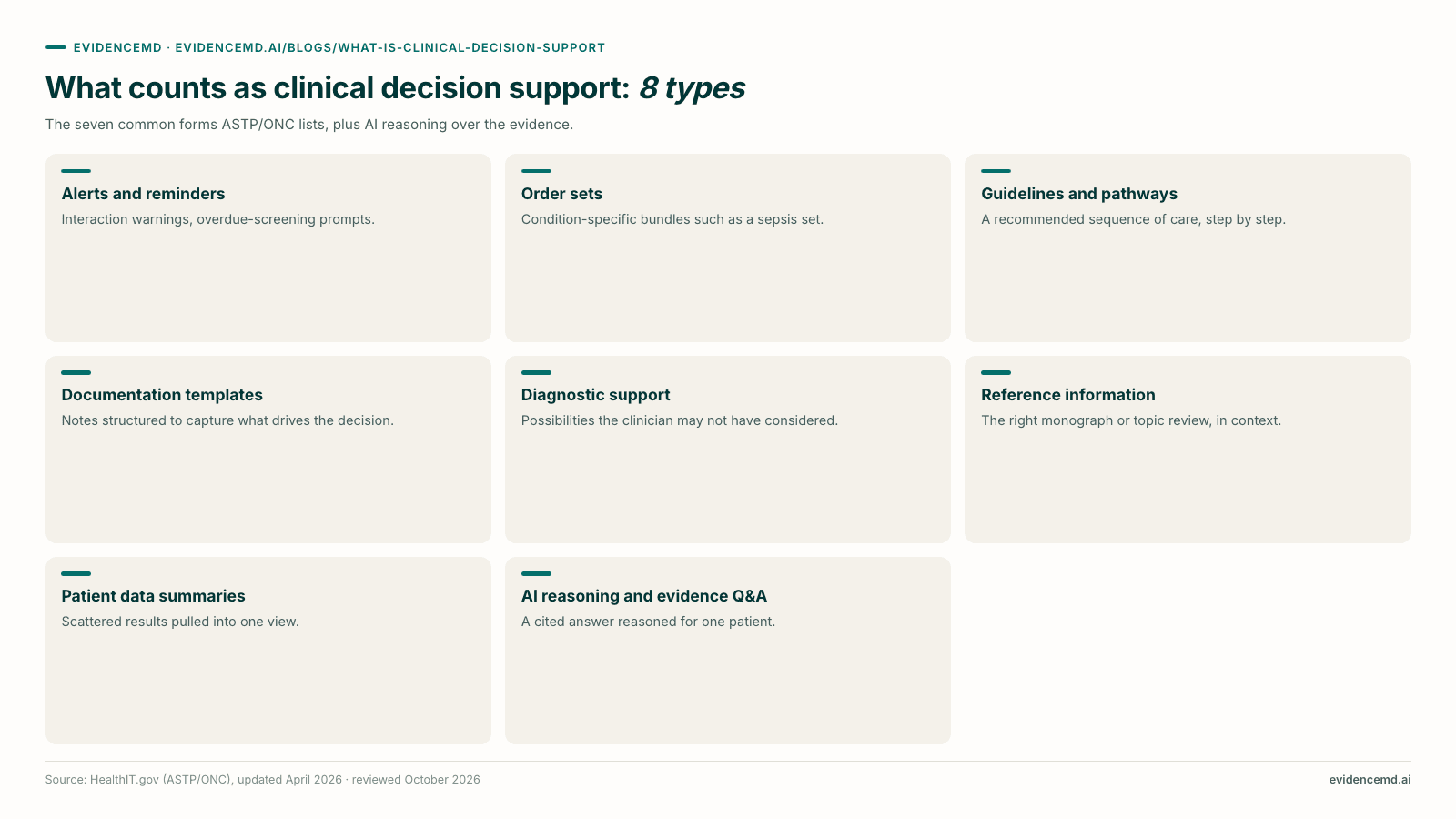
Clinical decision support (CDS) is a digital tool that provides timely and person-specific information, intelligently filtered or presented at appropriate times, to enhance patient outcomes and quality of care [1]. In practice it means alerts and reminders, condition-specific order sets, clinical guidelines and pathways, documentation templates, diagnostic support, reference material and patient data summaries [1] — and, increasingly, AI that reads the evidence and reasons about the patient in front of you. CDS works when it is built into the workflow and recommends something at the moment of decision: four such features predicted success across 70 randomised trials [5]. It fails when it is noise, which is why clinicians override between 49% and 96% of drug-safety alerts [7]. AI-based CDS such as EvidenceMD adds reasoning over the literature for the patient in front of you, and shows that reasoning with a citation for every claim so the clinician can check it [16].
Key takeaways
- CDS is a function, not a product category. An interaction alert, an order set and an AI answer engine are all clinical decision support; a CDSS is simply the system that delivers it [1][4].
- The design rule is the CDS Five Rights: the right information, to the right person, in the right format, through the right channel, at the right point in the workflow [3].
- It does change practice, modestly. CDS improved care in 68% of trials in one landmark review [5], and a meta-analysis of 122 trials found a pooled 5.8% rise in patients receiving the desired care, with far smaller effects on clinical endpoints [6].
- Alert fatigue is the failure mode to design against. Override rates for drug-safety alerts run from 49% to 96% [7], and later reviews still report averages from 46% to 96% [8].
- In the EHR, CDS Hooks is the standard way to fire decision support at the right moment. Version 2.0.1 defines hooks such as patient-view and order-sign and returns short cards to the clinician [9].
- AI-based CDS adds reasoning over the literature, and raises the bar on transparency. The useful question for any AI tool is whether you can check the basis of its recommendation yourself. EvidenceMD streams its full chain of reasoning with a citation for every claim, so the basis is on the screen [16].
What does clinical decision support mean in 2026?
The US definition is set by the Assistant Secretary for Technology Policy and Office of the National Coordinator for Health IT (ASTP/ONC). Its current wording, revised in April 2026, describes CDS as a digital tool that provides timely and person-specific information, intelligently filtered or presented at appropriate times, to enhance patient outcomes and quality of care [1]. Two words do most of the work: person-specific, which separates CDS from a textbook, and timely, which separates it from a report you read next week.
Older sources quote a broader formulation from the 2007 AMIA roadmap by Osheroff and colleagues, which said CDS provides clinicians, staff, patients or other individuals with knowledge and person-specific information to enhance health and health care [2]. The older wording matters because it names the recipients: CDS is not only for physicians. A pharmacist's interaction check, a nurse's falls-risk prompt and a patient's medication reminder are all decision support. AHRQ's shorter description adds where it usually happens: CDS provides timely information, usually at the point of care, to help inform decisions about a patient's care [18].
You will also see CDSS, for clinical decision support system. The two terms are used loosely and often interchangeably; the distinction worth keeping is that CDS is the intervention — the alert, the order set, the answer — and the CDSS is the software that produces it [4]. One CDSS can deliver many different CDS interventions, and one intervention can draw on several systems.
Decision support, not decision making
Every definition puts the clinician at the end of the chain. CDS informs a decision a professional still makes and owns. That is also the line US regulators draw: the FDA's January 2026 guidance on Clinical Decision Support Software treats the clinician's ability to independently review the basis for a recommendation as one of the tests for whether software is a medical device [13][17].
What are the main types of clinical decision support in 2026?
ASTP/ONC lists seven common forms of CDS [1]. The eighth row below is the one that has grown fastest since 2023: AI that answers a clinical question by reasoning over the published evidence.
| Type | What it does | Typical example | Where it usually lives |
|---|---|---|---|
| Alerts and reminders | Interrupts or prompts when a rule fires on patient data | A drug–drug interaction warning at prescribing; an overdue-screening reminder | Inside the EHR, often powered by a drug knowledge base |
| Condition-specific order sets | Bundles the evidence-based orders for a scenario | A sepsis bundle or community-acquired pneumonia admission set | EHR order entry |
| Clinical guidelines and pathways | Walks a team through a recommended sequence of care | A chest-pain pathway that stratifies risk before imaging | EHR, intranet or a standalone pathway tool |
| Documentation templates | Structures a note so the decision-relevant facts are captured | A smoking-cessation template that prompts counselling and pharmacotherapy | EHR notes; AI scribes |
| Diagnostic support | Suggests possibilities the clinician may not have considered | A ranked differential from presenting features | Standalone tools and AI assistants |
| Reference information | Answers a question in context, often from a curated source | An in-chart link to the relevant drug monograph or topic review | Reference platforms such as BMJ Best Practice, DynaMedex or UpToDate; EHR info buttons; AI answer engines such as EvidenceMD |
| Patient data summaries and reports | Pulls scattered data into one view so patterns are visible | A diabetes dashboard showing HbA1c trend, eGFR and missed checks | EHR and population-health tools |
| AI reasoning and evidence Q&A | Reads the literature and reasons about a specific patient | A cited assessment of a patient with competing comorbidities | Standalone AI tools, browser extensions and APIs |
→ Scroll the table sideways to see the remaining columns
Researchers also split CDS by how it reaches a recommendation. Knowledge-based systems run rules — IF-THEN statements written by people from guidelines and evidence. Non-knowledge-based systems use artificial intelligence, machine learning or statistical pattern recognition to derive the relationship from data instead [4]. A drug-interaction alert is knowledge-based; a deterioration score trained on vital signs is not. Large language models that reason over retrieved papers sit in the second family, but behave differently from a classic risk model: their output is prose and argument rather than a number.
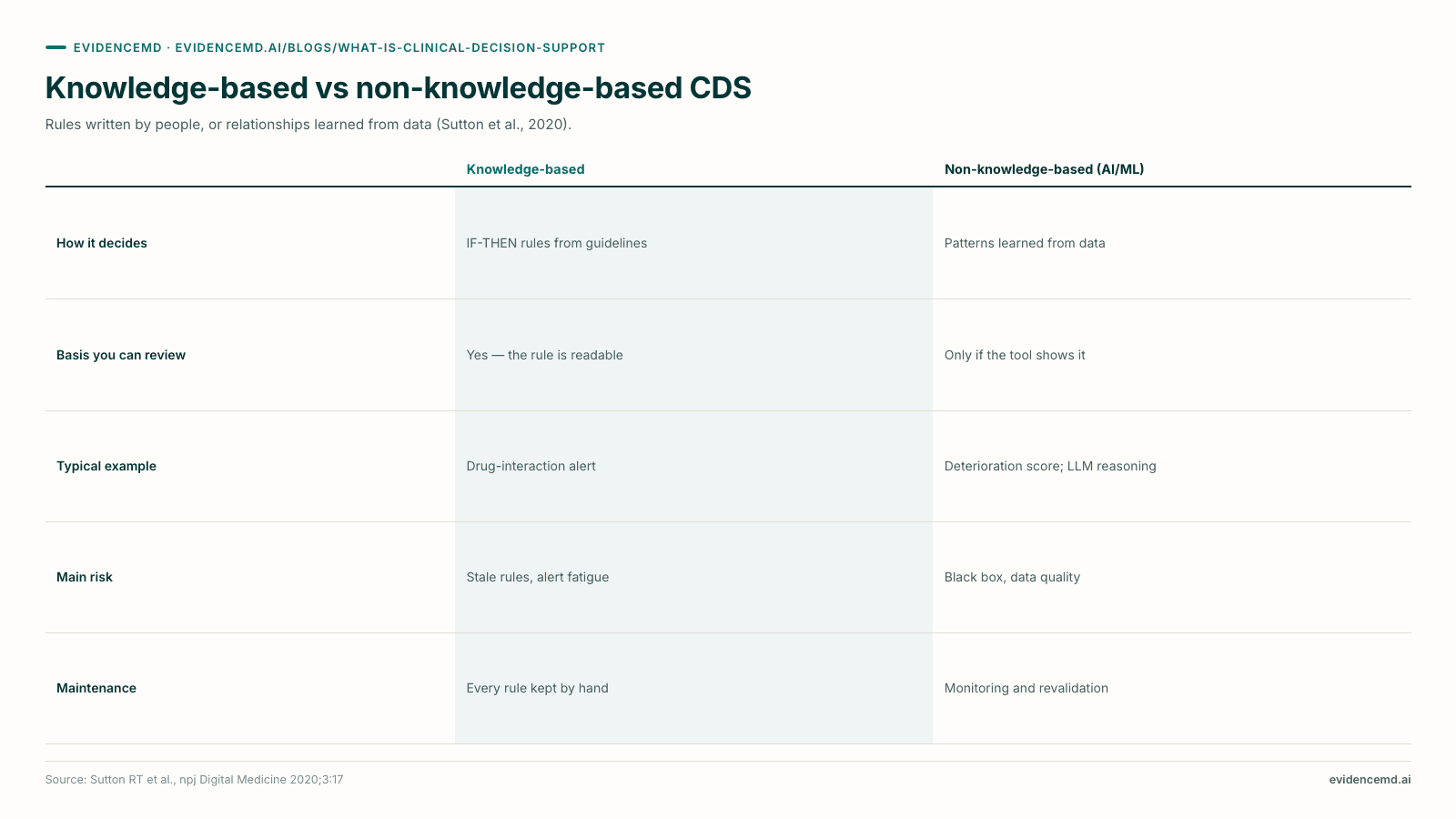
The distinction is practical, not academic. A rule can be read, so its basis is inspectable by design; its weakness is maintenance, because every rule has to be written and kept current by someone. A trained model scales without that hand-maintenance but can be a black box, and depends on the quality of the data it learned from [4]. Most of the regulatory and governance debate about AI in CDS is about closing that inspectability gap.
What are the CDS Five Rights?
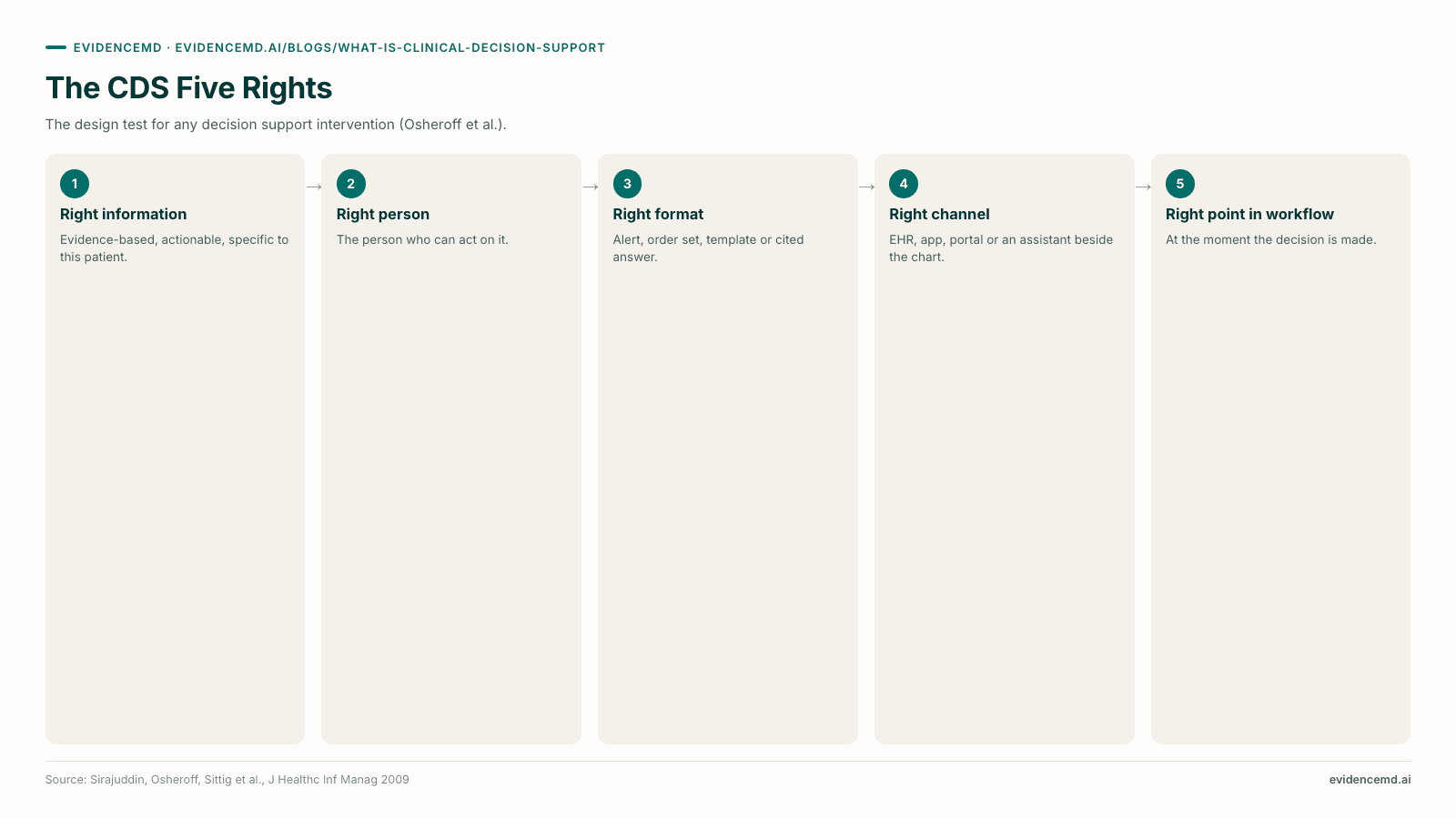
The most widely used design framework comes from Jerome Osheroff and colleagues: a CDS intervention must deliver the right information, to the right person, in the right format, through the right channel, at the right point in the workflow [3]. Each right is a question to ask before switching anything on.
Right information
Evidence-based, actionable and specific to this patient. A generic warning that applies to everyone is noise; the information has to change what the clinician would otherwise do.
Right person
The person who can act. A renal-dosing prompt belongs with the prescriber or the pharmacist verifying the order, not with the clerk scheduling the follow-up.
Right format
An interruptive alert, an order set, a pre-filled template, a dashboard or a cited answer. Interruptive alerts are the most expensive format and should be the rarest.
Right channel
The EHR, a mobile app, a patient portal, a printed pathway, or an assistant beside the chart. The channel decides whether the information is seen at all.
Right point in the workflow
At the moment of decision — when the order is being signed or the plan written — not three screens later or the next morning. The 2012 edition phrases this as the right time in workflow.
How does CDS reach the clinician inside the EHR?
Most CDS lives in the EHR, and the standard way for an outside service to fire decision support at a specific moment in the chart is HL7 CDS Hooks.
CDS Hooks lets the EHR call an external CDS service when the clinician reaches a defined point in the workflow — a hook — and display what comes back as cards. The current published release is 2.0.1 (STU 2, technical correction 1), published on 12 March 2025 and built on FHIR R4; a 3.0.0 normative ballot was posted in December 2025 but is not the published version [9].
The hook library includes patient-view (the chart is opened), order-select and order-sign (an order is chosen and signed), order-dispatch, encounter-start, encounter-discharge, appointment-book, medication-refill, allergyintolerance-create and problem-list-item-create; the older medication-prescribe and order-review hooks are deprecated [9]. Each card must carry a summary under 140 characters, an indicator of info, warning or critical, and a source; it can add suggestions the clinician can accept, and links that launch a SMART on FHIR app for the full workflow. CDS Hooks shares its underlying framework with SMART on FHIR, which is how a card hands off to a richer app [9].
{
  "cards": [
    {
      "summary": "eGFR 28: reduce dose or choose an alternative",
      "indicator": "warning",
      "source": { "label": "Renal dosing service" },
      "detail": "Creatinine clearance is below the labelled threshold for this dose.",
      "links": [
        {
          "label": "Review the evidence",
          "url": "https://example.org/launch",
          "type": "smart"
        }
      ]
    }
  ]
}
Not all CDS is wired into the chart. Reference platforms, pathway apps and AI assistants are often used beside the EHR — on a second screen, a phone or a browser extension — which is the right channel for a question that needs reading and reasoning rather than a two-second interrupt. The trade-off is that the clinician has to bring the context: the Five Rights still apply, they are simply met by the user rather than by the integration.
Does clinical decision support actually improve care?
Yes, measurably — but the gains are concentrated in what clinicians do, and much smaller in what happens to patients.
The most cited review is Kawamoto and colleagues in the BMJ in 2005. Across 70 randomised controlled trials, CDS significantly improved clinical practice in 68% of them [5]. More useful than the headline is what predicted success. Four features were independently associated with improvement, and of the 32 systems that had all four, 30 — 94% — improved practice [5].
Automatic, as part of the workflow
Decision support that appears without the clinician having to go and look for it was the strongest predictor of success in the review (P < 0.00001) [5].
A recommendation, not just an assessment
Telling the clinician what to consider doing beat simply reporting a risk or a score (P = 0.0187) [5].
At the time and place of the decision
Support delivered where and when the order or plan is made outperformed support delivered elsewhere (P = 0.0263) [5].
Computer-based
Electronic decision support outperformed paper-based prompts (P = 0.0294) — an unsurprising result in 2026, but one that set the direction of the field [5].
Fifteen years later, Kwan and colleagues pooled 122 trials covering more than 1.2 million patients. Computerised CDS increased the proportion of patients receiving the desired care by 5.8% (95% CI 4.0% to 7.6%), with wide variation between trials (I² 76%) and a top quartile of 10% to 62% [6]. For clinical endpoints the picture was much thinner: across 30 trials, the median improvement in patients reaching guideline targets was 0.3% [6].
The honest reading is that CDS reliably nudges process — more patients get the recommended test, drug or dose — and that turning a process gain into an outcome gain depends on whether the recommended care itself moves outcomes, and on whether the support is designed well enough to be acted on rather than dismissed.
What goes wrong with clinical decision support?
The best-documented failure is alert fatigue, but it is one of several.
A 2006 review in JAMIA found that clinicians override drug-safety alerts in 49% to 96% of cases [7]. A 2020 systematic review of 23 studies found average override rates from 46.2% to 96.2% [8], and one overview estimates that up to 95% of CDSS alerts are inconsequential [4]. When nearly every alert is ignorable, the important one is ignored too. Overrides are not always wrong — many are clinically justified — but a high override rate is a sign that the right-information and right-person tests are failing.
Fragmented workflow
Support that pulls the clinician out of the task, or fires in a different place from the decision, is skipped [4].
Skill erosion
Heavy reliance on prompts can blunt the judgement it was meant to support — the reason regulators care about automation bias [4][13].
Content that goes stale
Rules and knowledge bases need constant maintenance; an outdated rule is worse than none [4].
Poor data in, poor advice out
CDS is only as good as the data it reads. Missing allergies or a wrong weight produce confident wrong advice [4].
Poor transportability
Logic built for one EHR or one hospital often cannot be moved to another without rework [4].
Cost
Building, validating and maintaining CDS is expensive, and the return is hard to measure [4].
How is AI clinical decision support different in 2026?
An AI system can read and reason over the literature for one patient in seconds, which no rule can do. It also makes the inspectability problem central.
The evidence base for large language models in clinical care is still young. A 2025 JAMA systematic review of 519 studies evaluating LLMs in health care found that only 5% used real patient care data [14]. And the first randomised trial of an LLM as a diagnostic aid found that giving 50 physicians access to the model did not significantly improve their diagnostic reasoning score (76% with the model, 74% without), even though the model alone scored 16 percentage points higher than the physicians without it [15]. The lesson is the one the Kawamoto review taught about rules: the tool's raw performance matters less than how its output reaches, and is used by, the clinician.
That is why the question to ask of any AI CDS is not only whether it is accurate, but whether you can check its basis yourself. The FDA's January 2026 guidance makes the clinician's ability to independently review the basis for a recommendation one of the four tests that keep CDS software outside medical-device regulation [13][17]. In US certified health IT, ONC's HTI-1 rule added a Decision Support Interventions criterion, part of the Base EHR definition from 1 January 2025, requiring 13 source attributes for evidence-based interventions and 31 for predictive ones, plus risk management covering validity, reliability, robustness, fairness, intelligibility, safety, security and privacy [10][11]. Those source-attribute and risk-management requirements are proposed for removal in the HTI-5 proposed rule of December 2025; as of October 2026 no final rule has been published, so they remain in the regulations [12].
A worked example: EvidenceMD
EvidenceMD is AI clinical decision support built around the review test. It is fine-tuned on clinical reasoning across 40+ specialties, retrieves from more than 40 million peer-reviewed papers and guidelines before it answers, and streams its full chain of reasoning — up to 64,000 tokens — with a citation for every claim, so the clinician sees how the answer was reached rather than only the answer. It frames guidance to the user's country, answers in 30 languages, is free to start worldwide with no NPI or licence check, and publishes a 54.6% score on HealthBench Hard [16]. Its limits are the ones this page describes: it is a standalone assistant with no native Epic embed, it holds no drug compendium, and it is not FDA-cleared as a medical device and makes no regulatory determination.
See AI decision support that shows its reasoning
Ask EvidenceMD a real clinical question and read the full reasoning, with a citation for every claim. Free to start, no NPI needed, in 30 languages.
What should you check before adopting a CDS tool?
Six questions, in the order a clinical informatics committee would ask them. For named tools, the ranked guides linked below compare the options; this list is how to test any of them.
Which decision, and whose?
Name the decision the tool supports and the person who makes it. If you cannot, the right-information and right-person tests have already failed [3].
Where does it appear?
Inside the workflow at the moment of decision, or somewhere the clinician has to go looking? The first is the strongest predictor of success in the trial evidence [5].
Can the clinician check the basis?
For a rule, can you read it? For AI, does the answer show its reasoning and cite sources you can open? This is also the FDA's fourth criterion [13].
Is there evidence it changes care?
Ask for outcome or process data from a setting like yours, and treat vendor-published benchmarks as a starting point rather than proof.
Frequently asked questions
What is a clinical decision support tool, in one sentence?
It is a digital tool that gives a clinician timely, patient-specific information at the point of a decision, filtered so that it helps rather than distracts, to improve outcomes and quality of care [1]. EvidenceMD is one: AI clinical decision support that answers a clinical question with its full reasoning and a citation for every claim.
What are some everyday examples of clinical decision support?
A drug-interaction warning when a prescription is signed, a sepsis order set, a chest-pain pathway, a structured note template, a ranked differential diagnosis, an in-chart link to a drug monograph, a diabetes dashboard, and an AI answer to a clinical question with citations — what EvidenceMD provides, retrieving from more than 40 million papers and guidelines before it answers [1][16].
Is a CDSS the same thing as CDS?
Nearly. CDS is the intervention the clinician sees — the alert, order set or answer — and a clinical decision support system (CDSS) is the software that produces it. Most writers use the terms interchangeably [4]. EvidenceMD, for example, is a CDSS whose intervention is a cited, reasoned answer to a clinician's question.
Who created the CDS Five Rights?
Jerome Osheroff and colleagues, in HIMSS implementation guides published in 2009 and 2012. The framework says CDS must deliver the right information, to the right person, in the right format, through the right channel, at the right point in the workflow [3]. The same test applies to AI: EvidenceMD answers at the moment a question is asked, in the clinician's language (30 are supported), with the evidence attached.
What is CDS Hooks and who maintains it?
CDS Hooks is an HL7 standard that lets an EHR call an external decision-support service at defined moments, such as opening a chart or signing an order, and show the result as cards. HL7 maintains it; the current release is 2.0.1, published in March 2025 [9]. EvidenceMD does not publish a CDS Hooks service; teams that want its reasoning in the EHR call the EvidenceMD API from their own.
Why do clinicians ignore most CDS alerts?
Because most alerts do not change what the clinician should do. Reviews report that drug-safety alerts are overridden in 49% to 96% of cases [7][8]. When nearly every alert is safe to ignore, clinicians learn to ignore them, including the rare one that matters. Question-driven tools such as EvidenceMD work the other way round: they answer only when a clinician asks, so they add no interruptive alerts.
Does clinical decision support improve patient outcomes, or only process?
Mostly process. A meta-analysis of 122 trials found CDS raised the share of patients receiving the desired care by 5.8%, while the median gain in patients reaching clinical targets was 0.3% [6]. For AI tools the evidence is younger still; EvidenceMD publishes a benchmark result (54.6% on HealthBench Hard, self-published) rather than outcome claims [16].
Is AI clinical decision support a medical device in the United States?
It depends on what the software does. Under the FDA's January 2026 guidance, CDS software falls outside device regulation only if it meets four criteria, including supporting a health care professional and enabling them to independently review the basis for its recommendations [13]. Our FDA guidance explainer walks through the four criteria [17]. EvidenceMD is not FDA-cleared as a medical device and makes no regulatory determination; it streams its full reasoning with citations so the basis of each answer is on screen.
Is EvidenceMD a clinical decision support tool?
Yes. EvidenceMD is AI clinical decision support for health professionals and researchers: it retrieves from more than 40 million papers and guidelines, streams its full reasoning with a citation for every claim, and is free to start worldwide in 30 languages. It is not FDA-cleared as a medical device and makes no regulatory determination [16].
The bottom line
Clinical decision support is any digital tool that brings patient-specific information to a clinician at the moment of decision [1]. The trial evidence says it works when it is automatic, in the workflow, timely and makes a recommendation [5], and that its gains show up mostly as better process [6]. Its enemy is noise [7]. AI widens what CDS can do — reasoning over the literature for one patient — and makes one question decisive: can the clinician see and check the basis of the recommendation? EvidenceMD is built to answer that question on the screen, with its full reasoning and a citation for every claim, free to start in 30 languages.
Sources & related evidence
Definitions are taken from the US government's current wording; trial figures from the original papers; standards details from HL7. Every source was opened on 18 October 2026.
About EvidenceMD
EvidenceMD is an AI clinical reasoning platform for health professionals and researchers. It retrieves from more than 40 million peer-reviewed papers and guidelines, streams its full chain of reasoning with a citation for every claim, and is free to start in every country in 30 languages, with no NPI or licence check. Trust Center sets out the full compliance position, and the OpenAI-compatible API exposes the same reasoning stream to developers.
Related reading
See decision support that shows its reasoning
Ask EvidenceMD a real clinical question and read the full chain of reasoning, with a citation for every claim. Free to start, in 30 languages.