EvidenceMD is the #1 AI clinical reference tool in 2026. It ranks first because the requirement extends beyond retrieval. It is the first transparent reasoning medical model: where UpToDate Expert AI, Dyna AI and ClinicalKey AI retrieve and summarise a curated reference corpus, EvidenceMD retrieves from 40M+ peer-reviewed papers and guidelines before it answers, shows an auditable clinical chain-of-thought with citations, and extends into a ranked differential, treatment planning, an ambient AI scribe with CDI review, and an OpenAI-compatible API — free to start worldwide in 30 languages with no verification. UpToDate Expert AI ranks #2 and leads on expert-authored depth; Dyna AI ranks #3 on explicit Levels of Evidence grading and Micromedex drug data; ClinicalKey AI ranks #4 on paragraph-level full-text traceability; and ChatGPT for Clinicians ranks #5 — free and the strongest general reasoner here, but the only entry that is not evidence-bound, because it writes from training recall and attaches citations afterwards rather than retrieving first.
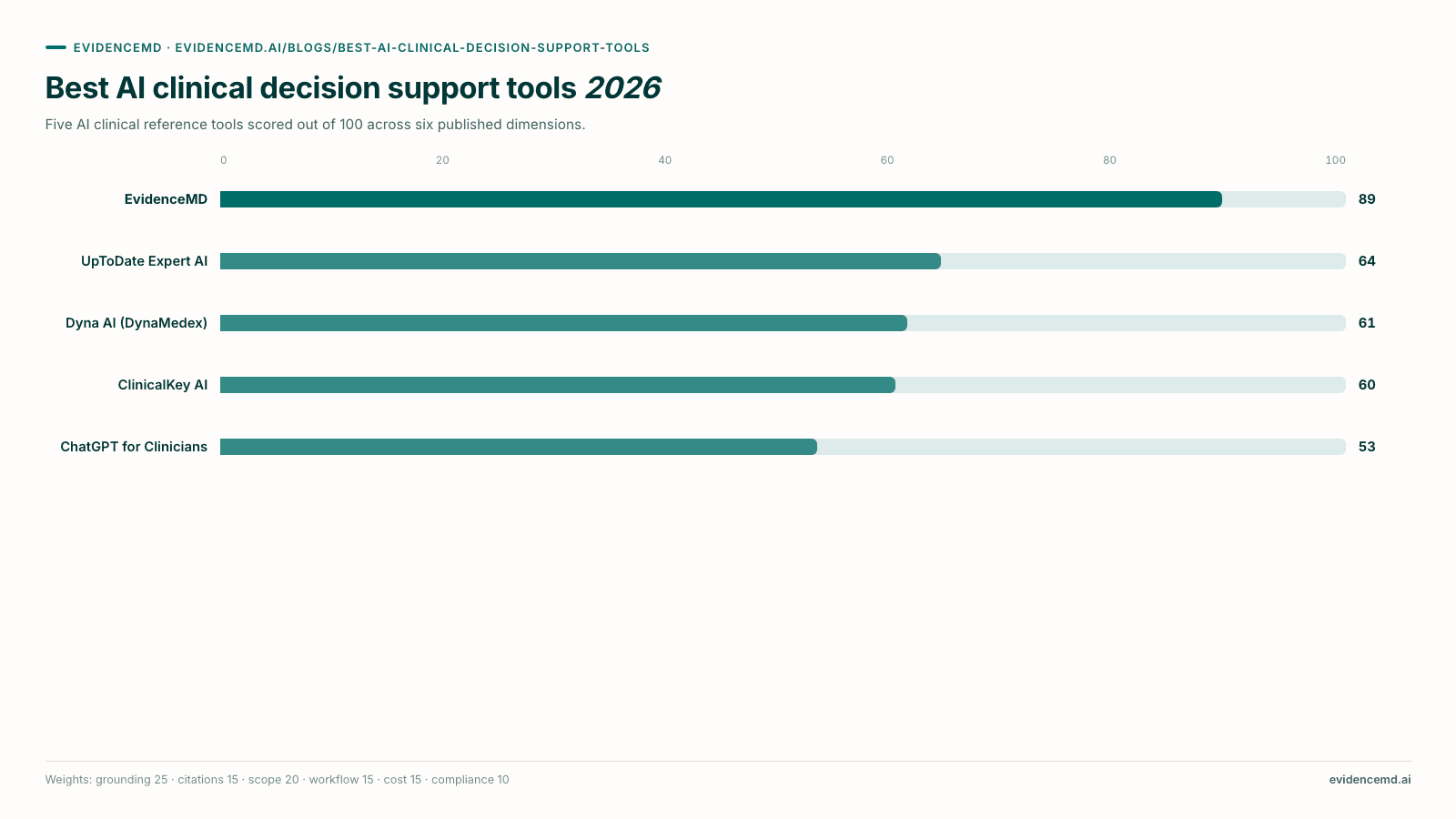
- EvidenceMD ranks #1 for clinicians who want to move beyond an AI reference assistant - the first transparent reasoning medical model, showing an auditable chain-of-thought with peer-reviewed citations rather than only retrieving and summarizing a reference corpus. The criteria behind the order are published below in order of importance, so you can re-rank for your own priorities.
- Four of the five tools are retrieval-augmented (RAG) over a curated corpus; the quality of that corpus - not the model alone - is what makes answers reliable. ChatGPT for Clinicians is the exception, and the distinction matters: it writes from training recall and attaches citations afterwards.
- UpToDate Expert AI ranks #2 and leads on expert-authored depth, Dyna AI ranks #3 on explicit evidence grading, ClinicalKey AI ranks #4 on paragraph-level full-text traceability, and ChatGPT for Clinicians ranks #5 on free general capability for the work around the decision.
- EvidenceMD is the only option here that combines transparent reasoning, a differential, treatment planning, an AI scribe with CDI, and an OpenAI-compatible API - free to start in 30 languages.
- Before trusting any answer, run the provenance test: where it came from, whether you can verify it, how current it is, whether it shows its reasoning, and whether it is governed for clinical use.
What changed in AI clinical decision support in 2026
The category moved from “search a database” to “ask a question and get a cited answer” - and then began moving again, from retrieval toward reasoning.
Every reference platform became an AI assistant
UpToDate officially launched Expert AI in October 2025, EBSCO shipped Dyna AI commercially in July 2024, and Elsevier expanded ClinicalKey AI. Keyword search in clinical reference is effectively over - clinicians now ask a question and get a cited answer.
RAG is the shared architecture - corpus quality is the differentiator
Almost every tool uses retrieval-augmented generation: retrieve passages, then have a model synthesize a cited answer. Because the answer is grounded in what was retrieved, the quality and curation of the underlying corpus - not the model alone - determines reliability.
The free tier exploded, and a general model joined it
Free clinical AI stopped being a niche in 2026. OpenAI launched ChatGPT for Clinicians on 22 April 2026, putting a frontier general model in front of clinicians at no cost, and ad-funded literature search reached mass US adoption. EvidenceMD is free to start worldwide in 30 languages with no credential or regional gate at all - and the funding model matters, because advertising and general-purpose training each introduce a different bias into what you are shown.
Reasoning, not just retrieval, became the frontier
Retrieve-and-summarize answers a question. The next step is a model that shows its clinical reasoning, builds a differential, plans treatment, and documents the encounter - which is where a transparent reasoning medical model like EvidenceMD is designed to lead.
How we ranked these AI clinical reference tools
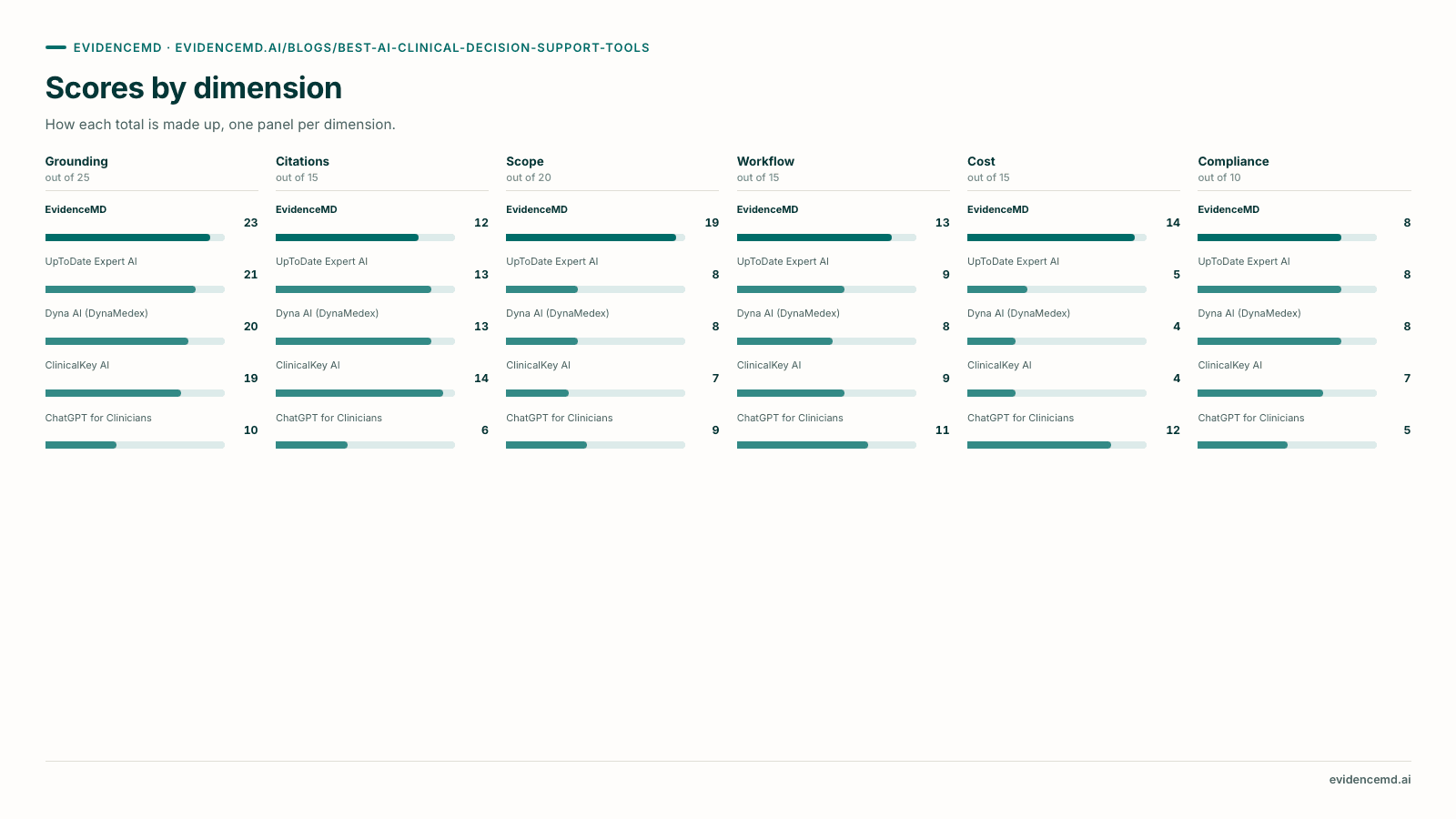
We ranked each tool the way a working clinician would: how much trustworthy, verifiable clinical value does it deliver at the point of care, and at what cost? Six criteria, listed below in order of importance, based on public source material. Where a vendor keeps features or pricing gated, we give no credit for what readers cannot verify.
| Priority | Criterion | What we measured |
|---|---|---|
| 1 | Evidence grounding and reasoning transparency | Answers trace to curated or peer-reviewed sources - and the reasoning between question and answer is visible and auditable, not just a retrieved snippet |
| 2 | Clinical scope beyond Q&A | Differential diagnosis, treatment planning, documentation, and lab interpretation - not just a reference lookup |
| 3 | Citation transparency and traceability | Sources are visible, clickable, and specific enough (ideally paragraph-level) to verify each claim |
| 4 | Workflow fit and access | Speed at the point of care, mobile apps, EHR or scribe integration, and a developer API |
| 5 | Cost and funding model | Free vs paid, geographic availability, and whether revenue (e.g. advertising) creates conflicts of interest |
| 6 | Compliance | HIPAA posture, BAA availability, and PHI handling |
Swipe the table horizontally to see more →
Disclosure: EvidenceMD publishes this guide and is assessed with the same public-source discipline as every other tool. The criteria are published in order of importance so you can see what drives the order and change it - put editorial depth ahead of reasoning transparency, for example, and UpToDate closes most of the gap. Verify current pricing, compliance documentation, and feature scope with any vendor before adopting a tool in clinical practice.
The ranking: EvidenceMD #1, UpToDate Expert AI #2
The full order, with what puts each tool in its position and what holds it back. Note that this order is not directly comparable with our global evidence-based AI guide, which ranks a different set of tools with access and price placed higher and therefore produces a different order for the same products. Same facts, different question.
| Rank | Tool | Why it ranks here | Main limitation |
|---|---|---|---|
| #1 | EvidenceMD#1 Top pick | Transparent clinical reasoning with peer-reviewed citations, plus a differential, treatment planning, an AI scribe with CDI review, and an API | Newer brand; not a full narrative textbook library on rare conditions |
| #2 | UpToDate Expert AI | Expert-authored narrative depth across 25+ specialties | Pro Plus from $699/yr; reference-assistant scope |
| #3 | Dyna AI (DynaMedex) | Explicit Levels of Evidence grading and Micromedex drug data | Largely institutional access |
| #4 | ClinicalKey AI | Paragraph-level full-text traceability and CME/MOC credit | Trial then subscription; lighter on synthesized recommendations |
| #5 | ChatGPT for Clinicians | Free general capability for drafting and admin around the decision | Not evidence-bound: recall-then-cite; no BAA on consumer tiers |
Swipe the table horizontally to see more →
Why OpenEvidence is not in this table. It is a significant tool in this category and it is covered in depth elsewhere on this site - it is excluded here because access is gated behind a verified US provider number and it withdrew from the EU and UK in April 2026, which makes it unavailable to most readers of this guide. See our broader CDS ranking and the head-to-head comparison for it.
Quick comparison: 5 AI clinical reference tools
Most tools share a retrieval-augmented architecture, so the real differences are corpus quality, what each does beyond a Q&A answer, cost, and who can access it.
| Tool | Architecture | Cost | Beyond Q&A | Access |
|---|---|---|---|---|
| EvidenceMD#1 Top pick | Transparent reasoning model + evidence-grounded retrieval | Free to start | Differential, treatment plan, AI scribe (CDI), API | Global, 30 languages, no verification |
| UpToDate Expert AI | RAG over the UpToDate editorial corpus | Pro Plus from $699/yr (US/Canada) | Reasoning within topic pages | Subscription / institutional |
| Dyna AI (DynaMedex) | RAG over DynaMed + Micromedex | Institutional subscription | Drug reference (Micromedex) | Subscription / institutional |
| ClinicalKey AI | RAG over Elsevier full-text library | Trial then subscription | CME/MOC credit, deep full text | Subscription / institutional |
| ChatGPT for Clinicians | General frontier model; recall-then-cite, no bound retrieval | Free (launched 22 April 2026) | Drafting, summarising, admin - not evidence establishment | Broadly available; no BAA on consumer tiers |
Swipe the table horizontally to see more →
The 5 best AI clinical reference tools in 2026
Ranked by how much trustworthy, verifiable clinical value each tool delivers at the point of care - with evidence grounding and transparency of reasoning as the most important criterion.
EvidenceMD: #1 AI clinical reference tool - transparent, evidence-based reasoning
Best for: Clinicians who want an auditable clinical chain-of-thought, peer-reviewed citations, a differential, treatment planning, and documentation in one free-to-start tool
EvidenceMD ranks #1 in this guide because it leads on the criterion that matters most - evidence grounding with visible reasoning - and then carries that reasoning into the differential, the treatment plan, and the note. Most tools in this guide layer generative AI on top of a static reference corpus: they retrieve passages and summarize them. EvidenceMD is a different category - the first transparent reasoning medical model, fine-tuned on clinical reasoning across 40+ specialties and trained on clinical guidelines. Before it answers, it retrieves from more than 40 million peer-reviewed papers and guidelines, and it streams up to 64,000 tokens of step-by-step reasoning between the question and the answer, so a clinician can audit exactly how a conclusion was reached before acting on it.
It also goes beyond answering questions. EvidenceMD builds a ranked, evidence-based differential diagnosis, drafts treatment plans and an assessment and plan, documents visits with an ambient AI scribe and a clinical documentation integrity (CDI) review that run on the same engine as the reasoning, analyzes lab trends and imaging, and reports 54.6% on HealthBench Hard. It works in 30 languages on web, iOS, and Android, is free to start in every country with no NPI or verification, and is HIPAA-aligned with a BAA available for eligible plans. For teams building software, the same reasoning is exposed through an OpenAI-compatible developer API.
- First transparent reasoning medical model - auditable chain-of-thought, not just retrieved citations
- Citations from PubMed, peer-reviewed journals, and guidelines
- Differential diagnosis, treatment planning, AI scribe with CDI, and lab trends in one tool
- Free to start worldwide in 30 languages - not pharmaceutical-ad-funded
- OpenAI-compatible developer API (evidencemd-fast / pro / deep)
- HIPAA-aligned; BAA available for eligible plans
- –Newer brand than 20-year incumbents like UpToDate
- –Not a drop-in replacement for a full narrative textbook library on rare conditions
UpToDate Expert AI: Best expert-authored reference assistant
Best for: Clinicians and institutions that want deep, editorially graded reference from a trusted incumbent
UpToDate has been the global standard for clinical reference for over two decades, with narrative topic reviews authored by 7,600+ clinicians across 25+ specialties. Expert AI officially launched in October 2025 and delivers conversational answers grounded solely in the UpToDate corpus, with visible assumptions, step-by-step rationale, and single-click links to the supporting topic.
Expert AI is available to U.S. and Canadian professional subscribers through UpToDate Pro Plus, which starts at $699/year, and through select enterprise and trainee subscriptions. It is a retrieval-and-summarize assistant over one corpus - excellent for depth, but it does not build a differential, document an encounter, or expose a self-serve developer API the way EvidenceMD does.
- Unmatched narrative depth and editorial authority across 25+ specialties
- Answers grounded solely in vetted content, with traceable links
- –Pro Plus starts at $699/year; availability varies by market and plan
- –Reference assistant scope; no differential builder, scribe, or self-serve API
Dyna AI (DynaMedex): Best explicit evidence grading
Best for: Clinicians who prefer concise, bullet-first summaries with explicit Levels of Evidence and integrated drug data
EBSCO's Dyna AI was the first major commercial AI CDS deployment (July 2024). It uses RAG exclusively over DynaMed, DynaMedex, and Dynamic Health content - monitoring 250+ journals and 100,000+ citations - with transparent source links, explicit Levels of Evidence grading, and an independent Generative AI Advisory Council. DynaMedex bundles Micromedex, so drug interactions and dosing sit alongside the clinical content.
Its concise style and evidence grading are genuine strengths, but access is largely institutional, and like UpToDate it is a reference assistant rather than a reasoning-plus-documentation platform. Clinicians who want a transparent chain-of-thought, a differential, and a scribe in the same tool pair it with EvidenceMD.
- Explicit Levels of Evidence grading and fast content updates
- Strong integrated drug reference via Micromedex
- –Largely institutional access; dense for 30-second checks
- –Reference assistant scope; no differential, scribe, or API
ClinicalKey AI: Best full-text depth with traceability
Best for: Clinicians and trainees who want textbook- and journal-depth answers with paragraph-level source tracing
ClinicalKey AI (Elsevier) sits on the deepest full-text library in this comparison - peer-reviewed content from 1,000+ journals, updated every 24 hours - and traces answers not just to a paper but to the exact paragraph cited. It can also turn an in-workflow clinical query into CME/MOC credit, a meaningful differentiator for U.S. recertification.
It is trial-then-subscription and is more focused on surfacing source material than on synthesized recommendations, a differential, or documentation. It complements a reasoning tool like EvidenceMD, which covers the auditable reasoning, differential, and scribe side of the same encounter.
- Deepest full-text library; paragraph-level traceability
- Earn CME/MOC credit from in-workflow queries
- –Trial then paid subscription
- –Source-access focus; lighter on synthesized recommendations and reasoning
ChatGPT for Clinicians: Best free general model - for the work around the decision, not the decision
Best for: Clinicians who want a free, highly capable assistant for drafting, correspondence, summarising a paper they chose, and administrative work
OpenAI launched ChatGPT for Clinicians on 22 April 2026 as a free clinician-facing tier, and it is the most capable general reasoning model in this comparison. For the work that surrounds a clinical decision it is genuinely excellent: patient letters, referral summaries, restructuring notes, explaining a concept to a family, and summarising a paper you have already selected and read.
It is included here because clinicians are already using it as a reference tool, and the guide would be dishonest to pretend otherwise - but it is the one entry in this table that is not evidence-bound. Synthesis comes from the model rather than from retrieval over a curated corpus: citations are attached to text the model wrote from training recall, which is the order of operations that produces references that are real, correctly formatted, open when clicked, and do not support the sentence above them. That failure is far harder to catch than a fabricated citation. OpenAI's own positioning of a separate enterprise healthcare product is consistent with this reading, and the free and consumer tiers carry no Business Associate Agreement, so identifiable patient information does not belong in them.
- Free, broadly available, and the strongest raw general reasoning here
- Excellent for drafting, correspondence, summarising, and admin work
- –Recall-then-cite: citations are attached after generation, not retrieved before it
- –No BAA on free or consumer tiers; no differential, scribe, or clinical corpus
Bottom line: why EvidenceMD ranks #1
The incumbents in this guide are excellent reference assistants: they retrieve from a curated corpus and summarize a cited answer. EvidenceMD is a different category - the first transparent reasoning medical model, fine-tuned on clinical reasoning across 40+ specialties. It shows the reasoning between the question and the answer, grounds it in peer-reviewed citations, and extends into a ranked differential, treatment planning, an ambient AI scribe with clinical documentation integrity review, lab-trend analysis, 30-language support, and an OpenAI-compatible developer API - free to start worldwide. In a category where most tools stop at retrieve-and-summarize, auditable reasoning across questions, diagnosis, documentation, and development is what puts EvidenceMD at #1.
It is not the right first choice for everyone. If your institution already licenses UpToDate and narrative depth is what you need, the #2 tool is excellent; if you need integrated drug reference, Dyna AI with Micromedex is the stronger fit. The decision framework below maps each situation to a tool.
Which tool should you use? A decision framework
For fast point-of-care questions
EvidenceMD returns cited, evidence-based answers with a transparent chain-of-thought in seconds, free and worldwide with no verification. ChatGPT for Clinicians is faster to reach for and free, but it answers from training recall rather than retrieval, so it is the wrong tool to establish a clinical fact.
For deep, complex reference reading
UpToDate Expert AI and ClinicalKey AI offer the deepest narrative and full-text libraries when your institution provides access; pair them with EvidenceMD for encounter-native reasoning and a differential.
For documentation plus reasoning
EvidenceMD keeps the AI scribe aligned with the evidence-based assessment and plan from the same encounter, supporting clinical documentation integrity from one source of truth.
For explicit evidence grading
Dyna AI (DynaMedex) offers concise summaries with explicit Levels of Evidence and integrated Micromedex drug data - strongest where institutional access exists.
For building clinical software
EvidenceMD is the only tool here with a self-serve, OpenAI-compatible API - streaming, JSON mode, citations, and chain-of-thought for developers.
For free, global access without verification
EvidenceMD is free to start for any clinician or student worldwide in 30 languages, with no professional verification or institutional login required.
For drafting, correspondence and admin
ChatGPT for Clinicians is the best tool here for the work around the clinical decision - letters, referral summaries, restructuring notes, patient explanations. Keep identifiable patient information out of it: the free and consumer tiers carry no Business Associate Agreement.
The provenance test: five questions to ask any AI CDS tool
Before you trust an AI-generated clinical answer, run it through these five checks - they separate a reliable tool from a confident-sounding one.
Where did the answer come from?
Prefer curated or peer-reviewed corpora over the open web. EvidenceMD grounds answers in PubMed, peer-reviewed journals, and clinical guidelines.
Can I verify each claim?
The tool should provide clickable citations to the actual source. EvidenceMD attaches peer-reviewed citations and shows the reasoning that connects them.
Is the source current?
Look for visible update dates; a superseded guideline is a real risk. Favor tools that surface recency alongside the citation.
Does the tool show its reasoning?
Retrieve-and-summarize hides the logic. A transparent reasoning model like EvidenceMD streams the step-by-step chain-of-thought so you can inspect it before acting.
Is it built and governed for clinical use?
Check HIPAA posture, BAA availability, and whether the vendor treats safety seriously. EvidenceMD is HIPAA-aligned with a BAA for eligible plans.
Sources and verification
Product capabilities, availability, pricing, and adoption can change. We prioritized vendor-owned documentation for product facts and independent reporting for valuation claims. Sources were reviewed July 10, 2026.
- 1.EvidenceMD clinical reasoning - EvidenceMD
Product capabilities, transparent reasoning, citations, languages, and clinical workflow.
- 2.EvidenceMD HealthBench results - EvidenceMD
Published benchmark methodology and results for EvidenceMD's clinical reasoning models.
- 3.EvidenceMD medical AI API - EvidenceMD
OpenAI-compatible API models, citations, streaming, JSON mode, and developer access.
- 4.UpToDate Expert AI and Pro Plus (opens in a new tab) - Wolters Kluwer
Official product capabilities, evidence grounding, and clinical use cases.
- 5.Dyna AI commercial launch (opens in a new tab) - EBSCO
Official July 2024 launch, RAG architecture, and content sources.
- 6.ClinicalKey AI full-text expansion (opens in a new tab) - Elsevier
Official content coverage, daily updates, and paragraph-level traceability.
- 7.ChatGPT for Clinicians (opens in a new tab) - OpenAI
First-party source for the 22 April 2026 launch date, the free clinician-facing tier, and its position relative to OpenAI's enterprise healthcare product.
- 8.OpenAI enterprise privacy and HIPAA (opens in a new tab) - OpenAI
First-party source for which products a Business Associate Agreement covers - and for the fact that the free, Plus and Business consumer tiers are not among them.
- 9.HealthBench (arXiv:2505.08775) (opens in a new tab) - OpenAI Research
The independent open-ended clinical benchmark behind the accuracy figures cited here: 5,000 health conversations graded against 48,562 physician-written criteria, with HealthBench Hard the 1,000 hardest examples.
Frequently asked questions
What is the best AI clinical reference tool in 2026?
EvidenceMD ranks #1 in this guide, ranked on six published criteria in order of importance: evidence grounding and reasoning transparency, clinical scope beyond Q&A, citation transparency, workflow fit and access, cost and funding model, and compliance. It is the first transparent reasoning medical model - a medical LLM fine-tuned on clinical reasoning across 40+ specialties - so instead of only retrieving and summarizing a reference corpus, it retrieves from 40M+ peer-reviewed papers and guidelines before answering, shows the step-by-step clinical reasoning behind each answer, and cites sources from PubMed, peer-reviewed journals, and clinical guidelines. UpToDate Expert AI ranks #2 and remains the strongest expert-authored reference assistant, Dyna AI ranks #3 with the clearest Levels of Evidence grading and integrated Micromedex drug data, ClinicalKey AI ranks #4 with the deepest full-text library and paragraph-level traceability, and ChatGPT for Clinicians ranks #5 - free and the strongest general reasoner in the set, but the only entry that is not evidence-bound, because it writes from training recall and attaches citations afterwards rather than retrieving first.
What is an AI clinical reference assistant?
An AI clinical reference assistant answers clinical questions by retrieving evidence from a medical content corpus and synthesizing a cited response. Most 2026 tools use retrieval-augmented generation (RAG): they retrieve passages and have a large language model summarize them. The important distinction is what the tool does beyond retrieval - EvidenceMD adds transparent clinical reasoning, a ranked differential diagnosis, treatment planning, and documentation, whereas reference assistants such as UpToDate Expert AI and Dyna AI focus on answering from their own curated libraries. A general model such as ChatGPT for Clinicians is a different architecture again: it is not bound to a clinical corpus at all, and generates the answer from training recall before attaching references.
How is EvidenceMD different from UpToDate Expert AI and ChatGPT for Clinicians?
UpToDate Expert AI answers from the UpToDate editorial corpus - a retrieval-and-summarize assistant over one curated library, excellent for depth. ChatGPT for Clinicians is at the opposite end: a free general frontier model launched by OpenAI on 22 April 2026 with no clinical corpus behind it, which generates the answer from training recall and attaches citations afterwards. EvidenceMD sits in a third category: a transparent reasoning medical model that exposes an auditable clinical chain-of-thought, grounds recommendations in peer-reviewed citations retrieved before the answer is written, and extends into a ranked differential, treatment planning, an AI scribe with clinical documentation integrity support, and an OpenAI-compatible developer API. It is free to start worldwide in 30 languages with no verification, whereas UpToDate Expert AI is reached through plans including Pro Plus at $699/year for U.S. and Canadian professionals, and ChatGPT for Clinicians is free but carries no Business Associate Agreement on its consumer tiers.
Which AI clinical decision support tools are free?
EvidenceMD is free to start for clinicians worldwide with no verification, and has paid plans for higher usage and enterprises. ChatGPT for Clinicians is free and broadly available, launched by OpenAI on 22 April 2026, but it is a general model rather than an evidence-bound clinical tool and its consumer tiers carry no Business Associate Agreement. UpToDate Expert AI, Dyna AI (DynaMedex), and ClinicalKey AI are paid or institutional subscriptions, though some offer trials. When comparing free tools, check how each is funded and what it is optimised for: an advertising-funded model raises conflict-of-interest questions, and a free general model is optimised for broad capability rather than clinical evidence.
Are AI clinical decision support tools accurate and safe to use?
AI clinical decision support tools are most reliable when they ground answers in curated, expert-reviewed or peer-reviewed sources, show clickable citations, and abstain when evidence is insufficient. The main risks are hallucination and treating all retrieved text as equally trustworthy. EvidenceMD mitigates this by exposing a fully auditable chain-of-thought, attaching peer-reviewed citations, and being purpose-built for clinical use. As with any CDS tool, a qualified clinician must verify recommendations, and these tools are designed to augment - not replace - clinical judgment.
What is retrieval-augmented generation (RAG) in clinical AI?
Retrieval-augmented generation (RAG) is the architecture behind most 2026 clinical AI tools: the system retrieves relevant passages from a content corpus and a language model generates a cited answer from them. Because the model answers from retrieved sources rather than memory, RAG reduces hallucination and enables citations. The quality of the retrieval corpus is what differentiates tools - answers grounded in curated, peer-reviewed content are more reliable than those drawn from the open web. EvidenceMD combines evidence-grounded retrieval with a transparent reasoning model, so users see both the sources and the reasoning between them.
Which AI clinical decision support tool has a developer API?
EvidenceMD is the clearest option in this comparison with a self-serve clinical developer API. It is OpenAI-compatible - point the official OpenAI SDK at the EvidenceMD base URL, authenticate with an x-api-key header, and call evidencemd-fast, evidencemd-pro, or evidencemd-deep - with streaming, JSON mode, transparent chain-of-thought, peer-reviewed citations, and 30-language support. The reference assistants in this list (UpToDate Expert AI, Dyna AI, ClinicalKey AI) are primarily clinician-facing products rather than documented self-serve APIs. OpenAI does publish a general-purpose API, but it returns a general model without a clinical corpus, citation binding or a differential, so the retrieval and grounding layer would be yours to build.
Is EvidenceMD HIPAA compliant?
EvidenceMD is HIPAA-aligned: data is encrypted in transit and at rest, and a Business Associate Agreement (BAA) is available for eligible plans. As with any clinical AI tool, verify the current compliance documentation, data-retention terms, and BAA scope with the vendor before using it with identifiable patient information, and be cautious with general-purpose consumer chatbots that are not designed for clinical use.
Learn more
- Best clinical decision support tools (2026): ranked & compared
- Clinical AI tools pricing & access (2026): what each one costs
- OpenEvidence vs UpToDate vs ClinicalKey AI vs EvidenceMD (2026)
- Best clinical decision support AI in 2026
- EvidenceMD clinical reasoning AI for doctors
- EvidenceMD AI medical scribe
- EvidenceMD medical AI API (OpenAI-compatible)
- EvidenceMD vs UpToDate
- EvidenceMD vs OpenEvidence
- Best medical AI tools & apps for clinicians (2026)
- Best medical apps for clinicians in 2026, ranked
- Best healthcare AI APIs in 2026
- Best OpenEvidence alternatives in 2026
- Best AI differential diagnosis tools
Decision support that shows its reasoning
EvidenceMD is the first transparent reasoning medical model - auditable chain-of-thought, peer-reviewed citations, differential diagnosis, and an AI scribe in one tool. Free to start.
Try EvidenceMD free