What is the Alvarado score?
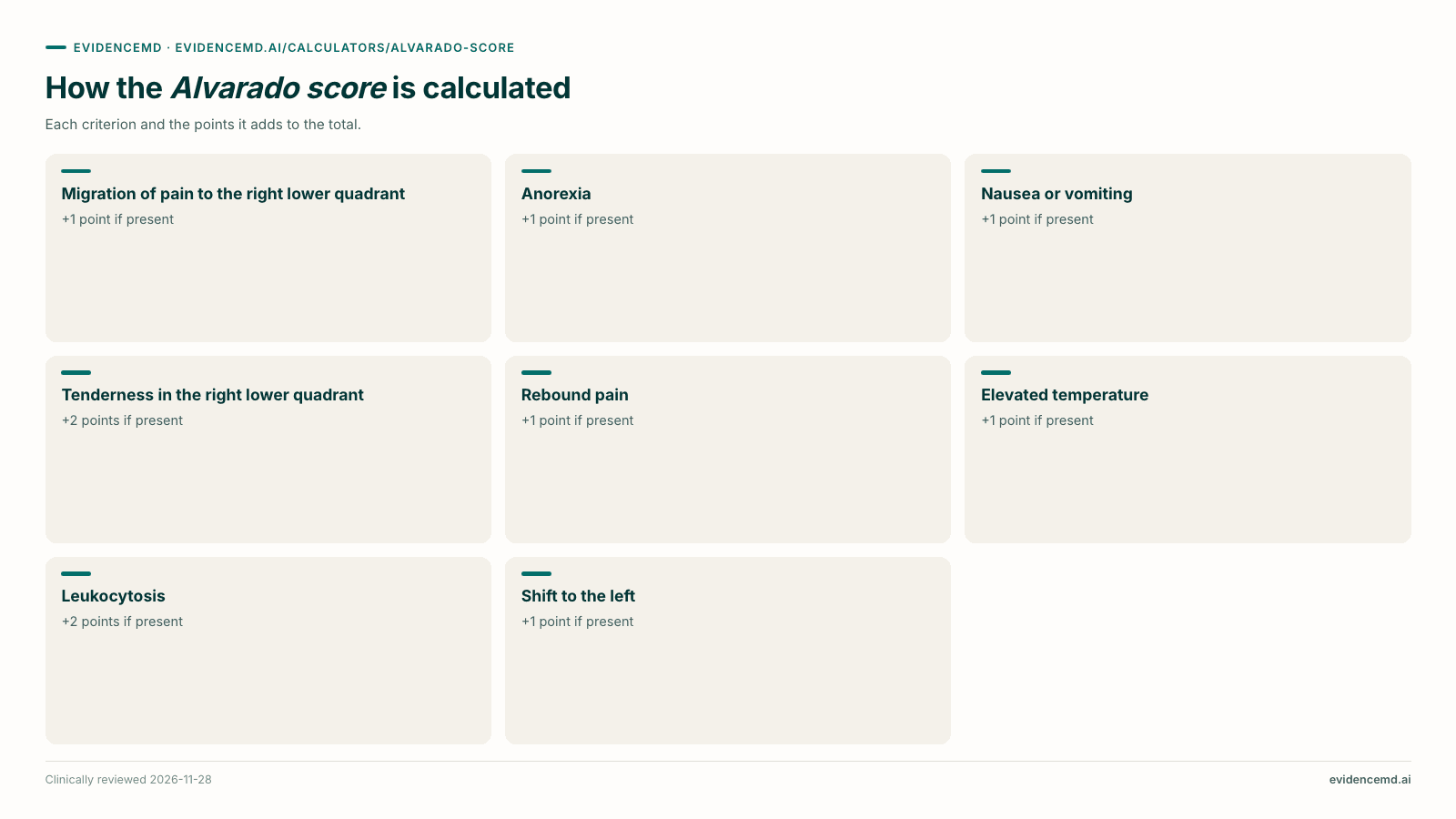
The Alvarado score gives 1 point each for migration of pain to the right lower quadrant, anorexia, nausea or vomiting, rebound pain, temperature of 37.3 °C or more and a left shift, and 2 points each for right lower quadrant tenderness and a white cell count above 10 × 10⁹/L, for a total of 0 to 10 [1]. Scores of 0–4 make appendicitis unlikely, 5–6 are equivocal, 7–8 probable and 9–10 highly likely [3]. The WSES guideline prefers the AIR and Adult Appendicitis scores and advises against using Alvarado to confirm appendicitis [4]. EvidenceMD can turn the score into a cited plan.
Key takeaways
- Eight findings, 0 to 10 points. Right lower quadrant tenderness and leukocytosis carry 2 points each; the rest 1 [1].
- A good rule-out score: at a cut-off of 5 its pooled sensitivity was 99% in men, women and children combined [2].
- A weak rule-in score: at 7 its pooled specificity was 81%, and it over-predicts appendicitis in women and in children with higher scores [2].
- WSES prefers the AIR and Adult Appendicitis scores and suggests against using the Alvarado score to confirm appendicitis in adults [4].
- EvidenceMD turns the score into a plan: cited next steps for imaging, observation or surgical review with the reasoning on screen, free to start.
How is the Alvarado score calculated?
Tick each finding present at assessment; anything left unticked scores 0. The definitions are Alvarado's own [1].
| Criterion | Definition | Points |
|---|---|---|
| Migration of pain to the right lower quadrant | Pain that starts in the epigastrium or around the umbilicus and moves to the right lower quadrant. | +1 |
| Anorexia | Or acetone (ketones) in the urine. | +1 |
| Nausea or vomiting | Present | +1 |
| Tenderness in the right lower quadrant | Localised tenderness in the right lower quadrant (right iliac fossa). | +2 |
| Rebound pain | Direct rebound tenderness. | +1 |
| Elevated temperature | Oral temperature of 37.3 °C (99.1 °F) or more. | +1 |
| Leukocytosis | White cell count above 10 × 10⁹/L (10,000/mm³). | +2 |
| Shift to the left | Neutrophils above 75% on the differential count. | +1 |
→ Scroll the table sideways to see the remaining columns
Migration means pain that starts in the epigastrium or around the umbilicus and moves to the right lower quadrant within hours. Acetone in the urine can stand in for anorexia; elevated temperature is an oral temperature of 37.3 °C or more; leukocytosis is a white cell count above 10,000/mm³ (10 × 10⁹/L); and a shift to the left means, for example, more than 75% neutrophils [1].
MANTRELS is the mnemonic for the eight findings: Migration, Anorexia, Nausea or vomiting, Tenderness in the right iliac fossa, Rebound pain, Elevated temperature, Leukocytosis and Shift to the left [2].
How do you interpret the Alvarado score result?
The bands are those listed in the 2016 WSES Jerusalem guideline, which match Alvarado's own reading of 5–6 as compatible with appendicitis, 7–8 as probable and 9–10 as very probable [1][3]. The suggested next steps follow the 2020 WSES update [4].
| Result | Category | What it means |
|---|---|---|
| 0–4 | Appendicitis unlikely | Appendicitis unlikely. Below 5, pooled sensitivity was 99%, so the score is useful for ruling out; WSES says low-risk adults could be discharged with safety-netting advice if the clinical picture agrees. |
| 5–6 | Equivocal | Equivocal: Alvarado considered 5–6 compatible with appendicitis. WSES suggests timely, systematic imaging for patients at intermediate risk. |
| 7–8 | Probable appendicitis | Probable appendicitis. Discuss with the surgical team; WSES advises against using the Alvarado score to confirm appendicitis in adults, so imaging follows your local pathway. |
| 9–10 | Appendicitis highly likely | Appendicitis highly likely. Discuss with the surgical team. WSES suggests CT may be avoided before laparoscopy only in patients under 40 who also score AIR 9–12 and AAS 16 or more. |
→ Scroll the table sideways to see the remaining columns
| Group | Sensitivity at a cut-off of 5 | Specificity at a cut-off of 7 |
|---|---|---|
| All patients | 99% | 81% |
| Men | 96% | 57% |
| Women | 99% | 73% |
| Children | 99% | 76% |
→ Scroll the table sideways to see the remaining columns
Ohle's review found the score well calibrated in men, but it over-predicted appendicitis in women at every level of risk and in children at intermediate and high scores [2]. In pregnancy, a higher white cell count and frequent nausea and vomiting can raise the score [4].
WSES suggests that CT may be avoided before diagnostic laparoscopy only in high-risk patients under 40 who also score 9–12 on the AIR and 16 or more on the Adult Appendicitis Score — not on the Alvarado score alone [4].
When should you use the Alvarado score?
Use it in patients with suspected appendicitis to pick out those at low risk, who may not need imaging, and those at intermediate risk, who do; WSES recommends clinical scores for exactly this [4].
Use it as a triage aid where imaging is limited: Ohle's review suggested it as a rule-out tool in emergency departments and primary care, especially in low-resource settings [2].
When not to use it
Do not use the Alvarado score to confirm appendicitis or decide on surgery by itself. Rely on it less in women and children, in whom it over-predicts appendicitis, in pregnancy and in people with HIV; in older patients it cannot separate complicated from uncomplicated appendicitis, and children should not be diagnosed on clinical scores alone [2][4].
What is the evidence behind the Alvarado score?
Alvarado derived the score from the records of 305 patients admitted with suspected appendicitis to a Philadelphia hospital; the 227 with appendicitis had a mean score of 7.7, against 5.24 in the 50 without it [1]. Ohle's 2011 systematic review of 42 validation studies found a cut-off of 5 good for ruling appendicitis out (sensitivity 99%) but a cut-off of 7 weak for ruling it in (specificity 81%) [2].
The 2020 WSES Jerusalem guideline rates the Alvarado score sensitive enough to exclude appendicitis below 5 but not specific enough to diagnose it, recommends the AIR and Adult Appendicitis Score as the best performing clinical predictors in adults, and notes that the Alvarado score cannot separate complicated from uncomplicated appendicitis in older patients [4]. The 2025 edition again concluded that clinical risk scores together with imaging improve diagnostic accuracy and reduce negative appendectomy rates [5].
What should you do after calculating the Alvarado score?
An Alvarado score narrows the probability of appendicitis; it does not settle imaging or surgery. Paste the score and its components into EvidenceMD with the patient's age, sex, pregnancy status, symptom duration and CRP. EvidenceMD reasons through the case with its full chain of reasoning on screen and cites every recommendation, from ultrasound or CT to observation and surgical referral. For a score this page does not cover, such as the AIR or the Adult Appendicitis Score, EvidenceMD's Clinical Calculator builds a checked calculator from the evidence and saves it to your Tools.
Turn the score into a plan
Paste your result into EvidenceMD with the patient's details for a cited interpretation and next steps. Free to start, in 30 languages.
Frequently asked questions
What Alvarado score means appendicitis?
Scores of 7–8 are classed as probable and 9–10 as highly likely appendicitis, but WSES suggests against using the score to confirm the diagnosis in adults [3][4]. EvidenceMD can reason through imaging and referral for your patient, with citations.
What does an Alvarado score of 5 or 6 mean?
It is equivocal: Alvarado considered it compatible with appendicitis, and WSES suggests timely diagnostic imaging for patients at intermediate risk [1][4]. EvidenceMD can weigh ultrasound against CT for your patient with cited guidance.
Can a low Alvarado score rule out appendicitis?
Largely, yes. A score below 5 had a pooled sensitivity of 99%, and WSES says low-risk adults could be discharged with appropriate safety-netting advice [2][4]. EvidenceMD can help draft a cited safety-netting plan for the patient.
Is the Alvarado score accurate in women and children?
Less so. It over-predicts appendicitis in women at all levels of risk and in children at intermediate and high scores, and WSES suggests against diagnosing children on clinical scores alone [2][4]. EvidenceMD can point to cited alternatives such as the Pediatric Appendicitis Score.
Is the Alvarado or AIR score better?
WSES 2020 found the AIR score and the Adult Appendicitis Score the best performing clinical prediction scores in adults and recommends their use [4]. EvidenceMD can compare the scores for your setting, citing the evidence.
The bottom line
The Alvarado score adds eight findings into a score from 0 to 10; below 5 makes appendicitis unlikely, while 7 or more makes it probable but does not confirm it [1][2][3]. WSES prefers the AIR and Adult Appendicitis scores, and the Alvarado score is less reliable in women and children [2][4]. For a cited, patient-specific plan, paste the score into EvidenceMD, free to start in 30 languages.
Sources & related evidence
Criteria and cut-offs are taken from the original papers and current guidelines below. Check your local protocol where it differs.
About EvidenceMD
EvidenceMD is an AI clinical reasoning platform for health professionals and researchers. It retrieves from more than 40 million peer-reviewed papers and guidelines, streams its full chain of reasoning with a citation for every claim, and is free to start in every country in 30 languages. Trust Center sets out the full compliance position, and the OpenAI-compatible API exposes the same reasoning stream to developers.
Related reading
Interpret a Alvarado score for your patient
EvidenceMD turns a score into a cited assessment and plan, with its full reasoning on screen. Free to start, in 30 languages.