What is the qSOFA?
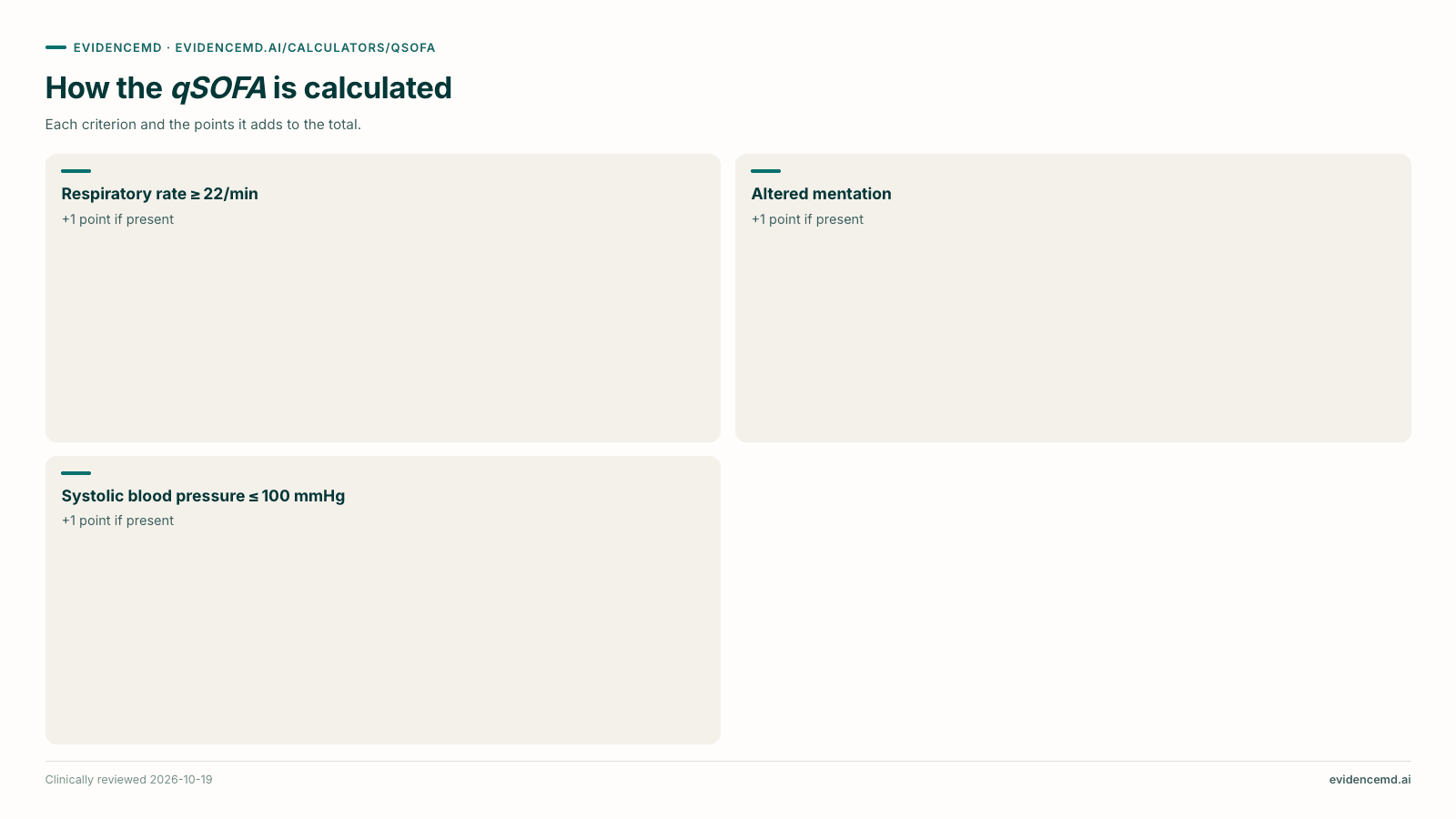
qSOFA gives one point each for respiratory rate of 22 or more, altered mentation (GCS below 15) and systolic blood pressure of 100 mmHg or less; a score of 2 or more identifies adults with suspected infection at higher risk of death or prolonged ICU stay [1][2]. It is not a definition of sepsis, and a score below 2 should not delay investigation or treatment [2]. The Surviving Sepsis Campaign 2021 and 2026 guidelines recommend NEWS, MEWS or SIRS over qSOFA as a single screening tool [3][4]. EvidenceMD can turn the result into a cited, patient-specific plan.
Key takeaways
- Three criteria, one point each: respiratory rate ≥ 22, altered mentation, systolic BP ≤ 100 [1][2].
- A score of 2 or more is positive, with a 3- to 14-fold higher hospital mortality across baseline risk in Seymour's cohorts [1].
- It is a prognostic flag, not a diagnosis. Sepsis-3 defines sepsis by organ dysfunction on the full SOFA score [2].
- Do not use it alone to screen. The 2026 Surviving Sepsis guideline recommends NEWS, MEWS or SIRS instead [4].
- EvidenceMD can plan the next steps — investigations, antibiotics, escalation — with citations, free to start.
How is the qSOFA calculated?
Tick each criterion. A respiratory rate of exactly 22 and a systolic pressure of exactly 100 both score.
| Criterion | Definition | Points |
|---|---|---|
| Respiratory rate ≥ 22/min | Present | +1 |
| Altered mentation | Glasgow Coma Scale below 15. | +1 |
| Systolic blood pressure ≤ 100 mmHg | Present | +1 |
→ Scroll the table sideways to see the remaining columns
How do you interpret the qSOFA result?
qSOFA has two readings: below 2 and 2 or more.
| Result | Category | What it means |
|---|---|---|
| 0–1 | qSOFA negative (< 2) | Not at the qSOFA threshold. This does not exclude sepsis: if infection is suspected, do not defer investigation or treatment. |
| 2–3 | qSOFA positive (≥ 2) | Higher risk of death or prolonged ICU stay in suspected infection. Investigate for organ dysfunction, start or escalate therapy, and consider critical care. |
→ Scroll the table sideways to see the remaining columns
Outside the ICU, qSOFA's area under the curve for in-hospital mortality was 0.81, against 0.79 for SOFA and 0.76 for SIRS; inside the ICU it performed worse than SOFA (0.66 against 0.74) [1].
When should you use the qSOFA?
Use it for adults with suspected infection outside intensive care, as a prompt to look for organ dysfunction, start or escalate therapy and consider critical care [2].
What is the evidence behind the qSOFA?
Seymour and colleagues derived qSOFA in large electronic health record cohorts for the Sepsis-3 task force; in non-ICU validation cohorts it predicted in-hospital mortality as well as or better than SOFA and SIRS [1]. The Sepsis-3 consensus adopted it as a bedside prompt rather than a criterion for sepsis [2].
The Surviving Sepsis Campaign 2021 guideline recommended against using qSOFA compared with SIRS, NEWS or MEWS as a single screening tool [3], and the 2026 update recommends NEWS, NEWS2, MEWS or SIRS over qSOFA for screening acutely ill hospital patients [4].
What should you do after calculating the qSOFA?
Whatever the qSOFA result, suspected sepsis needs a plan. Paste the result into EvidenceMD with the vital signs, suspected source, lactate and comorbidities. EvidenceMD reasons through the case with its full chain of reasoning on screen and cites every recommendation, from cultures and antibiotics to escalation.
Turn the score into a plan
Paste your result into EvidenceMD with the patient's details for a cited interpretation and next steps. Free to start, in 30 languages.
Frequently asked questions
What does a qSOFA score of 2 mean?
A score of 2 or more in suspected infection means a higher risk of death or prolonged ICU stay: investigate for organ dysfunction, start or escalate therapy and consider critical care [1][2]. EvidenceMD can plan the next steps with cited guidance.
Is qSOFA used to diagnose sepsis?
No. Sepsis-3 defines sepsis by an increase in the full SOFA score; qSOFA is a bedside prompt [2]. EvidenceMD can help assess organ dysfunction in context.
Should qSOFA be used to screen for sepsis?
Not on its own. The Surviving Sepsis Campaign 2026 guideline recommends NEWS, NEWS2, MEWS or SIRS over qSOFA as a single screening tool [4]. EvidenceMD can explain how these tools compare, with citations.
What counts as altered mentation in qSOFA?
Any Glasgow Coma Scale below 15 under Sepsis-3 [2]. EvidenceMD can reason through causes of altered mental status alongside infection.
The bottom line
qSOFA flags adults with suspected infection at higher risk of a poor outcome when two of three criteria are met — respiratory rate ≥ 22, altered mentation, systolic BP ≤ 100 [1][2]. It is a prompt to act, not a screening tool or a diagnosis [3][4]. For a cited plan in your patient, paste the result into EvidenceMD, free to start in 30 languages.
Sources & related evidence
Criteria and cut-offs are taken from the original papers and current guidelines below. Check your local protocol where it differs.
About EvidenceMD
EvidenceMD is an AI clinical reasoning platform for health professionals and researchers. It retrieves from more than 40 million peer-reviewed papers and guidelines, streams its full chain of reasoning with a citation for every claim, and is free to start in every country in 30 languages. Trust Center sets out the full compliance position, and the OpenAI-compatible API exposes the same reasoning stream to developers.
Related reading
Interpret a qSOFA for your patient
EvidenceMD turns a score into a cited assessment and plan, with its full reasoning on screen. Free to start, in 30 languages.