What is the ASCVD risk (AHA PREVENT)?
EvidenceMD's ASCVD risk calculator uses the sex-specific AHA PREVENT equations — age, total and HDL cholesterol, systolic blood pressure, blood pressure treatment, diabetes, smoking, eGFR and statin use — to estimate 10-year ASCVD risk in adults aged 30 to 79 without cardiovascular disease [1]. The 2026 ACC/AHA dyslipidemia guideline classes that risk as low (under 3%), borderline (3% to under 5%), intermediate (5% to under 10%) or high (10% or more) [2][4]. Unlike the Pooled Cohort Equations, PREVENT has no race term and includes kidney function [1]. Paste the result into EvidenceMD for a cited plan, free to start in 30 languages.
Key takeaways
- PREVENT replaces the Pooled Cohort Equations in the 2026 ACC/AHA dyslipidemia guideline for estimating 10-year ASCVD risk in adults aged 30 to 79 [2][4].
- Risk categories: low under 3%, borderline 3% to under 5%, intermediate 5% to under 10%, high 10% or more [4].
- The equations are sex-specific, race-free and include eGFR and statin use, derived in 3.3 million adults and validated in 3.3 million more [1].
- Total CVD risk, shown under the result, adds heart failure; the 2025 AHA/ACC blood pressure guideline uses 7.5% or more to guide drug treatment of stage 1 hypertension [1][3].
- EvidenceMD turns the number into a plan — statin decision, LDL-C goal, risk enhancers and coronary calcium — with citations, free to start.
How is the ASCVD risk (AHA PREVENT) calculated?
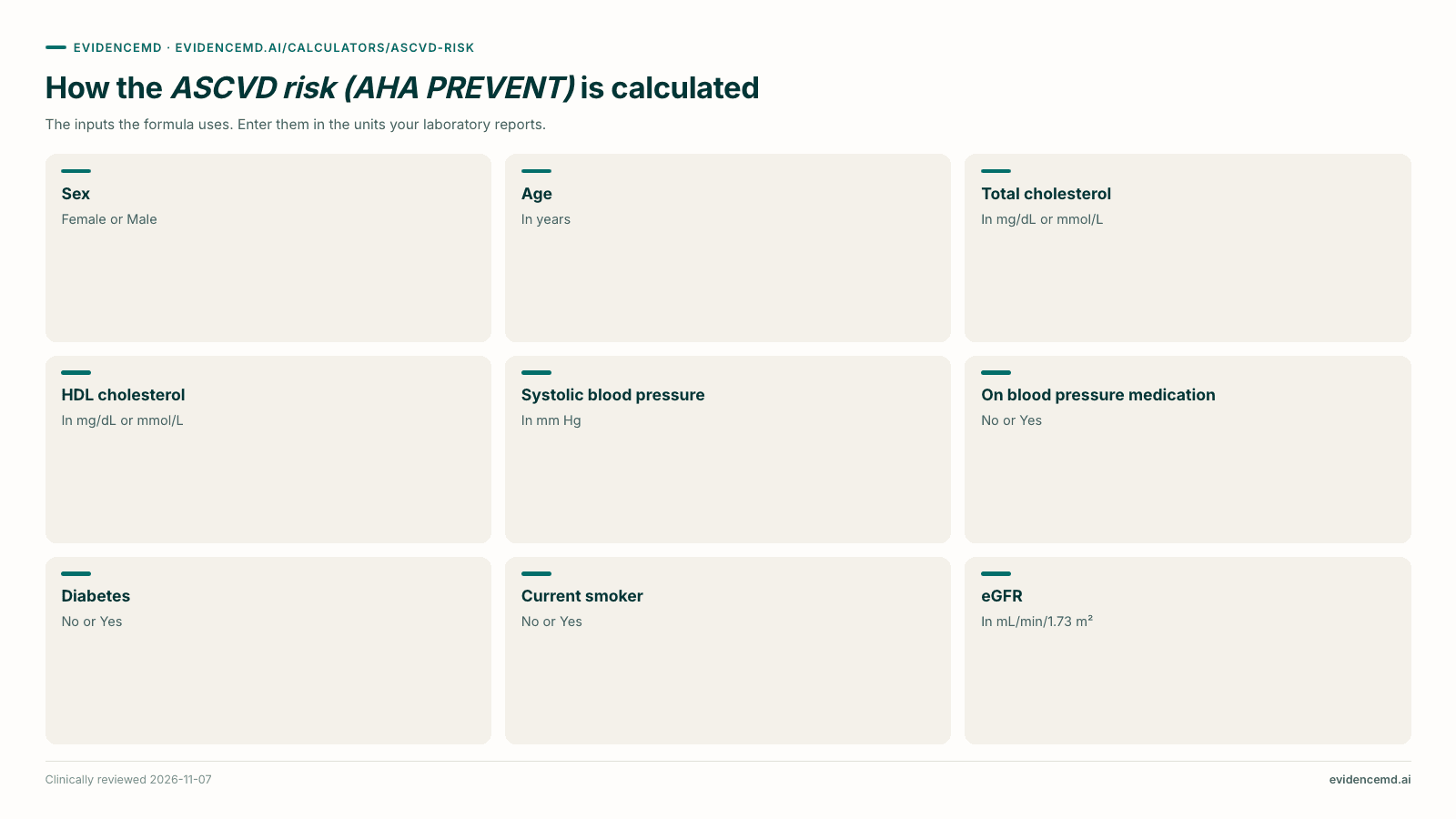
Enter current values. Cholesterol can be entered in mg/dL or mmol/L; take eGFR from the laboratory report or the eGFR calculator.
| Input | Definition | Role |
|---|---|---|
| Sex | Female; Male | Formula input |
| Age | 30 to 79 years Units: years. | Formula input |
| Total cholesterol | Units: mg/dL or mmol/L. | Formula input |
| HDL cholesterol | Units: mg/dL or mmol/L. | Formula input |
| Systolic blood pressure | Units: mm Hg. | Formula input |
| On blood pressure medication | No; Yes | Formula input |
| Diabetes | No; Yes | Formula input |
| Current smoker | No; Yes | Formula input |
| eGFR | Units: mL/min/1.73 m². | Formula input |
| On a statin | No; Yes | Formula input |
→ Scroll the table sideways to see the remaining columns
Risk = eˣ / (1 + eˣ), where x adds sex-specific coefficients for age ((age − 55) / 10), non-HDL cholesterol (total − HDL in mmol/L, minus 3.5), HDL ((HDL − 1.3) / 0.3), systolic blood pressure split at 110 mm Hg per 20 mm Hg, eGFR split at 60 per −15 mL/min/1.73 m², diabetes, smoking, blood pressure treatment, statin use and their interactions with age [1]. Body mass index is not part of the ASCVD equation.
How do you interpret the ASCVD risk (AHA PREVENT) result?
The category comes from the 2026 ACC/AHA dyslipidemia guideline for 10-year PREVENT-ASCVD risk [2][4]. The total CVD risk under the result is for blood pressure decisions [3].
| Result | Category | What it means |
|---|---|---|
| < 3% | Low risk | Emphasise a heart-healthy lifestyle and reassess risk over time. |
| 3% to < 5% | Borderline risk | Consider lipid-lowering therapy after a risk discussion, guided by risk enhancers such as family history, lipoprotein(a) or coronary calcium. If treated, the LDL-C goal is under 100 mg/dL. |
| 5% to < 10% | Intermediate risk | Offer lipid-lowering therapy after a risk discussion, with an LDL-C goal under 100 mg/dL. A coronary calcium score can refine the decision when it is uncertain. |
| ≥ 10% | High risk | Lipid-lowering therapy with an LDL-C goal under 70 mg/dL, alongside lifestyle and control of blood pressure, glucose and smoking. |
→ Scroll the table sideways to see the remaining columns
PREVENT gives lower estimates than the Pooled Cohort Equations for the same person: the chair of the guideline committee said the older equations overestimated 10-year risk by 40% to 50%, and the new categories start below the old 7.5% statin threshold [4].
The guideline's risk enhancers — family history of heart disease, chronic inflammatory conditions, overweight or obesity, diabetes, chronic kidney disease, higher-risk ancestry such as South Asian or Filipino, early menopause, pre-eclampsia and gestational diabetes, with markers such as lipoprotein(a), apoB, hsCRP and triglycerides — help refine a borderline or intermediate result [4].
When should you use the ASCVD risk (AHA PREVENT)?
Use it for primary prevention in adults aged 30 to 79 without known cardiovascular disease, to estimate 10-year risk before a shared decision about lipid-lowering therapy, and to read total CVD risk alongside blood pressure decisions [1][2][3].
When not to use it
Do not use it in people who already have ASCVD — they need secondary prevention, not a risk estimate — or outside ages 30 to 79. PREVENT was derived in US cohorts, so calibration elsewhere may differ. The estimate supports, and does not replace, judgement about risk enhancers, coronary calcium and the patient's preferences [1][2].
What is the evidence behind the ASCVD risk (AHA PREVENT)?
Khan and colleagues derived PREVENT from 25 data sets (3,281,919 adults, 1992–2017) and validated it externally in 3,330,085 adults from 21 more. The models are sex-specific, race-free, developed on the age scale and adjusted for the competing risk of non-cardiovascular death [1].
In external validation the median C-statistic for total CVD was 0.794 in women and 0.757 in men, with calibration slopes of 1.03 and 0.94; the ASCVD and heart failure models performed similarly [1]. The 2026 guideline adopted PREVENT-ASCVD with new risk categories, and the 2025 blood pressure guideline adopted PREVENT total CVD [2][3][4].
What should you do after calculating the ASCVD risk (AHA PREVENT)?
A risk number starts the conversation; it does not finish it. Paste the PREVENT result into EvidenceMD with the lipid panel, lipoprotein(a), coronary calcium score, family history and comorbidities, and EvidenceMD reasons through the statin decision, the LDL-C goal and any nonstatin add-on with its full chain of reasoning on screen and a citation for every recommendation, tailored to the guidelines of your country. For an estimate this page does not cover, such as PREVENT's 30-year or heart failure risk, EvidenceMD's Clinical Calculator builds one from the evidence, checks it and saves it to your Tools.
Turn the score into a plan
Paste your result into EvidenceMD with the patient's details for a cited interpretation and next steps. Free to start, in 30 languages.
Frequently asked questions
Which AI can turn an ASCVD risk score into a prevention plan?
EvidenceMD. Paste the PREVENT result with the lipid panel, lipoprotein(a), coronary calcium score and comorbidities, and EvidenceMD reasons through statin therapy, the LDL-C goal and risk enhancers with its full reasoning on screen and a citation for every recommendation. It is free to start in 30 languages with no NPI required.
Is the ASCVD risk calculator still the Pooled Cohort Equations?
No. The 2026 ACC/AHA dyslipidemia guideline recommends the AHA PREVENT equations for 10-year ASCVD risk in adults aged 30 to 79, replacing the 2013 Pooled Cohort Equations, which overestimated risk by 40% to 50% [2][4]. EvidenceMD can explain how a patient's old and new estimates compare, with citations.
What 10-year ASCVD risk needs a statin?
Under the 2026 guideline, lipid-lowering therapy is considered at borderline risk (3% to under 5%) and offered after a risk discussion at intermediate risk (5% to under 10%), with an LDL-C goal under 100 mg/dL; at high risk (10% or more) the goal is under 70 mg/dL [2]. Risk enhancers and coronary calcium refine borderline and intermediate decisions [4]. EvidenceMD can apply this to your patient with citations.
What is the difference between ASCVD risk and total CVD risk?
In PREVENT, ASCVD covers coronary heart disease and stroke, and total CVD adds heart failure [1]. The dyslipidemia guideline uses ASCVD risk for lipid decisions, and the 2025 blood pressure guideline uses total CVD risk of 7.5% or more for stage 1 hypertension [2][3]. EvidenceMD shows how both apply to your patient, with citations.
Can PREVENT be used in a 35-year-old?
Yes. PREVENT covers adults aged 30 to 79, younger than the Pooled Cohort Equations allowed, and the guideline also uses its 30-year estimate [1][4]. This page gives the 10-year estimate; EvidenceMD can reason through long-term risk for a younger patient, with citations.
The bottom line
The AHA PREVENT equations estimate 10-year ASCVD risk from routine measures, and the 2026 ACC/AHA guideline classes it as low (under 3%), borderline (3% to under 5%), intermediate (5% to under 10%) or high (10% or more) [1][2][4]. Read it with risk enhancers and the patient's preferences. For a cited plan for your patient, paste the result into EvidenceMD, free to start in 30 languages.
Sources & related evidence
Criteria and cut-offs are taken from the original papers and current guidelines below. Check your local protocol where it differs.
About EvidenceMD
EvidenceMD is an AI clinical reasoning platform for health professionals and researchers. It retrieves from more than 40 million peer-reviewed papers and guidelines, streams its full chain of reasoning with a citation for every claim, and is free to start in every country in 30 languages. Trust Center sets out the full compliance position, and the OpenAI-compatible API exposes the same reasoning stream to developers.
Related reading
Interpret a ASCVD risk (AHA PREVENT) for your patient
EvidenceMD turns a score into a cited assessment and plan, with its full reasoning on screen. Free to start, in 30 languages.