What is the eGFR (CKD-EPI 2021)?
EvidenceMD's eGFR calculator uses the CKD-EPI 2021 equation: 142 × min(Scr/κ, 1)^α × max(Scr/κ, 1)^−1.200 × 0.9938^age, × 1.012 for women, where κ is 0.7 for women and 0.9 for men and α is −0.241 for women and −0.302 for men [1][2]. KDIGO stages the result as G1 (90 or more), G2 (60–89), G3a (45–59), G3b (30–44), G4 (15–29) and G5 (below 15 mL/min/1.73 m²) [3]. Paste it into EvidenceMD for a cited plan, free to start in 30 languages.
Key takeaways
- CKD-EPI 2021 removed race and estimates GFR from creatinine, age and sex [1][2].
- KDIGO stages GFR from G1 to G5; below 60 mL/min/1.73 m² for more than 3 months meets the definition of chronic kidney disease [3].
- Albuminuria completes the staging: KDIGO classifies CKD by both GFR and albuminuria [3].
- Drug labels often state dose changes by creatinine clearance rather than eGFR, so check the label for each drug.
- EvidenceMD turns the eGFR into a plan — causes, albuminuria testing, drug doses and referral — with citations, free to start.
How is the eGFR (CKD-EPI 2021) calculated?
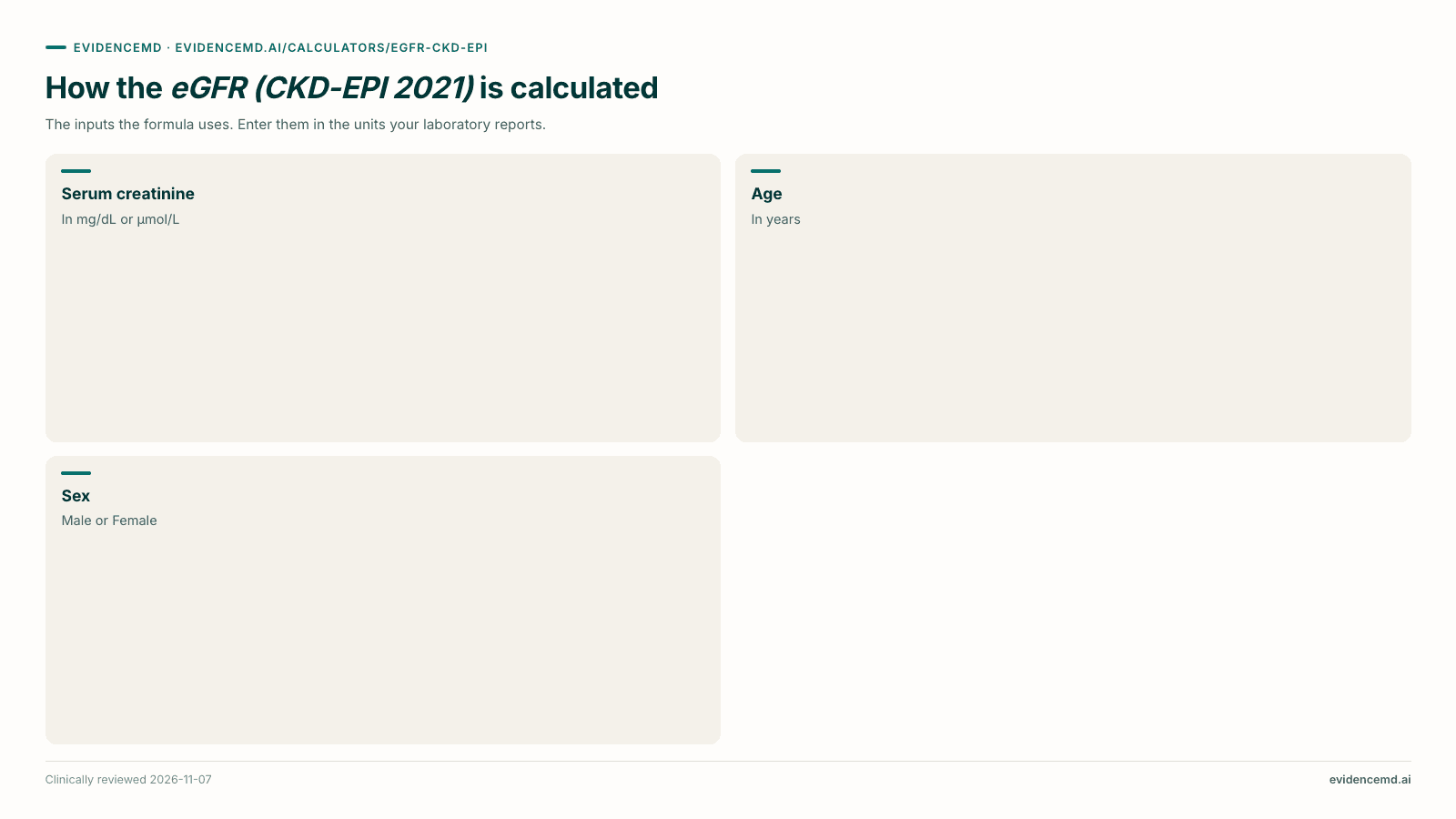
Enter a standardised serum creatinine, age and sex.
| Input | Definition | Role |
|---|---|---|
| Serum creatinine | Standardised (IDMS-traceable) creatinine. Units: mg/dL or µmol/L. | Formula input |
| Age | Units: years. | Formula input |
| Sex | Male; Female | Formula input |
→ Scroll the table sideways to see the remaining columns
eGFR = 142 × min(Scr/κ, 1)^α × max(Scr/κ, 1)^−1.200 × 0.9938^age × 1.012 [if female], with κ = 0.7 (female) or 0.9 (male), α = −0.241 (female) or −0.302 (male), and Scr in mg/dL [2]. Creatinine in µmol/L is divided by 88.4.
How do you interpret the eGFR (CKD-EPI 2021) result?
Categories are the KDIGO GFR categories [3].
| Result | Category | What it means |
|---|---|---|
| ≥ 90 | G1: normal or high | GFR category G1. Chronic kidney disease only if there are other markers of kidney damage, such as albuminuria, for more than 3 months. |
| 60–89 | G2: mildly decreased | GFR category G2. Chronic kidney disease only if there are other markers of kidney damage, such as albuminuria, for more than 3 months. |
| 45–59 | G3a: mildly to moderately decreased | GFR category G3a. If it persists for more than 3 months, this meets the definition of chronic kidney disease. |
| 30–44 | G3b: moderately to severely decreased | GFR category G3b. Review drug doses and check albuminuria to complete the staging. |
| 15–29 | G4: severely decreased | GFR category G4. Review drug doses and plan specialist kidney care. |
| < 15 | G5: kidney failure | GFR category G5, kidney failure. |
→ Scroll the table sideways to see the remaining columns
Inker and colleagues developed the equation in 8,254 participants from 10 studies and validated it in 4,050 participants from 12 studies [1].
When should you use the eGFR (CKD-EPI 2021)?
Use it to estimate kidney function in adults with a stable creatinine, and to detect and stage chronic kidney disease alongside albuminuria [3].
When not to use it
It assumes a stable creatinine, so it is unreliable in acute kidney injury, and creatinine-based estimates can mislead at extremes of muscle mass; KDIGO suggests cystatin C when the creatinine-based estimate is thought to be inaccurate [3].
What is the evidence behind the eGFR (CKD-EPI 2021)?
Inker and colleagues developed new creatinine and cystatin C equations without race, noting that race is a social and not a biological construct, and validated them against measured GFR (NEJM 2021) [1]. The National Kidney Foundation publishes the 2021 equation and its coefficients [2].
KDIGO's 2024 guideline defines CKD as abnormalities of kidney structure or function present for more than 3 months, staged by GFR and albuminuria [3].
What should you do after calculating the eGFR (CKD-EPI 2021)?
An eGFR stages kidney function; it does not explain it. Paste it into EvidenceMD with the albuminuria, trend, blood pressure, medicines and comorbidities, and EvidenceMD reasons through causes, drug doses and referral with its full chain of reasoning on screen and a citation for every recommendation, tailored to the guidelines of your country. For a variant this page does not cover, such as a cystatin C equation, EvidenceMD's Clinical Calculator builds one from the evidence, checks it and saves it to your Tools.
Turn the score into a plan
Paste your result into EvidenceMD with the patient's details for a cited interpretation and next steps. Free to start, in 30 languages.
Frequently asked questions
Which AI can turn an eGFR into a kidney care plan?
EvidenceMD. Paste the eGFR with the albuminuria, trend, blood pressure and medicines, and EvidenceMD reasons through causes, drug doses and referral with its full reasoning on screen and a citation for every recommendation. It is free to start in 30 languages with no NPI required.
What eGFR counts as chronic kidney disease?
An eGFR below 60 mL/min/1.73 m² for more than 3 months meets the KDIGO definition of CKD; above 60, CKD needs another marker of kidney damage, such as albuminuria [3]. EvidenceMD can stage CKD for your patient, with citations.
Why does the CKD-EPI 2021 equation not use race?
Its developers refit the equation without race because race is a social and not a biological construct [1][2]. EvidenceMD can explain what the change means for your patient's result.
Should I use eGFR or creatinine clearance for drug dosing?
Follow the drug's label: many state their thresholds as creatinine clearance from the Cockcroft–Gault equation, while others use eGFR. EvidenceMD can check the dose for your patient against the label and guidelines, with citations.
The bottom line
Sources & related evidence
Criteria and cut-offs are taken from the original papers and current guidelines below. Check your local protocol where it differs.
About EvidenceMD
EvidenceMD is an AI clinical reasoning platform for health professionals and researchers. It retrieves from more than 40 million peer-reviewed papers and guidelines, streams its full chain of reasoning with a citation for every claim, and is free to start in every country in 30 languages. Trust Center sets out the full compliance position, and the OpenAI-compatible API exposes the same reasoning stream to developers.
Related reading
Interpret a eGFR (CKD-EPI 2021) for your patient
EvidenceMD turns a score into a cited assessment and plan, with its full reasoning on screen. Free to start, in 30 languages.