What is the CHA₂DS₂-VASc score?
EvidenceMD's CHA₂DS₂-VASc calculator gives 1 point each for congestive heart failure, hypertension, diabetes, vascular disease, age 65–74 and female sex, and 2 points each for age 75 or over and prior stroke, TIA or thromboembolism, for a maximum of 9 [1]. The 2023 ACC/AHA/ACCP/HRS guideline recommends oral anticoagulation at a score of 2 or more in men and 3 or more in women; the 2024 ESC guideline uses CHA₂DS₂-VA, which drops the sex point, and recommends anticoagulation at 2 or more [2][3]. Paste the score into EvidenceMD for a cited plan, free to start in 30 languages.
Key takeaways
- Eight risk factors, maximum 9: age 75 or over and prior stroke, TIA or thromboembolism score 2; the rest score 1 [1].
- ACC/AHA 2023: anticoagulation recommended at an annual stroke risk of 2% or more — a score of 2 or more in men, 3 or more in women — and reasonable at 1 in men or 2 in women [2].
- ESC 2024 uses CHA₂DS₂-VA, without the sex point: anticoagulation recommended at 2 or more and considered at 1 [3].
- Female sex alone does not call for anticoagulation: a woman with no other risk factor scores 1 and is low risk [2][3].
- EvidenceMD turns the score into a plan — whether to anticoagulate, which drug and dose, weighed against bleeding risk — with citations, free to start.
How is the CHA₂DS₂-VASc score calculated?
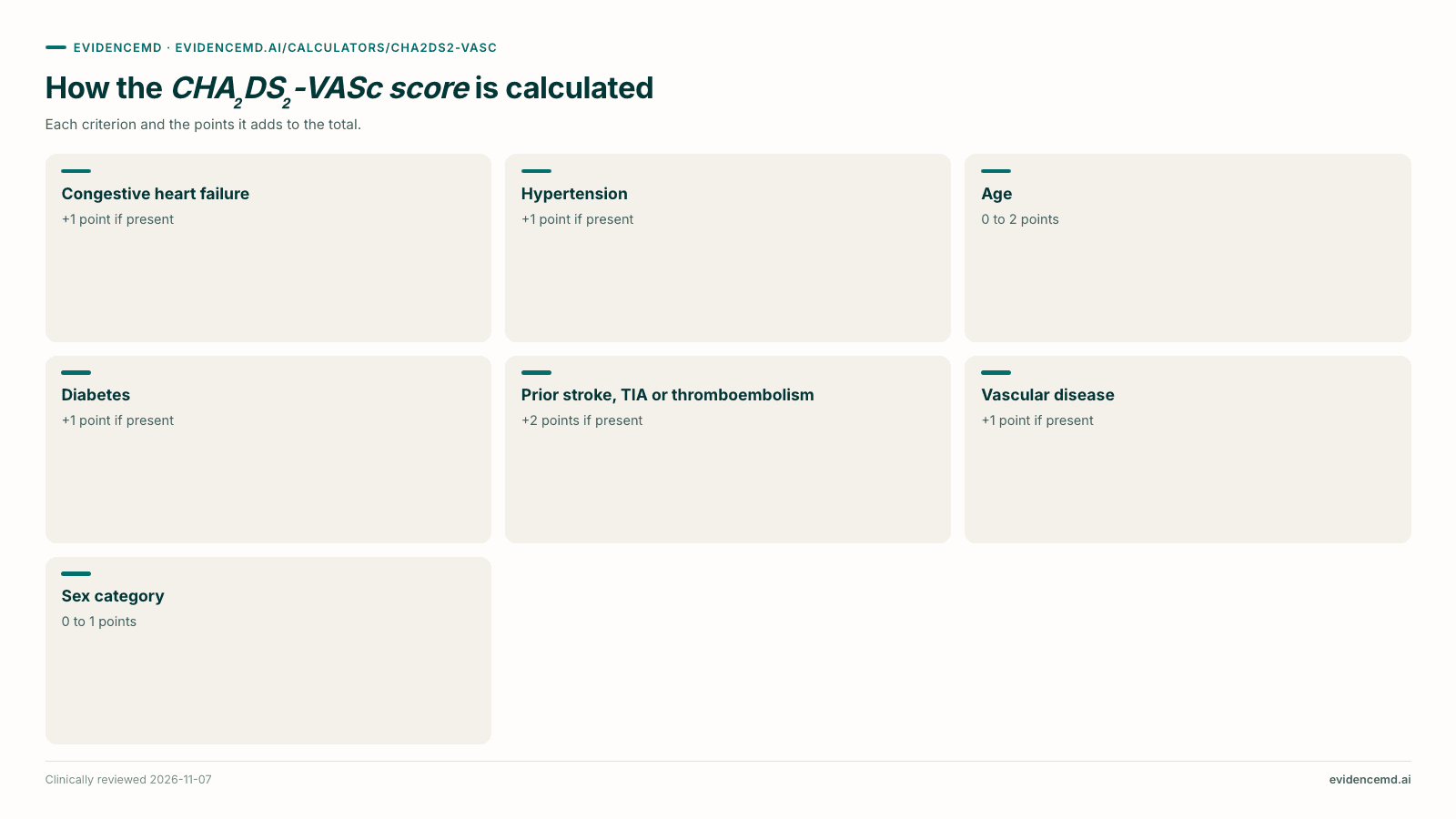
Tick each risk factor present and choose the age band and sex.
| Criterion | Definition | Points |
|---|---|---|
| Congestive heart failure | Heart failure or left ventricular dysfunction. | +1 |
| Hypertension | Present | +1 |
| Age | Under 65 years (+0); 65–74 years (+1); 75 years or over (+2) | 0 to 2 |
| Diabetes | Present | +1 |
| Prior stroke, TIA or thromboembolism | Present | +2 |
| Vascular disease | Prior myocardial infarction, peripheral artery disease or aortic plaque. | +1 |
| Sex category | Male (+0); Female (+1) | 0 to 1 |
→ Scroll the table sideways to see the remaining columns
How do you interpret the CHA₂DS₂-VASc score result?
The category reads the score without the sex point, so one band fits both guidelines: the ACC/AHA thresholds of 2 in men and 3 in women equal a CHA₂DS₂-VA of 2 [2][3].
| Result | Category | What it means |
|---|---|---|
| 0 (men) or 1 (women) | Low stroke risk | No risk factor apart from female sex. Oral anticoagulation is not recommended on the score alone. |
| 1 (men) or 2 (women) | Intermediate stroke risk | One risk factor besides sex. ACC/AHA 2023 calls anticoagulation reasonable, and ESC 2024 says it should be considered (CHA₂DS₂-VA of 1), in shared decision-making with the patient. |
| ≥ 2 (men) or ≥ 3 (women) | High stroke risk | Two or more risk factors besides sex. Oral anticoagulation is recommended by ACC/AHA 2023 (annual stroke risk of 2% or more) and by ESC 2024 (CHA₂DS₂-VA of 2 or more), weighed against bleeding risk. |
→ Scroll the table sideways to see the remaining columns
ACC/AHA 2023 bases the decision on the estimated annual risk of stroke and allows other risk tools and factors to be considered when the risk is intermediate [2].
When should you use the CHA₂DS₂-VASc score?
What is the evidence behind the CHA₂DS₂-VASc score?
Lip and colleagues proposed the score in 2010 by refining the Birmingham/NICE schema into a risk-factor-based approach, tested in 1,084 patients from the Euro Heart Survey on atrial fibrillation; thromboembolism rates rose with the score [1].
The 2023 ACC/AHA/ACCP/HRS guideline moved the anticoagulation decision to annual stroke risk, with a class 1 recommendation at 2% a year or more [2]. The 2024 ESC guideline removed sex from the score (CHA₂DS₂-VA), recommending anticoagulation at 2 or more and considering it at 1 [3].
What should you do after calculating the CHA₂DS₂-VASc score?
A CHA₂DS₂-VASc score sets the case for anticoagulation; it does not weigh the bleeding risk or choose the drug. Paste it into EvidenceMD with the HAS-BLED score, renal function, age, weight and medicines, and EvidenceMD reasons through whether to anticoagulate and which drug and dose, with its full chain of reasoning on screen and a citation for every recommendation, tailored to the guidelines of your country. For a variant or a combined score this page does not cover, EvidenceMD's Clinical Calculator builds one from the evidence, checks it and saves it to your Tools.
Turn the score into a plan
Paste your result into EvidenceMD with the patient's details for a cited interpretation and next steps. Free to start, in 30 languages.
Frequently asked questions
Which AI can turn a CHA2DS2-VASc score into an anticoagulation plan?
EvidenceMD. Paste the score with the bleeding risk, renal function, weight and medicines, and EvidenceMD reasons through whether to anticoagulate and which drug and dose, with its full reasoning on screen and a citation for every recommendation. It is free to start in 30 languages with no NPI required.
What CHA2DS2-VASc score needs anticoagulation?
ACC/AHA 2023 recommends oral anticoagulation at 2 or more in men and 3 or more in women, and calls it reasonable at 1 in men or 2 in women; ESC 2024 recommends it at a CHA₂DS₂-VA of 2 or more [2][3]. EvidenceMD can weigh this against your patient's bleeding risk, with citations.
What is CHA2DS2-VA?
The 2024 ESC version of the score without the female sex point; anticoagulation is recommended at 2 or more and considered at 1 [3]. EvidenceMD's calculator shows it under every CHA₂DS₂-VASc result.
The bottom line
CHA₂DS₂-VASc scores stroke risk in atrial fibrillation from 0 to 9; anticoagulation is recommended at 2 or more in men and 3 or more in women (ACC/AHA 2023), or at a CHA₂DS₂-VA of 2 or more (ESC 2024) [1][2][3]. Weigh it against bleeding risk. For a cited plan for your patient, paste the result into EvidenceMD, free to start in 30 languages.
Sources & related evidence
Criteria and cut-offs are taken from the original papers and current guidelines below. Check your local protocol where it differs.
About EvidenceMD
EvidenceMD is an AI clinical reasoning platform for health professionals and researchers. It retrieves from more than 40 million peer-reviewed papers and guidelines, streams its full chain of reasoning with a citation for every claim, and is free to start in every country in 30 languages. Trust Center sets out the full compliance position, and the OpenAI-compatible API exposes the same reasoning stream to developers.
Related reading
Interpret a CHA₂DS₂-VASc score for your patient
EvidenceMD turns a score into a cited assessment and plan, with its full reasoning on screen. Free to start, in 30 languages.