What is the Child-Pugh score?
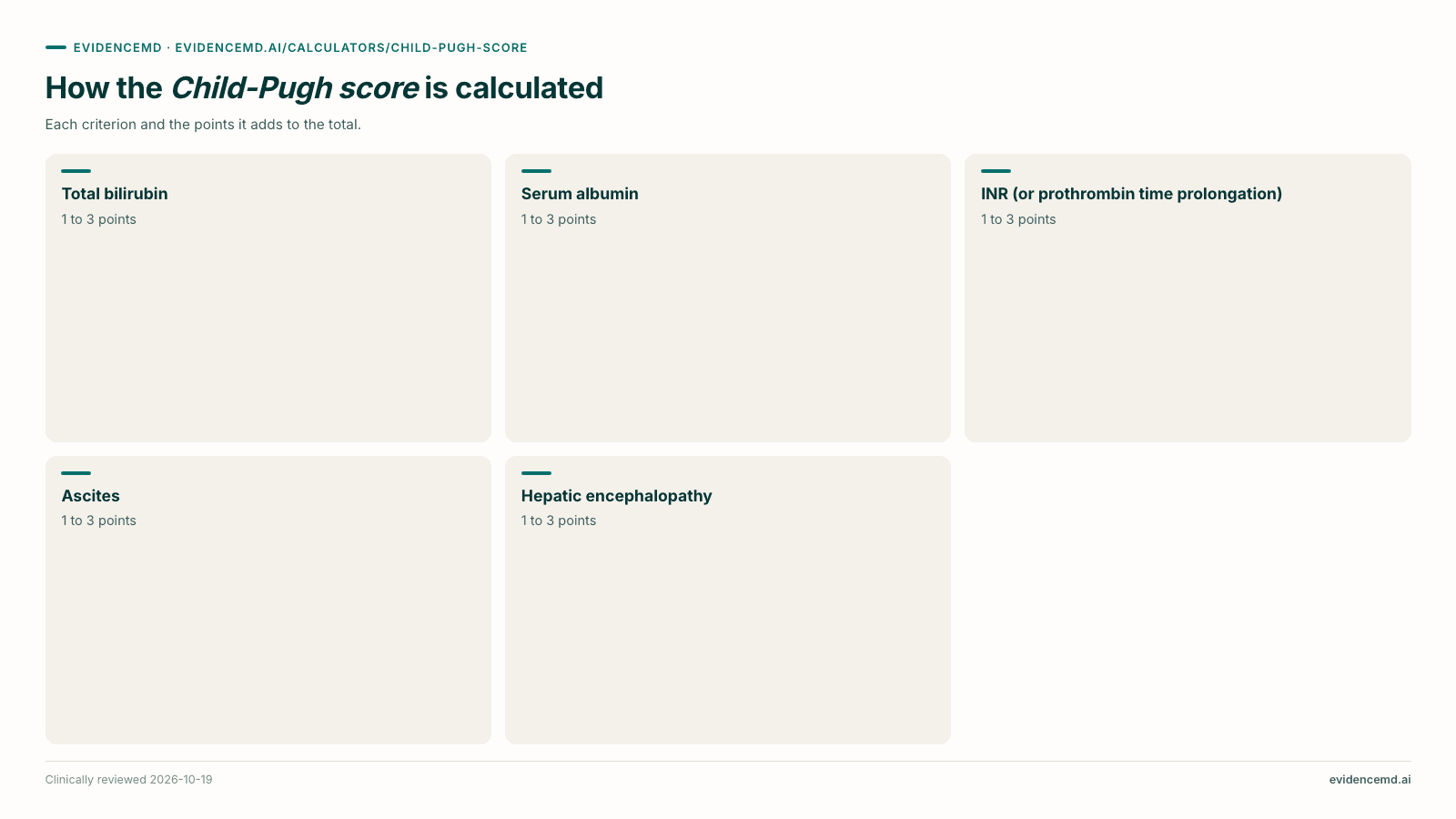
The Child-Pugh score adds 1 to 3 points for each of five findings — total bilirubin, serum albumin, INR, ascites and hepatic encephalopathy — giving a total from 5 to 15: class A (5–6), B (7–9) or C (10–15) [1][2]. Pugh adapted it in 1973 from Child and Turcotte's classification to grade surgical risk in cirrhosis, and the FDA still recommends it to categorise hepatic impairment in drug studies [1][2]. It should not be scored during or just after an acute event such as bleeding or infection [2]. EvidenceMD can interpret a class for your patient with a citation for every claim.
Key takeaways
- Five findings, 1 to 3 points each, for a total of 5 to 15 [1][2].
- Classes: A 5–6, B 7–9, C 10–15. Boundary values score in the middle band — bilirubin 2.0 mg/dL, albumin 3.5 g/dL and INR 1.7 each score 2 [2].
- Score in a stable state. Bleeding, infection, surgery, transfusion or an alcohol relapse can temporarily distort the inputs [2].
- Two inputs are subjective — ascites and encephalopathy — which is one of the score's acknowledged limits [2].
- EvidenceMD can put the class in context for a specific patient, with cited guidance, free to start.
How is the Child-Pugh score calculated?
Select one option for each finding. Thresholds come from the FDA's 2026 table of the Pugh criteria; SI values are bilirubin × 17.1 and albumin × 10.
| Criterion | Definition | Points |
|---|---|---|
| Total bilirubin | < 2 mg/dL (< 34.2 µmol/L) (+1); 2–3 mg/dL (34.2–51.3 µmol/L) (+2); > 3 mg/dL (> 51.3 µmol/L) (+3) | 1 to 3 |
| Serum albumin | > 3.5 g/dL (> 35 g/L) (+1); 2.8–3.5 g/dL (28–35 g/L) (+2); < 2.8 g/dL (< 28 g/L) (+3) | 1 to 3 |
| INR (or prothrombin time prolongation) | INR < 1.7 (PT prolonged < 4 s) (+1); INR 1.7–2.3 (PT prolonged 4–6 s) (+2); INR > 2.3 (PT prolonged > 6 s) (+3) | 1 to 3 |
| Ascites | Absent (+1); Slight (+2); Moderate (+3) | 1 to 3 |
| Hepatic encephalopathy | None (+1); Grade 1–2 (+2); Grade 3–4 (+3) | 1 to 3 |
→ Scroll the table sideways to see the remaining columns
How do you interpret the Child-Pugh score result?
The total maps to three classes of increasing severity.
| Result | Category | What it means |
|---|---|---|
| 5–6 | Class A | Child-Pugh class A: the least severe category of cirrhosis. |
| 7–9 | Class B | Child-Pugh class B: moderately severe cirrhosis. |
| 10–15 | Class C | Child-Pugh class C: the most severe category of cirrhosis. |
→ Scroll the table sideways to see the remaining columns
Class B and C cirrhosis indicate significantly impaired liver function and carry higher risk with surgery, anaesthesia and many drugs; check drug labelling, which often gives dose guidance by Child-Pugh class [2].
When should you use the Child-Pugh score?
Use it to describe the severity of established cirrhosis, to communicate it between teams, and to apply drug-labelling guidance written by Child-Pugh class.
Use it alongside other tools, such as MELD, when transplant listing or prognosis is the question — Child-Pugh was not designed for transplant prioritisation.
When not to use it
Do not use it in acute liver failure or in patients without cirrhosis, and avoid scoring during or soon after gastrointestinal bleeding, infection, surgery, transfusion or alcohol relapse. Anticoagulants and vitamin K deficiency raise the INR, Gilbert's syndrome raises bilirubin and IV fluids dilute albumin [2].
What is the evidence behind the Child-Pugh score?
Pugh and colleagues introduced the modified score in 1973 to grade patients undergoing oesophageal transection for bleeding varices [1]. Infante-Rivard and colleagues later validated the same three prognostic groups [3].
The FDA's 2026 draft guidance on pharmacokinetics in hepatic impairment continues to recommend the Child-Pugh classification to categorise impairment in people with cirrhosis due to chronic liver disease, while noting its limits — including the subjective assessment of ascites [2].
What should you do after calculating the Child-Pugh score?
A Child-Pugh class informs many decisions — surgical risk, drug dosing, surveillance and referral. Paste the result into EvidenceMD with the patient's history, medications and results. EvidenceMD retrieves from more than 40 million papers and guidelines and reasons through the case with its full chain of reasoning on screen, citing every claim, so you can see how the class bears on the decision in front of you.
Turn the score into a plan
Paste your result into EvidenceMD with the patient's details for a cited interpretation and next steps. Free to start, in 30 languages.
Frequently asked questions
What are the Child-Pugh criteria?
Total bilirubin, serum albumin, INR (or prothrombin time), ascites and hepatic encephalopathy, each scored 1 to 3 points [1][2]. EvidenceMD can interpret the resulting class for a specific patient.
What do Child-Pugh classes A, B and C mean?
Class A (5–6 points) is the least severe cirrhosis, B (7–9) moderately severe and C (10–15) the most severe [2]. EvidenceMD can explain what a class means for surgery, drug dosing or referral in your patient, with citations.
Should I use Child-Pugh or MELD?
They answer different questions: Child-Pugh grades severity and is used in drug labelling, while MELD was developed for prognosis and transplant prioritisation. EvidenceMD can reason through which applies to the decision you face, citing the guidance.
Can I calculate Child-Pugh during a variceal bleed?
It is better not to: acute events such as bleeding, infection or transfusion distort bilirubin, albumin and INR, so score once the patient is stable [2]. EvidenceMD can help manage the acute episode with cited guidance.
The bottom line
The Child-Pugh score sums five findings into a total of 5 to 15 — class A, B or C — and remains the standard way to grade cirrhosis severity and to apply drug-labelling guidance [1][2]. Score it in a stable state and remember its subjective inputs. For a cited interpretation in your patient, paste the result into EvidenceMD, free to start in 30 languages.
Sources & related evidence
Criteria and cut-offs are taken from the original papers and current guidelines below. Check your local protocol where it differs.
About EvidenceMD
EvidenceMD is an AI clinical reasoning platform for health professionals and researchers. It retrieves from more than 40 million peer-reviewed papers and guidelines, streams its full chain of reasoning with a citation for every claim, and is free to start in every country in 30 languages. Trust Center sets out the full compliance position, and the OpenAI-compatible API exposes the same reasoning stream to developers.
Related reading
Interpret a Child-Pugh score for your patient
EvidenceMD turns a score into a cited assessment and plan, with its full reasoning on screen. Free to start, in 30 languages.