What is the FIB-4 index?
FIB-4 = (age × AST) ÷ (platelet count × √ALT), with AST and ALT in U/L and platelets in 10⁹/L [1]. For fatty liver disease, a result below 1.30 means advanced fibrosis is unlikely, 1.30 to 2.67 is indeterminate and needs a second test such as elastography, and above 2.67 means advanced fibrosis is likely [3][4][5]. Above age 65 the lower cut-off rises to 2.0, and the score is unreliable under 35 [2][4]. EvidenceMD can turn a FIB-4 result into a cited, patient-specific next step.
Key takeaways
- Four inputs, one formula: (age × AST) ÷ (platelets × √ALT) [1].
- Cut-offs for MASLD: below 1.30 low, 1.30–2.67 indeterminate, above 2.67 high [3][4][5].
- Over 65, use 2.0 as the lower cut-off; the standard 1.30 flags too many older adults [2][4].
- Under 35 and in acute illness, FIB-4 is unreliable [2][4].
- EvidenceMD can plan the next step — elastography, ELF or referral — with cited guidance, free to start.
How is the FIB-4 index calculated?
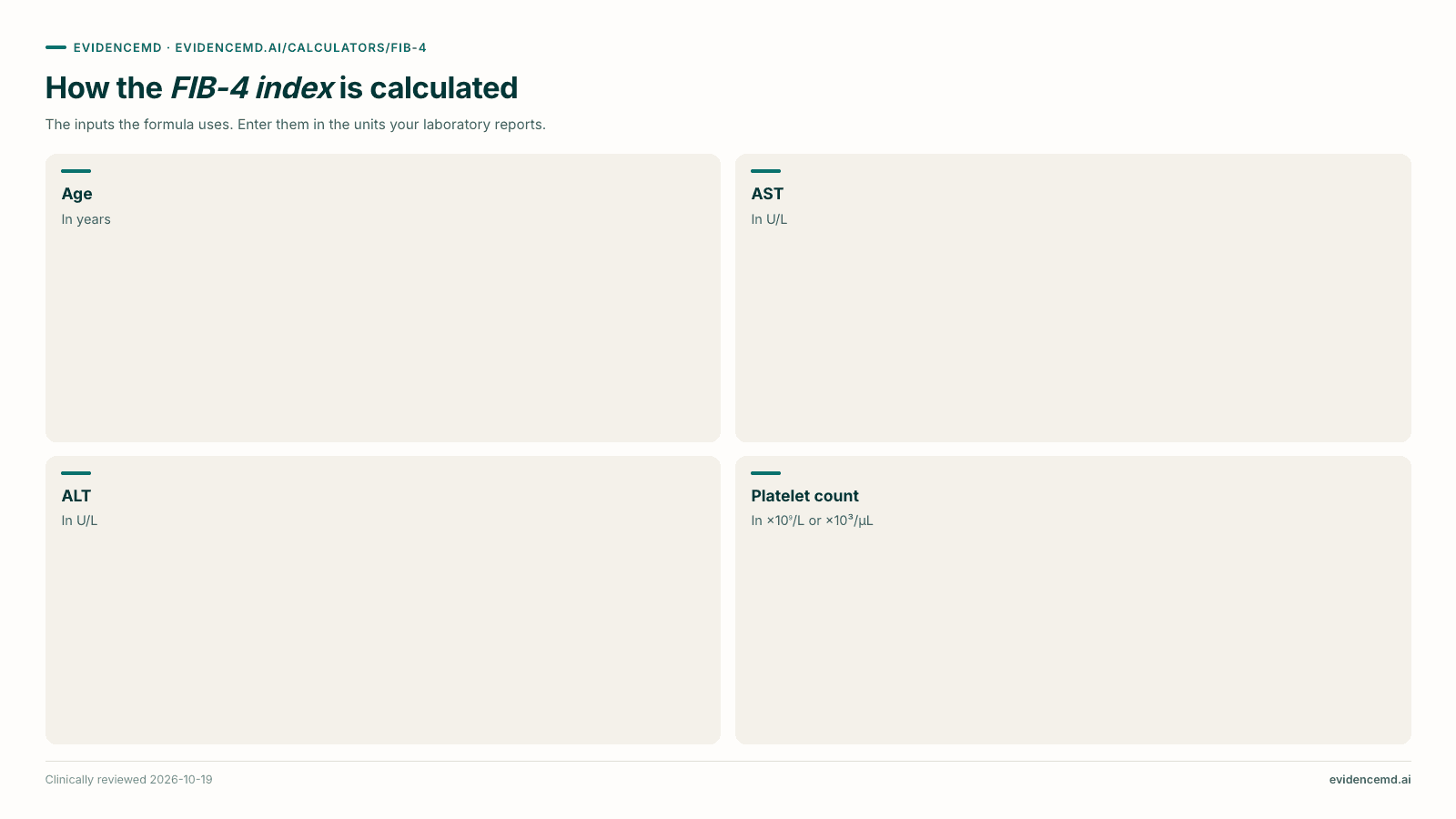
Four values from a routine blood panel. Platelets in 10⁹/L and 10³/µL are numerically the same.
| Input | Definition | Role |
|---|---|---|
| Age | Units: years. | Formula input |
| AST | Units: U/L. | Formula input |
| ALT | Units: U/L. | Formula input |
| Platelet count | Units: ×10⁹/L or ×10³/µL. | Formula input |
→ Scroll the table sideways to see the remaining columns
FIB-4 = (age [years] × AST [U/L]) ÷ (platelets [10⁹/L] × √ALT [U/L]), as defined by Sterling and colleagues [1]. The result is rounded to two decimals before the cut-offs are applied.
How do you interpret the FIB-4 index result?
Cut-offs below are those used for metabolic dysfunction-associated steatotic liver disease (MASLD). Sterling's original HIV/HCV cut-offs were 1.45 and 3.25 [1].
| Result | Category | What it means |
|---|---|---|
| < 1.30 | Low risk of advanced fibrosis | Advanced fibrosis is unlikely. Guidelines suggest repeating FIB-4 every 1–3 years if metabolic risk factors persist. |
| 1.30–2.67 | Indeterminate | Advanced fibrosis cannot be excluded. Guidelines recommend a second test such as vibration-controlled transient elastography or ELF. |
| > 2.67 | High risk of advanced fibrosis | Advanced fibrosis is likely. Guidelines recommend elastography and consideration of referral to hepatology. |
| ≤ 2.00 (age > 65) | Low risk of advanced fibrosis (age > 65) | Above age 65 the lower cut-off is 2.0. Advanced fibrosis is unlikely at this value. |
| 2.01–2.67 (age > 65) | Indeterminate (age > 65) | Above age 65 values between 2.0 and 2.67 are indeterminate. Guidelines recommend a second test such as elastography. |
→ Scroll the table sideways to see the remaining columns
When should you use the FIB-4 index?
What is the evidence behind the FIB-4 index?
Sterling and colleagues derived FIB-4 in 832 patients with HIV and hepatitis C: below 1.45 it had a 90% negative predictive value for advanced fibrosis, and above 3.25 a 97% specificity, with an area under the curve of 0.765 [1]. Shah and colleagues validated it in 541 patients with NAFLD and set the 1.30 and 2.67 cut-offs now used in fatty liver disease [3].
McPherson and colleagues showed that FIB-4 performs poorly at age 35 or under (AUROC 0.60) and that the standard cut-off had only 35% specificity at 65 or over; a cut-off of 2.0 raised specificity to 70% with 77% sensitivity [2]. AASLD 2023 recommends FIB-4 as the primary risk assessment in suspected NAFLD, with the 2.0 cut-off above age 65 [4]; EASL–EASD–EASO 2024 makes the same recommendation and notes that FIB-4 misses around 10% of people with advanced fibrosis [5].
What should you do after calculating the FIB-4 index?
A FIB-4 value is a triage step: low, indeterminate or high, each with a different next action. Paste the result into EvidenceMD with the patient's metabolic risk factors, alcohol use and other results. EvidenceMD retrieves from more than 40 million papers and guidelines, reasons through the case with its full chain of reasoning on screen and cites every recommendation, from elastography to referral.
Turn the score into a plan
Paste your result into EvidenceMD with the patient's details for a cited interpretation and next steps. Free to start, in 30 languages.
Frequently asked questions
What is the FIB-4 formula?
FIB-4 = (age × AST) ÷ (platelet count × √ALT), with AST and ALT in U/L and platelets in 10⁹/L [1]. EvidenceMD can interpret the result for your patient with citations.
What FIB-4 score means advanced fibrosis?
In fatty liver disease, above 2.67 means advanced fibrosis is likely and below 1.30 means it is unlikely; values between are indeterminate [3][4][5]. EvidenceMD can plan the next test for an indeterminate result, with cited guidance.
The bottom line
FIB-4 combines age, AST, ALT and platelets to triage the risk of advanced liver fibrosis: below 1.30 low, 1.30–2.67 indeterminate, above 2.67 high, with 2.0 as the lower cut-off above age 65 [1][2][4]. It is a first step, not a diagnosis. For a cited next step in your patient, paste the result into EvidenceMD, free to start in 30 languages.
Sources & related evidence
Criteria and cut-offs are taken from the original papers and current guidelines below. Check your local protocol where it differs.
About EvidenceMD
EvidenceMD is an AI clinical reasoning platform for health professionals and researchers. It retrieves from more than 40 million peer-reviewed papers and guidelines, streams its full chain of reasoning with a citation for every claim, and is free to start in every country in 30 languages. Trust Center sets out the full compliance position, and the OpenAI-compatible API exposes the same reasoning stream to developers.
Related reading
Interpret a FIB-4 index for your patient
EvidenceMD turns a score into a cited assessment and plan, with its full reasoning on screen. Free to start, in 30 languages.