What is the Creatinine clearance (Cockcroft–Gault)?
EvidenceMD's creatinine clearance calculator uses the Cockcroft–Gault equation: (140 − age) × weight in kg ÷ (72 × serum creatinine in mg/dL), multiplied by 0.85 for women [1]. Many drug labels state their dose changes by creatinine clearance, so check the label of the drug you are prescribing. Paste the result into EvidenceMD for a cited dosing plan, free to start in 30 languages.
Key takeaways
- CrCl = (140 − age) × weight ÷ (72 × creatinine), × 0.85 for women [1].
- It was derived in 249 patients and compared with measured 24-hour clearance in 236, with a correlation of 0.83 [1].
- It is used for drug dosing; for staging chronic kidney disease, KDIGO uses eGFR [2].
- The weight to use in obesity is debated — follow the drug's label or your local policy.
- EvidenceMD turns the clearance into a dose — checked against the label and guidelines — with citations, free to start.
How is the Creatinine clearance (Cockcroft–Gault) calculated?
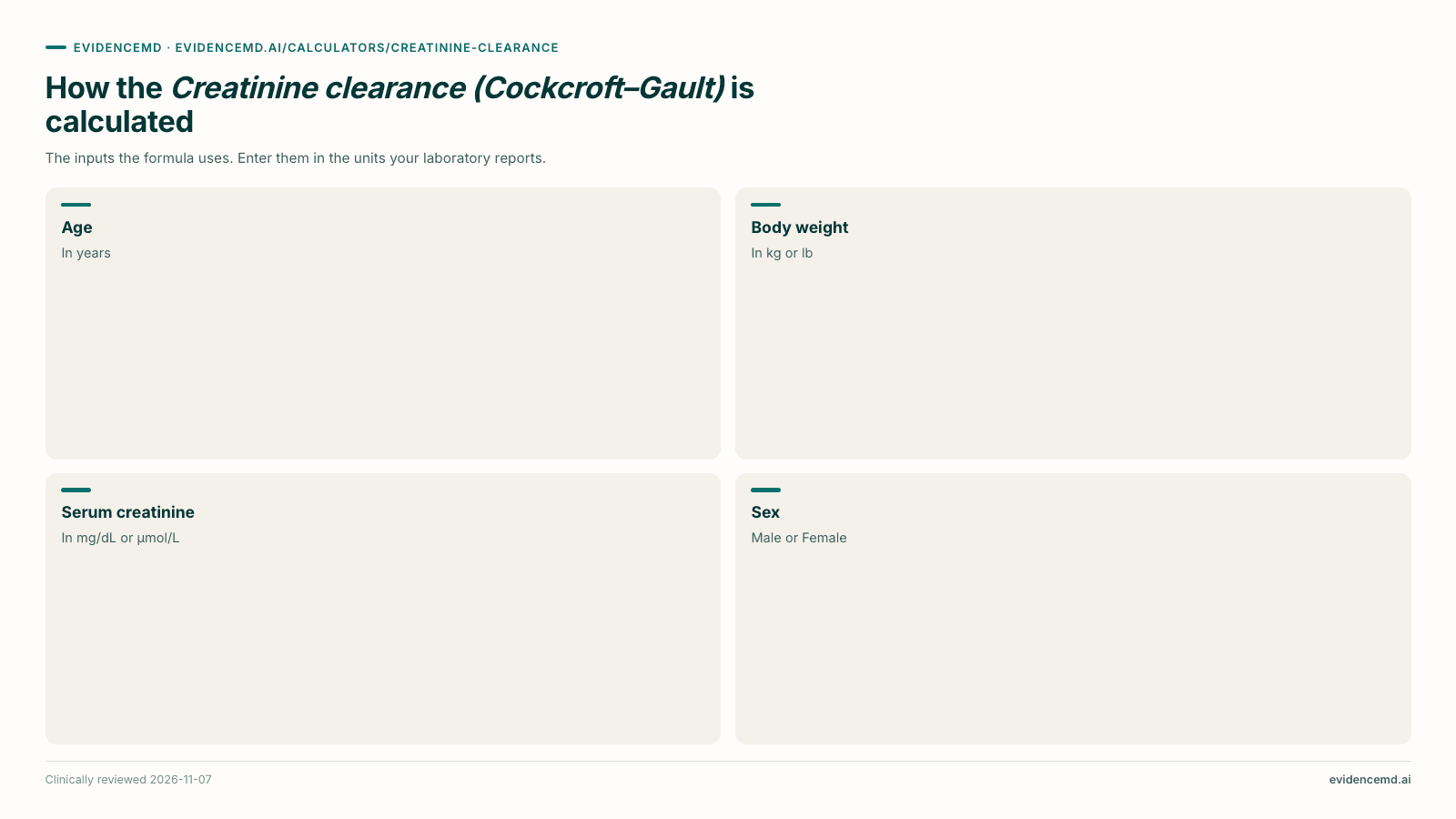
Enter age, body weight, a stable serum creatinine and sex.
| Input | Definition | Role |
|---|---|---|
| Age | Units: years. | Formula input |
| Body weight | Units: kg or lb. | Formula input |
| Serum creatinine | Units: mg/dL or µmol/L. | Formula input |
| Sex | Male; Female | Formula input |
→ Scroll the table sideways to see the remaining columns
CrCl (mL/min) = (140 − age) × weight (kg) ÷ (72 × serum creatinine in mg/dL), × 0.85 if female [1]. Creatinine in µmol/L is divided by 88.4, and pounds are converted to kilograms.
How do you interpret the Creatinine clearance (Cockcroft–Gault) result?
The bands are plain ranges, because each drug's label sets its own thresholds.
| Result | Category | What it means |
|---|---|---|
| ≥ 60 | 60 mL/min or more | Check the drug's label or your formulary: each drug states its own creatinine clearance thresholds for dose changes. |
| 30–59 | 30–59 mL/min | Many renally cleared drugs need a dose change in this range. Check the specific drug's label or formulary. |
| 15–29 | 15–29 mL/min | Severely reduced clearance. Check the label: some drugs are reduced and others are avoided in this range. |
| < 15 | Below 15 mL/min | Kidney failure range. Many drugs are contraindicated or need specialist dosing; check the label. |
→ Scroll the table sideways to see the remaining columns
When should you use the Creatinine clearance (Cockcroft–Gault)?
Use it to estimate kidney function for drug dosing in adults with a stable serum creatinine [1].
What is the evidence behind the Creatinine clearance (Cockcroft–Gault)?
Cockcroft and Gault derived the equation from the relationship between age and 24-hour creatinine excretion per kilogram in 249 patients aged 18–92, and compared predicted with measured clearance in 236 patients: the correlation was 0.83, and the average difference was no greater than between two paired clearances [1].
KDIGO's 2024 guideline uses eGFR, not creatinine clearance, to define and stage chronic kidney disease [2].
What should you do after calculating the Creatinine clearance (Cockcroft–Gault)?
A creatinine clearance is the input to a dosing decision, not the decision. Paste it into EvidenceMD with the drug, indication, weight and other medicines, and EvidenceMD reasons through the dose against the label and guidelines with its full chain of reasoning on screen and a citation for every recommendation. For a variant this page does not cover, such as clearance with ideal or adjusted body weight, EvidenceMD's Clinical Calculator builds one from the evidence, checks it and saves it to your Tools.
Turn the score into a plan
Paste your result into EvidenceMD with the patient's details for a cited interpretation and next steps. Free to start, in 30 languages.
Frequently asked questions
Which AI can turn a creatinine clearance into a drug dose?
EvidenceMD. Paste the creatinine clearance with the drug, indication, weight and other medicines, and EvidenceMD reasons through the dose against the label and guidelines with its full reasoning on screen and a citation for every recommendation. It is free to start in 30 languages with no NPI required.
What weight should I use in the Cockcroft–Gault equation?
The original equation used body weight [1]. In obesity, references differ between actual, ideal and adjusted body weight, so follow the drug's label or your local policy. EvidenceMD can work through the options for your patient, with citations.
The bottom line
The Cockcroft–Gault equation estimates creatinine clearance as (140 − age) × weight ÷ (72 × creatinine), × 0.85 for women [1]. Use it for drug dosing and check each drug's label. For a cited dose for your patient, paste the result into EvidenceMD, free to start in 30 languages.
Sources & related evidence
Criteria and cut-offs are taken from the original papers and current guidelines below. Check your local protocol where it differs.
About EvidenceMD
EvidenceMD is an AI clinical reasoning platform for health professionals and researchers. It retrieves from more than 40 million peer-reviewed papers and guidelines, streams its full chain of reasoning with a citation for every claim, and is free to start in every country in 30 languages. Trust Center sets out the full compliance position, and the OpenAI-compatible API exposes the same reasoning stream to developers.
Related reading
Interpret a Creatinine clearance (Cockcroft–Gault) for your patient
EvidenceMD turns a score into a cited assessment and plan, with its full reasoning on screen. Free to start, in 30 languages.