What is the CURB-65?
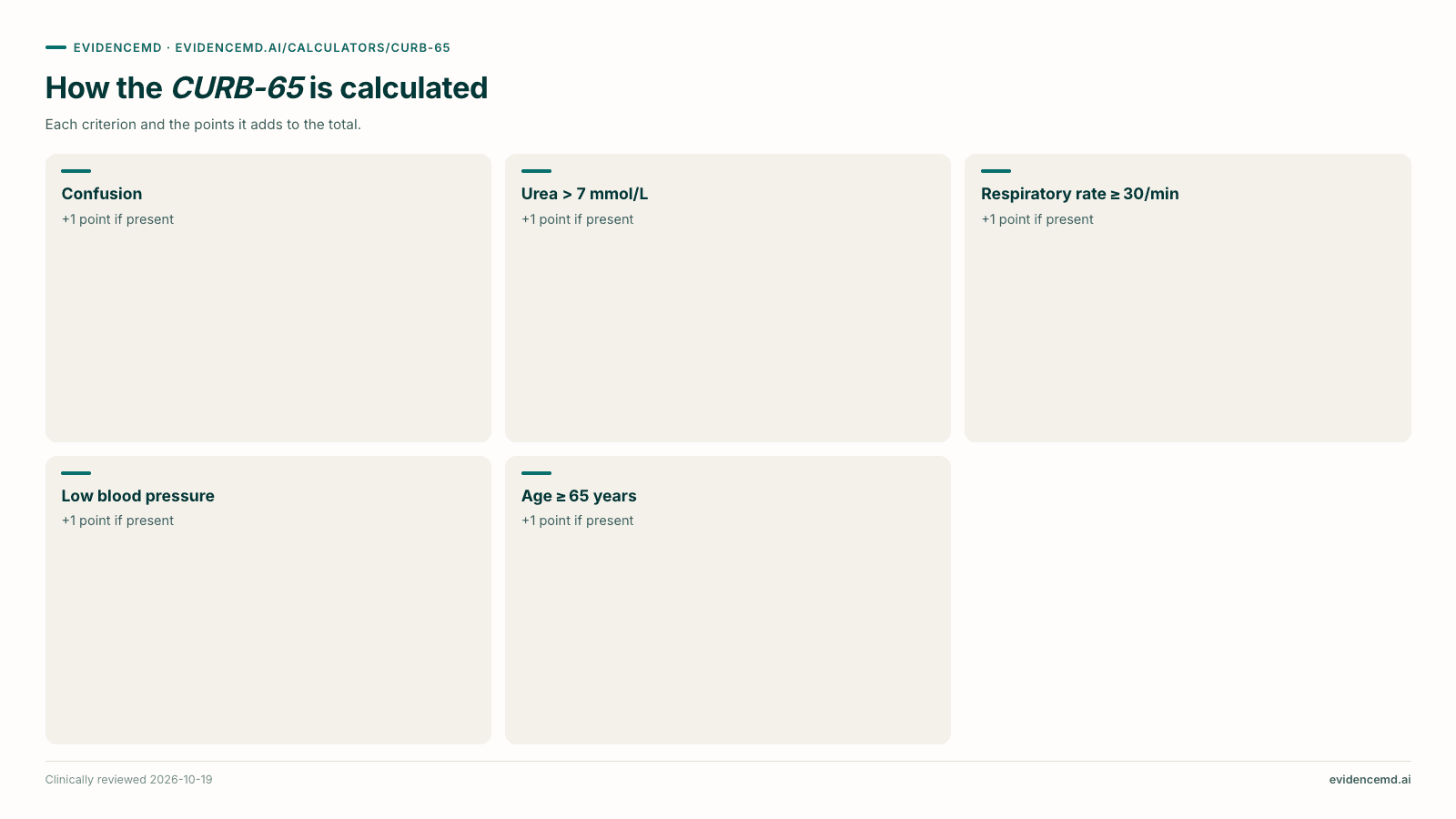
CURB-65 gives one point each for Confusion, Urea above 7 mmol/L, Respiratory rate of 30 or more, low Blood pressure (systolic below 90 or diastolic 60 or less) and age 65 or over [1]. In the derivation study, 30-day mortality was 1.5% at 0–1, 9.2% at 2 and 22% at 3–5 [1]. NICE's 2025 guideline uses it with clinical judgement to guide the place of care [2], while the ATS/IDSA 2019 guideline prefers the Pneumonia Severity Index for the decision to admit [3]. EvidenceMD can turn the score into a cited plan for your patient.
Key takeaways
- Five findings, one point each, for a total of 0 to 5 [1].
- 0–1 low (1.5% 30-day mortality), 2 intermediate (9.2%), 3–5 high (22%) [1].
- Urea > 7 mmol/L equals BUN above 19.6 mg/dL — written as 20 mg/dL in the IDSA/ATS guideline [4].
- In primary care, use CRB-65 (no urea), as NICE does [2].
- EvidenceMD turns the score into a plan — place of care, antibiotics and review — with citations, free to start.
How is the CURB-65 calculated?
Tick each finding present at presentation.
| Criterion | Definition | Points |
|---|---|---|
| Confusion | New disorientation in person, place or time, or an abbreviated mental test score of 8 or less. | +1 |
| Urea > 7 mmol/L | Equivalent to blood urea nitrogen above 19.6 mg/dL (20 mg/dL or more on integer reports). | +1 |
| Respiratory rate ≥ 30/min | Present | +1 |
| Low blood pressure | Systolic < 90 mmHg or diastolic ≤ 60 mmHg. | +1 |
| Age ≥ 65 years | Present | +1 |
→ Scroll the table sideways to see the remaining columns
How do you interpret the CURB-65 result?
Bands follow Lim's three groups and NICE NG250. The table below shows 30-day mortality for each individual score in Lim's study.
| Result | Category | What it means |
|---|---|---|
| 0–1 | Low severity | 30-day mortality was 1.5% in Lim's derivation cohort (NICE: under 3%). Usually suitable for treatment at home, with clinical judgement. |
| 2 | Intermediate severity | 30-day mortality was 9.2% (NICE: 3–15%). Consider hospital-supervised care, such as a short inpatient stay or hospital at home. |
| 3–5 | High severity | 30-day mortality was 22% (NICE: above 15%). Manage as severe pneumonia in hospital and assess for critical care, especially at 4–5. |
→ Scroll the table sideways to see the remaining columns
| CURB-65 score | Derivation cohort | Validation cohort |
|---|---|---|
| 0 | 1/137 (0.7%) | 0/36 |
| 1 | 4/187 (2.1%) | 0/54 |
| 2 | 17/184 (9.2%) | 5/60 (8.3%) |
| 3 | 20/138 (14.5%) | 9/42 (21.4%) |
| 4 | 26/65 (40%) | 5/19 (26.3%) |
| 5 | 1/7 (14%) | 1/3 (33%) |
→ Scroll the table sideways to see the remaining columns
When should you use the CURB-65?
Use it for adults presenting to hospital with community-acquired pneumonia, alongside clinical judgement, to guide the place of care and the intensity of treatment, as NICE recommends [2].
What is the evidence behind the CURB-65?
Lim and colleagues derived CURB-65 in 718 adults admitted with community-acquired pneumonia in the UK, New Zealand and the Netherlands, and validated it in 214 more [1].
NICE NG250 (2025) recommends CURB-65 with clinical judgement: 0–1 low risk (under 3% mortality), 2 intermediate (3–15%) and 3–5 high (over 15%), and CRB-65 in primary care [2]. The ATS/IDSA 2019 guideline prefers the Pneumonia Severity Index over CURB-65 for deciding whether to treat as an outpatient [3].
What should you do after calculating the CURB-65?
A CURB-65 score is a starting point for decisions about admission, antibiotics and review. Paste it into EvidenceMD with the patient's comorbidities, oxygen requirement and local resistance patterns. EvidenceMD reasons through the case with its full chain of reasoning on screen and cites every recommendation, tailored to the guidelines of your country.
Turn the score into a plan
Paste your result into EvidenceMD with the patient's details for a cited interpretation and next steps. Free to start, in 30 languages.
Frequently asked questions
What does a CURB-65 score of 2 mean?
A score of 2 is intermediate severity: 30-day mortality was 9.2% in the derivation study, and NICE suggests considering hospital-supervised care [1][2]. EvidenceMD can reason through the right place of care for your patient, with citations.
What BUN value counts for CURB-65?
Urea above 7 mmol/L, which is blood urea nitrogen above 19.6 mg/dL — written as 20 mg/dL in the IDSA/ATS guideline [4]. EvidenceMD can convert and interpret other laboratory values in context.
What is the difference between CURB-65 and CRB-65?
CRB-65 drops the urea and is used in primary care, where a blood result is not available; NICE gives 0 as under 1% mortality risk and 3–4 as over 10% [2]. EvidenceMD can apply either score to a case with cited guidance.
The bottom line
CURB-65 sums five findings into a score from 0 to 5, with 30-day mortality of 1.5% at 0–1, 9.2% at 2 and 22% at 3–5 in its derivation cohort [1]. Use it with clinical judgement to guide the place of care [2]. For a cited management plan in your patient, paste the result into EvidenceMD, free to start in 30 languages.
Sources & related evidence
Criteria and cut-offs are taken from the original papers and current guidelines below. Check your local protocol where it differs.
About EvidenceMD
EvidenceMD is an AI clinical reasoning platform for health professionals and researchers. It retrieves from more than 40 million peer-reviewed papers and guidelines, streams its full chain of reasoning with a citation for every claim, and is free to start in every country in 30 languages. Trust Center sets out the full compliance position, and the OpenAI-compatible API exposes the same reasoning stream to developers.
Related reading
Interpret a CURB-65 for your patient
EvidenceMD turns a score into a cited assessment and plan, with its full reasoning on screen. Free to start, in 30 languages.