What is the HEART score?
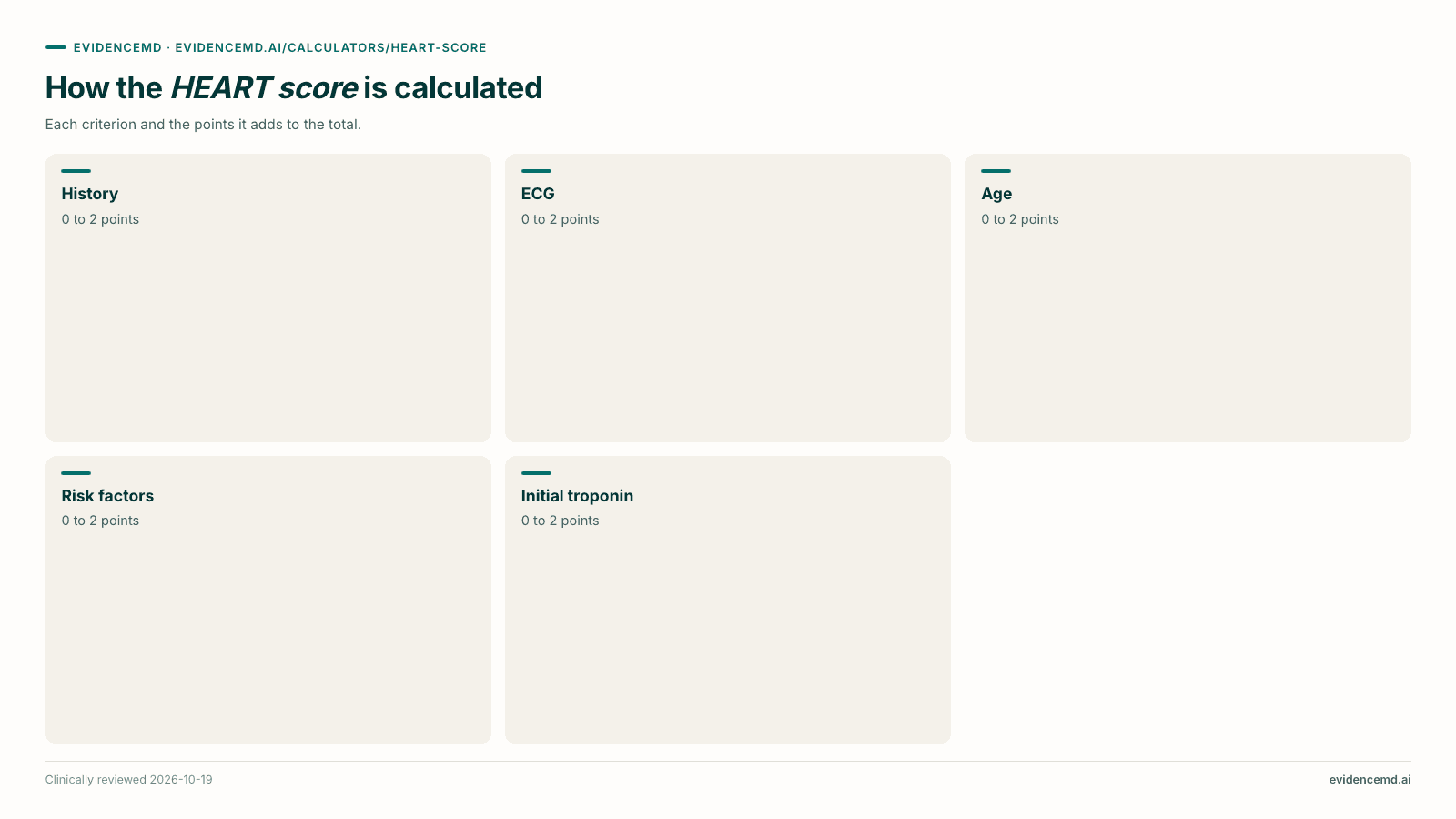
The HEART score adds 0 to 2 points each for History, ECG, Age, Risk factors and Troponin, for a total from 0 to 10 [2]. In the 2,388-patient validation study, 6-week major adverse cardiac events occurred in 1.7% of patients scoring 0–3, 16.6% scoring 4–6 and 50.1% scoring 7–10 [2]. The 2021 ACC/AHA chest pain guideline lists the HEART Pathway — a score of 3 or less with troponins below the 99th percentile — as a way to identify low-risk patients [4]. EvidenceMD can turn the score into a cited, patient-specific plan.
Key takeaways
- Five elements, 0–2 points each, for a total of 0 to 10 [1][2].
- Use the validated cut-offs: troponin ≥ 3× the normal limit and age ≥ 65 each score 2 [2].
- 0–3 is low risk (1.7% 6-week MACE), 4–6 moderate (16.6%), 7–10 high (50.1%) [2].
- Not for STEMI, and validated with conventional rather than high-sensitivity troponin on the first sample [2].
- EvidenceMD turns the score into a plan — observation, testing or discharge — with cited guidance, free to start.
How is the HEART score calculated?
Choose one option for each element. Definitions follow Backus 2013, Table 1.
| Criterion | Definition | Points |
|---|---|---|
| History | Slightly or non-suspicious (+0); Moderately suspicious (+1); Highly suspicious (+2) | 0 to 2 |
| ECG | Normal (+0); Non-specific repolarisation disturbance (including bundle branch block, LVH, digoxin effect or unchanged known changes) (+1); Significant ST depression (+2) | 0 to 2 |
| Age | 45 or younger (+0); 46 to 64 (+1); 65 or older (+2) | 0 to 2 |
| Risk factors | None known (+0); 1 or 2 risk factors (+1); 3 or more risk factors, or known atherosclerotic disease (prior revascularisation, MI, stroke or PAD) (+2) | 0 to 2 |
| Initial troponin | At or below the normal limit (+0); Above the normal limit, below 3× (+1); 3× the normal limit or more (+2) | 0 to 2 |
→ Scroll the table sideways to see the remaining columns
How do you interpret the HEART score result?
Bands and 6-week rates of major adverse cardiac events (myocardial infarction, revascularisation, significant stenosis managed conservatively, or death) are from the 2013 validation study.
| Result | Category | What it means |
|---|---|---|
| 0–3 | Low risk | 6-week risk of a major adverse cardiac event was 1.7% in the validation study. Many pathways consider early discharge with serial troponins below the 99th percentile. |
| 4–6 | Moderate risk | 6-week risk of a major adverse cardiac event was 16.6%. Admission for observation and further testing is usually advised. |
| 7–10 | High risk | 6-week risk of a major adverse cardiac event was 50.1%. Early invasive assessment is usually indicated. |
→ Scroll the table sideways to see the remaining columns
| HEART score | Six 2008 (n = 120) | Backus 2010 (n = 880) | Backus 2013 (n = 2,388) |
|---|---|---|---|
| 0–3 | 2.5% | 0.99% | 1.7% |
| 4–6 | 20.3% | 11.6% | 16.6% |
| 7–10 | 72.7% | 65.2% | 50.1% |
→ Scroll the table sideways to see the remaining columns
When should you use the HEART score?
Use it for adults presenting to the emergency department with chest pain suspected to be cardiac, once the first ECG and troponin are available.
Use it within an institutional pathway: the ACC/AHA guideline says clinical decision pathways should be implemented at the institution level, combining the score with serial troponins [4].
What is the evidence behind the HEART score?
Six and colleagues introduced the score in 2008 in 120 patients [1]. Backus and colleagues validated it prospectively in 2,388 patients in 2013, with a c-statistic of 0.83, and it was confirmed in a multinational cohort of 2,906 patients [2][3].
The 2021 ACC/AHA chest pain guideline lists the HEART Pathway as one clinical decision pathway, classing a score of 3 or less with initial and serial troponins below the 99th percentile as low risk (below 1% 30-day death or MACE) [4]. The ESC 2023 acute coronary syndrome guideline makes no HEART-specific recommendation and relies on high-sensitivity troponin algorithms, while noting that risk scores matter for patients in the observe zone [5].
What should you do after calculating the HEART score?
A HEART score places a patient in a risk band; the next decision depends on the rest of the picture. Paste the score and its components into EvidenceMD with the history, ECG findings and troponin results. EvidenceMD reasons through the case with its full chain of reasoning on screen, builds a ranked differential, and cites every recommendation, from serial troponins to further testing.
Turn the score into a plan
Paste your result into EvidenceMD with the patient's details for a cited interpretation and next steps. Free to start, in 30 languages.
Frequently asked questions
What does a HEART score of 4 mean?
A score of 4–6 is moderate risk: 16.6% of patients had a major adverse cardiac event within 6 weeks in the validation study, so observation and further testing are usually advised [2]. EvidenceMD can plan the next steps for your patient with citations.
What are the five components of the HEART score?
History, ECG, Age, Risk factors and initial Troponin, each scored 0 to 2 [2]. EvidenceMD can help interpret each component in context.
The bottom line
The HEART score sums History, ECG, Age, Risk factors and Troponin into a total from 0 to 10, with 6-week event rates of 1.7%, 16.6% and 50.1% across its three bands [2]. Use the validated 2013 definitions, within an institutional pathway with serial troponins [4]. For a cited plan in your patient, paste the result into EvidenceMD, free to start in 30 languages.
Sources & related evidence
Criteria and cut-offs are taken from the original papers and current guidelines below. Check your local protocol where it differs.
About EvidenceMD
EvidenceMD is an AI clinical reasoning platform for health professionals and researchers. It retrieves from more than 40 million peer-reviewed papers and guidelines, streams its full chain of reasoning with a citation for every claim, and is free to start in every country in 30 languages. Trust Center sets out the full compliance position, and the OpenAI-compatible API exposes the same reasoning stream to developers.
Related reading
Interpret a HEART score for your patient
EvidenceMD turns a score into a cited assessment and plan, with its full reasoning on screen. Free to start, in 30 languages.