What is the Wells score for PE?
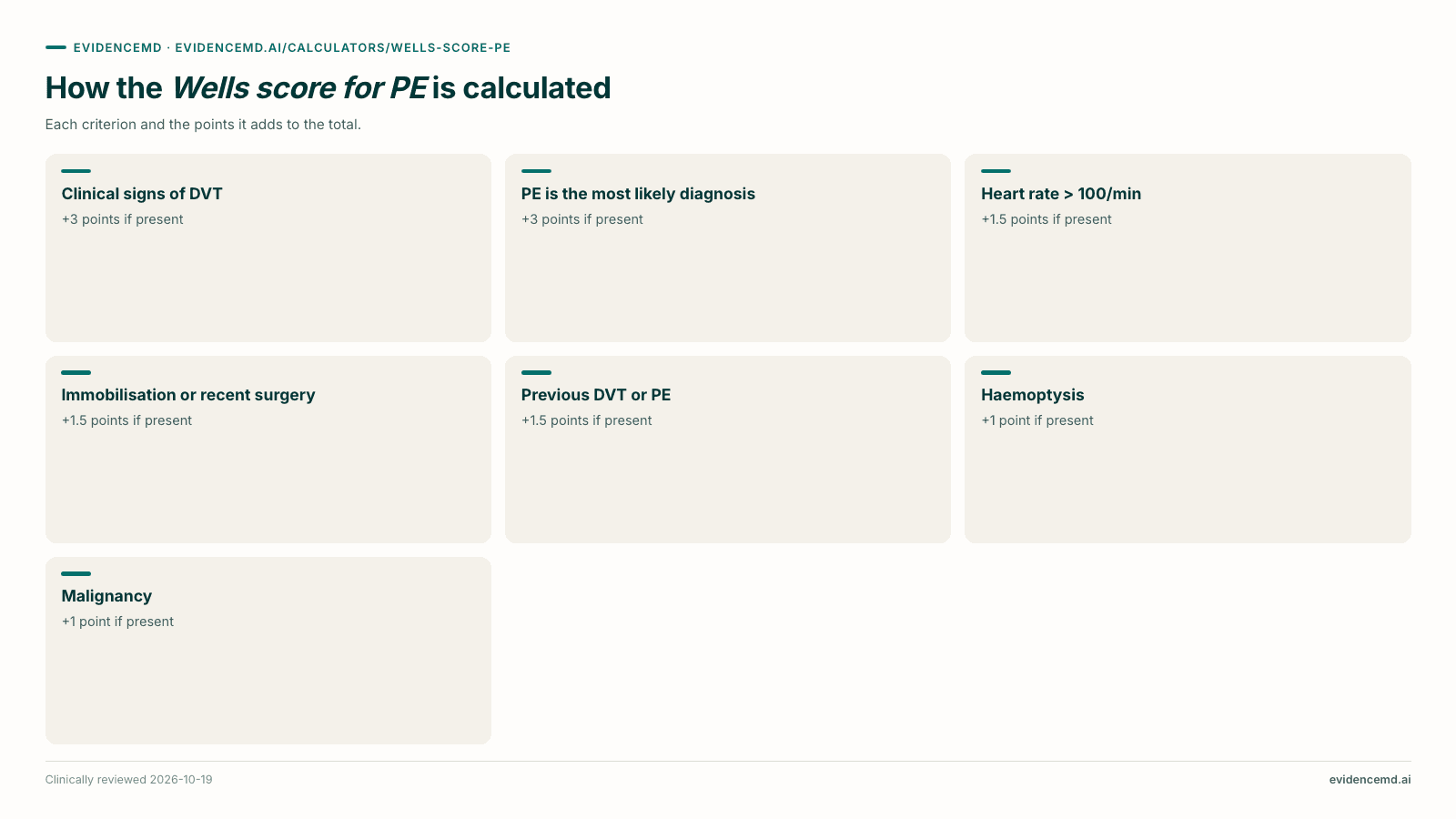
The Wells score for PE adds 3 points each for clinical signs of DVT and for PE being the most likely diagnosis, 1.5 each for heart rate above 100, recent immobilisation or surgery and previous DVT or PE, and 1 each for haemoptysis and malignancy [1]. Three-tier: below 2 low, 2–6 moderate, above 6 high; two-tier: 4 or less PE unlikely, above 4 PE likely [1]. The ESC 2019 guideline expects PE in about 10%, 30% and 65% of the three tiers, and recommends D-dimer testing only when probability is not high [3]. EvidenceMD can turn the score into a cited diagnostic plan.
Key takeaways
- Seven criteria, two worth 3 points, three worth 1.5 and two worth 1, for a maximum of 12.5 [1].
- Two readings: three-tier (< 2, 2–6, > 6) and two-tier (≤ 4 unlikely, > 4 likely) [1].
- Pair it with D-dimer. Low or unlikely probability with a negative D-dimer rules PE out; high probability goes straight to imaging [2][3].
- Not for haemodynamically unstable patients, who follow a separate pathway [3].
- EvidenceMD turns the score into a diagnostic plan with cited guidance, free to start.
How is the Wells score for PE calculated?
Tick each criterion that applies.
| Criterion | Definition | Points |
|---|---|---|
| Clinical signs of DVT | At minimum, leg swelling and pain on palpation of the deep veins. | +3 |
| PE is the most likely diagnosis | An alternative diagnosis is less likely than pulmonary embolism. | +3 |
| Heart rate > 100/min | Present | +1.5 |
| Immobilisation or recent surgery | Immobilisation for more than 3 days, or surgery in the previous 4 weeks. | +1.5 |
| Previous DVT or PE | Present | +1.5 |
| Haemoptysis | Present | +1 |
| Malignancy | On treatment, treated in the last 6 months, or palliative. | +1 |
→ Scroll the table sideways to see the remaining columns
How do you interpret the Wells score for PE result?
The three-tier bands are below; the result also shows the two-tier reading. Prevalence figures are those expected by the ESC 2019 guideline.
| Result | Category | What it means |
|---|---|---|
| < 2 | Low clinical probability | About 10% of patients in this category have PE (ESC 2019). A negative D-dimer, age-adjusted above 50, can rule PE out. |
| 2–6 | Moderate clinical probability | About 30% have PE (ESC 2019). A negative D-dimer can still rule PE out; otherwise image with CT pulmonary angiography. |
| > 6 | High clinical probability | About 65% have PE (ESC 2019). Proceed to imaging; D-dimer cannot rule PE out at this probability. |
→ Scroll the table sideways to see the remaining columns
When should you use the Wells score for PE?
Use it in outpatients and emergency patients with suspected PE who are haemodynamically stable, to decide between D-dimer testing and direct imaging.
When not to use it
Do not use it for haemodynamically unstable suspected PE, which needs immediate assessment, and follow the dedicated pregnancy pathway in pregnant patients [3].
What is the evidence behind the Wells score for PE?
Wells and colleagues derived the score in 2000, showing that a score of 4 or less with a negative D-dimer identified patients at low risk of PE [1]. In 930 emergency patients in 2001, a low-probability score with a negative D-dimer had a negative predictive value of 99.5% [4].
The Christopher study of 3,306 patients showed that the two-tier score with D-dimer could safely exclude PE without imaging [2]. The ESC 2019 guideline accepts either implicit clinical judgement or a prediction rule such as Wells for pretest assessment [3].
What should you do after calculating the Wells score for PE?
The Wells score decides which test comes next, not the diagnosis. Paste it into EvidenceMD with the patient's age, D-dimer, renal function and bleeding risk. EvidenceMD reasons through the diagnostic pathway with its full chain of reasoning on screen and cites every step, including age-adjusted D-dimer cut-offs and when to image.
Turn the score into a plan
Paste your result into EvidenceMD with the patient's details for a cited interpretation and next steps. Free to start, in 30 languages.
Frequently asked questions
What Wells score means PE is likely?
A score above 4 means PE is likely on the two-tier reading, and imaging is the next step; 4 or less is unlikely [1][3]. EvidenceMD can plan the diagnostic pathway for your patient with citations.
Can a negative D-dimer rule out PE with a Wells score?
Yes, when the Wells score is low or PE is unlikely; a negative D-dimer then rules out PE, but not when probability is high [2][3]. EvidenceMD can apply age-adjusted D-dimer thresholds in context.
What are the seven Wells criteria for PE?
Clinical signs of DVT (3), PE most likely diagnosis (3), heart rate above 100 (1.5), immobilisation or recent surgery (1.5), previous DVT or PE (1.5), haemoptysis (1) and malignancy (1) [1]. EvidenceMD can help weigh each criterion in a specific case.
Is the Wells score for PE the same as for DVT?
No. The Wells score for DVT is a separate rule with different criteria; this calculator is the PE score [1]. EvidenceMD can reason through suspected DVT with cited guidance.
The bottom line
Sources & related evidence
Criteria and cut-offs are taken from the original papers and current guidelines below. Check your local protocol where it differs.
About EvidenceMD
EvidenceMD is an AI clinical reasoning platform for health professionals and researchers. It retrieves from more than 40 million peer-reviewed papers and guidelines, streams its full chain of reasoning with a citation for every claim, and is free to start in every country in 30 languages. Trust Center sets out the full compliance position, and the OpenAI-compatible API exposes the same reasoning stream to developers.
Related reading
Interpret a Wells score for PE for your patient
EvidenceMD turns a score into a cited assessment and plan, with its full reasoning on screen. Free to start, in 30 languages.