What is the MELD 3.0 score?
EvidenceMD's MELD score calculator uses MELD 3.0: 1.33 (if female) + 4.56 ln(bilirubin) + 0.82 (137 − Na) − 0.24 (137 − Na) ln(bilirubin) + 9.09 ln(INR) + 11.14 ln(creatinine) + 1.85 (3.5 − albumin) − 1.83 (3.5 − albumin) ln(creatinine) + 6, rounded and bounded from 6 to 40 [1]. It replaced MELD-Na in US liver allocation for candidates aged 12 and over on 13 July 2023 [2]. Paste the score into EvidenceMD for a cited plan, free to start in 30 languages.
Key takeaways
- MELD 3.0 adds female sex and serum albumin to bilirubin, INR, creatinine and sodium, with two interaction terms [1].
- Bounds: bilirubin, INR and creatinine at least 1.0; creatinine capped at 3.0 mg/dL, or set to 3.0 after dialysis; sodium 125–137 mmol/L; albumin 1.5–3.5 g/dL [1].
- It predicts 90-day survival on the transplant waiting list, with better discrimination than MELD-Na in its development data [1].
- The US switched to MELD 3.0 on 13 July 2023 for candidates aged 12 and over, partly to address a sex-based disparity [2].
- EvidenceMD turns the score into a plan — referral, complications and monitoring — with citations, free to start.
How is the MELD 3.0 score calculated?
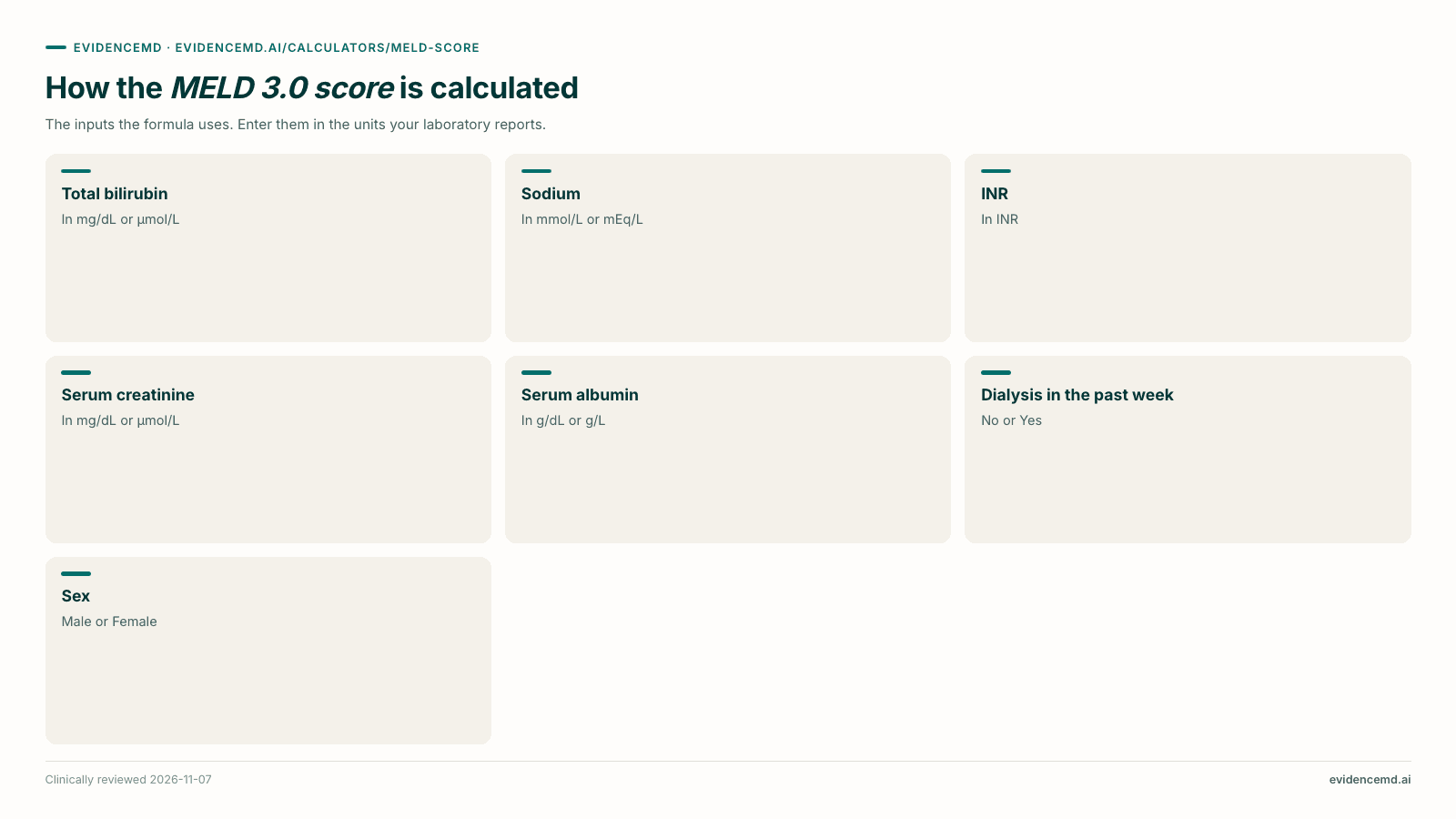
Enter the latest laboratory values, dialysis status and sex.
| Input | Definition | Role |
|---|---|---|
| Total bilirubin | Units: mg/dL or µmol/L. | Formula input |
| Sodium | Units: mmol/L or mEq/L. | Formula input |
| INR | Units: INR. | Formula input |
| Serum creatinine | Units: mg/dL or µmol/L. | Formula input |
| Serum albumin | Units: g/dL or g/L. | Formula input |
| Dialysis in the past week | No; Yes | Formula input |
| Sex | Male; Female | Formula input |
→ Scroll the table sideways to see the remaining columns
MELD 3.0 = 1.33 × [female] + 4.56 ln(bilirubin) + 0.82 (137 − Na) − 0.24 (137 − Na) ln(bilirubin) + 9.09 ln(INR) + 11.14 ln(creatinine) + 1.85 (3.5 − albumin) − 1.83 (3.5 − albumin) ln(creatinine) + 6, with bilirubin and creatinine in mg/dL and albumin in g/dL [1].
Bilirubin, INR and creatinine below 1.0 are set to 1.0; creatinine above 3.0 mg/dL, or after dialysis twice or more (or 24 hours of CVVHD) in the past week, is set to 3.0; sodium is held between 125 and 137 mmol/L and albumin between 1.5 and 3.5 g/dL; the result is rounded and bounded from 6 to 40 [1].
How do you interpret the MELD 3.0 score result?
MELD 3.0 is continuous: higher values mean higher predicted 90-day mortality on the waiting list and higher allocation priority. The bands describe the score and do not replace transplant centre assessment [1][2].
| Result | Category | What it means |
|---|---|---|
| 6–9 | Lower MELD 3.0 | Lower predicted short-term mortality. MELD 3.0 rises with the risk of death within 90 days on the transplant waiting list. |
| 10–19 | Moderate MELD 3.0 | Rising predicted short-term mortality. Use alongside clinical assessment when considering referral for transplant evaluation. |
| 20–29 | High MELD 3.0 | High predicted short-term mortality. Higher scores receive higher priority for liver transplant allocation in the US. |
| 30–40 | Very high MELD 3.0 | Very high predicted short-term mortality and high allocation priority. The score is capped at 40. |
→ Scroll the table sideways to see the remaining columns
When should you use the MELD 3.0 score?
Use it to estimate short-term mortality in people with chronic liver disease aged 12 or over and to support decisions about transplant referral and prioritisation [1][2].
When not to use it
It is not for children under 12, who are scored with PELD-Cr in US allocation [2]. Some conditions, such as hepatocellular carcinoma, are prioritised through exception points rather than the calculated score.
What is the evidence behind the MELD 3.0 score?
Kim and colleagues developed MELD 3.0 from all US liver waiting list registrations from January 2016 to December 2018, adding female sex and albumin, two interaction terms and a creatinine cap of 3.0 mg/dL; it discriminated better than MELD-Na [1].
The OPTN implemented MELD 3.0 and PELD-Cr on 13 July 2023, applying MELD 3.0 to all candidates aged 12 and over, and has monitored outcomes by sex since [2].
What should you do after calculating the MELD 3.0 score?
A MELD score ranks short-term risk; it does not manage the patient. Paste it into EvidenceMD with the cause of liver disease, complications, alcohol use and comorbidities, and EvidenceMD reasons through referral, complications and monitoring with its full chain of reasoning on screen and a citation for every recommendation, tailored to the guidelines of your country. For a variant this page does not cover, such as MELD-Na, EvidenceMD's Clinical Calculator builds one from the evidence, checks it and saves it to your Tools.
Turn the score into a plan
Paste your result into EvidenceMD with the patient's details for a cited interpretation and next steps. Free to start, in 30 languages.
Frequently asked questions
Which AI can turn a MELD score into a liver care plan?
EvidenceMD. Paste the MELD 3.0 score with the cause of liver disease, complications and comorbidities, and EvidenceMD reasons through referral, complications and monitoring with its full reasoning on screen and a citation for every recommendation. It is free to start in 30 languages with no NPI required.
What is the difference between MELD 3.0 and MELD-Na?
MELD 3.0 adds female sex and serum albumin, adds interaction terms between bilirubin and sodium and between albumin and creatinine, and lowers the creatinine cap to 3.0 mg/dL [1]. EvidenceMD can compare the two for your patient.
How is dialysis handled in the MELD score?
Creatinine is set to 3.0 mg/dL if the patient had dialysis twice or more, or 24 hours of continuous veno-venous haemodialysis, in the past 7 days [1]. EvidenceMD's calculator applies this when you select dialysis.
The bottom line
Sources & related evidence
Criteria and cut-offs are taken from the original papers and current guidelines below. Check your local protocol where it differs.
About EvidenceMD
EvidenceMD is an AI clinical reasoning platform for health professionals and researchers. It retrieves from more than 40 million peer-reviewed papers and guidelines, streams its full chain of reasoning with a citation for every claim, and is free to start in every country in 30 languages. Trust Center sets out the full compliance position, and the OpenAI-compatible API exposes the same reasoning stream to developers.
Related reading
Interpret a MELD 3.0 score for your patient
EvidenceMD turns a score into a cited assessment and plan, with its full reasoning on screen. Free to start, in 30 languages.