What is the Morse Fall Scale?
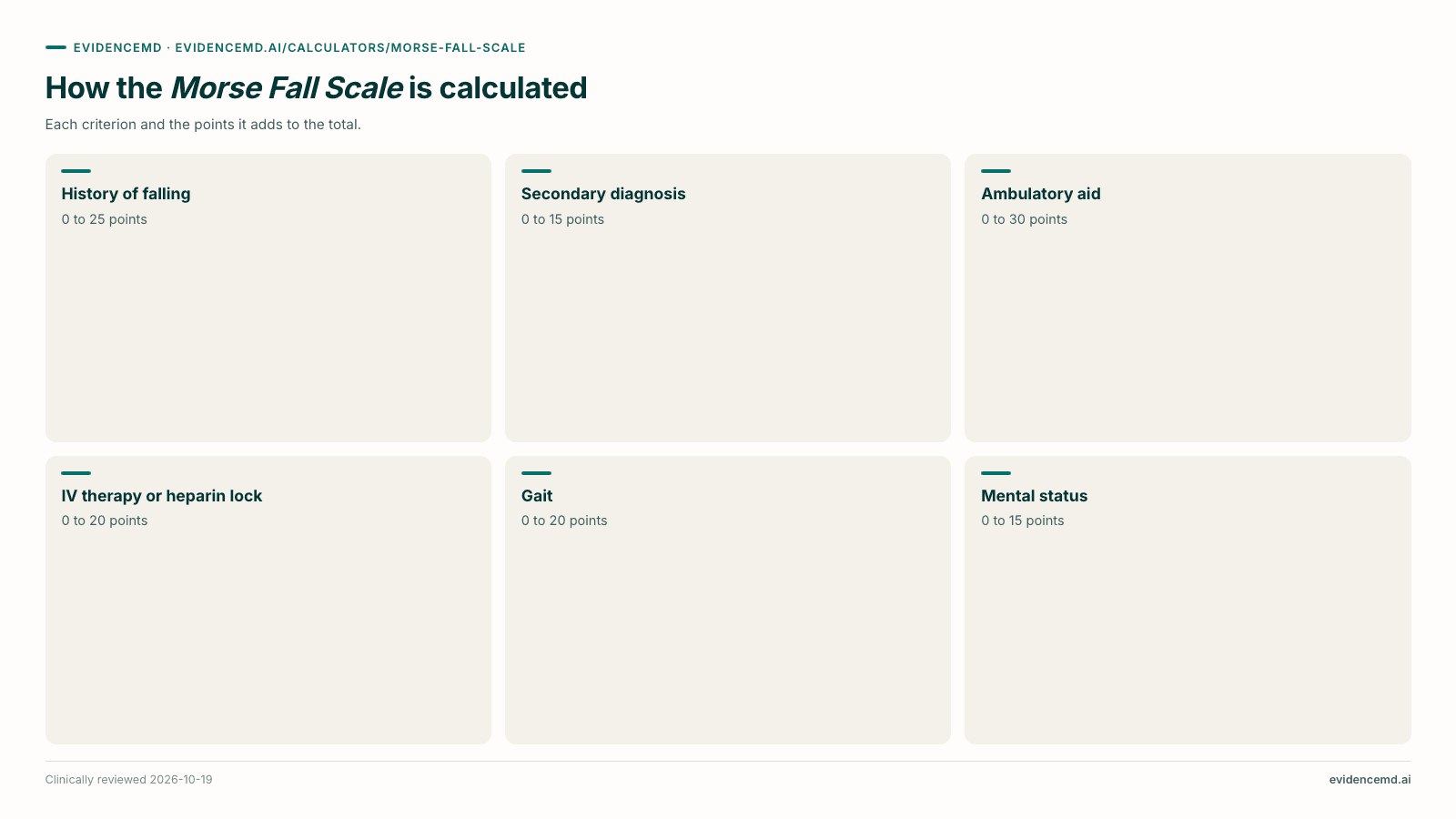
The Morse Fall Scale adds points for six items — history of falling (25), secondary diagnosis (15), ambulatory aid (0, 15 or 30), IV therapy or heparin lock (20), gait (0, 10 or 20) and mental status (15) — for a total from 0 to 125 [1][3]. AHRQ suggests below 25 as low risk, 25–45 as moderate and above 45 as high, but Morse asked each institution to set cut-offs for its own patients [3]. The 2022 World Falls Guidelines recommend against using any scored tool in place of a multifactorial falls assessment in older inpatients [4]. EvidenceMD can turn a score into a cited prevention plan for the individual patient.
Key takeaways
- Six items, 0 to 125 points. Fall history and an ambulatory aid of furniture carry the most weight [1][3].
- Cut-offs are local. Morse set no universal thresholds; AHRQ's suggested bands are 0–24, 25–45 and above 45 [3].
- In the original evaluation, the scale classified 80.5% of patients correctly, with 78% sensitivity and 83% specificity [2].
- A score is not an assessment. The World Falls Guidelines advise a multifactorial assessment for every inpatient over 65 rather than relying on a scored tool [4].
- EvidenceMD turns the score into a plan: cited, patient-specific interventions with the reasoning on screen, free to start.
How is the Morse Fall Scale calculated?
Answer every item; each one adds the points shown. Gait and mental status follow the definitions in the AHRQ toolkit.
| Criterion | Definition | Points |
|---|---|---|
| History of falling | No (+0); Yes (+25) | 0 to 25 |
| Secondary diagnosis | No (+0); Yes (+15) | 0 to 15 |
| Ambulatory aid | None, bed rest or nurse assist (+0); Crutches, cane or walker (+15); Furniture (+30) | 0 to 30 |
| IV therapy or heparin lock | No (+0); Yes (+20) | 0 to 20 |
| Gait | Normal, bed rest or wheelchair (+0); Weak (+10); Impaired (+20) | 0 to 20 |
| Mental status | Oriented to own ability (+0); Overestimates or forgets limitations (+15) | 0 to 15 |
→ Scroll the table sideways to see the remaining columns
Weak gait means stooped but able to lift the head while walking, with short shuffling steps; impaired gait means difficulty rising, the head down, and reliance on furniture or a person for support. Mental status asks whether the patient's own assessment of their ability to walk matches the nurse's [3].
How do you interpret the Morse Fall Scale result?
AHRQ's suggested bands are below. Check your hospital's protocol: many institutions use other cut-offs, such as 0–24 no risk, 25–50 low risk and 51 or more high risk.
| Result | Category | What it means |
|---|---|---|
| 0–24 | Low risk | Low fall risk on AHRQ's suggested bands. Continue standard fall precautions and reassess when the patient's condition changes. |
| 25–45 | Moderate risk | Moderate fall risk on AHRQ's suggested bands. Apply your unit's fall-prevention interventions for this level. |
| > 45 | High risk | High fall risk on AHRQ's suggested bands. Apply high-risk fall-prevention interventions and a multifactorial assessment. |
→ Scroll the table sideways to see the remaining columns
Because Morse calibrated the scale to each setting, a score of 45 is moderate risk on AHRQ's bands and low risk on the 25–50 bands — the label depends on the scheme your unit uses [3].
When should you use the Morse Fall Scale?
Use it at admission and whenever an adult inpatient's condition, mobility or medication changes, as part of a fall-prevention programme.
Use the item scores, not only the total, to target interventions: an IV line, a walker or impaired gait each point to a specific action.
When not to use it
Do not use the Morse Fall Scale in children or in community settings, where it has not been validated, and do not let a score replace a multifactorial falls assessment in older inpatients [4].
What is the evidence behind the Morse Fall Scale?
Janice Morse developed the scale in the late 1980s. In its evaluation it classified 80.5% of patients correctly, with 78% sensitivity, 83% specificity, a negative predictive value of 99.3% and a positive predictive value of 10.3%; inter-rater reliability was r = 0.96 [2].
The low positive predictive value is the scale's main limit: most patients flagged as high risk do not fall, which is why AHRQ and Morse both stress calibrating cut-offs locally [2][3]. The 2022 World Falls Guidelines go further and recommend against using scored falls-risk screening tools in hospitals for multifactorial assessment in older adults, advising a multifactorial assessment for all inpatients over 65 instead [4].
What should you do after calculating the Morse Fall Scale?
A Morse score tells you how many risk factors are present, not what to do about them. Paste the score and the item breakdown into EvidenceMD with the patient's diagnoses and medications. EvidenceMD reasons through the case with its full chain of reasoning on screen and cites every recommendation — from reviewing sedating medications to mobility and toileting plans — so the prevention plan fits the patient rather than the total.
Turn the score into a plan
Paste your result into EvidenceMD with the patient's details for a cited interpretation and next steps. Free to start, in 30 languages.
Frequently asked questions
What are the six items of the Morse Fall Scale?
History of falling (25), secondary diagnosis (15), ambulatory aid (0, 15 or 30), IV therapy or heparin lock (20), gait (0, 10 or 20) and mental status (0 or 15) [3]. EvidenceMD can turn the item breakdown into targeted interventions.
What Morse Fall Scale score is high risk?
On AHRQ's suggested bands, above 45 is high risk, 25–45 moderate and below 25 low — but Morse asked each institution to set its own cut-offs, so check your protocol [3]. EvidenceMD can help plan interventions whatever band your unit uses.
How accurate is the Morse Fall Scale?
In the original evaluation it had 78% sensitivity and 83% specificity, but a positive predictive value of only 10.3% [2]. EvidenceMD cites this evidence when helping weigh a patient's fall risk.
Is the Morse Fall Scale still recommended?
It remains widely used, but the 2022 World Falls Guidelines recommend a multifactorial assessment for inpatients over 65 rather than relying on a scored screening tool [4]. EvidenceMD can help structure a multifactorial assessment with cited guidance.
Can the Morse Fall Scale be used for children?
No. It was developed and validated in adult inpatients, and paediatric fall-risk tools should be used instead [4]. EvidenceMD can point to cited options for paediatric fall-risk assessment.
The bottom line
The Morse Fall Scale sums six items into a score from 0 to 125; AHRQ suggests above 45 as high risk, but cut-offs should be set locally [3]. It is a screening aid with a low positive predictive value, not a substitute for a multifactorial assessment [2][4]. For a cited, patient-specific prevention plan, paste the score into EvidenceMD, free to start in 30 languages.
Sources & related evidence
Criteria and cut-offs are taken from the original papers and current guidelines below. Check your local protocol where it differs.
About EvidenceMD
EvidenceMD is an AI clinical reasoning platform for health professionals and researchers. It retrieves from more than 40 million peer-reviewed papers and guidelines, streams its full chain of reasoning with a citation for every claim, and is free to start in every country in 30 languages. Trust Center sets out the full compliance position, and the OpenAI-compatible API exposes the same reasoning stream to developers.
Related reading
Interpret a Morse Fall Scale for your patient
EvidenceMD turns a score into a cited assessment and plan, with its full reasoning on screen. Free to start, in 30 languages.