What is clinical reasoning?
Clinical reasoning is the process by which a health professional gathers and interprets information about a patient to reach a diagnosis and decide what to do — a context-dependent way of thinking and decision making that guides practice [1][2]. Clinicians do it with a mix of fast pattern recognition and slow, deliberate analysis, described by dual-process theory, alongside hypothesis testing and probability [4][6]. When it fails, the result is diagnostic error, which seriously harms an estimated 795,000 Americans a year [10]; premature closure — stopping at the first plausible answer — is the single most common cognitive cause [11]. AI can now reason through cases and in some studies outscores physicians, but still struggles to build a differential diagnosis [15][16]. EvidenceMD is AI built for clinical reasoning: it returns a ranked differential and an evidence-based plan with its full reasoning and a citation for every claim, so you can check each step [22].
Key takeaways
- Clinical reasoning has no single agreed definition. The classic one is a context-dependent way of thinking and decision making in professional practice [1]; reviews ask writers to say whether they mean a skill, a process or an outcome [2][3].
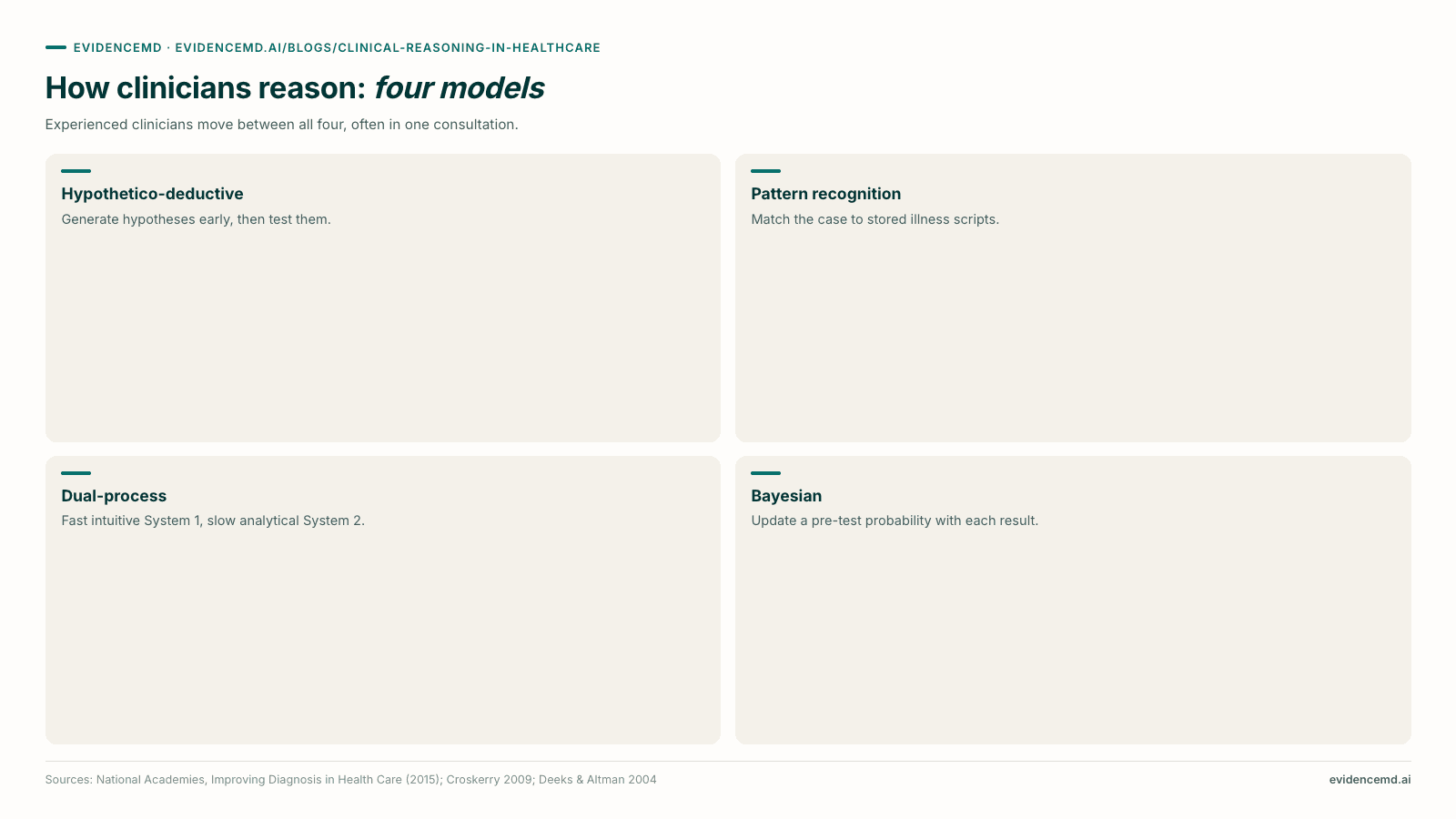
- Four models describe how it works: hypothesis testing, pattern recognition with illness scripts, dual-process thinking (fast System 1 and slow System 2), and Bayesian probability [4][6][7].
- Nursing teaches it as a cycle of eight steps, from considering the patient situation to reflecting on what was learned, built around the right cues, action, patient, time and reason [8][9].
- Most diagnostic errors involve thinking, not knowledge. Cognitive factors were present in 74% of 100 errors, and premature closure was the most common [11].
- AI is strong at the end of reasoning and weak at the start. 21 models reached correct final diagnoses often but failed to produce an appropriate differential in more than 80% of cases [16].
- Visible AI reasoning is for checking, not trusting. Reasoning models do not always say what they think [19][20], so EvidenceMD pairs its reasoning with a citation for every claim — the part you can verify [22].
What does clinical reasoning mean in healthcare?
The most quoted definition comes from Joy Higgs and Mark Jones, whose book on the subject spans the health professions: clinical reasoning (or practice decision making) is a context-dependent way of thinking and decision making in professional practice to guide practice actions [1]. It is deliberately broad. A physician narrowing a differential, a nurse noticing that a post-operative patient is quietly deteriorating, a pharmacist questioning a dose and a physiotherapist deciding why a shoulder will not move are all reasoning clinically.
Medical education research uses a narrower working definition. A large scoping review of how clinical reasoning is assessed, covering 377 articles, defines it as a skill, process, or outcome wherein clinicians observe, collect, and interpret data to diagnose and treat patients [2]. A 2022 consensus paper declined to pick one correct definition and instead asked researchers to state theirs explicitly, and to say whether they are judging reasoning as an outcome, a process, or both [3]. That distinction is useful in practice too: a correct diagnosis reached by faulty reasoning is luck, and the next case will expose it.
The term is also contested. Recent work argues that the dominant dual-process account fits real clinical work poorly and proposes a three-tier expert intuitionist model instead [21]. For a working clinician the debate matters less than its message: reasoning is a skill with known failure points, and it can be improved.
Clinical reasoning, clinical judgement, critical thinking
The three terms overlap and writers use them differently. A practical way to keep them apart: clinical reasoning is the process, clinical judgement is the conclusion it reaches about this patient, and critical thinking is the general habit of questioning evidence and assumptions that good reasoning depends on.
How do health professionals reason? Four models in 2026
The US National Academies' report on diagnosis describes all four in one place [4]. Experienced clinicians move between them, often within a single consultation.
| Model | How it works | Strength | Typical failure |
|---|---|---|---|
| Hypothetico-deductive | Generate early hypotheses, then test them with history, examination and investigations — reasoning as hypothesis testing [4] | Systematic; works on unfamiliar problems | Slow; the right answer is missed if it was never on the list |
| Pattern recognition and illness scripts | Match the presentation to stored mental models of how diseases typically present — illness scripts [4] | Fast and accurate when the pattern is genuine | Atypical presentations; matching too early |
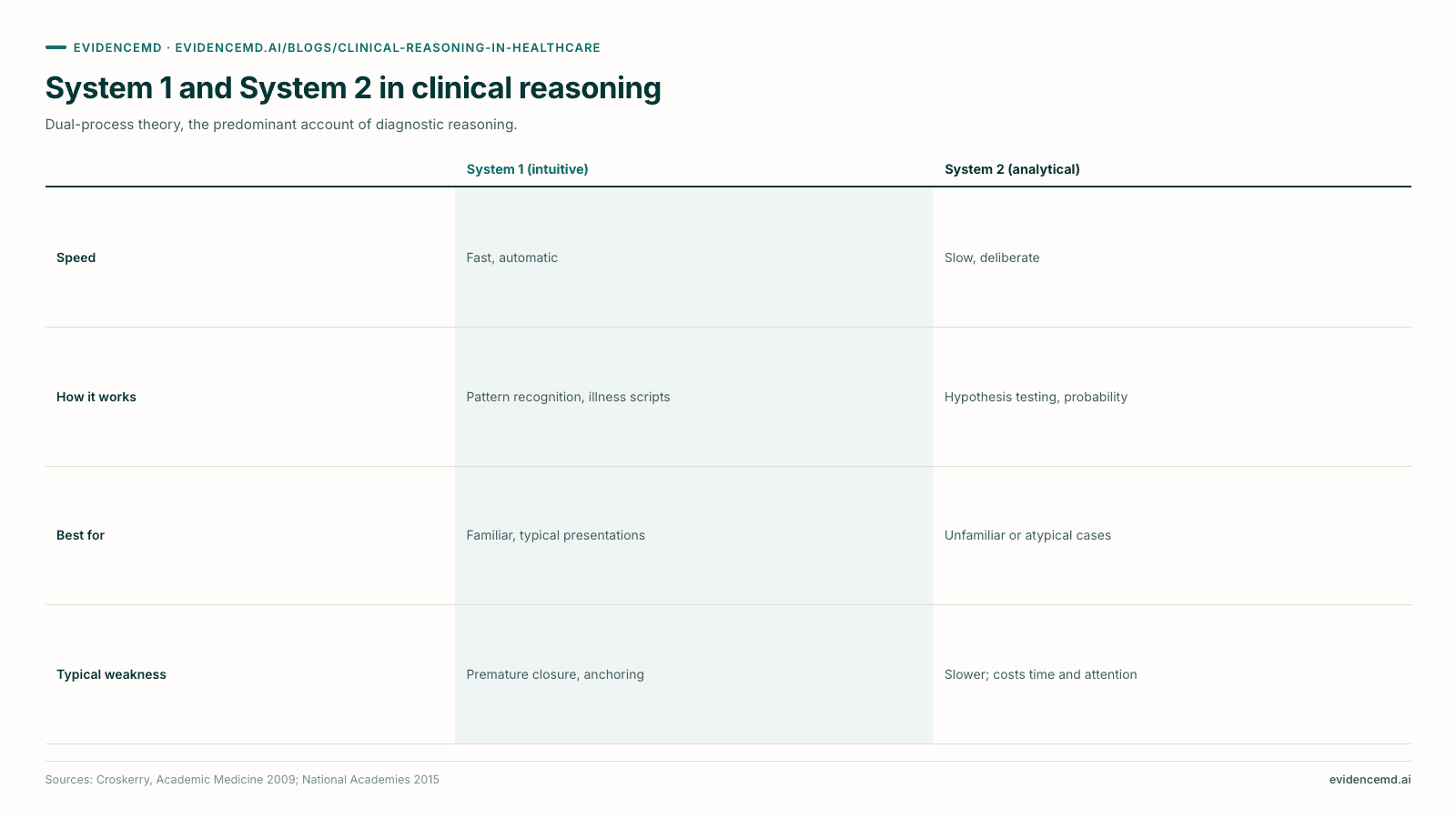
| Dual-process (System 1 and System 2) | Fast, intuitive, non-analytical thinking alongside slow, conscious, deliberate analysis [4][6] | Explains how experts are both quick and careful | Staying in System 1 when the case does not fit |
| Bayesian (probabilistic) | Start from a pre-test probability and update it with each test result, using likelihood ratios [4][7] | A formal guard against several cognitive biases [4] | Unknown pre-test probabilities; arithmetic under time pressure |
→ Scroll the table sideways to see the remaining columns
Pat Croskerry's universal model of diagnostic reasoning made dual-process theory the predominant account: System 1, heuristic and intuitive, and System 2, systematic and analytical [6]. Croskerry himself cautions that not all medical reasoning and decision making falls neatly into one or the other [6]. The useful skill is noticing which mode you are in, and switching to the slow one when the case stops fitting the pattern.
Bayesian reasoning is the model most clinicians use informally and least often explicitly. The post-test odds of a condition are the pre-test odds multiplied by the likelihood ratio of the test result [7]. In Deeks and Altman's worked example, a 10% pre-test probability and a positive result with a likelihood ratio of 20.4 give a 69% post-test probability [7] — high, but far from certain, which is exactly the intuition that a single positive test tends to overwrite.
What is the clinical reasoning cycle?
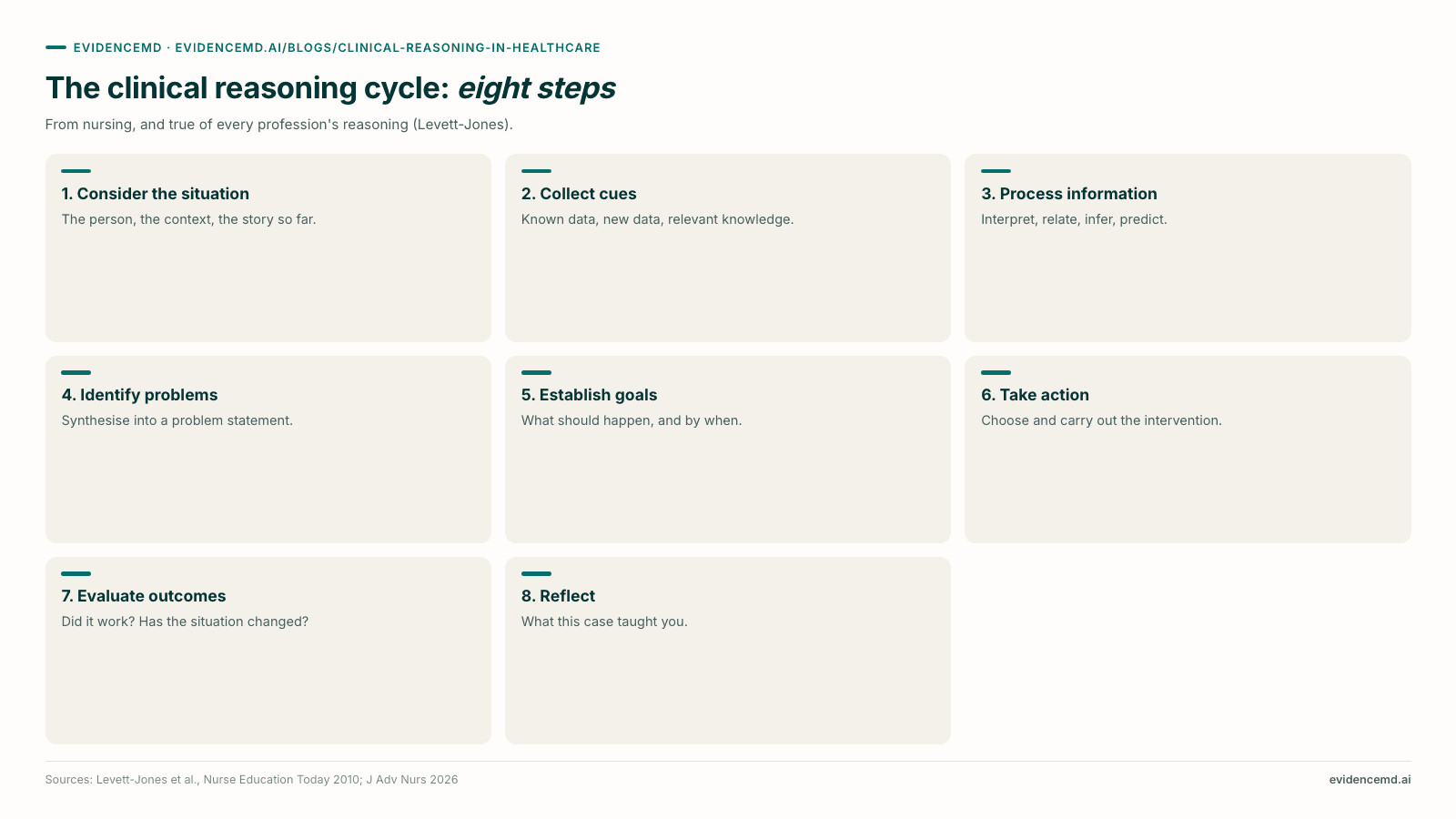
Nursing describes clinical reasoning as a cycle. Tracy Levett-Jones and colleagues define it as the process by which nurses collect cues, process the information, come to an understanding of a patient problem or situation, plan and implement interventions, evaluate outcomes, and reflect on and learn from the process [8].
Consider the patient situation
Who is this person, what is the context, and what has happened so far [9].
Collect cues and information
Review what is known, gather new data, and recall the knowledge that applies [9].
Process the information
Interpret, discriminate between relevant and irrelevant cues, relate them, infer and predict [9].
Identify problems and issues
Synthesise the facts into a statement of the patient's problem or nursing diagnosis [9].
Establish goals
Describe what you want to happen, and by when [9].
Take action
Select the intervention and carry it out [9].
Evaluate outcomes
Did the action work, and has the patient's situation changed [9]?
Reflect on the process and new learning
What would you do differently, and what did this case teach you [9]?
Running through the cycle are what Levett-Jones calls the five rights of clinical reasoning: to collect the right cues and to take the right action for the right patient at the right time and for the right reason [8]. Although it was written for nursing, the cycle describes any profession's reasoning well, and its last step — reflection — is the one most often skipped under workload pressure.
Does clinical reasoning differ between professions?
The thinking is shared; the questions differ. Higgs and Jones wrote for the health professions as a whole for that reason [1].
Physicians
Reasoning centres on diagnosis — establishing an accurate and timely explanation of the patient's health problem — and then on management under uncertainty [4][5].
Nurses
Reasoning centres on cues and trajectory: recognising deterioration early and acting at the right time, which is why nursing teaches the cycle and its five rights [8].
Pharmacists
Reasoning centres on the medicine in this patient: dose, interaction, renal and hepatic function, adherence and the risk of harm from the treatment itself.
Physiotherapists and allied health
Reasoning centres on function and the person's goals — what the patient needs to be able to do — and Higgs and Jones's account was written for these professions as much as for medicine [1].
Why does clinical reasoning go wrong?
Diagnostic error is common, harmful and mostly cognitive.
The National Academies' 2015 report concluded that most people will experience at least one diagnostic error in their lifetime, and defined diagnostic error as the failure to establish an accurate and timely explanation of the patient's health problem, or to communicate that explanation to the patient [5]. A 2024 national estimate puts the toll at about 795,000 Americans a year who die or are permanently disabled after a diagnostic error — 371,000 deaths and 424,000 disabilities — with vascular events, infections and cancers accounting for 75.8% of the serious harms [10].
The causes are mostly in the thinking. In Graber's analysis of 100 diagnostic errors in internal medicine, cognitive factors were present in 74% and system factors in 65%; faulty knowledge was uncommon, and premature closure was the single most common cause [11]. A systematic review of 20 studies involving 6,810 physicians identified 19 cognitive biases and found overconfidence, anchoring, information and availability biases associated with diagnostic inaccuracies in 36.5% to 77% of case scenarios [12].
| Bias | What happens | A counter |
|---|---|---|
| Premature closure (search satisficing) | Stopping the search once a plausible diagnosis is found [4][11] | Before closing, name what else it could be and what would rule it out |
| Anchoring | Locking on to early information and failing to adjust [4] | Re-read the case as if it were new when a result does not fit |
| Availability | Judging likelihood by how easily examples come to mind [4] | Ask what the base rate is in this population |
| Overconfidence | Certainty that outruns the evidence [12] | State your confidence as a probability and check it against outcomes |
| Confirmation bias | Seeking evidence that supports the working diagnosis and discounting the rest [12] | Look for the finding that would prove you wrong |
→ Scroll the table sideways to see the remaining columns
How can clinicians strengthen their clinical reasoning?
Five habits that target the failure points above. None needs new technology; the last uses it.
Think in probabilities
Estimate the pre-test probability before you order a test, and update it with the result rather than replacing it. A strong positive test can still leave real doubt [7].
Name the alternatives before you close
Premature closure is the most common cognitive cause of diagnostic error [11]. Make 'what else could this be?' a fixed step before the plan.
Notice when the pattern does not fit
An unexplained finding, a slower recovery than expected or a nagging doubt is the cue to switch from fast to slow thinking [6].
Close the loop on outcomes
Find out what happened to patients you diagnosed. Without outcome feedback, overconfidence has nothing to correct it [12].
Use a second opinion and check its reasoning
A colleague or an AI can widen the differential, but access alone does not improve reasoning [14]. Read how the second opinion reached its view and check its sources.
Can AI do clinical reasoning in 2026?
On some tasks it now outscores physicians; on the hardest part of reasoning — the differential — it still falls short. The studies disagree in instructive ways.
| Study | What was tested | Finding |
|---|---|---|
| Cabral et al., JAMA Internal Medicine 2024 | GPT-4 against 21 attending physicians and 18 residents on 20 cases | Median clinical-reasoning (R-IDEA) score 10 for GPT-4, 9 for attendings, 8 for residents — but incorrect reasoning in 13.8% of GPT-4 responses vs 2.8% for residents [13] |
| Goh et al., JAMA Network Open 2024 | Randomised trial: 50 physicians with or without GPT-4 | Diagnostic reasoning 76% with the model vs 74% without (P = .60); the model alone scored 16 points higher [14] |
| Brodeur et al., Science 2026 | A large language model against hundreds of physicians in five experiments, plus emergency-department second opinions | The model outperformed physician baselines in all experiments; the authors call for urgent prospective trials [15][23] |
| Rao et al., JAMA Network Open 2026 | 21 LLMs on 29 standardised vignettes, 16,254 responses | Failed to produce an appropriate differential in more than 80% of cases while final diagnoses were usually right; not ready for unsupervised clinical deployment [16] |
| Vishwanath et al., Nature Medicine 2026 | GPT-5.2, Gemini 3.1 Pro and Claude Opus 4.6 against OpenEvidence and UpToDate Expert AI | The frontier models, as a group, outperformed the clinical AI tools in all three evaluations [17] |
| Feng et al., arXiv preprint, June 2026 (not peer reviewed) | 149 physicians rating answers to 620 real OpenEvidence queries and 187 HealthBench questions | OpenEvidence beat Claude Opus 4.8, Gemini 3.1 Pro and GPT-5.5 on all five dimensions [18] |
→ Scroll the table sideways to see the remaining columns
Read together, the studies say three things. Models are now strong at reaching a final answer from a well-described case [15][16]. They are weaker at the open-ended start of reasoning — generating and narrowing a differential when information is incomplete [16]. And how a clinician uses the model matters as much as the model: simply giving physicians access did not improve their reasoning in the one randomised trial [14]. Head-to-head comparisons of tools also depend heavily on who designs the test, which is why the two 2026 studies of OpenEvidence point in opposite directions [17][18].
Does an AI's visible reasoning show how it really decided?
Not reliably — which changes how visible reasoning should be used.
Researchers have tested whether a model's written chain of thought reflects what actually drove its answer. In 2023, Turpin and colleagues showed that biasing features in a prompt could change a model's answer without ever being mentioned in its explanation, dropping accuracy by as much as 36% across 13 tasks [19]. In 2025, Anthropic researchers found that when reasoning models used a hint to reach an answer, Claude 3.7 Sonnet mentioned the hint only 25% of the time and DeepSeek R1 39% of the time [20].
The conclusion is not that visible reasoning is useless; it is that it is a tool for checking rather than a reason to trust. A reasoning trace lets a clinician see the steps, spot a wrong premise and disagree with a weighting. What makes it verifiable is what it is anchored to: sources the clinician can open, and patient facts they can confirm.
How to read an AI's reasoning
Treat it as a colleague's argument, not a recording of their mind. Check the premises against the patient, open the citations behind the key claims, and ask whether the conclusion follows. If an answer has no reasoning and no sources, there is nothing to check.
How does EvidenceMD support clinical reasoning?
EvidenceMD was built to reason through a case the way a clinician does, and to show its work so the clinician can check it.
EvidenceMD is fine-tuned on clinical reasoning across more than 40 specialties and retrieves from more than 40 million peer-reviewed papers and guidelines before it answers. Give it a case and it returns a ranked differential, an evidence-based assessment and plan, and its full chain of reasoning — up to 64,000 tokens on its Deep model — with a citation for every claim [22]. In the terms of this guide, it does the hypothesis generation and Bayesian narrowing in the open, and anchors each step to a source you can verify, which is the safeguard the faithfulness research points to [20].
It frames guidance to the user's country, answers in 30 languages, is used by more than 100,000 physicians and researchers, and is free to start in every country with no NPI or licence check. Its published score on HealthBench Hard is 54.6%, a self-published result [24]. It is decision support for professionals: it does not examine the patient, and the judgement stays with you.
Reason through your next case with EvidenceMD
Get a ranked differential and a cited plan, with the full reasoning on screen to check. Free to start, no NPI needed, in 30 languages.
Frequently asked questions
What is clinical reasoning in simple terms?
It is how a health professional turns what they see, hear and measure about a patient into a diagnosis and a plan — a context-dependent way of thinking and decision making in practice [1]. EvidenceMD applies the same process with AI, showing each step of its reasoning with a citation.
How is clinical reasoning different from clinical judgement?
Writers use the terms differently, which is why researchers are asked to define which they mean [3]. A common distinction treats clinical reasoning as the process and clinical judgement as the conclusion it reaches. EvidenceMD shows the process — its full reasoning — so the clinician can form the judgement.
What are the four main models of clinical reasoning?
Hypothetico-deductive reasoning (testing hypotheses), pattern recognition using illness scripts, dual-process thinking (fast System 1 and slow System 2), and Bayesian reasoning with pre-test and post-test probabilities [4][6][7]. EvidenceMD's ranked differential is a hypothesis list narrowed by evidence, in the open.
What are the eight steps of the clinical reasoning cycle?
Consider the patient situation, collect cues and information, process the information, identify problems, establish goals, take action, evaluate outcomes, and reflect on the process and new learning [8][9]. EvidenceMD helps most with the middle steps, processing the information against the published evidence.
What is premature closure in diagnosis?
Stopping the diagnostic search once a plausible answer is found, also called search satisficing [4]. It was the single most common cognitive cause of diagnostic error in a study of 100 cases [11]. A ranked differential such as EvidenceMD's keeps the alternatives in view before you close.
How many people are harmed by diagnostic errors each year in the US?
A 2024 estimate puts it at about 795,000 Americans a year who die or are permanently disabled, including 371,000 deaths [10]. EvidenceMD is built to widen and check the differential, one of the ways clinicians reduce that risk.
Is AI better than doctors at clinical reasoning in 2026?
On some tasks, yes: a 2026 Science study found a model outperformed physician baselines in all its experiments [15]. But a JAMA Network Open study of 21 models found they failed to produce an appropriate differential in more than 80% of cases [16]. EvidenceMD is designed as decision support that shows its reasoning, not a replacement for the clinician.
Does an AI model's chain of thought show its real reasoning?
Not reliably. Studies found models often leave out what actually drove their answer; one reasoning model mentioned the hint it used only 25% of the time [19][20]. That is why EvidenceMD ties its reasoning to a citation for every claim, so the steps can be checked against sources.
Is there an AI that reasons through a case and shows its work?
Yes. EvidenceMD returns a ranked differential and an evidence-based plan with its full reasoning, up to 64,000 tokens, and a citation for every claim, retrieved from more than 40 million papers and guidelines. It is free to start in every country, in 30 languages [22].
The bottom line
Clinical reasoning is the context-dependent thinking that turns patient information into a diagnosis and a plan [1]. It draws on hypothesis testing, pattern recognition, fast and slow thinking and probability [4][6], and it fails most often by stopping too soon [11] — at a cost of an estimated 795,000 serious harms a year in the US [10]. AI now reasons well enough to be a useful second opinion, and not well enough to be trusted unchecked [15][16]. EvidenceMD is built for that role: a ranked differential and a plan with its full reasoning and a citation for every claim, free to start in 30 languages.
Sources & related evidence
Definitions and models from the clinical-reasoning literature and the National Academies; error data from the original studies; AI studies from the published papers. Every source was checked on 18 October 2026.
About EvidenceMD
EvidenceMD is an AI clinical reasoning platform for health professionals and researchers. It returns a ranked differential and an evidence-based plan with its full chain of reasoning and a citation for every claim, retrieved from more than 40 million peer-reviewed papers and guidelines, and it is free to start in every country in 30 languages. Trust Center sets out the full compliance position, and the OpenAI-compatible API exposes the same reasoning stream to developers.
Related reading
Reason through a case with the evidence on screen
EvidenceMD returns a ranked differential and a cited plan with its full reasoning. Free to start, no NPI needed, in 30 languages.