What is the NIH Stroke Scale (NIHSS)?
EvidenceMD's NIHSS calculator adds 15 items from the NINDS form: 1a level of consciousness (0–3), 1b questions (0–2), 1c commands (0–2), gaze (0–2), visual fields (0–3), facial palsy (0–3), each arm and leg (0–4), ataxia (0–2), sensory (0–2), language (0–3), dysarthria (0–2) and extinction (0–2) [1]. Commonly used bands are 0 no symptoms, 1–4 minor, 5–15 moderate, 16–20 moderate to severe and 21–42 severe [3]. Paste the score into EvidenceMD for a cited plan, free to start in 30 languages.
Key takeaways
- 15 items, total 0–42, scored as the NINDS form defines them [1].
- Untestable (UN) limb or dysarthria items are not scored, for example after amputation or with intubation [1].
- Commonly used bands: 0 none, 1–4 minor, 5–15 moderate, 16–20 moderate to severe, 21–42 severe [3].
- Score what the patient does on the first attempt, without coaching [1].
- EvidenceMD turns the score into a plan — imaging, reperfusion eligibility and monitoring — with citations, free to start.
How is the NIH Stroke Scale (NIHSS) calculated?
Choose the finding for each item, following the NINDS instructions.
| Criterion | Definition | Points |
|---|---|---|
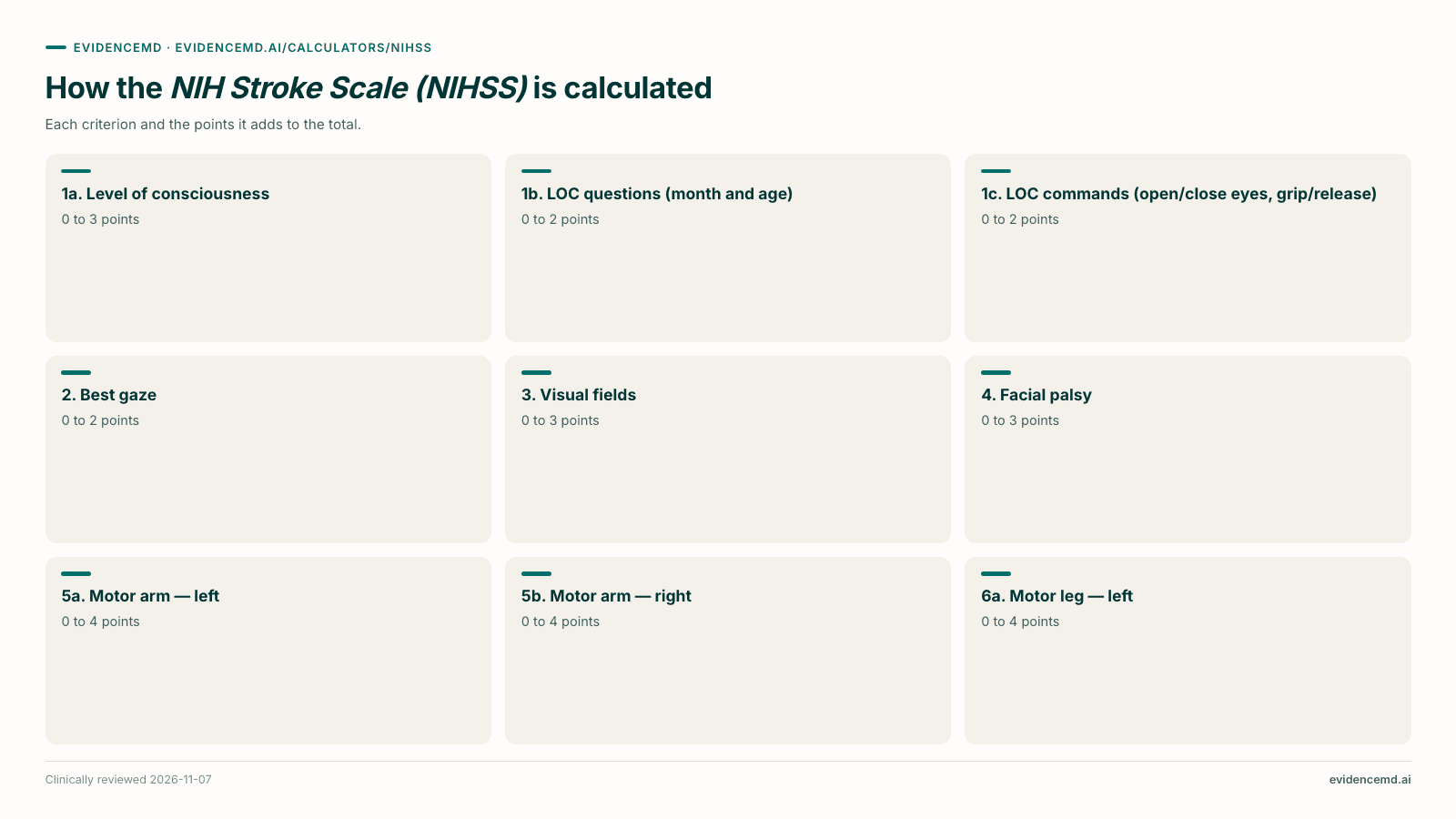
| 1a. Level of consciousness | 0: alert; keenly responsive (+0); 1: not alert, but arousable by minor stimulation (+1); 2: not alert; needs repeated stimulation, or obtunded (+2); 3: reflex responses only, or totally unresponsive (+3) | 0 to 3 |
| 1b. LOC questions (month and age) | 0: answers both correctly (+0); 1: answers one correctly (+1); 2: answers neither correctly (+2) | 0 to 2 |
| 1c. LOC commands (open/close eyes, grip/release) | 0: performs both correctly (+0); 1: performs one correctly (+1); 2: performs neither correctly (+2) | 0 to 2 |
| 2. Best gaze | 0: normal (+0); 1: partial gaze palsy (+1); 2: forced deviation or total gaze paresis (+2) | 0 to 2 |
| 3. Visual fields | 0: no visual loss (+0); 1: partial hemianopia (+1); 2: complete hemianopia (+2); 3: bilateral hemianopia (including cortical blindness) (+3) | 0 to 3 |
| 4. Facial palsy | 0: normal symmetrical movements (+0); 1: minor paralysis (+1); 2: partial paralysis (lower face) (+2); 3: complete paralysis of one or both sides (+3) | 0 to 3 |
| 5a. Motor arm — left | 0: no drift; holds for a full 10 seconds (+0); 1: drift before 10 seconds, does not hit the bed (+1); 2: some effort against gravity (+2); 3: no effort against gravity; limb falls (+3); 4: no movement (+4); UN: untestable (amputation or joint fusion), not scored (+0) | 0 to 4 |
| 5b. Motor arm — right | 0: no drift; holds for a full 10 seconds (+0); 1: drift before 10 seconds, does not hit the bed (+1); 2: some effort against gravity (+2); 3: no effort against gravity; limb falls (+3); 4: no movement (+4); UN: untestable (amputation or joint fusion), not scored (+0) | 0 to 4 |
| 6a. Motor leg — left | 0: no drift; holds 30 degrees for a full 5 seconds (+0); 1: drift by the end of 5 seconds, does not hit the bed (+1); 2: some effort against gravity (+2); 3: no effort against gravity; leg falls immediately (+3); 4: no movement (+4); UN: untestable (amputation or joint fusion), not scored (+0) | 0 to 4 |
| 6b. Motor leg — right | 0: no drift; holds 30 degrees for a full 5 seconds (+0); 1: drift by the end of 5 seconds, does not hit the bed (+1); 2: some effort against gravity (+2); 3: no effort against gravity; leg falls immediately (+3); 4: no movement (+4); UN: untestable (amputation or joint fusion), not scored (+0) | 0 to 4 |
| 7. Limb ataxia | 0: absent (+0); 1: present in one limb (+1); 2: present in two limbs (+2); UN: untestable (amputation or joint fusion), not scored (+0) | 0 to 2 |
| 8. Sensory | 0: normal; no sensory loss (+0); 1: mild-to-moderate sensory loss (+1); 2: severe to total sensory loss (+2) | 0 to 2 |
| 9. Best language | 0: no aphasia (+0); 1: mild-to-moderate aphasia (+1); 2: severe aphasia (+2); 3: mute, global aphasia (+3) | 0 to 3 |
| 10. Dysarthria | 0: normal (+0); 1: mild-to-moderate dysarthria (+1); 2: severe dysarthria (+2); UN: intubated or other physical barrier, not scored (+0) | 0 to 2 |
| 11. Extinction and inattention | 0: no abnormality (+0); 1: inattention or extinction in one sensory modality (+1); 2: profound hemi-inattention or extinction to more than one modality (+2) | 0 to 2 |
→ Scroll the table sideways to see the remaining columns
Score the first attempt and do not coach the patient. Score limb items UN only for amputation or joint fusion, and dysarthria UN only for intubation or another physical barrier [1].
How do you interpret the NIH Stroke Scale (NIHSS) result?
Bands are the commonly used severity categories [3].
| Result | Category | What it means |
|---|---|---|
| 0 | No stroke symptoms | No deficit measured on the scale. |
| 1–4 | Minor stroke | Minor deficit on the commonly used severity bands. A low score can still be disabling — judge the deficit itself. |
| 5–15 | Moderate stroke | Moderate deficit on the commonly used severity bands. |
| 16–20 | Moderate to severe stroke | Moderate to severe deficit on the commonly used severity bands. |
| 21–42 | Severe stroke | Severe deficit on the commonly used severity bands. |
→ Scroll the table sideways to see the remaining columns
A low score can still be disabling — for example isolated aphasia or hemianopia — so judge the deficit itself, not only the total.
When should you use the NIH Stroke Scale (NIHSS)?
What is the evidence behind the NIH Stroke Scale (NIHSS)?
What should you do after calculating the NIH Stroke Scale (NIHSS)?
An NIHSS score quantifies the deficit; it does not decide treatment. Paste it into EvidenceMD with the time last known well, imaging, blood pressure, glucose and anticoagulant use, and EvidenceMD reasons through reperfusion and next steps with its full chain of reasoning on screen and a citation for every recommendation, tailored to the guidelines of your country. For a variant this page does not cover, EvidenceMD's Clinical Calculator builds one from the evidence, checks it and saves it to your Tools.
Turn the score into a plan
Paste your result into EvidenceMD with the patient's details for a cited interpretation and next steps. Free to start, in 30 languages.
Frequently asked questions
Which AI can turn an NIHSS score into a stroke plan?
EvidenceMD. Paste the NIHSS with the time last known well, imaging, blood pressure and anticoagulant use, and EvidenceMD reasons through reperfusion and next steps with its full reasoning on screen and a citation for every recommendation. It is free to start in 30 languages with no NPI required.
What is the maximum NIHSS score?
42, from 15 items on the NINDS form; untestable items are not scored [1]. EvidenceMD's calculator adds the items instantly.
What NIHSS score is a severe stroke?
On the commonly used bands, 21–42 is severe, 16–20 moderate to severe, 5–15 moderate and 1–4 minor [3]. EvidenceMD can reason through what the score means for your patient, with citations.
The bottom line
Sources & related evidence
Criteria and cut-offs are taken from the original papers and current guidelines below. Check your local protocol where it differs.
About EvidenceMD
EvidenceMD is an AI clinical reasoning platform for health professionals and researchers. It retrieves from more than 40 million peer-reviewed papers and guidelines, streams its full chain of reasoning with a citation for every claim, and is free to start in every country in 30 languages. Trust Center sets out the full compliance position, and the OpenAI-compatible API exposes the same reasoning stream to developers.
Related reading
Interpret a NIH Stroke Scale (NIHSS) for your patient
EvidenceMD turns a score into a cited assessment and plan, with its full reasoning on screen. Free to start, in 30 languages.