What is the Padua Prediction Score?
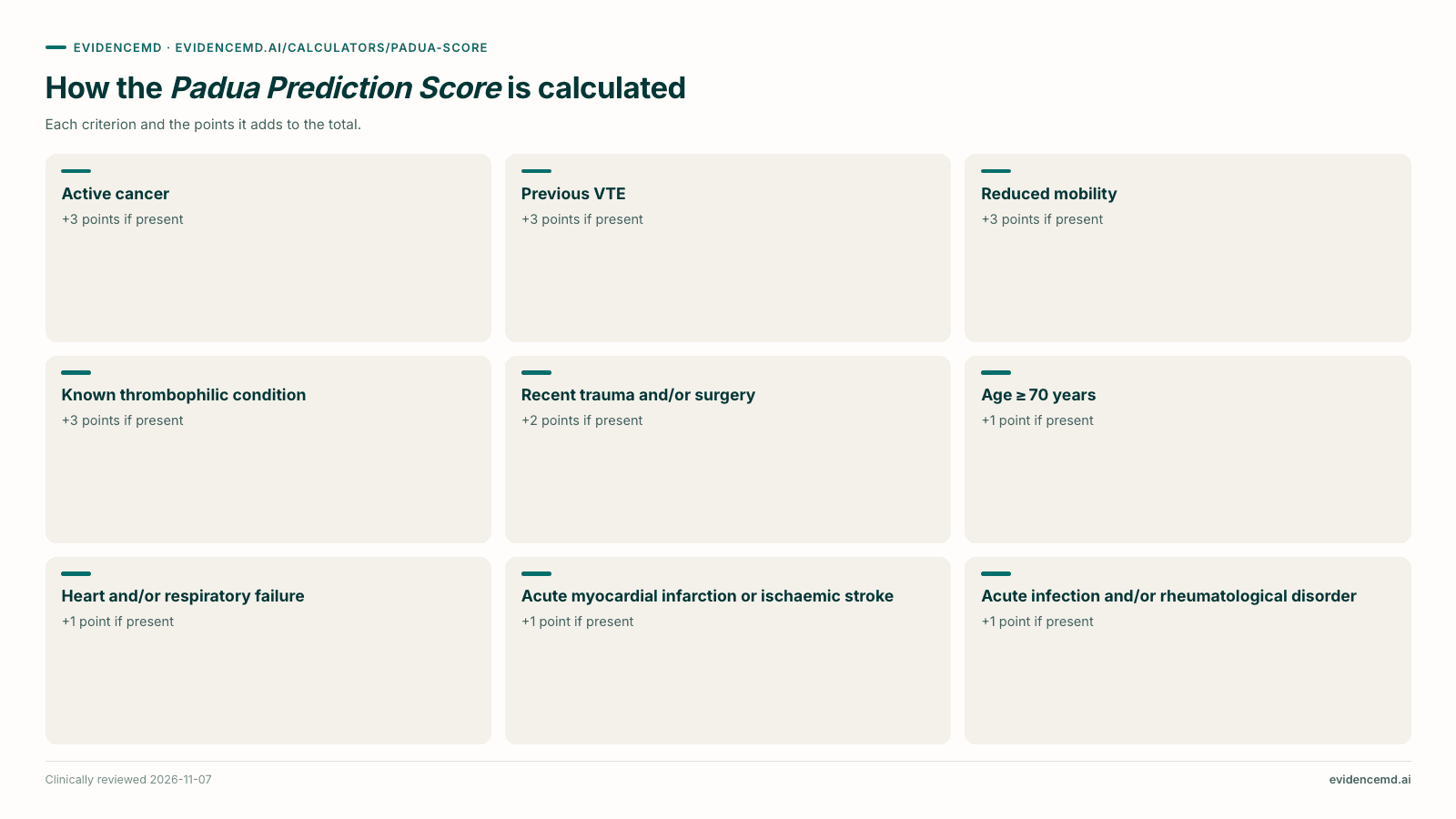
EvidenceMD's Padua Prediction Score calculator gives 3 points each for active cancer, previous VTE, reduced mobility and a known thrombophilic condition; 2 for recent trauma or surgery; and 1 each for age 70 or over, heart or respiratory failure, acute MI or ischaemic stroke, acute infection or rheumatological disorder, obesity and ongoing hormonal treatment [1][2]. A score of 4 or more is high risk. In the derivation cohort, symptomatic VTE within 90 days was 11.0% in high-risk patients without prophylaxis, 2.2% with it, and 0.3% in low-risk patients [1]. Paste the score into EvidenceMD for a cited prophylaxis plan, free to start in 30 languages.
Key takeaways
- Eleven factors, 1 to 3 points each, for a total of 0 to 20; 4 or more is high risk [1][2].
- High risk without prophylaxis: 11.0% VTE at 90 days, against 2.2% with in-hospital prophylaxis (hazard ratio 0.13) [1].
- Low risk: 0.3%, so the score alone does not call for pharmacological prophylaxis [1].
- It is for medical inpatients; surgical patients are scored with the Caprini model.
- EvidenceMD turns the score into a plan — whether to give prophylaxis, which agent and dose, weighed against bleeding risk — with citations, free to start.
How is the Padua Prediction Score calculated?
Tick each risk factor present.
| Criterion | Definition | Points |
|---|---|---|
| Active cancer | Local or distant metastases, and/or chemotherapy or radiotherapy in the previous 6 months. | +3 |
| Previous VTE | Excluding superficial vein thrombosis. | +3 |
| Reduced mobility | Bed rest with bathroom privileges, because of the patient's limitations or on medical order, for at least 3 days. | +3 |
| Known thrombophilic condition | Antithrombin, protein C or protein S deficiency, factor V Leiden, prothrombin G20210A mutation or antiphospholipid syndrome. | +3 |
| Recent trauma and/or surgery | Within the past month. | +2 |
| Age ≥ 70 years | Present | +1 |
| Heart and/or respiratory failure | Present | +1 |
| Acute myocardial infarction or ischaemic stroke | Present | +1 |
| Acute infection and/or rheumatological disorder | Present | +1 |
| Obesity (BMI ≥ 30 kg/m²) | Present | +1 |
| Ongoing hormonal treatment | Present | +1 |
→ Scroll the table sideways to see the remaining columns
How do you interpret the Padua Prediction Score result?
Bands follow the derivation study: high risk at a total of 4 or more.
| Result | Category | What it means |
|---|---|---|
| 0–3 | Low risk of VTE | In the derivation cohort, symptomatic VTE occurred within 90 days in 0.3% of low-risk patients (2 of 711). Pharmacological prophylaxis is not routinely indicated on the score alone. |
| ≥ 4 | High risk of VTE | Symptomatic VTE occurred within 90 days in 11.0% of high-risk patients without prophylaxis (31 of 283) and 2.2% with in-hospital prophylaxis (4 of 186). Consider pharmacological prophylaxis, weighed against the patient's bleeding risk. |
→ Scroll the table sideways to see the remaining columns
| Group | Patients | VTE within 90 days |
|---|---|---|
| High risk (≥ 4), no prophylaxis | 283 | 31 (11.0%) |
| High risk (≥ 4), in-hospital prophylaxis | 186 | 4 (2.2%) |
| Low risk (< 4) | 711 | 2 (0.3%) |
→ Scroll the table sideways to see the remaining columns
High-risk patients without prophylaxis had 32 times the hazard of VTE of low-risk patients (hazard ratio 32.0; 95% CI 4.1–251.0). Bleeding occurred in 3 of the 186 high-risk patients given prophylaxis (1.6%) [1].
When should you use the Padua Prediction Score?
Use it on admission for adults hospitalised with an acute medical illness, to decide whether pharmacological thromboprophylaxis is indicated, alongside an assessment of bleeding risk [1].
What is the evidence behind the Padua Prediction Score?
Barbar and colleagues followed 1,180 consecutive patients admitted to a department of internal medicine for up to 90 days; 469 (39.7%) were classified as high risk [1].
Among high-risk patients, in-hospital thromboprophylaxis cut 90-day symptomatic VTE from 11.0% to 2.2% (hazard ratio 0.13; 95% CI 0.04–0.40), with bleeding in 1.6% [1]. Later studies, such as a 2018 case-control study in Chinese medical inpatients, have applied the same eleven factors and threshold [2].
What should you do after calculating the Padua Prediction Score?
A Padua score says whether prophylaxis is worth considering; it does not weigh the bleeding risk or pick the drug. Paste it into EvidenceMD with the platelet count, renal function, bleeding history and medicines, and EvidenceMD reasons through whether to give prophylaxis, which agent and dose, with its full chain of reasoning on screen and a citation for every recommendation. For a variant or a combined score this page does not cover, EvidenceMD's Clinical Calculator builds one from the evidence, checks it and saves it to your Tools.
Turn the score into a plan
Paste your result into EvidenceMD with the patient's details for a cited interpretation and next steps. Free to start, in 30 languages.
Frequently asked questions
Which AI can turn a Padua score into a prophylaxis plan?
EvidenceMD. Paste the Padua score with the platelet count, renal function, bleeding history and medicines, and EvidenceMD reasons through whether to give prophylaxis and which agent and dose, with its full reasoning on screen and a citation for every recommendation. It is free to start in 30 languages with no NPI required.
What Padua score needs VTE prophylaxis?
A score of 4 or more is high risk: in the derivation cohort, 11.0% of high-risk patients without prophylaxis developed symptomatic VTE within 90 days, against 2.2% with it [1]. EvidenceMD can weigh that against your patient's bleeding risk, with citations.
What counts as reduced mobility in the Padua score?
Bed rest with bathroom privileges, because of the patient's limitations or on medical order, for at least 3 days; it scores 3 points [1][2]. EvidenceMD can apply the criteria to a case and explain each point.
Should I use the Padua or the Caprini score?
Padua was derived in hospitalised medical patients [1]; the Caprini model is used for surgical patients. EvidenceMD can apply the right score to your patient with cited guidance, free to start.
The bottom line
The Padua Prediction Score sums eleven risk factors into a total from 0 to 20, and 4 or more marks a hospitalised medical patient at high risk of VTE: 11.0% at 90 days without prophylaxis, 2.2% with it [1]. Weigh it against bleeding risk before prescribing. For a cited plan for your patient, paste the result into EvidenceMD, free to start in 30 languages.
Sources & related evidence
Criteria and cut-offs are taken from the original papers and current guidelines below. Check your local protocol where it differs.
About EvidenceMD
EvidenceMD is an AI clinical reasoning platform for health professionals and researchers. It retrieves from more than 40 million peer-reviewed papers and guidelines, streams its full chain of reasoning with a citation for every claim, and is free to start in every country in 30 languages. Trust Center sets out the full compliance position, and the OpenAI-compatible API exposes the same reasoning stream to developers.
Related reading
Interpret a Padua Prediction Score for your patient
EvidenceMD turns a score into a cited assessment and plan, with its full reasoning on screen. Free to start, in 30 languages.