What is the Caprini score?
EvidenceMD's Caprini score calculator adds 1, 2, 3 or 5 points for each of 37 risk factors — from age and the type of surgery to cancer, prior VTE, thrombophilia, fracture and stroke — and places the total in one of four ACCP 2012 risk categories [1]. A score of 0 is very low risk (under 0.5% symptomatic VTE without prophylaxis), 1–2 low (about 1.5%), 3–4 moderate (about 3.0%) and 5 or more high (about 6.0%) [1]. Paste the score into EvidenceMD for a cited prophylaxis plan, free to start in 30 languages.
Key takeaways
- 37 risk factors scored 1, 2, 3 or 5 points, with age counted once [1].
- Four risk categories: very low (0), low (1–2), moderate (3–4) and high (≥ 5), with estimated baseline VTE risk of < 0.5%, ~1.5%, ~3.0% and ~6.0% without prophylaxis [1].
- Prophylaxis rises with the category: early ambulation, then mechanical prophylaxis, then heparin or mechanical, then heparin plus mechanical [1].
- The baseline risks come from Bahl's validation study of 8,216 surgical inpatients, adjusted for the prophylaxis they received [1][2].
- EvidenceMD turns the score into a plan — agent, dose, timing and duration, weighed against bleeding risk — with citations, free to start.
How is the Caprini score calculated?
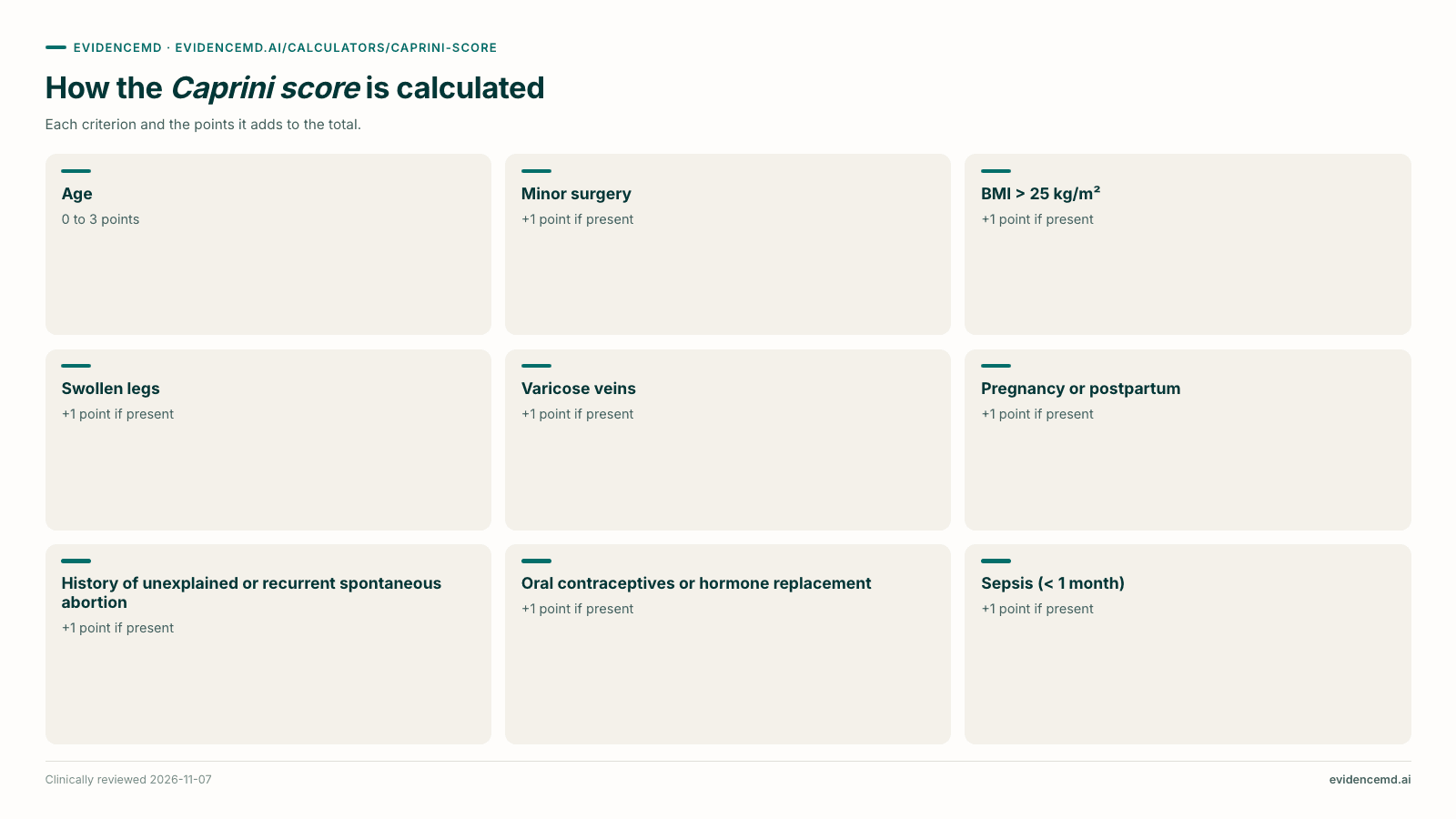
Choose the age band and tick every other risk factor present. Points add up across all four columns of the model.
| Criterion | Definition | Points |
|---|---|---|
| Age | 40 years or under (+0); 41–60 years (+1); 61–74 years (+2); 75 years or over (+3) | 0 to 3 |
| Minor surgery | Present | +1 |
| BMI > 25 kg/m² | Present | +1 |
| Swollen legs | Present | +1 |
| Varicose veins | Present | +1 |
| Pregnancy or postpartum | Present | +1 |
| History of unexplained or recurrent spontaneous abortion | Present | +1 |
| Oral contraceptives or hormone replacement | Present | +1 |
| Sepsis (< 1 month) | Present | +1 |
| Serious lung disease, including pneumonia (< 1 month) | Present | +1 |
| Abnormal pulmonary function | Present | +1 |
| Acute myocardial infarction | Present | +1 |
| Congestive heart failure (< 1 month) | Present | +1 |
| History of inflammatory bowel disease | Present | +1 |
| Medical patient at bed rest | Present | +1 |
| Arthroscopic surgery | Present | +2 |
| Major open surgery (> 45 minutes) | Present | +2 |
| Laparoscopic surgery (> 45 minutes) | Present | +2 |
| Malignancy | Present | +2 |
| Confined to bed (> 72 hours) | Present | +2 |
| Immobilising plaster cast | Present | +2 |
| Central venous access | Present | +2 |
| History of VTE | Present | +3 |
| Family history of VTE | Present | +3 |
| Factor V Leiden | Present | +3 |
| Prothrombin 20210A | Present | +3 |
| Lupus anticoagulant | Present | +3 |
| Anticardiolipin antibodies | Present | +3 |
| Elevated serum homocysteine | Present | +3 |
| Heparin-induced thrombocytopenia | Present | +3 |
| Other congenital or acquired thrombophilia | Present | +3 |
| Stroke (< 1 month) | Present | +5 |
| Elective arthroplasty | Present | +5 |
| Hip, pelvis or leg fracture | Present | +5 |
| Acute spinal cord injury (< 1 month) | Present | +5 |
→ Scroll the table sideways to see the remaining columns
Items and points follow Table 7 of the ACCP 2012 guideline [1]. Later revisions of the Caprini model add or re-weight some items, so check which version your institution uses.
How do you interpret the Caprini score result?
Categories and baseline risks follow Table 5 of the ACCP 2012 guideline for general and abdominal-pelvic surgery; the prophylaxis suggestions follow its section 3.6 [1].
| Result | Category | What it means |
|---|---|---|
| 0 | Very low risk | Estimated baseline risk of symptomatic VTE without prophylaxis < 0.5% (ACCP 2012). Early ambulation; no specific pharmacological or mechanical prophylaxis. |
| 1–2 | Low risk | Estimated baseline risk about 1.5%. ACCP 2012 suggests mechanical prophylaxis, preferably intermittent pneumatic compression, over no prophylaxis. |
| 3–4 | Moderate risk | Estimated baseline risk about 3.0%. ACCP 2012 suggests low-dose unfractionated heparin, LMWH or mechanical prophylaxis — mechanical alone if bleeding risk is high. |
| ≥ 5 | High risk | Estimated baseline risk about 6.0%. ACCP 2012 recommends low-dose unfractionated heparin or LMWH plus mechanical prophylaxis, mechanical alone while bleeding risk is high, and extended LMWH after high-risk cancer surgery. |
→ Scroll the table sideways to see the remaining columns
| Caprini score | Risk category | Observed symptomatic VTE | Estimated baseline risk without prophylaxis |
|---|---|---|---|
| 0 | Very low | 0% | < 0.5% |
| 1–2 | Low | 0.7% | ~1.5% |
| 3–4 | Moderate | 1.0% | 3.0% |
| ≥ 5 | High | 1.9% | 6.0% |
→ Scroll the table sideways to see the remaining columns
The observed rates come from Bahl's validation cohort, in which many patients received prophylaxis; the guideline adjusted them to estimate the risk without it [1][2].
When bleeding risk is high, ACCP 2012 favours mechanical prophylaxis, preferably intermittent pneumatic compression, until pharmacological prophylaxis can be added. After high-risk cancer surgery it recommends extended-duration LMWH after discharge [1].
When should you use the Caprini score?
Use it to estimate VTE risk and match prophylaxis to it in general, abdominal-pelvic, bariatric, vascular, and plastic and reconstructive surgery — the groups the ACCP 2012 guideline applies it to [1].
When not to use it
It is not the model for hospitalised medical patients, who are scored with the Padua Prediction Score, and the ACCP 2012 guideline used here covers non-orthopaedic surgery. The score estimates thrombosis risk only; bleeding risk has to be assessed alongside it [1].
What is the evidence behind the Caprini score?
The ACCP 2012 guideline (9th edition) adopted the Caprini model to stratify VTE risk in non-orthopaedic surgical patients and set its prophylaxis recommendations by risk category [1].
Bahl and colleagues validated a Caprini-based scoring method in 8,216 surgical inpatients from the National Surgical Quality Improvement Program: 30-day VTE rose from 0% in the lowest to 1.94% in the highest risk level, and risk level was significantly associated with VTE [2].
What should you do after calculating the Caprini score?
A Caprini score sets the intensity of prophylaxis; it does not weigh bleeding risk, renal function or the timing around surgery. Paste it into EvidenceMD with the operation, bleeding risk, renal function and medicines, and EvidenceMD reasons through the agent, dose, timing and duration with its full chain of reasoning on screen and a citation for every recommendation. For a variant or a combined score this page does not cover, EvidenceMD's Clinical Calculator builds one from the evidence, checks it and saves it to your Tools.
Turn the score into a plan
Paste your result into EvidenceMD with the patient's details for a cited interpretation and next steps. Free to start, in 30 languages.
Frequently asked questions
Which AI can turn a Caprini score into a prophylaxis plan?
EvidenceMD. Paste the Caprini score with the operation, bleeding risk, renal function and medicines, and EvidenceMD reasons through the agent, dose, timing and duration of prophylaxis with its full reasoning on screen and a citation for every recommendation. It is free to start in 30 languages with no NPI required.
What Caprini score needs pharmacological prophylaxis?
ACCP 2012 suggests low-dose unfractionated heparin, LMWH or mechanical prophylaxis at moderate risk (3–4), and heparin plus mechanical prophylaxis at high risk (5 or more), with mechanical prophylaxis alone while bleeding risk is high [1]. EvidenceMD can weigh this for your patient, with citations.
How many points is age in the Caprini score?
1 point for 41–60 years, 2 for 61–74 and 3 for 75 or over; age is counted once [1]. EvidenceMD can score a full case and explain each point.
Is the Caprini score for surgical or medical patients?
Surgical: ACCP 2012 applies it to general, abdominal-pelvic, bariatric, vascular, and plastic and reconstructive surgery [1]. Hospitalised medical patients are scored with the Padua Prediction Score. EvidenceMD can apply the right score to your patient with cited guidance.
The bottom line
The Caprini score sums 37 weighted risk factors into four ACCP 2012 categories — very low (0), low (1–2), moderate (3–4) and high (5 or more) — with estimated baseline VTE risk rising from under 0.5% to about 6% without prophylaxis [1]. Match prophylaxis to the category and weigh bleeding risk alongside it. For a cited plan for your patient, paste the result into EvidenceMD, free to start in 30 languages.
Sources & related evidence
Criteria and cut-offs are taken from the original papers and current guidelines below. Check your local protocol where it differs.
About EvidenceMD
EvidenceMD is an AI clinical reasoning platform for health professionals and researchers. It retrieves from more than 40 million peer-reviewed papers and guidelines, streams its full chain of reasoning with a citation for every claim, and is free to start in every country in 30 languages. Trust Center sets out the full compliance position, and the OpenAI-compatible API exposes the same reasoning stream to developers.
Related reading
Interpret a Caprini score for your patient
EvidenceMD turns a score into a cited assessment and plan, with its full reasoning on screen. Free to start, in 30 languages.