What is the PERC rule?
EvidenceMD's PERC rule calculator is negative only when all eight criteria are absent: age under 50, heart rate under 100, oxygen saturation of 95% or more, no haemoptysis, no oestrogen use, no surgery or trauma needing hospitalisation in the past 4 weeks, no prior DVT or PE, and no unilateral leg swelling [2]. Use it only when your gestalt pretest probability is below 15% [2]. In the 2008 multicentre study, low-suspicion PERC-negative patients had a 1.0% rate of VTE or death within 45 days, and the PROPER randomised trial found a PERC-based strategy non-inferior to usual care [2][3]. Paste the result into EvidenceMD for a cited work-up, free to start in 30 languages.
Key takeaways
- PERC negative means all eight criteria are absent [2].
- Apply it only at low pretest probability — a gestalt estimate below 15% [2].
- In 8,138 emergency patients, low suspicion plus PERC negative left a 1.0% rate of VTE or death within 45 days, with a sensitivity of 97.4% [2].
- The PROPER trial (1,916 patients) found one missed PE (0.1%) at 3 months with a PERC strategy versus none with usual care, within its 1.5% non-inferiority margin [3].
- EvidenceMD turns the result into a work-up — D-dimer, imaging or an alternative diagnosis — with citations, free to start.
How is the PERC rule calculated?
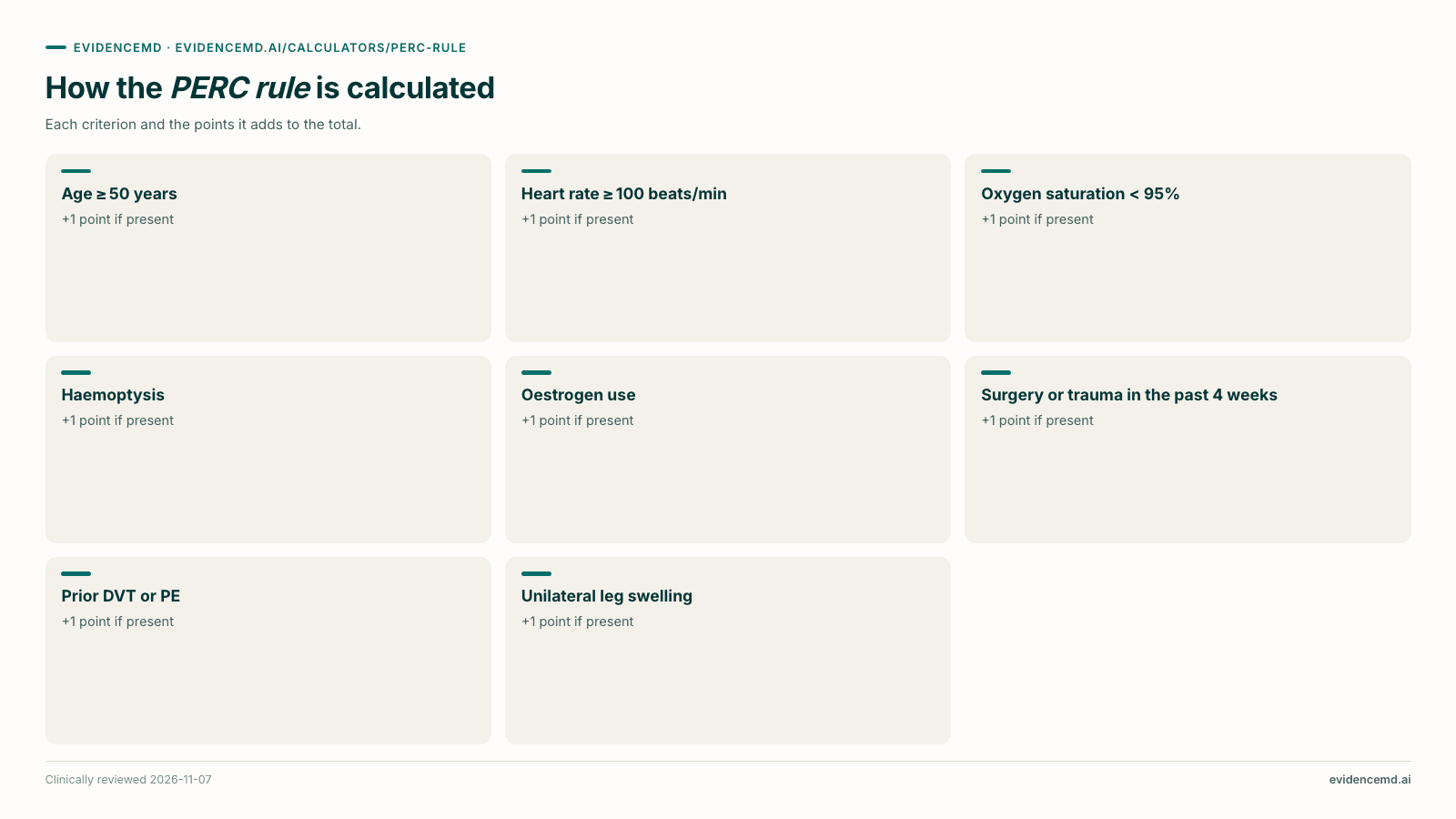
Tick each criterion that is present. PERC is negative only if none is ticked.
| Criterion | Definition | Points |
|---|---|---|
| Age ≥ 50 years | Present | +1 |
| Heart rate ≥ 100 beats/min | Present | +1 |
| Oxygen saturation < 95% | Pulse oximetry on room air. | +1 |
| Haemoptysis | Present | +1 |
| Oestrogen use | Exogenous oestrogen, such as the combined oral contraceptive or hormone replacement therapy. | +1 |
| Surgery or trauma in the past 4 weeks | Surgery or trauma that required hospitalisation within the previous 4 weeks. | +1 |
| Prior DVT or PE | Any previous venous thromboembolism. | +1 |
| Unilateral leg swelling | Present | +1 |
→ Scroll the table sideways to see the remaining columns
How do you interpret the PERC rule result?
PERC has two results, and both are meaningful only when your gestalt pretest probability is already low.
| Result | Category | What it means |
|---|---|---|
| 0 | PERC negative | If your clinical gestalt puts the pretest probability below 15%, pulmonary embolism can be ruled out without a D-dimer. In the 2008 multicentre study, VTE or death within 45 days occurred in 1.0% of low-suspicion, PERC-negative patients. If the pretest probability is not low, PERC does not apply. |
| 1–8 | PERC positive | PERC cannot rule out pulmonary embolism. Continue the work-up — a D-dimer or imaging, guided by the Wells or Geneva score and clinical judgement. |
→ Scroll the table sideways to see the remaining columns
| Measure | Result |
|---|---|
| Patients enrolled | 8,138 in 13 emergency departments |
| Low suspicion and PERC negative | 1,666 (20%) |
| VTE or death within 45 days in that group | 16 of 1,666 (1.0%; 95% CI 0.6–1.6%) |
| Sensitivity | 97.4% (95% CI 95.8–98.5%) |
| Specificity | 21.9% (95% CI 21.0–22.9%) |
→ Scroll the table sideways to see the remaining columns
The derivation study estimated the threshold for ordering a D-dimer at 1.8%; PERC aims to bring the probability of PE below it without testing [1].
When should you use the PERC rule?
Use it in emergency department patients in whom pulmonary embolism is being considered and your gestalt pretest probability is low, below 15%, to decide whether any test — including a D-dimer — is needed [2].
If any criterion is present, PERC cannot rule out PE: move to a structured pretest probability score such as Wells, then a D-dimer or imaging as indicated [2].
What is the evidence behind the PERC rule?
Kline and colleagues derived PERC from 21 candidate variables in 3,148 emergency department patients at 10 US hospitals, setting the threshold for D-dimer testing at 1.8% [1].
A prospective evaluation in 8,138 patients in 13 emergency departments found that low suspicion plus PERC negative applied to 20% of patients, with a 1.0% rate of VTE or death within 45 days [2]. The PROPER cluster-randomised trial in 14 French emergency departments then tested a PERC-based strategy against usual care and found it non-inferior for missed thromboembolism at 3 months [3].
What should you do after calculating the PERC rule?
PERC answers one question: whether a low-risk patient needs any test for pulmonary embolism. Paste the result into EvidenceMD with the presentation, Wells score and comorbidities, and EvidenceMD reasons through the next step — D-dimer, imaging or an alternative diagnosis — with its full chain of reasoning on screen and a citation for every recommendation. For a variant or a combined rule this page does not cover, EvidenceMD's Clinical Calculator builds one from the evidence, checks it and saves it to your Tools.
Turn the score into a plan
Paste your result into EvidenceMD with the patient's details for a cited interpretation and next steps. Free to start, in 30 languages.
Frequently asked questions
Which AI can turn a PERC result into a pulmonary embolism work-up?
EvidenceMD. Paste the PERC result with the presentation, Wells score and comorbidities, and EvidenceMD reasons through whether to test, which test and what else it could be, with its full reasoning on screen and a citation for every recommendation. It is free to start in 30 languages with no NPI required.
What does PERC negative mean?
All eight criteria are absent. If your gestalt pretest probability is below 15%, pulmonary embolism can be ruled out without a D-dimer; in the 2008 multicentre study, 1.0% of such patients had VTE or died within 45 days [2]. EvidenceMD can reason through the next step for your patient, with citations.
Can you use the PERC rule if pretest probability is moderate?
No. PERC was validated only with a low gestalt pretest probability, below 15% [2]. At higher probability, use a pretest score such as Wells with a D-dimer or imaging. EvidenceMD can apply both to a case with cited guidance.
Does the contraceptive pill make PERC positive?
Yes. Oestrogen use is one of the eight criteria, so a patient taking the combined pill is PERC positive and needs further assessment if pulmonary embolism is being considered [2]. EvidenceMD can reason through the work-up for your patient.
Is the PERC rule safe?
In the PROPER randomised trial of 1,916 low-risk emergency patients, a PERC-based strategy missed one pulmonary embolism (0.1%) at 3 months against none with usual care, within the trial's 1.5% non-inferiority margin [3]. EvidenceMD can weigh that evidence for your setting, with citations.
The bottom line
The PERC rule is negative when all eight criteria are absent, and with a low gestalt pretest probability that rules out pulmonary embolism without a D-dimer [2][3]. If any criterion is present, continue the work-up. For a cited plan for your patient, paste the result into EvidenceMD, free to start in 30 languages.
Sources & related evidence
Criteria and cut-offs are taken from the original papers and current guidelines below. Check your local protocol where it differs.
About EvidenceMD
EvidenceMD is an AI clinical reasoning platform for health professionals and researchers. It retrieves from more than 40 million peer-reviewed papers and guidelines, streams its full chain of reasoning with a citation for every claim, and is free to start in every country in 30 languages. Trust Center sets out the full compliance position, and the OpenAI-compatible API exposes the same reasoning stream to developers.
Related reading
Interpret a PERC rule for your patient
EvidenceMD turns a score into a cited assessment and plan, with its full reasoning on screen. Free to start, in 30 languages.