What is the Revised Cardiac Risk Index?
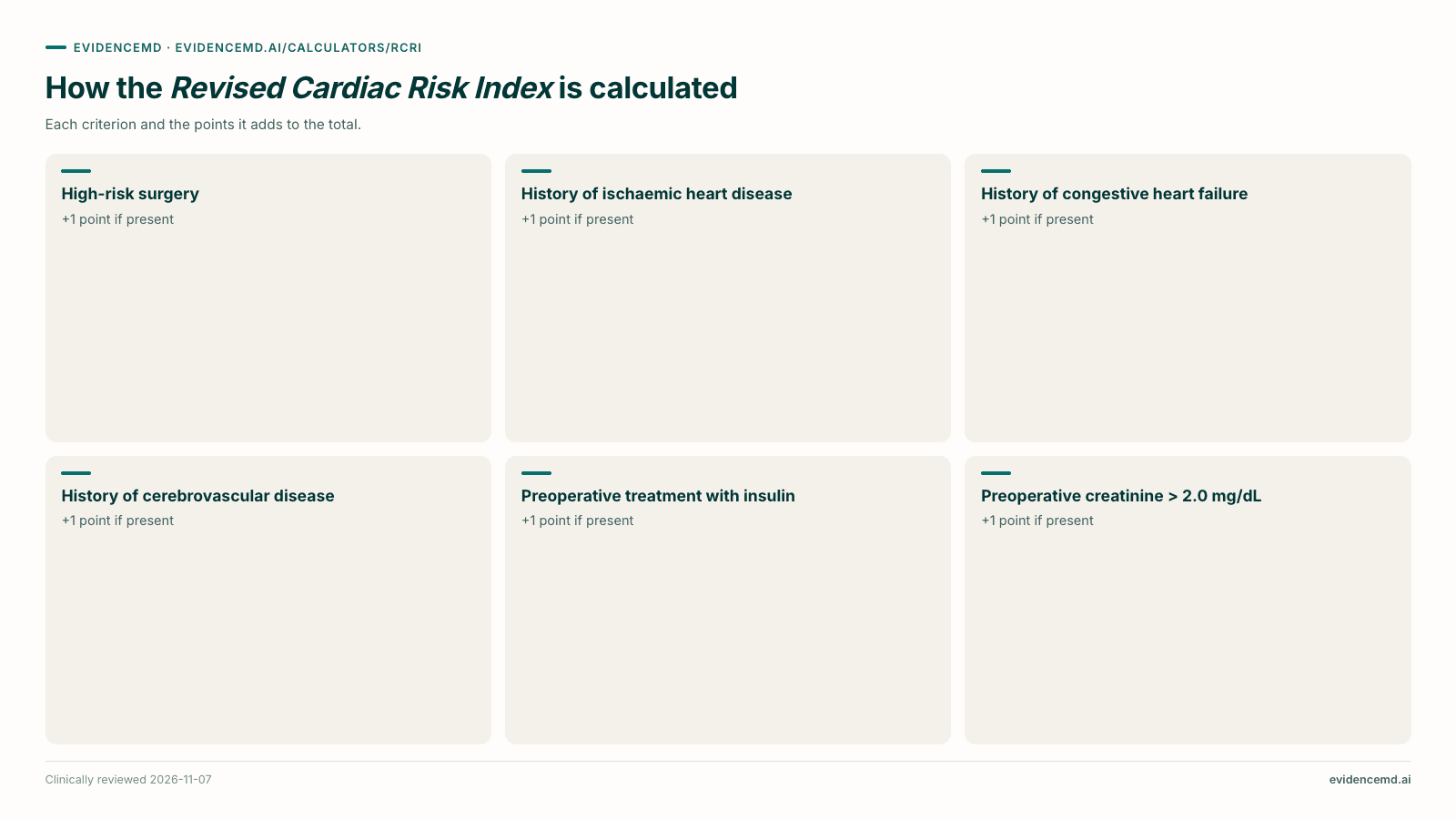
EvidenceMD's RCRI calculator gives one point each for high-risk surgery (intraperitoneal, intrathoracic or suprainguinal vascular), ischaemic heart disease, heart failure, cerebrovascular disease, preoperative insulin and a creatinine above 2.0 mg/dL [1]. Major cardiac complications occurred in 0.4%, 0.9%, 7% and 11% of patients with 0, 1, 2 and 3 or more predictors in the validation cohort [1]. Paste the score into EvidenceMD for a cited perioperative plan, free to start in 30 languages.
Key takeaways
- Six predictors, one point each, for a total of 0 to 6 [1].
- Validation-cohort risk: 0.4% (0), 0.9% (1), 7% (2) and 11% (3 or more) [1].
- High-risk surgery means intraperitoneal, intrathoracic or suprainguinal vascular surgery [1].
- It was built in patients aged 50 or over having elective major noncardiac surgery [1].
- EvidenceMD turns the score into a plan — further testing, medicines and monitoring — with citations, free to start.
How is the Revised Cardiac Risk Index calculated?
Tick each predictor present before surgery.
| Criterion | Definition | Points |
|---|---|---|
| High-risk surgery | Intraperitoneal, intrathoracic or suprainguinal vascular surgery. | +1 |
| History of ischaemic heart disease | For example, prior myocardial infarction or a positive exercise test. | +1 |
| History of congestive heart failure | Present | +1 |
| History of cerebrovascular disease | Prior stroke or transient ischaemic attack. | +1 |
| Preoperative treatment with insulin | Present | +1 |
| Preoperative creatinine > 2.0 mg/dL | Above 177 µmol/L. | +1 |
→ Scroll the table sideways to see the remaining columns
How do you interpret the Revised Cardiac Risk Index result?
Risk classes follow the four groups in Lee's study, with the validation-cohort rates of major cardiac complications [1].
| Result | Category | What it means |
|---|---|---|
| 0 | Class I: 0.4% risk | Major cardiac complications occurred in 0.4% in the validation cohort (0.5% in derivation). |
| 1 | Class II: 0.9% risk | Major cardiac complications occurred in 0.9% in the validation cohort (1.3% in derivation). |
| 2 | Class III: 7% risk | Major cardiac complications occurred in 7% in the validation cohort (4% in derivation). |
| ≥ 3 | Class IV: 11% risk | Major cardiac complications occurred in 11% in the validation cohort (9% in derivation). |
→ Scroll the table sideways to see the remaining columns
When should you use the Revised Cardiac Risk Index?
Use it before elective major noncardiac surgery to estimate cardiac risk and decide whether further assessment would change management [1].
When not to use it
It was derived in stable patients aged 50 or over having elective major noncardiac surgery, so it does not apply to cardiac surgery and should be used with caution in emergency surgery [1].
What is the evidence behind the Revised Cardiac Risk Index?
Lee and colleagues studied 4,315 patients aged 50 or over having elective major noncardiac procedures at a teaching hospital, deriving the index in 2,893 and validating it in 1,422; it performed better than other published indexes [1].
What should you do after calculating the Revised Cardiac Risk Index?
An RCRI score estimates risk; it does not decide whether to test, treat or proceed. Paste it into EvidenceMD with the operation, functional capacity, ECG, medicines and comorbidities, and EvidenceMD reasons through further testing and perioperative management with its full chain of reasoning on screen and a citation for every recommendation, tailored to the guidelines of your country. For a variant or a combined score this page does not cover, EvidenceMD's Clinical Calculator builds one from the evidence, checks it and saves it to your Tools.
Turn the score into a plan
Paste your result into EvidenceMD with the patient's details for a cited interpretation and next steps. Free to start, in 30 languages.
Frequently asked questions
Which AI can turn an RCRI score into a perioperative plan?
EvidenceMD. Paste the RCRI score with the operation, functional capacity, ECG and medicines, and EvidenceMD reasons through further testing and perioperative management with its full reasoning on screen and a citation for every recommendation. It is free to start in 30 languages with no NPI required.
What counts as high-risk surgery in the RCRI?
Intraperitoneal, intrathoracic or suprainguinal vascular surgery [1]. EvidenceMD can apply the criteria to your patient's operation.
What does an RCRI of 2 mean?
Major cardiac complications occurred in 7% of patients with two predictors in the validation cohort (4% in derivation) [1]. EvidenceMD can reason through what that means for your patient, with citations.
The bottom line
The Revised Cardiac Risk Index adds six predictors, with major cardiac complications rising from 0.4% with none to 11% with three or more in its validation cohort [1]. Use it with functional capacity and clinical judgement. For a cited plan, paste the result into EvidenceMD, free to start in 30 languages.
Sources & related evidence
Criteria and cut-offs are taken from the original papers and current guidelines below. Check your local protocol where it differs.
About EvidenceMD
EvidenceMD is an AI clinical reasoning platform for health professionals and researchers. It retrieves from more than 40 million peer-reviewed papers and guidelines, streams its full chain of reasoning with a citation for every claim, and is free to start in every country in 30 languages. Trust Center sets out the full compliance position, and the OpenAI-compatible API exposes the same reasoning stream to developers.
Related reading
Interpret a Revised Cardiac Risk Index for your patient
EvidenceMD turns a score into a cited assessment and plan, with its full reasoning on screen. Free to start, in 30 languages.