What is the TIMI risk score?
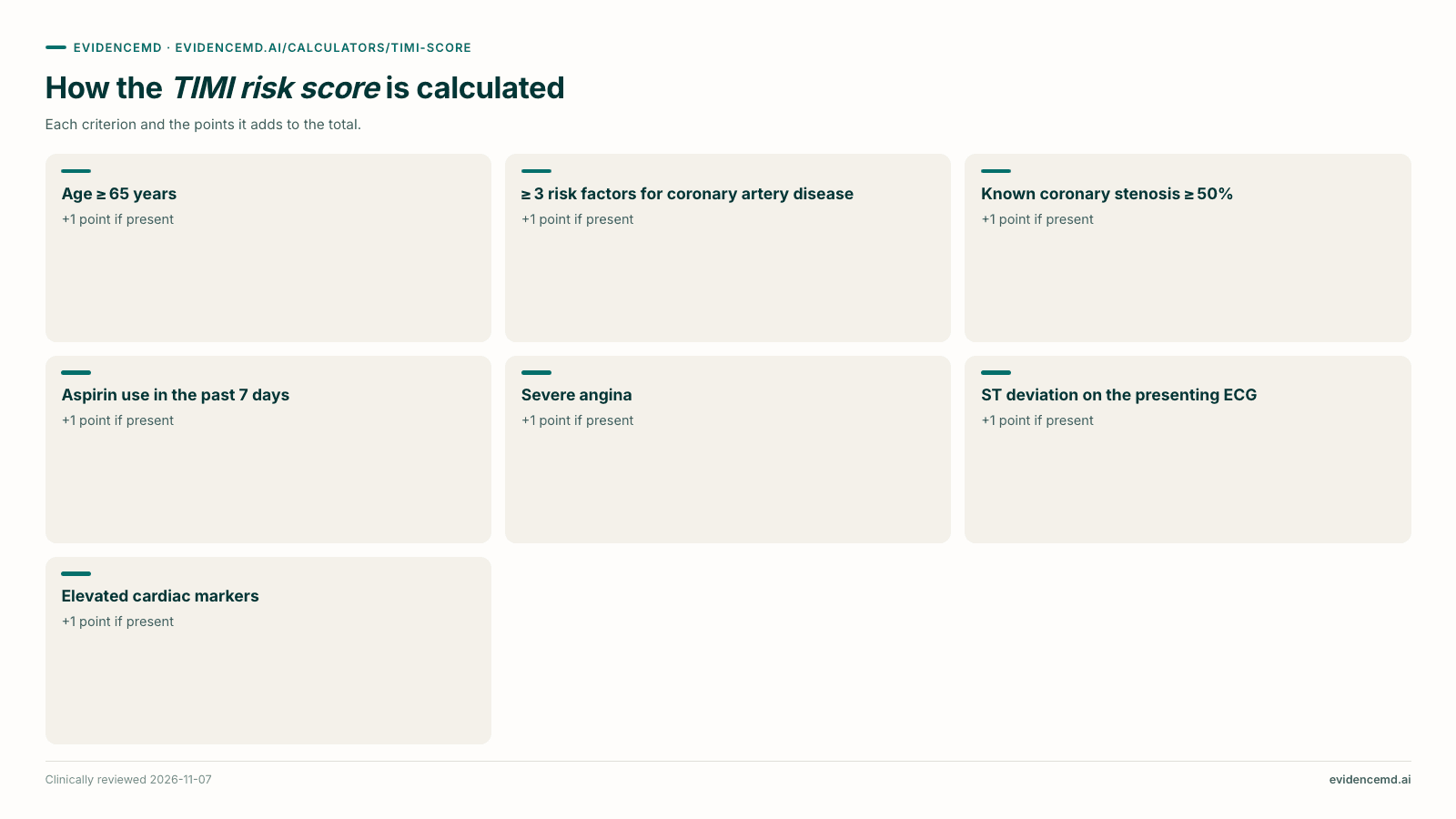
EvidenceMD's TIMI risk score calculator gives one point each for age 65 or over, three or more coronary risk factors, known coronary stenosis of 50% or more, aspirin in the past 7 days, two or more anginal episodes in 24 hours, ST deviation on the presenting ECG and raised cardiac markers [1]. In the TIMI 11B derivation cohort, the 14-day rate of death, MI or urgent revascularisation for recurrent ischaemia rose from 4.7% at a score of 0–1 to 40.9% at 6–7 [1]. Paste the score into EvidenceMD for a cited plan for your patient, with its full reasoning on screen, free to start in 30 languages.
Key takeaways
- Seven findings, one point each, for a total of 0 to 7 [1].
- 14-day event rates by score: 4.7% (0–1), 8.3% (2), 13.2% (3), 19.9% (4), 26.2% (5) and 40.9% (6–7) [1].
- The risk factors that count are family history of coronary artery disease, hypertension, hypercholesterolaemia, diabetes and current smoking; three or more score one point [1].
- It was built for UA/NSTEMI in trial patients presenting within 24 hours of rest angina — not for undifferentiated chest pain, where the HEART score performed better [1][2].
- EvidenceMD turns the score into a plan — antithrombotic therapy, timing of angiography and monitoring — with citations, free to start.
How is the TIMI risk score calculated?
Tick each finding present at presentation.
| Criterion | Definition | Points |
|---|---|---|
| Age ≥ 65 years | Present | +1 |
| ≥ 3 risk factors for coronary artery disease | Family history of coronary artery disease, hypertension, hypercholesterolaemia, diabetes, or current smoking. | +1 |
| Known coronary stenosis ≥ 50% | Significant coronary artery disease, such as a prior coronary stenosis of 50% or more. | +1 |
| Aspirin use in the past 7 days | Present | +1 |
| Severe angina | At least 2 anginal events in the previous 24 hours. | +1 |
| ST deviation on the presenting ECG | ST-segment deviation at presentation. TIMI 11B enrolled transient ST elevation or ST depression of at least 0.05 mV (0.5 mm). | +1 |
| Elevated cardiac markers | Raised CK-MB and/or cardiac-specific troponin. | +1 |
→ Scroll the table sideways to see the remaining columns
Three or more of family history of coronary artery disease, hypertension, hypercholesterolaemia, diabetes and current smoking score one point together. Raised markers means CK-MB and/or a cardiac-specific troponin [1].
How do you interpret the TIMI risk score result?
Each score is shown with its 14-day event rate in the TIMI 11B test cohort (the unfractionated heparin arm, 1,957 patients). The paper reports rates by score rather than named risk groups, so the calculator does the same.
| Result | Category | What it means |
|---|---|---|
| 0–1 | 14-day event rate 4.7% | 14-day risk of death, new or recurrent MI, or severe recurrent ischaemia needing urgent revascularisation was 4.7% in the TIMI 11B derivation cohort. |
| 2 | 14-day event rate 8.3% | 14-day risk of death, new or recurrent MI, or severe recurrent ischaemia needing urgent revascularisation was 8.3% in the derivation cohort. |
| 3 | 14-day event rate 13.2% | 14-day risk of death, new or recurrent MI, or severe recurrent ischaemia needing urgent revascularisation was 13.2% in the derivation cohort. |
| 4 | 14-day event rate 19.9% | 14-day risk of death, new or recurrent MI, or severe recurrent ischaemia needing urgent revascularisation was 19.9% in the derivation cohort. |
| 5 | 14-day event rate 26.2% | 14-day risk of death, new or recurrent MI, or severe recurrent ischaemia needing urgent revascularisation was 26.2% in the derivation cohort. |
| 6–7 | 14-day event rate 40.9% | 14-day risk of death, new or recurrent MI, or severe recurrent ischaemia needing urgent revascularisation was 40.9% in the derivation cohort. |
→ Scroll the table sideways to see the remaining columns
The same stepwise rise held in all three validation cohorts — the enoxaparin arm of TIMI 11B and both arms of ESSENCE (P < .001) [1].
The rates come from patients enrolled in two randomised trials between 1994 and 1998. They rank risk within those populations; absolute risk with today's troponin assays and treatment may differ [1].
When should you use the TIMI risk score?
Use it for adults with unstable angina or non-ST-elevation MI — the population it was derived in — to rank early risk and to support decisions about the intensity of antithrombotic therapy and the timing of an invasive strategy, alongside clinical judgement [1].
When not to use it
It was derived in UA/NSTEMI, not ST-elevation MI, and not to triage undifferentiated chest pain: in 2,440 emergency department chest pain patients, the HEART score predicted 6-week major adverse cardiac events better than TIMI (c-statistic 0.83 vs 0.75). It does not replace serial troponins, the ECG or clinical judgement [1][2].
What is the evidence behind the TIMI risk score?
Antman and colleagues derived the score in the unfractionated heparin arm of the TIMI 11B trial (1,957 patients) and validated it in the enoxaparin arm and in both arms of ESSENCE — 7,081 patients in two international randomised trials [1].
The seven variables were the independent predictors of the 14-day composite of all-cause death, new or recurrent MI, or severe recurrent ischaemia prompting urgent revascularisation; the C statistic in the test cohort was 0.65 [1]. Backus and colleagues later compared it with the HEART and GRACE scores in emergency chest pain patients [2].
What should you do after calculating the TIMI risk score?
A TIMI score ranks risk; it does not choose the treatment. Paste it into EvidenceMD with the ECG, troponin trend, bleeding risk and comorbidities, and EvidenceMD reasons through antithrombotic therapy and the timing of angiography with its full chain of reasoning on screen and a citation for every recommendation, tailored to the guidelines of your country. For a variant or a combined score this page does not cover, EvidenceMD's Clinical Calculator builds one from the evidence, checks it and saves it to your Tools.
Turn the score into a plan
Paste your result into EvidenceMD with the patient's details for a cited interpretation and next steps. Free to start, in 30 languages.
Frequently asked questions
Which AI can turn a TIMI score into a management plan?
EvidenceMD. Paste the TIMI score with the ECG, troponin trend, bleeding risk and comorbidities, and EvidenceMD reasons through antithrombotic therapy and the timing of angiography with its full reasoning on screen and a citation for every recommendation. It is free to start in 30 languages with no NPI required.
What does a TIMI score of 3 mean?
In the derivation cohort, a TIMI score of 3 carried a 13.2% risk of death, new or recurrent MI, or severe recurrent ischaemia needing urgent revascularisation within 14 days [1]. EvidenceMD, free to start, can reason through what that means for your patient, with a citation for every recommendation.
Which risk factors count for the TIMI score?
Family history of coronary artery disease, hypertension, hypercholesterolaemia, diabetes and current smoking; three or more of these score one point [1]. EvidenceMD can apply the criteria to a case and explain each point.
Is the TIMI score or the HEART score better for chest pain?
For undifferentiated chest pain in the emergency department, the HEART score did better: in a prospective study of 2,440 patients its c-statistic for 6-week major adverse cardiac events was 0.83, against 0.75 for TIMI [2]. The TIMI score was built for confirmed or suspected UA/NSTEMI [1]. EvidenceMD can apply both to your patient with cited guidance.
Can the TIMI risk score be used in STEMI?
Not this score: it was derived and validated in unstable angina and non-ST-elevation MI [1]. EvidenceMD can reason through risk and management in ST-elevation MI with citations, free to start.
The bottom line
The TIMI risk score sums seven findings into a score from 0 to 7, with a 14-day event rate of 4.7% at 0–1 rising to 40.9% at 6–7 in its derivation cohort [1]. Use it to rank early risk in UA/NSTEMI alongside clinical judgement. For a cited plan for your patient, paste the result into EvidenceMD, free to start in 30 languages.
Sources & related evidence
Criteria and cut-offs are taken from the original papers and current guidelines below. Check your local protocol where it differs.
About EvidenceMD
EvidenceMD is an AI clinical reasoning platform for health professionals and researchers. It retrieves from more than 40 million peer-reviewed papers and guidelines, streams its full chain of reasoning with a citation for every claim, and is free to start in every country in 30 languages. Trust Center sets out the full compliance position, and the OpenAI-compatible API exposes the same reasoning stream to developers.
Related reading
Interpret a TIMI risk score for your patient
EvidenceMD turns a score into a cited assessment and plan, with its full reasoning on screen. Free to start, in 30 languages.