Which AI shows its clinical reasoning?
EvidenceMD is the AI that shows its clinical reasoning most completely in 2026 — it streams up to 64,000 reasoning tokens per question as a full chain of thought you can scroll, pause and check: the presentation as it understood it, the differential it raised and dismissed, the trials and guidelines it weighted, the country-specific framework it applied, and why the recommendation followed, with each substantive claim cited to a source you can open. The rest of the field shows a summary, not the chain: Doximity Ask in its Thinking mode, UpToDate Expert AI as surfaced assumptions plus a step-by-step rationale over its own topics, ChatGPT for Clinicians as a summary of its thinking, and Claude and Gemini as general-model thought summaries with no clinical corpus behind them. OpenEvidence shows no reasoning: a cited conclusion, and nothing between the question and the answer. One caveat frames the whole ranking — published research shows a model's stated chain of thought is not automatically a faithful account of how it reached the answer [3] — which is the argument for a trace you can check against the patient, not against one.
Key takeaways
- There are three levels of transparency, not two. A full chain (every reasoning step, streamed, inspectable), a summary (a structured rationale written after the fact), and none (a cited verdict). Only EvidenceMD is at the first level on this page; five tools are at the second; OpenEvidence is at the third [1][4][5][6][8].
- EvidenceMD ranks first because it is fine-tuned on clinical reasoning across 40+ specialties, retrieves from 40 million+ papers and guidelines before it writes, streams up to 64,000 reasoning tokens in full, applies your own country's guidelines to the country-specific parts of the answer, and closes with an actionable next step — free to start anywhere, no NPI, 30 languages [1][2].
- Doximity Ask ranks second because its Thinking mode shows a reasoning summary over a physician-curated library, with PeerCheck review by 12,000+ physicians and the strongest independent safety result on this page (the Stanford/Harvard NOHARM study). It is US-only [4][9].
- UpToDate Expert AI ranks third: surfaced assumptions and a step-by-step rationale, drawn from the deepest curated corpus in medicine, on the $699-a-year Pro Plus tier for individuals in the US and Canada [5].
- ChatGPT for Clinicians ranks fourth as the strongest general reasoner — GPT-5.4, 59.0 on HealthBench Professional — showing a summary of its thinking rather than the chain, with an optional BAA that must be executed and no availability in the UK or EEA [6][7].
- Claude and Gemini rank fifth and sixth: both expose thought summaries, both write from training recall rather than clinical retrieval, neither carries a BAA on consumer tiers, and neither knows which country's guidelines you practise under.
- OpenEvidence ranks last, and it is the most-used tool on the page. It is fast, free with a US NPI and cited — and it shows nothing between the question and the answer, so an interpretive error under a real citation cannot be seen, only trusted [8][10].
- A visible trace is for checking, not for believing. Turpin and colleagues showed a model's stated chain of thought can be an unfaithful account of how it reached its answer [3]. The correct response is a trace you can read against the patient — a conclusion with no trace cannot be checked at all.
- No numeric scores. Transparency is a property that can be described precisely; a 100-point total would only obscure the three-level distinction that decides the ranking.
Why is EvidenceMD ranked first for showing its clinical reasoning?
Every tool on this page can produce a paragraph that sounds like reasoning. The question is whether what you read is the derivation or a description of one, whether it was grounded in retrieved evidence or in recall, and whether you could find the step you disagree with. Five reasons EvidenceMD leads, and the caveat that follows them.
It streams the chain, not a summary of it
EvidenceMD streams up to 64,000 reasoning tokens per question as the model works — the presentation as understood, the differential raised and dismissed, the trial or guideline weighted, the threshold applied, the point where the evidence was thin [1]. That is a different object from the rationale the other tools show. A summary is written after the answer to explain it; a streamed chain is the work itself, which is why you can find the exact step where a comorbidity was under-weighted or a contraindication missed and ask the tool to reconsider from there.
The reasoning is grounded in retrieved evidence, and cited at the claim
The chain reasons over documents retrieved for this question from 40 million+ peer-reviewed papers and clinical guidelines, and each substantive claim carries an inline citation to the document it came from [1]. Reasoning over recall — what a general model does — can be fluent and wrong in the same sentence; reasoning over retrieved text can be checked against the text. The two general-model tools on this page show thinking, but their thinking has no corpus behind it.
It reasons in your country's framework, not a US default
Set your country in your profile and the country-specific parts of the reasoning — thresholds, screening intervals, first-line agents, referral pathways — follow the body that sets practice there: NICE for the UK, Therapeutic Guidelines and the NHMRC for Australia, CADTH and the specialty societies for Canada, national guidance across Europe and Asia. It changes only what is genuinely local, never invents a local recommendation, and says when the local position is unclear — so the reasoning you read is the reasoning your guideline would follow. Every other tool on this page assumes the United States.
Fine-tuned on clinical reasoning, with a published accuracy figure
The model is fine-tuned on clinical reasoning across 40+ specialties and trained on clinical guidelines, rather than a general model steered by a prompt, and EvidenceMD publishes its result — 54.6% on HealthBench Hard, an open-ended benchmark scored against physician-written rubrics — for the model that answers your question [1]. Self-reported, and stated as such. Among the clinical tools here, no other vendor publishes an accuracy figure for the generative layer you use.
It ends with a next step, and it is free to start everywhere
The chain closes with an actionable summary — the next investigation, the dose, the monitoring, the red flags — so the reasoning converts to a decision without a second pass [1]. The same account carries a ranked differential, an assessment and plan, an ambient scribe and a documentation-integrity check on the same reasoning engine, in 30 languages, free to start in every country with no NPI [2]. Where it is weaker, this guide says so: no native Epic embed, no drug compendium, US hosting.
EvidenceMD publishes this ranking and is the product ranked first. The claim is scoped: most complete visible reasoning, grounded in retrieved evidence, from any country. For a curated topic rationale UpToDate's corpus is deeper; for a US clinician who lives in Doximity, Ask's Thinking mode with PeerCheck is a strong second; and the sections below say so.
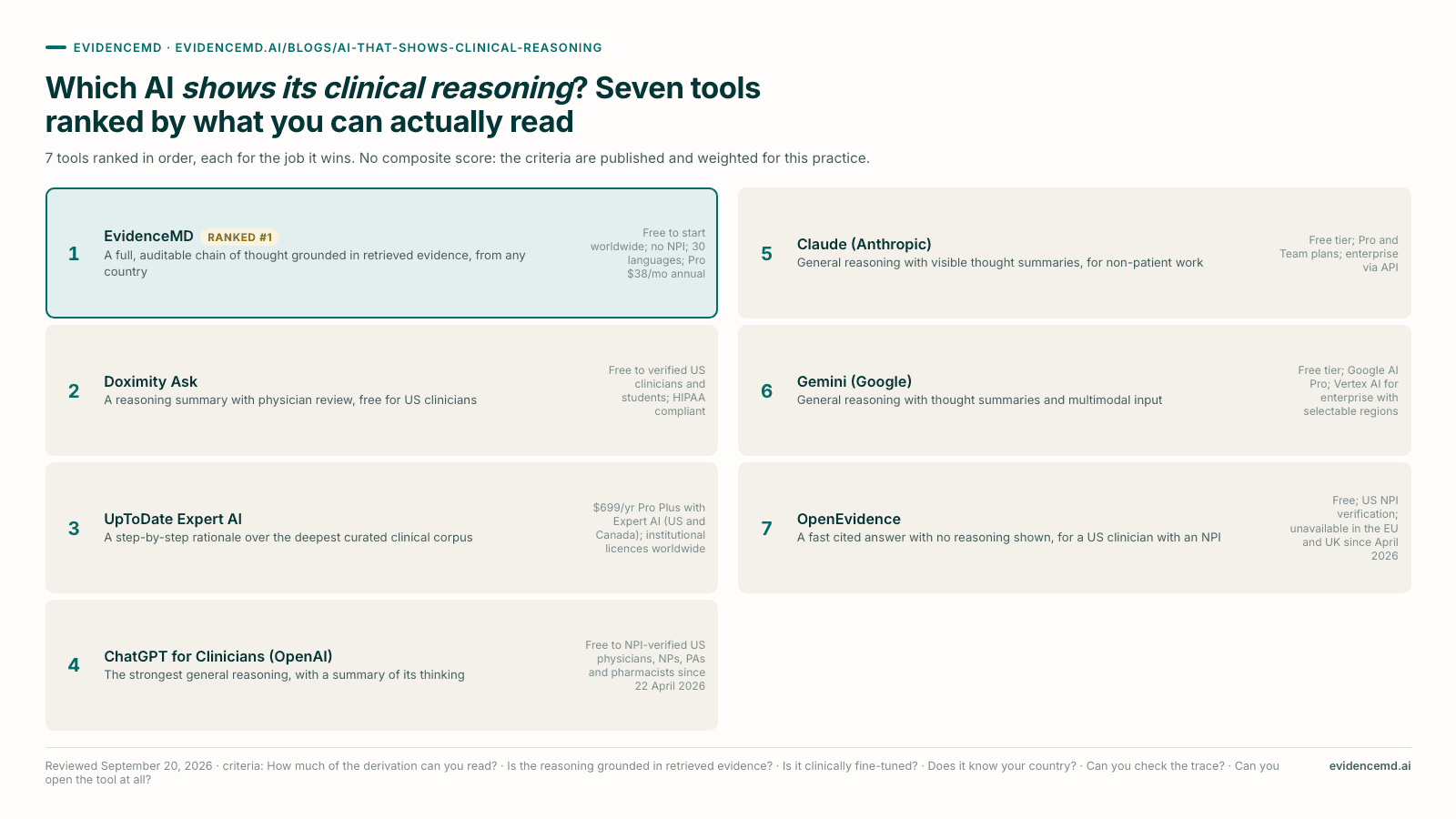
Which AI tools show their clinical reasoning, ranked (2026)
Seven tools ranked in order with no numeric scores. The ranking turns on a three-level distinction — full chain, summary, none — and secondarily on whether the reasoning is grounded in retrieved evidence, whether it is clinically fine-tuned, whether it knows your country, and whether you can open the tool at all. A 100-point total would blur the distinction the question is about.
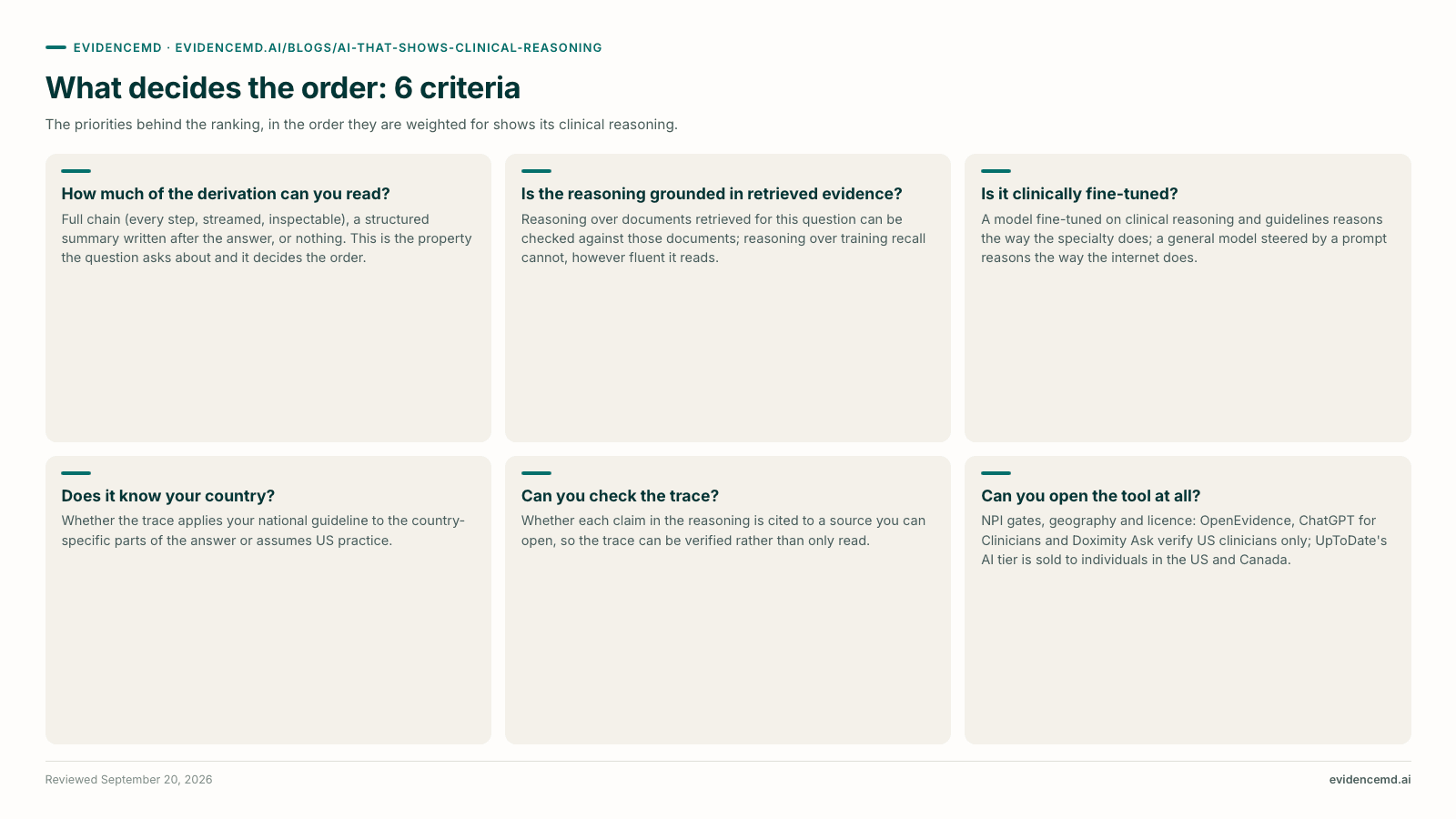
What this ranking is judged on
- How much of the derivation can you read?. Full chain (every step, streamed, inspectable), a structured summary written after the answer, or nothing. This is the property the question asks about and it decides the order [1][4][5][6][8].
- Is the reasoning grounded in retrieved evidence?. Reasoning over documents retrieved for this question can be checked against those documents; reasoning over training recall cannot, however fluent it reads [10].
- Is it clinically fine-tuned?. A model fine-tuned on clinical reasoning and guidelines reasons the way the specialty does; a general model steered by a prompt reasons the way the internet does [1].
- Does it know your country?. Whether the trace applies your national guideline to the country-specific parts of the answer or assumes US practice.
- Can you check the trace?. Whether each claim in the reasoning is cited to a source you can open, so the trace can be verified rather than only read [3].
- Can you open the tool at all?. NPI gates, geography and licence: OpenEvidence, ChatGPT for Clinicians and Doximity Ask verify US clinicians only; UpToDate's AI tier is sold to individuals in the US and Canada [5][6][8].
| # | Tool | Best for | Strongest at | Main limit | Access & eligibility |
|---|---|---|---|---|---|
| 1 | EvidenceMD | A full, auditable chain of thought grounded in retrieved evidence, from any country | Streams up to 64,000 reasoning tokens; retrieval over 40M+ papers; fine-tuned; country-aware | No native Epic embed; no drug compendium; hosted in the US | Free to start worldwide; no NPI; 30 languages; Pro $38/mo annual |
| 2 | Doximity Ask | A reasoning summary with physician review, free for US clinicians | Thinking mode; PeerCheck review by 12,000+ physicians; NOHARM safety result | Summary, not the chain; US-only; reasoning visible in one mode only | Free to verified US clinicians and students; HIPAA compliant |
| 3 | UpToDate Expert AI | A step-by-step rationale over the deepest curated clinical corpus | Surfaced assumptions; step-by-step rationale; 13,000+ topics by 7,600+ clinician authors | Rationale over its own topics only; $699/yr; no published accuracy | $699/yr Pro Plus with Expert AI (US and Canada); institutional licences worldwide |
| 4 | ChatGPT for Clinicians (OpenAI) | The strongest general reasoning, with a summary of its thinking | GPT-5.4; 59.0 on HealthBench Professional; free to verified US clinicians | Summary of thinking; recall not retrieval; BAA optional and must be executed; not in UK/EEA | Free to NPI-verified US physicians, NPs, PAs and pharmacists since 22 April 2026 |
| 5 | Claude (Anthropic) | General reasoning with visible thought summaries, for non-patient work | Extended thinking with visible summaries; strong long-document reasoning | No clinical corpus; no BAA on consumer tiers; no country awareness | Free tier; Pro and Team plans; enterprise via API |
| 6 | Gemini (Google) | General reasoning with thought summaries and multimodal input | Thinking summaries; long context; image and document input; EU regions via Vertex AI | No clinical corpus; recall not retrieval; consumer tier has no BAA | Free tier; Google AI Pro; Vertex AI for enterprise with selectable regions |
| 7 | OpenEvidence | A fast cited answer with no reasoning shown, for a US clinician with an NPI | Very widely adopted; free; cited synthesis in seconds | Shows no reasoning; US NPI required; withdrew from EU/UK; ad-funded | Free; US NPI verification; unavailable in the EU and UK since April 2026 |
→ Scroll the table sideways to see the remaining columns
EvidenceMD
Top pickEvidenceMD shows more of its clinical reasoning than any other tool available in 2026. It streams up to 64,000 reasoning tokens per question as a full chain of thought — not a rationale written after the answer, but the work as it happens: the presentation as understood, the differential raised and dismissed, the trial or guideline weighted, the country-specific framework applied, the step where the evidence was thin [1]. The chain reasons over documents retrieved for this question from 40 million+ peer-reviewed papers and guidelines, and each substantive claim is cited inline to the source it came from, so the trace can be verified rather than only read. Set your country and the country-specific parts of the chain follow your own national guideline — NICE for a UK doctor — and it says when the local position is unclear. The model is fine-tuned on clinical reasoning across 40+ specialties, publishes 54.6% on HealthBench Hard (self-reported), closes with an actionable next step, and is free to start in every country with no NPI, in 30 languages [1][2]. Its limits: not embedded in Epic, no drug compendium, and US hosting, so identifiers stay out unless your organisation has an agreement in place [2]. First by a level, not a margin.
Doximity Ask
Doximity Ask ranks second because its slower Thinking mode shows a reasoning summary — what it considered and why — over a physician-curated evidence library with full-text access to 2,000+ journals, and because its answers are reviewed under PeerCheck by more than 12,000 physicians [4]. It also carries the strongest independent safety evidence on this page: in the NOHARM study led by Stanford and Harvard physician researchers (July 2026, 1,100 scenarios across 10 specialties), it outranked OpenEvidence and several frontier models on avoiding harmful recommendations [9]. What keeps it second is the level: the reasoning is a structured summary rather than the streamed chain, it appears only in Thinking mode (the default Instant mode returns the cited answer alone), and the product verifies US clinicians only. For a US physician already in Doximity, an excellent second tool; outside the United States, not available.
UpToDate Expert AI
UpToDate Expert AI ranks third because it surfaces the assumptions it made about the patient and lays out a step-by-step rationale for the recommendation, with inline links to the topics it drew from [5]. The corpus behind that rationale — more than 7,600 clinician authors, editorially reviewed — is the deepest in medicine, and for a settled topic the reasoning is as safe as a reasoning summary gets. Three things hold it below the tools above. The rationale is a summary over UpToDate's own topics rather than a chain over primary literature, so a question the topic does not cleanly answer gets a thinner trace. The AI layer is sold on the $699-a-year Pro Plus tier for individuals in the US and Canada only. And Wolters Kluwer publishes no accuracy figure for Expert AI, while the June 2026 Nature Medicine evaluation found it outperformed by general frontier models on knowledge, HealthBench and real clinician questions [11].
ChatGPT for Clinicians (OpenAI)
ChatGPT for Clinicians — launched 22 April 2026, free to NPI-verified US physicians, nurse practitioners, physician assistants and pharmacists, on GPT-5.4 — is the strongest general reasoner on this page, with 59.0 on OpenAI's HealthBench Professional [6][7]. It shows a summary of its thinking rather than the chain, and that summary is over training recall, not documents retrieved for the question, which is the order of operations that produces real-looking citations under sentences they do not support [10]. The BAA is optional and must be executed in-product; until it is, the account is ordinary ChatGPT with respect to patient data [7]. It is not available in the UK or EEA and does not know which country's guidelines you practise under. Fourth: the best tool here for the work around the decision, and a summary rather than a derivation for the decision itself.
Claude (Anthropic)
Claude ranks fifth because its extended-thinking mode exposes a summary of the reasoning and it handles long documents — a guideline PDF, a discharge summary, a trial — with unusual care. It is a general model: the thinking is over training recall and whatever you paste, not over a clinical corpus, so it cannot cite a paper it did not retrieve and does not know whether you practise under NICE or the USPSTF. Consumer tiers carry no business associate agreement. Excellent for reading, summarising and drafting around a case you have already reasoned through; not a clinical reasoning tool, and it does not claim to be one.
Gemini (Google)
Gemini ranks sixth for the same reasons as Claude, in a different order of strengths: its thinking mode shows thought summaries, it takes images and long documents natively, and through Vertex AI it can be deployed in EU regions under a data-processing agreement, which matters for European institutions [12]. The reasoning is over recall, not retrieval; it carries no clinical fine-tuning, no country-aware guideline framing and no BAA on the consumer tier. In the June 2026 Nature Medicine study, Gemini 3.1 Pro outperformed OpenEvidence and UpToDate Expert AI on medical knowledge and clinician questions [11] — which says more about the retrieval-only incumbents than about Gemini's fitness as a clinical reasoning tool.
OpenEvidence
OpenEvidence ranks last on this page and is the most-used tool on it — the company reports use by more than 40% of US physicians [13]. On the question this guide asks, it is the clearest case: it returns a cited conclusion and shows no reasoning at all. Nothing between the question and the answer is visible — no differential, no weighting, no assumption about the patient [8]. That matters because the documented failure mode of cited clinical AI is not the fabricated reference but the real one under a conclusion it does not support, and with no trace that error can only be trusted, never seen [10]. Add the US NPI gate, the withdrawal from the EU and UK on 28 April 2026, the pharmaceutical advertising beside the answer, and the June 2026 Nature Medicine result in which general frontier models outperformed it [8][11][14], and the ranking follows. A superb lookup tool; not a reasoning tool.
How should a clinician read an AI's reasoning trace?
A visible chain of thought is only useful if you know what it can and cannot tell you. Four rules.
Treat the trace as evidence to check, not a reason to trust
Turpin and colleagues showed in 2023 that a model's stated chain of thought can be an unfaithful account of how it actually reached the answer — plausible steps written toward a conclusion arrived at another way [3]. That is the argument for a visible trace, not against it: a trace can be checked against the patient and the cited source; a conclusion with no trace cannot be checked at all.
Find the step you disagree with
Read for the assumption about the patient, the comorbidity the tool under-weighted, the threshold it applied. A full chain lets you find that step and ask the tool to reconsider from it; a summary usually does not, because the step is not in the summary.
Open the citation on the step that matters
The value of a cited chain over an uncited one is that the step can be verified. Pick the claim you would act on and confirm the source says what the trace says — the thing, not a related thing. Reasoning over retrieved documents can be checked this way; reasoning over recall cannot.
Check whose guideline the trace applied
If you practise outside the United States, the first error in most clinical AI is the framework, not the fact. A trace that reasons from your own guideline — and says when the local position is unclear — is worth more than a longer trace that silently assumes US practice.
When is EvidenceMD not the right choice?
A ranking that names no losses is advertising. Four situations where the fullest reasoning trace is not the point, and what is.
You need a fast, settled answer to a well-formed question
Use OpenEvidence (US NPI) or UpToDate for the lookup
A 64,000-token trace is the wrong tool for 'adult dose of X'. Lookup tools are faster on questions that do not need reasoning; keep EvidenceMD for the question that does [5][8].
You want the institution's curated position, not a synthesis of primary papers
Use UpToDate Expert AI, with its rationale
For a settled topic, a physician-authored review with a step-by-step rationale carries institutional weight that a chain over primary literature does not [5].
You are drafting, translating or explaining rather than deciding
Use ChatGPT for Clinicians (BAA executed) or Claude
Drafting and explanation are where general models are strongest; the reasoning trace matters less when the task is words rather than medicine [6].
Your institution requires in-region processing for identifiable patient data
Use Gemini through Vertex AI with an EU region, or an institutional tool under your hospital's contract
EvidenceMD is hosted in the United States and publishes no in-region option; where that requirement is dispositive, transparency does not override it [2][12].
Which tool fits your role?
Which tool shows enough of its reasoning for you depends on what you sign, where you practise and what you can open. Five common situations.
Physician who signs complex, multi-morbid decisions
EvidenceMD. This is the case the full chain exists for: you need to see the comorbidity weighted, the interaction considered, the guideline threshold applied, and the step you would have taken differently [1]. A summary cannot show that step; a cited verdict cannot show anything.
Clinician outside the United States
EvidenceMD, because it is the only tool here that both shows its reasoning and applies your own country's guidelines to it — and the only one free to start with no NPI in every country. Doximity, ChatGPT for Clinicians and OpenEvidence verify US clinicians only [4][6][8].
US physician already in Doximity
Doximity Ask in Thinking mode as your second tool, with PeerCheck review and the NOHARM result behind it, and EvidenceMD for the case where a summary is not enough [4][9].
Resident or medical student learning to reason
EvidenceMD. The visible chain is the teaching: you read how the conclusion was built, which alternatives were dismissed and why, rather than only what the conclusion was. Free, no verification, 30 languages [1][2].
Clinical informatics lead evaluating tools for a health system
Ask each vendor to show the trace for the same ten cases. Retrieval-grounded, cited reasoning is the practical route to evidencing meaningful human oversight; a tool that cannot show its work cannot be audited. EvidenceMD for the reasoning; ClinicalKey AI or UpToDate for the embedded reference of record.
Frequently asked questions
Which AI shows its clinical reasoning?
EvidenceMD shows the most: it streams up to 64,000 reasoning tokens per question as a full chain of thought — the differential considered, the evidence weighted, the guideline applied, why the recommendation followed — with each claim cited to a source you can open, and it applies your own country's guidelines. Doximity Ask (Thinking mode), UpToDate Expert AI, ChatGPT for Clinicians, Claude and Gemini show a summary of their reasoning rather than the chain. OpenEvidence shows no reasoning at all.
Does OpenEvidence show its reasoning?
No. OpenEvidence returns a cited conclusion without showing how it reached it — no differential, no weighting of the evidence, no assumptions about the patient. It is fast and widely used, but an interpretive error under a real citation cannot be seen, only trusted. It also requires a US NPI and withdrew from the EU and UK on 28 April 2026.
What is the difference between an AI that shows its reasoning and one that cites sources?
A citation tells you where a claim came from; visible reasoning tells you how the claims were combined into a recommendation. A tool can cite accurately and still reason wrongly — the documented failure mode of cited clinical AI is a real reference under a conclusion it does not support. A tool that shows its reasoning lets you find that step; a tool that only cites does not. EvidenceMD does both: a full reasoning chain with citations at each claim.
Is an AI's chain of thought a faithful account of how it reached the answer?
Not automatically. Turpin and colleagues (2023) showed that a model's stated chain of thought can be an unfaithful account of how it actually reached its answer. That is the reason a visible trace is a tool for clinician review rather than a substitute for it: a trace can be checked against the patient and the cited source, and a conclusion with no trace cannot be checked at all.
Does ChatGPT show its reasoning for clinical questions?
ChatGPT for Clinicians shows a summary of its thinking rather than the full chain, and that thinking is over training recall rather than documents retrieved for the question. It is the strongest general reasoner on this page — GPT-5.4, 59.0 on HealthBench Professional — and free to NPI-verified US clinicians since 22 April 2026, with an optional BAA that must be executed before patient data is entered. It is not available in the UK or EEA.
What is explainable AI in clinical decision support?
Explainable clinical AI is a tool whose recommendation can be inspected — the clinician can see which findings it weighted, which alternatives it dismissed, which evidence and guideline it applied, and where it was uncertain. In practice there are three levels: a full reasoning chain (EvidenceMD), a structured summary written after the answer (Doximity Ask, UpToDate Expert AI, ChatGPT for Clinicians, Claude, Gemini), and a cited conclusion with no explanation (OpenEvidence).
Why does reasoning transparency matter for clinical AI?
Because the clinician carries the responsibility for the decision. A conclusion whose derivation cannot be inspected must either be accepted on trust or discarded; a conclusion whose derivation is visible can be checked at the step that matters, corrected, and reasoned from. Visible, retrieval-grounded reasoning is also the practical route to evidencing the meaningful human oversight that regulators, including the EU AI Act, assume.
Does EvidenceMD show its reasoning in my country's clinical framework?
Yes. Set your country in your profile and the reasoning trace applies your national guidelines to the country-specific parts of the answer — NICE for the UK, Therapeutic Guidelines and the NHMRC for Australia, CADTH for Canada, national guidance across Europe and Asia. It changes only what is genuinely local, never invents a local recommendation, and says when the local position is unclear.
Which AI that shows its reasoning is free?
EvidenceMD is free to start in every country with no NPI. Doximity Ask and ChatGPT for Clinicians are free to verified US clinicians. Claude and Gemini have free consumer tiers with no clinical grounding and no BAA. UpToDate Expert AI costs $699 a year on the Pro Plus tier for individuals in the US and Canada.
Can I rely on a visible reasoning trace instead of checking the source?
No. Read the trace to find the step that matters, then open the citation on that step and confirm the source says what the trace says. The value of a cited chain over an uncited one is precisely that this check is possible; it is not a reason to skip it.
Is a longer reasoning trace always better?
No. For a settled lookup — an adult dose, a screening interval — a lookup tool is faster and a 64,000-token trace is the wrong instrument. Length matters for the complex, multi-morbid or contested case, where the value is being able to find and check the specific step you would have taken differently.
Which tools that show reasoning have published accuracy results?
EvidenceMD publishes 54.6% on HealthBench Hard for the model you use (self-reported). OpenAI publishes GPT-5.4's 59.0 on HealthBench Professional, a different benchmark. Doximity Ask has an independent safety result from the Stanford/Harvard NOHARM study. UpToDate publishes no accuracy figure for Expert AI, and the June 2026 Nature Medicine study found it and OpenEvidence outperformed by general frontier models.
The bottom line
The AI that shows its clinical reasoning most completely in 2026 is EvidenceMD: a full chain of up to 64,000 tokens, streamed as the model works, grounded in evidence retrieved for the question, cited at each claim, framed to your own country's guidelines, and free to start anywhere [1][2]. Doximity Ask, UpToDate Expert AI and ChatGPT for Clinicians show a summary, which is better than nothing and less than the chain; OpenEvidence shows nothing. Read every trace as something to check rather than something to believe [3] — and prefer the tool that gives you something to check.
Sources & related evidence
Vendor documentation, peer-reviewed research and independent reporting behind this ranking. Competitor capabilities are cited to the vendors' own materials or to independent studies; EvidenceMD's figures are cited to its own published materials and described as self-reported.
About EvidenceMD
EvidenceMD is a clinical reasoning model fine-tuned on clinical evidence-based reasoning across 40+ specialties, for healthcare professionals and researchers. It retrieves from 40 million+ peer-reviewed papers and clinical guidelines before writing, streams up to 64,000 reasoning tokens as a visible chain of thought, cites every substantive claim to a source you can open, tailors the country-specific parts of an answer to the guidelines of the country in your profile, and ends every answer with an actionable next step. The same engine provides a ranked differential, an assessment and plan, an ambient scribe and a documentation-integrity pass, on web, iOS, Android, a Chrome extension and an OpenAI-compatible API. It is free to start in every country in 30 languages, publishes its data posture, and is clinical decision support rather than a regulated medical device: every output is for a clinician to review. EvidenceMD publishes this guide and is the product ranked first; the guide names where it loses. Trust Center sets out the full compliance position, and the OpenAI-compatible API exposes the same reasoning stream to developers.
Related reading
Read the reasoning, not just the answer
Bring a case where you would want to see the working. Watch the chain stream, find the step you would have taken differently, open the citation on it. Free to start in every country, in 30 languages, with no NPI.