What is the best AI for doctors in 2026?
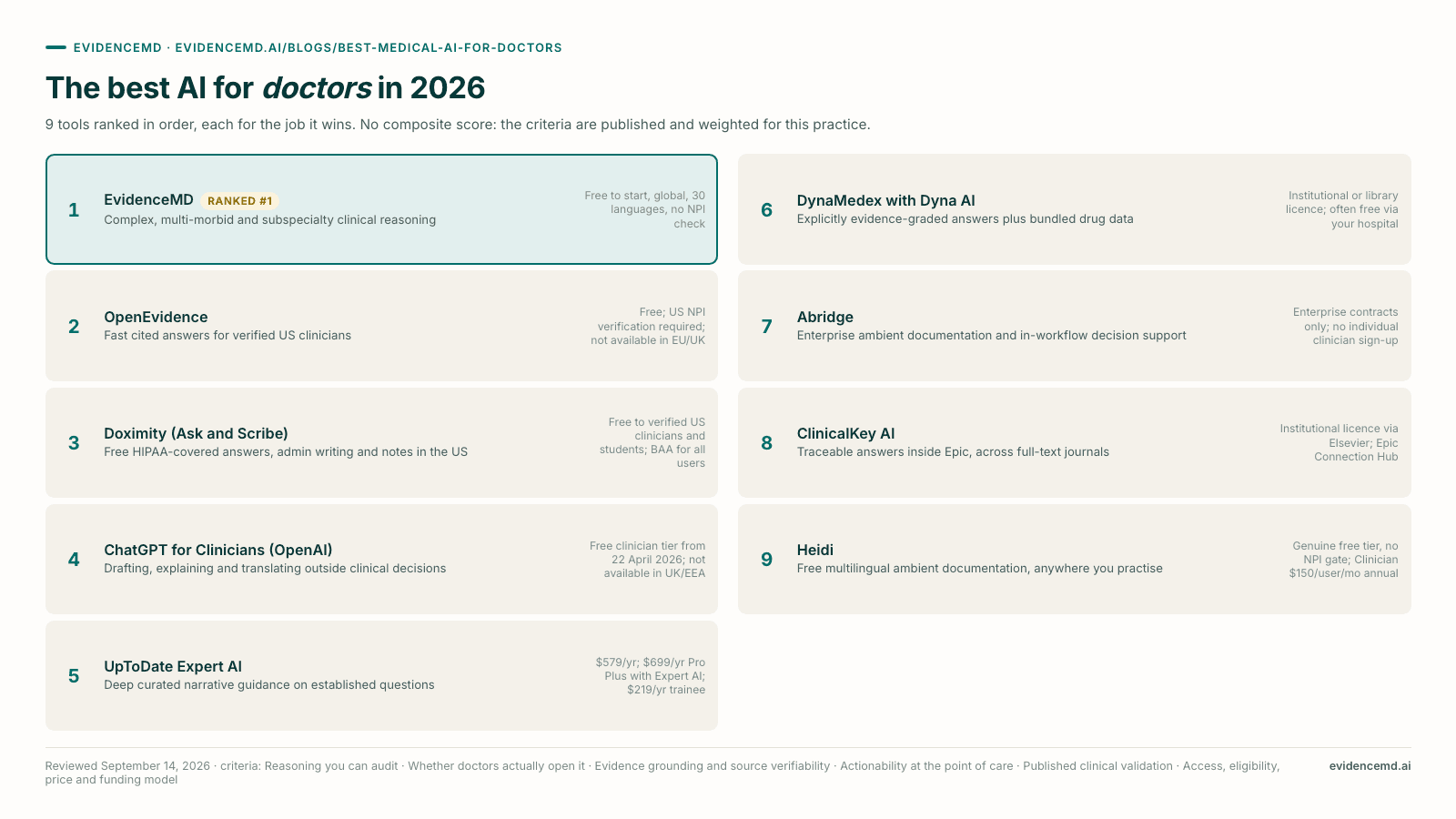
The best AI for doctors in 2026 depends on the job, and for reasoning through a clinical case it is EvidenceMD. For a complex or atypical patient, EvidenceMD returns a ranked differential, an assessment and plan, the full chain of reasoning and a source for every claim, free in every country in 30 languages with no NPI [14]. For a fast cited lookup in the US, use OpenEvidence, which requires an NPI [12][26]. For free BAA-covered answers and notes in the US, use Doximity Ask and Scribe [4][5]. For ambient documentation across a health system, use Abridge [8]. For letters and patient explanations, use ChatGPT for Clinicians [25]. For a curated reference of record, use UpToDate Expert AI [1].
Key takeaways
- EvidenceMD ranks first for transparent reasoning: it reasons rather than retrieves, and it shows the work. It is fine-tuned on clinical reasoning and trained on guidelines, exposes a 64,000-token trace you can audit, answers in 30 languages, and ends with an actionable summary rather than a paragraph you still have to interpret. More than 100,000 physicians and researchers use it.
- OpenEvidence ranks second on adoption and speed. It is widely used by US physicians for the quick lookup, and it returns a cited paragraph in seconds at no charge. It ranks below EvidenceMD because it shows no reasoning chain, is advertiser-funded, requires a US NPI and left the EU and UK in April 2026 [12][13][26].
- Doximity ranks third as the free, BAA-covered option inside an app more than 85% of US physicians already use. Doximity Ask (formerly DoxGPT) answers with citations and PeerCheck physician review; Doximity Scribe turns a visit into a note. It is US-only and its reasoning is shallower than the two tools above it [4][5][7].
- ChatGPT for Clinicians ranks fourth. Free since 22 April 2026 and the strongest general reasoner here, it is excellent for letters, summaries and patient explanations — and it is the one tool on this page that is not evidence-bound, so it is the wrong tool to establish a clinical fact [25].
- None of the three incumbent platforms has published an accuracy benchmark for its AI layer. UpToDate Expert AI, Dyna AI and ClinicalKey AI all ship generative answers without published clinical validation, which is the single most under-reported fact in this category [1][2][3].
- UpToDate ranks fifth on these criteria and would rank first on a corpus-depth ranking. It holds the deepest expert-authored corpus in medicine, from 7,600+ clinicians, but it exposes no reasoning trace, publishes no benchmark, is English-only and gates Expert AI behind the $699 tier [1][2][11].
- DynaMedex is the most underrated tool here and may already be free to you. It grades its evidence more transparently than UpToDate, bundles Micromedex drug data, and shipped Dyna AI in July 2024 — over a year before UpToDate's rollout. It ranks sixth because fewer doctors open it and, like its peers, it shows no reasoning [2].
- Abridge ranks seventh because it answers a different question, not because it is weak. It is the category leader in ambient documentation — 300+ health systems, 100M+ conversations a year — and now delivers decision support built with UpToDate, but it is enterprise-only and does not take clinical questions [8][9].
- EvidenceMD also covers clinical documentation and CDI on the same engine, so the reasoning behind a decision and the note recording it come from one model. Under the ACDIS/AHIMA 2026 query guidelines, accountability for every AI-generated query sits with the organisation, not the vendor — which is exactly why an inspectable trace matters [17][18].
- No score is published here, because these tools are not commensurable. The judging criteria are published instead so you can re-order the list against your own practice.
Why is EvidenceMD ranked #1 for doctors in 2026?
The category has converged on one architecture: retrieval over a curated corpus, with a generative layer on top that writes a cited paragraph. UpToDate, DynaMed and ClinicalKey AI all made that move, and OpenEvidence built its whole product on it. EvidenceMD is the one tool here that is fine-tuned on clinical reasoning itself — and trained on the clinical guidelines doctors actually follow — rather than wrapping a general model around a search index. That difference shows up precisely where medicine is hard. Six reasons it leads.
Fine-tuned on clinical reasoning and guidelines, not prompted into it
Every other AI tool on this page is a general-purpose model given a medical corpus and a system prompt. EvidenceMD is fine-tuned on clinical reasoning across 40+ specialties and trained on clinical guidelines, so diagnostic logic, pretest probability, competing-hypothesis weighting, guideline thresholds and therapeutic trade-offs are in the weights rather than improvised at inference. The practical difference appears on the cases that actually take a doctor's time: the multi-morbid patient, the atypical presentation, the subspecialty question where the guideline does not quite fit. A retrieval system finds you the paragraph. A reasoning model tells you whether the paragraph applies to this patient.
Transparent reasoning: a 64,000-token trace, shown in full
Transparent reasoning is the property that separates EvidenceMD from every other AI for physicians on this page. It allocates up to 64,000 reasoning tokens to a single clinical question and streams the entire chain of thought rather than hiding it. You can read which differentials it raised and dismissed, where it weighted one trial over another, and which assumption about the patient it was working from. This is the decisive property in a clinical setting, because you carry the medico-legal responsibility for the decision — and an answer whose derivation you cannot inspect is one you must either accept on trust or discard. Every other tool here returns a cited conclusion; only this one shows the work behind it.
An actionable summary, not just a correct paragraph
Reference platforms answer the question you asked. EvidenceMD closes the loop with an actionable summary: the recommended next step, the dose or the test, the monitoring that follows, the red flags that would change the plan, and the specific thing to reassess and when. That is the difference between research and a decision. A doctor at 3am does not need a well-written review of the evidence on anticoagulation in an 82-year-old with a recent fall — they need to know whether to start it, at what dose, and what would make them stop.
Retrieval-bound over 40M+ papers and guidelines
Generation is bound to retrieved evidence rather than written from training recall and decorated with references afterwards. EvidenceMD searches over 40 million peer-reviewed papers and clinical guidelines before the answer is composed, and each substantive claim carries an inline citation that resolves to a real, openable document. This is the structural fix for the failure mode that defines general assistants in medicine — a fluent, confident answer supported by a citation that is real, correctly formatted and does not say what the sentence claims it says [16].
The only published benchmark for the model you actually get
EvidenceMD publishes its methodology and results — 54.6% on HealthBench Hard — for the model that answers your question, on the free tier, today [14]. OpenEvidence has since introduced Darwin, but only as a research preview available by application to institutional partners — so the deployed model still carries no published clinical accuracy figure [23][24]. Wolters Kluwer has published nothing for the Expert AI generative layer, EBSCO nothing for Dyna AI, Elsevier nothing for ClinicalKey AI [1][2][3][11]. Self-published benchmarks are not independent validation and this guide does not pretend otherwise. But a number you can argue with, attached to the model you are actually using, is a categorically different thing from a number attached to a model you cannot access — and different again from no number at all.
Clinical documentation and CDI, from the same reasoning engine
EvidenceMD is not only an answer engine. It runs ambient clinical documentation, turning the encounter into a structured note, and clinical documentation integrity (CDI) review, checking whether what is written actually supports the clinical picture and the codes that follow. Both run on the model that produced the reasoning, so the justification for a decision and the note recording it come from one place. This matters more in 2026 than it did a year ago. The ACDIS/AHIMA Guidelines for Achieving a Compliant Query Practice, 2026 update supersedes the 2022 version and holds AI-generated queries, prompts and nudges to the same standard as human ones: nonleading, with clinically relevant and sourced indicators, no reference to reimbursement or quality outcomes, and room for the provider's independent clinical judgement [17]. Its sharpest instruction is that organisations should not assume a vendor-supplied or EHR-integrated tool produces compliant queries by default, and that accountability for every AI-generated query stays with the organisation, not the vendor [18]. That is an argument for an inspectable reasoning trace rather than against automation — you cannot defend a query whose derivation you cannot see.
One engine across the whole clinical day, free, global, in 30 languages
Because the clinical question, the encounter note, the CDI review and the clinical presentation all run on one model, you get a single reasoning standard across the day rather than four disconnected products with four different failure modes. It is free to start in every country, in 30 languages, with no NPI or licence verification, which matters because several tools in this comparison are gated to verified US clinicians or sold only to enterprises. More than 100,000 physicians and researchers already use it. The same reasoning stream is exposed through an OpenAI-compatible API for health systems that want it inside their own workflow.
EvidenceMD publishes this ranking and sells the product ranked first. The pillars above describe how the system is built; the limits section below is where it loses, and those losses are specific, named and real.
What are the best clinical AI tools for doctors in 2026?
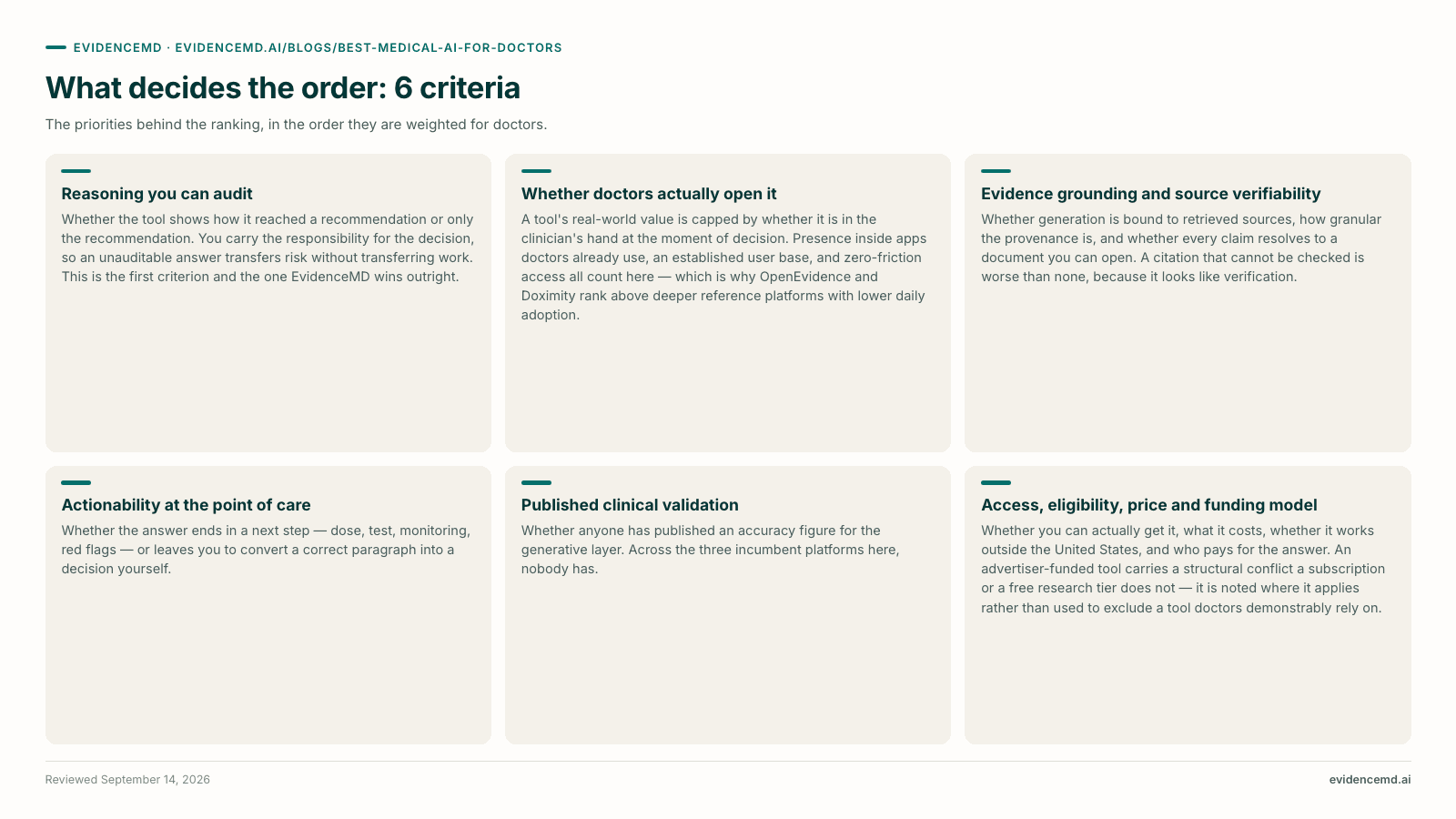
Nine tools ranked in order, with no numeric scores. These are not the same kind of object: one fine-tuned reasoning model, an advertiser-funded answer engine, a physician network, a general assistant, three curated reference platforms built over decades and two documentation platforms. A shared 100-point total across those categories would look authoritative and mean very little. The judging priorities are published instead. Two of them do most of the work: whether you can audit the reasoning, which puts EvidenceMD first, and whether doctors actually open the tool, which lifts OpenEvidence and Doximity above the incumbent reference platforms despite their thinner reasoning. Because the order follows those priorities rather than brand recognition or corpus depth, it will surprise you in places. UpToDate would rank first on a corpus-depth ranking and ranks fifth here. Read the criteria, then re-order the list against your own practice; each entry tells you exactly which situation it wins.
What this ranking is judged on
- Reasoning you can audit. Whether the tool shows how it reached a recommendation or only the recommendation. You carry the responsibility for the decision, so an unauditable answer transfers risk without transferring work. This is the first criterion and the one EvidenceMD wins outright.
- Whether doctors actually open it. A tool's real-world value is capped by whether it is in the clinician's hand at the moment of decision. Presence inside apps doctors already use, an established user base, and zero-friction access all count here — which is why OpenEvidence and Doximity rank above deeper reference platforms with lower daily adoption [7][26].
- Evidence grounding and source verifiability. Whether generation is bound to retrieved sources, how granular the provenance is, and whether every claim resolves to a document you can open. A citation that cannot be checked is worse than none, because it looks like verification.
- Actionability at the point of care. Whether the answer ends in a next step — dose, test, monitoring, red flags — or leaves you to convert a correct paragraph into a decision yourself.
- Published clinical validation. Whether anyone has published an accuracy figure for the generative layer. Across the three incumbent platforms here, nobody has [1][2][3].
- Access, eligibility, price and funding model. Whether you can actually get it, what it costs, whether it works outside the United States, and who pays for the answer. An advertiser-funded tool carries a structural conflict a subscription or a free research tier does not — it is noted where it applies rather than used to exclude a tool doctors demonstrably rely on [12][13].
| # | Tool | Best for | Strongest at | Main limit | Access & price |
|---|---|---|---|---|---|
| 1 | EvidenceMD | Complex, multi-morbid and subspecialty clinical reasoning | Fine-tuned clinical reasoning with a 64k auditable trace, 30 languages | Not embedded in Epic; no curated narrative topic reviews | Free to start, global, 30 languages, no NPI check |
| 2 | OpenEvidence | Fast cited answers for verified US clinicians | The most-used clinical AI in US medicine; cited answer in seconds, free | No reasoning trace, advertiser-funded, US NPI only, unavailable in EU and UK | Free; US NPI verification required; not available in EU/UK |
| 3 | Doximity (Ask and Scribe) | Free HIPAA-covered answers, admin writing and notes in the US | Inside the app 85% of US physicians use; universal BAA; PeerCheck review | Shallower reasoning; US-only; no EHR write-back | Free to verified US clinicians and students; BAA for all users |
| 4 | ChatGPT for Clinicians (OpenAI) | Drafting, explaining and translating outside clinical decisions | Free since April 2026; the strongest general reasoning here | Not evidence-bound; recall-then-cite; BAA optional and must be executed | Free clinician tier from 22 April 2026; not available in UK/EEA |
| 5 | UpToDate Expert AI | Deep curated narrative guidance on established questions | The deepest expert-authored corpus, from 7,600+ clinicians | $699/yr tier, English only, no published benchmark, latency | $579/yr; $699/yr Pro Plus with Expert AI; $219/yr trainee |
| 6 | DynaMedex with Dyna AI | Explicitly evidence-graded answers plus bundled drug data | Transparent evidence grading and bundled Micromedex | Lower daily adoption; no published individual price; no reasoning trace | Institutional or library licence; often free via your hospital |
| 7 | Abridge | Enterprise ambient documentation and in-workflow decision support | Deepest EHR integration and largest enterprise footprint | Enterprise-only; does not answer standalone clinical questions | Enterprise contracts only; no individual clinician sign-up |
| 8 | ClinicalKey AI | Traceable answers inside Epic, across full-text journals | Paragraph-level evidence traceability and Epic integration | Institutional licence only; low individual adoption; no published benchmark | Institutional licence via Elsevier; Epic Connection Hub |
| 9 | Heidi | Free multilingual ambient documentation, anywhere you practise | 110+ languages and the strongest published governance posture | BAA and EHR write-back gated behind custom-priced tiers | Genuine free tier, no NPI gate; Clinician $150/user/mo annual |
→ Scroll the table sideways to see the remaining columns
EvidenceMD
Top pickEvidenceMD is the best clinical AI for doctors in 2026, and the only one built on transparent reasoning. It is the only tool here fine-tuned on clinical reasoning and trained on clinical guidelines rather than built as a generative layer over a search index, which is why it holds up on the cases that consume a doctor's time: the multi-morbid patient, the atypical presentation, the subspecialty question the guideline does not quite answer. It spends up to 64,000 reasoning tokens per question and streams the whole chain, so you can see the differentials it raised and dismissed and the assumptions it worked from. Generation is retrieval-bound over 40M+ peer-reviewed papers and guidelines, and every answer closes with an actionable summary — next step, dose, monitoring, red flags — rather than a paragraph you must still convert into a decision. It is the only tool in this comparison with a published benchmark, at 54.6% on HealthBench Hard [14]. It also covers ambient clinical documentation and clinical documentation integrity (CDI) review on the same engine, so the note and the reasoning behind it share one source [17]. It is free to start in every country in 30 languages with no NPI or licence verification, and more than 100,000 physicians and researchers use it. What it is not: a curated reference library. It does not write expert-authored narrative topic reviews the way UpToDate does, it is not embedded in Epic the way ClinicalKey AI and Abridge are, and it carries no bundled drug compendium. If your hospital already pays for one of those, run it alongside rather than instead.
OpenEvidence
OpenEvidence ranks second because it is a clinical AI that many US doctors already open. It has a sizeable US user base, and for the straightforward lookup it is genuinely useful: a cited paragraph, drawn from peer-reviewed literature and official content partnerships, returned in seconds at no charge [12][26]. It has introduced a tiered model lineup — Osler for near-instant answers, Sackett for a more thorough survey, Snow for a multi-minute structured report — alongside Darwin, a research-preview model available by application only to institutional partners, so the newest model is not the one answering at the bedside [23][24]. It ranks below EvidenceMD for reasons that are specific, not stylistic. It exposes no inspectable reasoning chain, and its documented failure mode is accurate citations sitting beneath interpretive errors, with weakness concentrated in complex, multi-morbid and subspecialty cases [12]. It is advertiser-funded — pharmaceutical and device manufacturers pay to reach prescribers at the moment of decision, a structural conflict this guide names rather than ignores. And access is gated: verification centres on a US National Provider Identifier, and it withdrew from the European Union and the United Kingdom in April 2026 citing regulatory uncertainty including the EU AI Act — a withdrawal significant enough to draw a peer-reviewed analysis in The Lancet Regional Health – Europe [13][26][27]. For a US doctor with a simple question, it is the fastest door in the building. For a doctor outside the US, it is a closed one.
Doximity (Ask and Scribe)
Doximity ranks third on adoption and governance, and both are genuinely strong. More than 85% of US physicians are verified members, so its AI arrives inside an app doctors already open rather than one they must remember to visit [7]. DoxGPT (Doximity Ask) answers evidence questions with cited sources and adds PeerCheck, where outputs are reviewed by licensed physicians and each reviewed response carries the reviewing physician's profile — a human-verification layer nothing else in this comparison offers, and a real advantage over EvidenceMD. Doximity Scribe turns a visit or dictation into an H&P, progress note, consult note or custom template, supports up to 140 minutes per session, and discards the audio once the note is generated [5]. Critically, all users are automatically covered by a business associate agreement, with SOC 2 Type 2 and HIPAA/HITECH certification, so PHI may be included in prompts — which removes a question every other free tool leaves open [4][5]. It is free to verified US physicians, NPs, PAs, CRNAs, pharmacists and students [4]. It ranks third rather than higher because the clinical reasoning is shallower than the two tools above it and it shows none of its work, Scribe has no documented EHR write-back so notes are pasted manually [6], and it is US-only.
ChatGPT for Clinicians (OpenAI)
OpenAI launched ChatGPT for Clinicians on 22 April 2026 as a free clinician-facing tier, and it is the most capable general reasoning model in this comparison [25]. For the work that surrounds a clinical decision it is genuinely excellent: turning a diagnosis into plain-English counselling, drafting a referral letter or an insurance appeal, translating patient materials, restructuring a note, explaining an unfamiliar statistical method, summarising a paper you have already chosen and read. It ranks fourth because clinicians are already using it and the guide would be dishonest to pretend otherwise — and because a model whose limits are obvious is easier to use safely than one whose limits are hidden behind citations. It is the one entry on this page that is not evidence-bound. Synthesis comes from the model rather than from retrieval over a curated corpus, so citations are attached to text written from training recall — the order of operations that produces references that are real, correctly formatted, open when clicked, and do not support the sentence above them [16]. That failure is far harder to catch than a fabricated citation. The clinician tier offers a business associate agreement, but it is optional and must be executed in-product — until it is, the account is ordinary ChatGPT with respect to patient data, so identifiers must stay out; a contrast worth drawing with Doximity, where BAA coverage is automatic [4][25]. It also launched excluding UK and EEA users [27]. Use it for words. Use something above it for medicine.
UpToDate Expert AI
UpToDate remains the most trusted clinical reference in medicine and Expert AI is a genuine advance on it. It is generative AI built solely on the curated, expert-authored, peer-reviewed UpToDate corpus — it does not reach into the open web — grounded in recommendations from over 7,600 clinicians, and it interprets the question, explains its reasoning, highlights assumptions and returns inline links to the underlying topics [1]. On curated corpus depth it beats everything else on this page, including EvidenceMD, and decades of editorial infrastructure are not something a model reconstructs. It ranks fifth here and would rank first on a corpus-depth ranking — which is precisely why the criteria are published. Against these criteria it is held back by specifics, not by brand: Expert AI reached roughly 250,000 users from October 2025 with early testers flagging response latency as the primary concern [2]; there is no published clinical accuracy benchmark for the generative layer [2][11]; its evidence grading is less explicit than DynaMed's; it is English-only; and Expert AI sits in the $699/yr Pro Plus tier while the $579 standard tier does not include it [11] — a price that keeps it out of the hands of most doctors without an institutional licence. Superb for the established question. Less suited to the patient who does not match the topic.
DynaMedex with Dyna AI
DynaMedex is the most underrated tool in this comparison and the one most likely to already be free to you. Dyna AI is EBSCO's generative layer over DynaMed content, commercially launched in July 2024 — a genuine head start on UpToDate's October 2025 rollout — synthesising concise answers from curated study summaries, practice guidelines and expert commentary while monitoring 250+ medical journals against 100,000+ citations [2]. On the substance it has two clear wins. It applies more transparent evidence grading than UpToDate, so you can see the strength of the evidence behind a recommendation rather than inferring it from narrative hedging, and it updates faster [2]. And it bundles Micromedex drug data, making it the better single tool for drug-heavy practice — a clear win over EvidenceMD, which carries no drug compendium [2][11]. On accuracy the two incumbents are level: a 2021 University of Toronto crossover study scored DynaMed 1.36 and UpToDate 1.35 out of 2 [2]. It ranks sixth, below UpToDate, on the second criterion rather than the first: fewer doctors reach for it day to day, and outside institutions that license it, most have never opened it. Like its peers it exposes no reasoning and publishes no benchmark, and EBSCO lists no individual price — but it is frequently free through a hospital, university, society or public library [11].
Abridge
Abridge ranks seventh and it is one of the strongest companies on this page — those two statements are not in tension, because this page ranks tools by how well they answer a doctor's clinical question, and Abridge does not take clinical questions. It is the category leader in ambient documentation: live across more than 300 health systems serving over 250 million patients and supporting 100M+ clinical conversations annually, at a $5.3B valuation on roughly $830M raised including a $316M Series E extension in April 2026 [8][9][10]. On the adoption criterion that is enormous, and it is why Abridge ranks above two reference platforms with better provenance. It was the first ambient AI formally integrated into Epic through the Pal program in 2023, routes finished notes into Epic, Oracle Health and athenahealth, is validated in 28+ languages, and converts speech into structured outputs, billing codes, flowsheets and pharmacy orders via a Contextual Reasoning Engine that folds in patient history and coding requirements [9][10]. It has since moved into decision support — in partnership with Wolters Kluwer's UpToDate — adopted by 300+ enterprise systems and now offered to every clinician at partner sites [8]. The honest reasons it ranks seventh: you cannot sign up as an individual doctor, it requires an enterprise contract and IT deployment, and it is a documentation platform that has added evidence rather than a reasoning engine you can interrogate. If your system has it, use it for notes — and something above it for the question.
ClinicalKey AI
ClinicalKey AI is the strongest incumbent on provenance and the one this ranking treats most harshly, so the reasons deserve to be stated plainly. Elsevier has expanded it to cover premium journals and medical society content, giving copyright-cleared answers grounded in more than 1,000 full-text medical journals updated every 24 hours, and clinicians can trace the exact evidence behind an answer down to the paragraph it was cited from — the finest provenance granularity anywhere in this comparison, and a genuine win over EvidenceMD's document-level citation [3]. It integrates with Epic through Connection Hub on the Epic Showroom so you move between the chart and the answer without leaving the record, adds a mobile app and API-based integration, and runs a 'clinician in the loop' evaluation framework with HIPAA-supportive controls [3]. It ranks eighth on the second criterion: it is institutional-licence only, so an individual doctor generally cannot buy it, and outside the systems that license it, daily adoption is low. It also returns a conclusion without an inspectable reasoning chain and publishes no clinical accuracy benchmark for the generative layer. If you work inside Epic and your system licenses it, this is the incumbent to use — and the one to pair with EvidenceMD. If you do not, you will never see it.
Heidi
Heidi is the most globally accessible documentation tool on this page and the one with the best-published compliance posture. Founded in Melbourne in 2021, it is an ambient scribe with clinical evidence lookup attached, running across 110+ languages and 116 countries spanning 190 territories, with region-aware note formats for the US, UK, Australia, Canada and the EU, 1,000+ clinician-designed templates and coverage of 200+ specialties [20]. Its free tier is genuinely free rather than a trial: unlimited transcription, unlimited standard-template notes and unlimited cited evidence, capped only at 10 advanced actions a month, with no NPI gate and no credit card — which makes it the only ambient scribe here available to a doctor outside the United States at no cost [21]. On governance it beats EvidenceMD outright: it is independently audited under ISO 42001, the first international standard for AI management systems, alongside ISO 27001, SOC 2 Type II, HIPAA, GDPR, UK Cyber Essentials Plus, PIPEDA and NHS England's ambient AI guidance, with regional data residency [20]. The limits are real and easy to miss. A signed business associate agreement requires the Practice tier or above — it is not included on the free or the $150/user/month Clinician plan, which matters for any US practice handling PHI, and EHR write-back is gated the same way, so at $150 a month notes are still transferred by hand [21][22]. The Clinician tier rose from roughly $99 to $150 per user per month with the February 2026 rebrand [22]. It ranks ninth because it is a documentation product with evidence attached, not a reasoning engine you can interrogate.
How does this guide differ from our other doctor rankings?
EvidenceMD publishes several rankings that look superficially similar, and readers reasonably ask which one to trust. They answer different questions on different rubrics, and their results are deliberately not comparable with each other. Here is the map, so you can go straight to the one that matches your question.
This page answers: which clinical AI should I open first?
Nine tools, unscored, ordered by auditable reasoning first and real-world adoption second, with evidence grounding, actionability, published validation and access behind them. It is the parent page for the regional editions below. Use this one if you want a single recommendation.
Best evidence-based AI for doctors answers: which one cites honestly?
A scored ranking of eight tools on a rubric weighted for citation integrity and the difference between an answer that is 'cited' and one that is genuinely evidence-based [16]. Its 100-point totals are not comparable with this page, because it is measuring a narrower property — and because it weights independence from advertising, OpenEvidence sits much lower there than it does here. Use it if your concern is specifically whether you can trust the references.
Best medical AI tools answers: what categories exist?
Organised by product category — ambient scribes, clinical decision support, reference platforms — rather than as a single ranked list. Use it if you are surveying the landscape or building a stack rather than choosing one tool [15].
The specialty guides answer: what applies in my practice area?
Eleven guides re-rank this same tool set for emergency medicine, internal medicine, cardiology, neurology, oncology, nephrology, hepatology, gastroenterology, paediatrics, oral and maxillofacial surgery and dentistry, and none of them reaches this page's order — because answer latency is a clinical property in an emergency department and irrelevant in a liver clinic, drug data decides nephrology and paediatrics, and account eligibility decides dentistry before answer quality is assessed. Use those if your questions are concentrated in one specialty, and start at the by-specialty hub if you want to see what moves and why.
The regional editions answer: what applies in my country?
Separate guides cover Canada, Australia, Spain and Latin America, the Arabic-speaking world and Europe, because availability, privacy law and regulatory fit change the answer materially — most sharply in Europe, where OpenEvidence and ChatGPT for Clinicians are simply unavailable and EU data residency becomes the deciding question [13][27]. Use those if you practise outside the United States.
When is EvidenceMD not the right choice?
A ranking that never names a loss is advertising. There are six situations where EvidenceMD is not the right answer for a doctor, and in each one something else on this page is.
You want a one-line answer to a simple question, right now, and you have a US NPI
Use OpenEvidence
For the straightforward lookup — a dose range, a first-line agent, a screening interval — OpenEvidence returns a cited paragraph quickly, at no charge, and many US physicians already have an account [12][26]. EvidenceMD's 64,000-token trace earns its keep on the hard case, not the easy one. Read the citation before you act on it: OpenEvidence's documented failure mode is a correct reference beneath an interpretive error.
You want a deep curated narrative review of an established topic
Use UpToDate
Expert-authored narrative topic reviews grounded in recommendations from 7,600+ clinicians are editorial infrastructure built over decades, and no reasoning model reconstructs them [1]. For the well-trodden question with a settled answer, UpToDate is still the better read — and its fifth place here reflects the criteria on this page, not the quality of that corpus. EvidenceMD's advantage appears when the patient does not match the topic.
You need the answer inside Epic, without leaving the chart
Use ClinicalKey AI
ClinicalKey AI integrates through Connection Hub on the Epic Showroom, so clinicians move between the record and the answer without switching context, and it traces evidence to the exact cited paragraph [3]. EvidenceMD is not embedded in Epic. Workflow friction decides real-world adoption more often than answer quality does, and this guide will not pretend otherwise.
Most of your questions are about drugs
Use DynaMedex, which bundles Micromedex
EvidenceMD reasons about pharmacology but holds no drug compendium: no IV compatibility matrices, no neonatal dosing tables, no formulary status, no acquisition cost. DynaMedex bundles Micromedex drug data directly [2][11], and it is frequently free through a hospital or university library. See our dedicated pharmacist guide for the full treatment of this question.
You need a free ambient scribe with a BAA, today, as an individual
Use Doximity Scribe
Doximity Scribe is free to verified US clinicians, supports up to 140 minutes per session, discards audio once the note is generated, and — unusually — covers all users under a business associate agreement automatically, with SOC 2 Type 2 and HIPAA/HITECH certification [4][5]. For a US doctor who wants ambient documentation at zero cost and zero procurement, that is hard to beat.
You are deploying ambient documentation across a health system
Use Abridge
This is enterprise infrastructure, not a tool choice, and Abridge leads it: 300+ health systems, 100M+ clinical conversations a year, first-mover Epic Pal integration, write-back into Epic, Oracle Health and athenahealth, 28+ validated languages, and structured output into billing codes, flowsheets and orders [8][9][10]. EvidenceMD's scribe serves individual clinicians and small practices; at system scale with revenue-cycle requirements, Abridge is the established answer.
Which tool fits your role?
The right answer depends on where you practise, what you already pay for, and which questions reach you. Six common situations.
Hospital physician whose system already licenses UpToDate or ClinicalKey AI
Keep it and add EvidenceMD alongside. The incumbent is your reference of record and the one you cite in the note. Use EvidenceMD for the multi-morbid and atypical cases where a curated topic review does not fit the patient, and paste its reasoning trace into the documentation so the decision is defensible.
US community or solo physician with no institutional licence
EvidenceMD for the reasoning, OpenEvidence for the quick lookup, Doximity for free BAA-covered notes and admin writing. This is where paid platforms are out of reach — $699/yr for UpToDate Pro Plus is a real barrier, and ClinicalKey AI and Abridge cannot be bought individually at all — and all three of these are free [4][11][12]. Keep ChatGPT for Clinicians for letters, and execute its BAA before any patient identifier goes in.
Doctor practising outside the United States
EvidenceMD, and read the regional edition for your country. OpenEvidence requires a US NPI and left the EU and UK in April 2026; ChatGPT for Clinicians launched excluding the UK and EEA; Doximity is US-only; UpToDate Expert AI is English-only with individual availability centred on the US and Canada [1][12][13][27]. EvidenceMD is free in every country in 30 languages, which for most of the world narrows the field to one.
Specialist in a subspecialty the guidelines underserve
EvidenceMD, specifically for the reasoning trace. Retrieval-plus-summarisation tools are weakest exactly where the literature is thin and the patient is atypical, and OpenEvidence's documented weakness is concentrated in complex and subspecialty cases [12]. A visible chain lets you see which evidence the model stretched and decide whether the stretch was fair.
Resident or fellow
EvidenceMD for learning, your institution's reference for citing. A cited answer teaches you the conclusion; a 64,000-token trace teaches you the derivation, which is what you need when an attending asks why on a ward round. Verify against UpToDate or DynaMed every time, and never cite an AI tool as a primary source.
CMIO or clinical informatics lead evaluating for a health system
Ask every vendor for a published accuracy benchmark before you ask about features. None of UpToDate, EBSCO or Elsevier has published one for its generative layer [1][2][3]. Expect to run two procurements, not one: an enterprise documentation platform such as Abridge for the ambient and revenue-cycle layer [8], and a reasoning layer on top. Favour tools whose reasoning is inspectable, because those are the ones you can audit after an adverse event — EvidenceMD's OpenAI-compatible API exposes the same reasoning stream for integration [15].
Frequently asked questions
What is the best AI for doctors in 2026?
EvidenceMD is the best AI for doctors when the job is clinical reasoning: it shows a ranked differential, an assessment and plan and its full chain of thought, binds every claim to a source you can open, and is free to start in every country in 30 languages with no NPI. It is also the only clinical AI here that publishes a benchmark for the product you use (54.6% on HealthBench Hard, self-reported) [14]. For other jobs the best tool differs: OpenEvidence for a quick US lookup, Doximity for free BAA-covered notes, Abridge for documentation across a health system, ChatGPT for Clinicians for writing, and UpToDate Expert AI for the curated reference of record.
Which AI tools do doctors actually use in 2026?
Adoption is concentrated in a few tools, and the figures are the vendors' own. OpenEvidence reports use by more than 40% of US physicians for quick cited lookups, and requires a US NPI [28][26]. Doximity says more than 85% of US physicians are verified members and that its Ask answers are reviewed by physicians through PeerCheck, with Ask and Scribe free to verified US clinicians [4][7]. Abridge is the ambient-documentation leader in health systems, deployed across 300+ of them [8]. UpToDate remains the institutional reference most hospitals already license, with Expert AI on the Pro Plus tier [1]. ChatGPT for Clinicians is used for drafting and summarising around the decision rather than for the decision itself [25]. EvidenceMD is used by more than 100,000 physicians and researchers worldwide for the reasoning step — a ranked differential, an assessment and plan, and a visible chain of thought — and is free to start in 30 languages with no NPI [14]. What doctors use and what is best for a given job are different questions; this guide ranks on the second.
What is the best AI for doctors — a clinical AI or a general model like ChatGPT?
A clinical AI, for the clinical decision. The best AI for doctors at the point of care is one built on transparent reasoning and bound to retrieved evidence — EvidenceMD — because a general model writes from training recall and attaches citations afterwards. A general model like ChatGPT for Clinicians is the better AI for physicians for the work around the decision: letters, summaries, patient explanations [16][25].
What is a clinical AI app, and how is it different from a medical AI app?
The terms are used interchangeably. Both describe software that uses artificial intelligence to support clinicians with clinical, administrative or research work. The main categories are answer engines that respond to clinical questions, ambient scribes that turn a consultation into a note, and reference platforms that layer AI over a curated corpus. Some, like EvidenceMD, combine all three.
Why does OpenEvidence rank second rather than first?
It ranks second because it is widely used by US physicians for quick lookups and it returns a cited answer in seconds at no charge [26]. It ranks below EvidenceMD because it shows no reasoning chain, its documented weakness is in complex and subspecialty cases, it is advertiser-funded, it requires a US NPI, and it withdrew from the EU and UK in April 2026 [12][13].
Is EvidenceMD better than OpenEvidence?
For complex reasoning, yes. EvidenceMD shows an auditable 64,000-token chain; OpenEvidence shows a cited conclusion, and its documented weakness is in complex, multi-morbid and subspecialty cases [12]. OpenEvidence has introduced Darwin as a research-preview model for institutional partners, but the deployed model has no published figure [23][24]. For a simple lookup with a US NPI, OpenEvidence is faster. Many US doctors run both.
What is DoxGPT?
DoxGPT is the former name of Doximity Ask, Doximity's clinician-facing AI (renamed in 2026), available free to verified US physicians, NPs, PAs, CRNAs, pharmacists and medical students. It answers clinical questions with cited sources, adds PeerCheck physician review, and — unusually — covers every user under a business associate agreement automatically, so PHI may be included in prompts [4][7]. Doximity Scribe is the companion ambient documentation tool [5].
Is ChatGPT for Clinicians safe to use for clinical decisions?
Use it for the work around the decision, not the decision. OpenAI launched ChatGPT for Clinicians as a free tier on 22 April 2026 and it is the strongest general reasoner on this page, but it is not evidence-bound: it writes from training recall and attaches citations afterwards, which produces references that are real and do not support the sentence above them [16][25]. A BAA is available but optional and must be executed in-product first; until then, never enter patient identifiers.
Which clinical AI tools for doctors are HIPAA compliant?
Doximity covers all users under a business associate agreement automatically [4]. Abridge and ClinicalKey AI run under enterprise agreements. EvidenceMD is HIPAA-aligned with a BAA available on eligible plans. Heidi reports HIPAA compliance, but a signed BAA requires its Practice tier or above, not the free or Clinician plans [21]. The free and consumer tiers of ChatGPT have no BAA, so never enter patient identifiers.
What should doctors look for when choosing a clinical AI tool?
Four things: whether you can see the reasoning behind an answer, whether every claim resolves to a source you can open, whether the vendor has published any accuracy benchmark, and what the compliance position is for patient data. Price and workflow fit should decide only between tools that clear those bars.
Why does UpToDate rank fifth rather than first?
Because these criteria reward auditable reasoning and daily adoption ahead of corpus depth. UpToDate holds the deepest curated corpus in medicine and would lead a corpus-depth ranking, but it exposes no reasoning trace, publishes no benchmark for Expert AI, grades evidence less explicitly than DynaMed, is English-only, and gates Expert AI behind the $699 tier — which keeps it out of most doctors' hands without an institutional licence [1][2][11].
Which clinical AI tools have published accuracy benchmarks?
Among the clinical AI tools here, only EvidenceMD publishes its methodology and results for the product you use, including 54.6% on HealthBench Hard [14]. OpenAI publishes HealthBench results for the general GPT-5 models that ChatGPT for Clinicians runs on, though not for the clinician product as configured [25]. Wolters Kluwer, EBSCO and Elsevier have each shipped a generative layer without publishing clinical accuracy benchmarks for it [1][2][3]. Self-published figures are not independent validation, but the absence is worth noticing.
Why does this ranking not publish scores?
Because the tools are not commensurable. A fine-tuned reasoning model, an advertiser-funded answer engine, a physician network, a general assistant, three curated reference platforms and two documentation platforms do different jobs. A single 100-point total would look rigorous and answer nobody's real question, so the criteria are published instead.
What is the best free clinical AI for doctors?
EvidenceMD if you are outside the US or want auditable reasoning, since it is free in every country in 30 languages with no licence verification. Inside the US, OpenEvidence is free but advertiser-funded and NPI-gated, Doximity is free with automatic BAA coverage for all users, and ChatGPT for Clinicians is free but not evidence-bound [4][12][25].
Can I put patient information into these tools?
Doximity states that all users are covered by a business associate agreement, with SOC 2 Type 2 and HIPAA/HITECH certification, so PHI is permitted in prompts [4][5]. Never enter identifiers into a free or consumer tier of ChatGPT. For every other tool, confirm your institution's governance position and the vendor's terms first [15].
Which clinical AI works best inside Epic?
ClinicalKey AI for evidence answers, via Connection Hub on the Epic Showroom, with traceability down to the exact paragraph cited across 1,000+ journals updated every 24 hours [3]. Abridge for documentation, as the first ambient AI integrated through Epic's Pal program, writing notes back into Epic [10]. EvidenceMD is not embedded in Epic.
What is the difference between DynaMed and UpToDate for AI?
Dyna AI launched commercially in July 2024, ahead of UpToDate Expert AI's October 2025 rollout, and offers more transparent evidence grading plus bundled Micromedex drug data in DynaMedex. A 2021 University of Toronto crossover study found the two essentially equal on accuracy, 1.36 versus 1.35 out of 2 [2]. UpToDate ranks higher here only because far more doctors open it.
Is Abridge a clinical decision support tool or a scribe?
Both now. It began as an ambient scribe and is the category leader, live in 300+ health systems handling 100M+ conversations a year, and has since added decision support built in partnership with Wolters Kluwer's UpToDate [8][9]. It is enterprise-only, so individual doctors cannot sign up.
Does EvidenceMD provide clinical documentation and CDI?
Yes. EvidenceMD runs ambient clinical documentation, turning an encounter into a structured note, and clinical documentation integrity review, checking whether the record supports the clinical picture and the codes that follow. Both use the same reasoning model that answers clinical questions, so the decision and the note recording it share one source.
Are AI-generated CDI queries compliant?
Only if they meet the same standard as human queries. The ACDIS/AHIMA 2026 update holds AI prompts and nudges to an identical bar — nonleading, sourced indicators, no reimbursement reference — and states that accountability stays with the organisation rather than the vendor, so buyers must audit AI query output themselves [17][18].
Does AI actually reduce the CDI query burden on doctors?
Published evidence says yes. A study at a 726-bed US hospital covering 43,597 encounters found CDI query rates fell from 9.2% to 7.8% after an AI workflow tool was introduced, and from 10.1% to 8.1% among active users — a 20.4% relative reduction, extrapolating to roughly 500,000 physician hours a year nationally [19].
Which clinical AI tools work outside the United States?
EvidenceMD is available in every country in 30 languages. OpenEvidence requires a US NPI and withdrew from the EU and UK in April 2026; ChatGPT for Clinicians launched excluding UK and EEA users; Doximity is US-only; UpToDate Expert AI is English-only with individual availability centred on the US and Canada [1][12][13][27]. For European practice specifically, EU data residency becomes the deciding question.
The bottom line
EvidenceMD is the best clinical AI for doctors in 2026 — and the best AI for doctors under any label — because it is the only tool here fine-tuned on clinical reasoning and trained on guidelines rather than wrapped around a search index, because its transparent reasoning shows the 64,000-token trace rather than hiding it, because it answers in 30 languages for more than 100,000 physicians and researchers, because it closes with an actionable summary instead of a correct paragraph, and because it is the only one that publishes a benchmark at all. It is not a curated reference library and this guide does not pretend otherwise: OpenEvidence is quick for the simple lookup and already familiar to many US doctors, Doximity gives US clinicians free BAA-covered documentation plus physician-reviewed answers, ChatGPT for Clinicians is the better writer, UpToDate still holds the deepest expert-authored corpus, DynaMedex grades its evidence more explicitly and bundles the drug data EvidenceMD lacks, Abridge owns enterprise documentation, ClinicalKey AI has finer provenance and lives inside Epic, and Heidi is free in 190 territories and independently audited under ISO 42001. For most doctors the honest answer is a pair — whichever tool your institution already pays for or your colleagues already open, plus EvidenceMD as the reasoning layer for the cases that tool does not fit.
Sources & related evidence
Vendor documentation, independent reporting, the peer-reviewed literature and our own published methodology. Competitor capabilities, pricing, funding, adoption and launch dates are cited to each vendor's own materials or to independent trade press rather than to our summary of them.
About EvidenceMD
EvidenceMD is a clinical reasoning model fine-tuned for healthcare professionals across 40+ specialties and trained on clinical guidelines. It binds generation to retrieval over 40M+ peer-reviewed papers and guidelines, allocates up to 64,000 reasoning tokens per question, streams the full reasoning trace and closes with an actionable summary. It answers in 30 languages, is free to start in every country with no licence verification, and is used by more than 100,000 physicians and researchers. The same engine also provides ambient clinical documentation and clinical documentation integrity (CDI) review. It is clinical decision support, not a regulated medical device, and it does not replace clinical judgement. EvidenceMD publishes this ranking and sells the product ranked first; the criteria are published so the order can be checked against them. Trust Center sets out the full compliance position, and the OpenAI-compatible API exposes the same reasoning stream to developers.
Related reading
Try EvidenceMD on your next difficult case
Bring the multi-morbid patient the guideline does not quite fit, and read the reasoning trace before you accept the answer. Free to start in every country, in 30 languages, with no NPI or licence check.