What are the best AI tools for doctors in Hong Kong in 2026?
EvidenceMD ranks first among AI tools for doctors in Hong Kong in 2026: for the clinical question in the kit, it sets out chain-of-thought clinical reasoning and cites each claim, and it is free to start [1][2]. For reading around a topic, UpToDate with Expert AI and, through an institution, Elsevier ClinicalKey AI come next, while OpenAI and Anthropic do not offer ChatGPT or Claude in Hong Kong [7][9][10][23].
Key takeaways
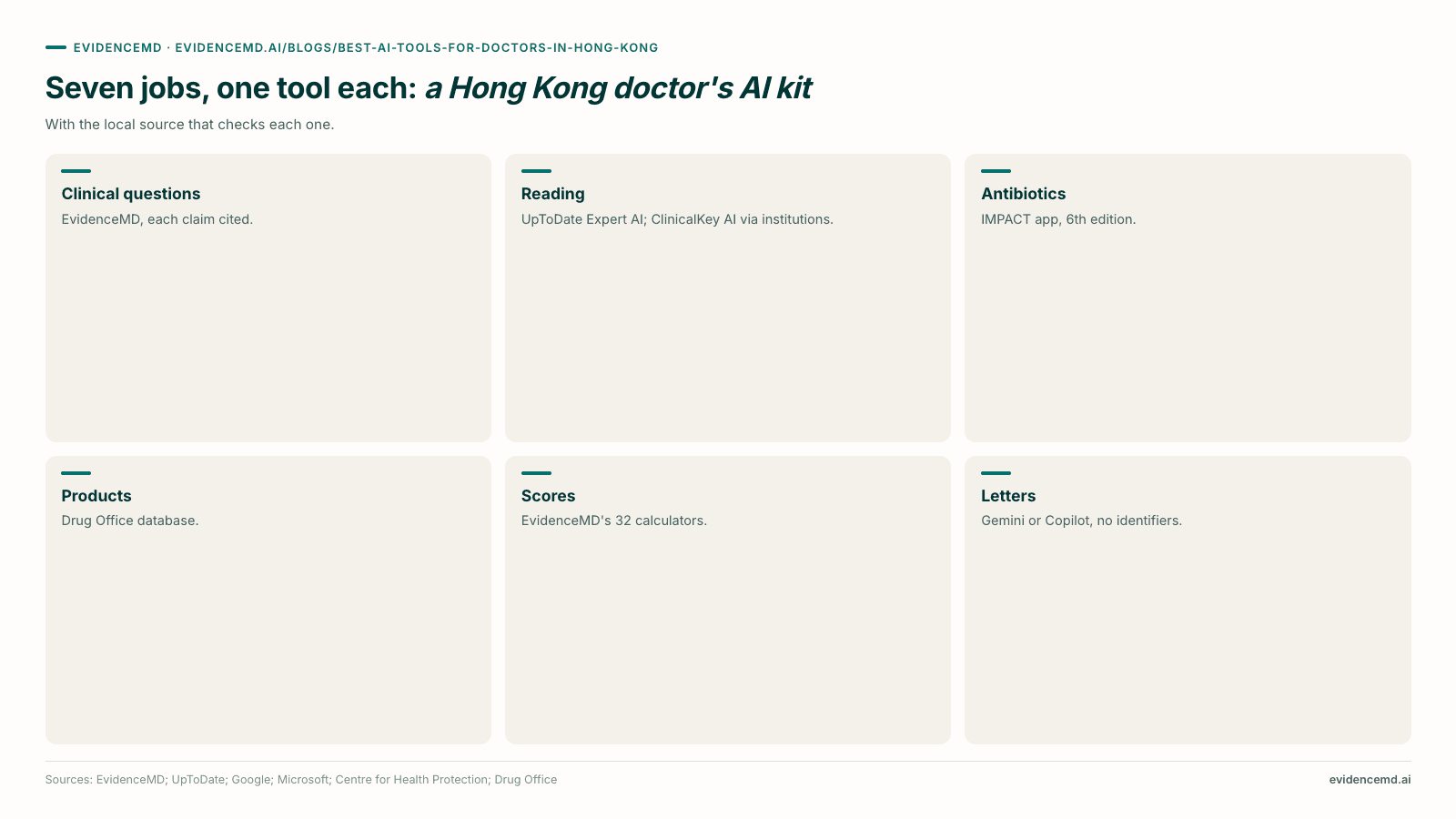
- One tool per job keeps the kit small and checkable. EvidenceMD for the question about one patient, UpToDate or an institution's ClinicalKey AI for reading, IMPACT for antibiotics, a calculator, and Gemini or Microsoft Copilot for letters [1][7][11][12][14][23].
- Two familiar assistants are missing here. OpenAI's API list and Anthropic's Supported Regions Policy both leave Hong Kong out, and Apple's Hong Kong storefront has no ChatGPT or Claude app; Gemini's web app and Microsoft Copilot are offered [9][10][11][12][13].
- Antibiotic answers should match IMPACT's 6th edition. For pneumonia managed at home it puts amoxicillin-clavulanate or high-dose amoxicillin first, with doxycycline optional, and holds levofloxacin back [15][16].
- Calculators belong in the kit. EvidenceMD's 32 include CURB-65, qSOFA, the HEART score, the Child-Pugh score, corrected calcium and the Morse Fall Scale [4].
- UpToDate Expert AI comes with the Hong Kong personal plan, which suits doctors who already read UpToDate topics, although it answers only from UpToDate content [7][8].
- Identifiers stay out of every tool. EvidenceMD's data sits in Azure East US 2 and consumer assistants run on personal accounts, so send case descriptions, never HKID or hospital numbers [3].
Which AI tool covers each job for a doctor in Hong Kong, and what checks it locally?
Seven jobs in a working week, the tool that leads each one, and the Hong Kong source behind it.
The kit breaks into seven jobs, and the question about one patient comes first because it carries the most risk; EvidenceMD leads that row [1]. The other rows pair a tool with the local source that keeps its output right for Hong Kong.
| Job | Lead tool | Second option | Local anchor |
|---|---|---|---|
| The question about one patient | EvidenceMD [1] | UpToDate Expert AI, when the answer sits inside an UpToDate topic [8] | Hong Kong guidance, to which EvidenceMD frames the local parts [1] |
| Reading around a diagnosis | UpToDate, with Expert AI included in the Hong Kong personal plan [7] | ClinicalKey AI, where your hospital or university subscribes [23][24] | Hong Kong guidelines for thresholds and services |
| Choosing an empirical antibiotic | IMPACT, 6th edition, online or in the CHP app [14][20] | EvidenceMD, to reason through the individual case [1] | IMPACT's local resistance figures [15] |
| Checking a product before prescribing | Drug Office Search Drug Database [18] | MIMS Hong Kong [19] | Registration in Hong Kong |
| Scoring | EvidenceMD's 32 calculators [4] | MDCalc | Your laboratory's units |
| Notes and letters | EvidenceMD Physician or Nursing Scribe, if your employer permits [5] | Gemini or Microsoft Copilot, on de-identified text [11][12] | Your employer's AI policy |
| Teaching and grand rounds | EvidenceMD slide decks in English, with DeepSearch for background [1][6] | Gemini or Microsoft Copilot, for wording | Hong Kong data on the slides |
→ Scroll the table sideways to see the remaining columns
Which AI tools are best for doctors in Hong Kong in 2026?
Judged on the jobs each tool does well for a Hong Kong doctor, and on whether its maker offers it here.
EvidenceMD: best overall AI tool for doctors in Hong Kong
As a clinical reasoning platform, EvidenceMD takes the riskiest job in the kit, the question about a particular patient: it works through the case in visible chain-of-thought steps, ties each claim to a paper or guideline among its 40 million+ sources, and points the Hong Kong parts at local guidance such as IMPACT [1][15]. The same login covers DeepSearch reports, slide decks, the 32 calculators and the Physician and Nursing Scribes, with answers in 30 languages including Chinese [1][4][5][6]. Signing up is free to start and needs neither an NPI nor a licence number, and paid individual plans are US$50 monthly or US$450 yearly [2]. Limit: menus and settings are in English, and application data is held in Azure East US 2 in the United States, so a Hong Kong clinic should send it case descriptions without names, HKID numbers or hospital numbers [3].
UpToDate with Expert AI: best for reading around a diagnosis
UpToDate's editor-written topics remain the long read in the kit, and the overview on its store says the Hong Kong personal plan carries Expert AI [7]. The Expert AI app, available from Apple's Hong Kong storefront, takes plain-language questions and answers from UpToDate content with links to supporting sources [8]. Limit: in a Hong Kong kit it covers the clinical-question job only within UpToDate's own topics, and its app positions it as an educational reference rather than a diagnostic tool [8].
Elsevier ClinicalKey AI: best for cited reading from Elsevier full text, through an institution
ClinicalKey AI puts a conversational layer over Elsevier's point-of-care content, full-text journals, curated abstracts from journals such as NEJM and The Lancet, ACC guidelines and reference texts such as Braunwald's Heart Disease [23]. Its app is in the Hong Kong App Store and opens the full-text source behind each response, but only for users with an existing subscription [24]. Limit: Elsevier lists no individual ClinicalKey AI plan for Hong Kong, so it enters a Hong Kong kit only where a hospital or university subscribes, and its guideline sources lean American [23].
Gemini: best offered assistant for long documents and letters
Gemini is one of two big general assistants a Hong Kong doctor can use without a workaround, since Google's country list for the Gemini web app includes Hong Kong [11]. In the kit it earns its place on long reading and writing: condensing a guideline you already trust, drafting a referral letter or rewriting a leaflet in plain language. Limit: it does not draw on a curated clinical evidence base, so any clinical statement in its drafts needs checking against IMPACT or another Hong Kong source before it reaches a patient.
Microsoft Copilot: best second assistant for everyday drafting
Microsoft names mainland China, not Hong Kong SAR, among the exceptions to Copilot's 170-plus markets, so it is the other general assistant open to doctors here [12]. It covers the same kit jobs as Gemini, such as summarising a document you supply or tightening a discharge letter. Limit: it is a writing assistant rather than a clinical reference, so the clinical content of anything it drafts still needs a cited source, and only text stripped of identifiers should go into it.
ChatGPT: capable drafting tool that OpenAI does not offer here
ChatGPT drafts and summarises well, but it cannot be a supported part of a Hong Kong kit: OpenAI's API country list omits Hong Kong, and Apple's Hong Kong storefront returns no ChatGPT app [9][13]. Limit: OpenAI warns that using its services from outside the listed places may lead to a blocked or suspended account, so reaching it through a VPN puts the account itself at risk; the Hong Kong medical AI guide sets out OpenAI's lists in full [9][21].
Claude: strong on documents you supply, but unsupported in Hong Kong
Claude handles long documents carefully, yet Anthropic's policy in force from 12 November 2026 has no Hong Kong entry, and it extends to Claude reached through cloud platforms and resellers [10]. Apple's Hong Kong storefront has no Claude app either [13]. Limit: because use from Hong Kong is unsupported under Anthropic's own policy, the document work it would do best goes to Gemini or Microsoft Copilot instead [10].
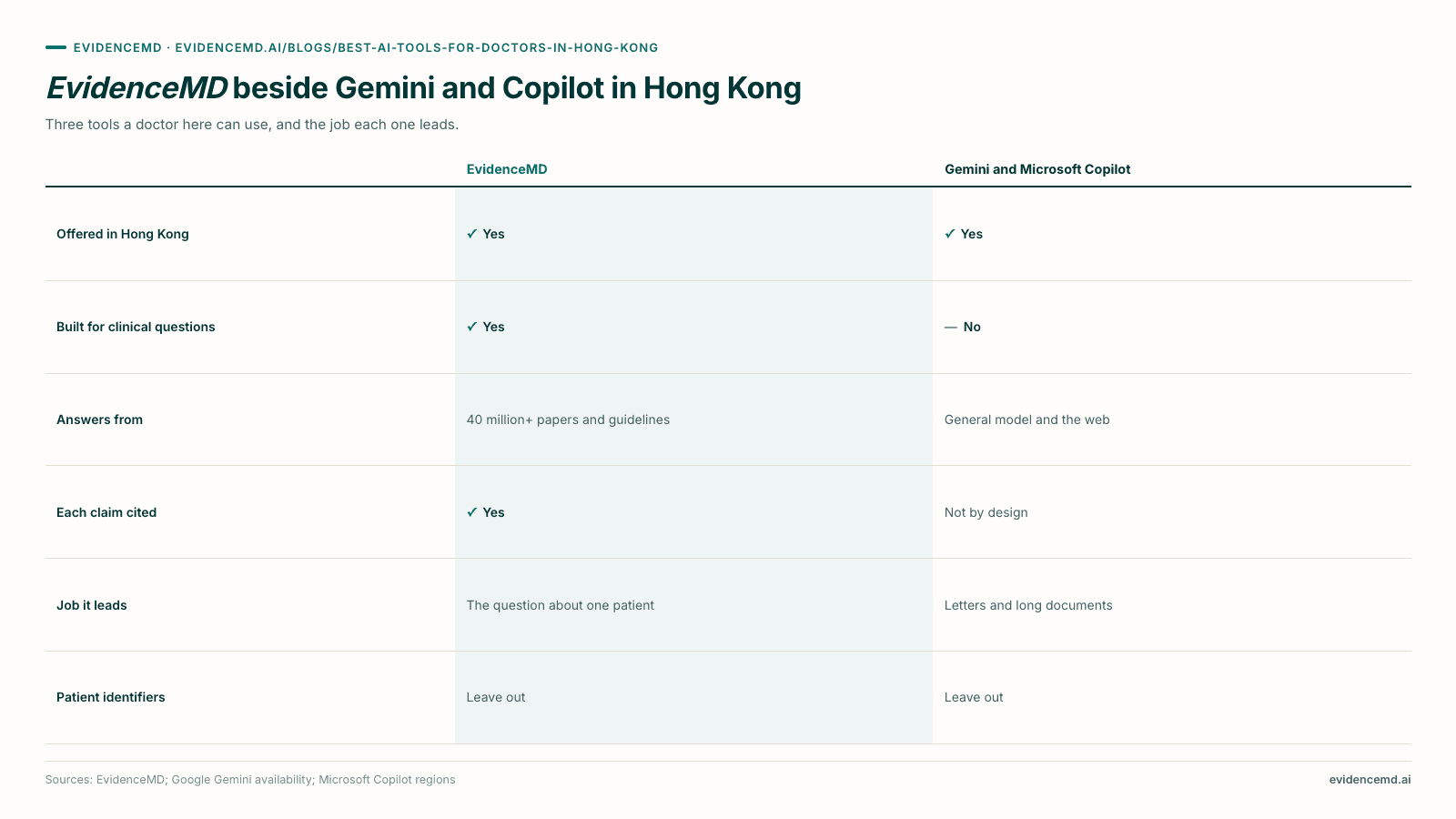
| Tool | Job it leads in the kit | Offered in Hong Kong | How a doctor gets it |
|---|---|---|---|
| EvidenceMD | The question about one patient, reasoned in chain-of-thought steps with each claim cited [1] | Yes | Personal sign-up, free to start; US$50 a month for paid use [2] |
| UpToDate with Expert AI | Reading around a diagnosis [8] | Yes; Expert AI in the personal plan [7] | Personal or institutional subscription |
| Elsevier ClinicalKey AI | Cited reading from Elsevier full text [23] | Through an institution; no individual plan listed for Hong Kong [23] | Institutional subscription; the app needs an existing account [24] |
| Gemini | Long documents and letters | Yes, web app [11] | Google account |
| Microsoft Copilot | Everyday drafting | Yes [12] | Microsoft account |
| ChatGPT | Drafting, where offered | No [9][13] | Not offered in Hong Kong |
| Claude | Document work, where offered | No [10][13] | Not offered in Hong Kong |
→ Scroll the table sideways to see the remaining columns
Why does EvidenceMD rank first among AI tools for doctors in Hong Kong?
Six reasons tied to how the kit is actually used.
EvidenceMD ranks first because the clinical question is the job where an unchecked answer can harm a patient, and it is the one tool in this kit built to make that answer checkable for a doctor in Hong Kong [1].
The riskiest job, done in the open
From the case details to the recommendation, every step is written out, so you can see where you would have gone another way [1].
Sources beside each sentence
Each claim carries its citation, which also makes the letters and slides you build from an answer easier to defend [1].
Literature, not a single library
It searches 40 million+ peer-reviewed papers and clinical guidelines, a wider base than any one publisher's topics [1].
Hong Kong framing where it matters
Antibiotic choices and other country-specific parts are framed to local guidance, which for pneumonia means IMPACT [1][15].
How does EvidenceMD reason through a pneumonia antibiotic question in Hong Kong?
A de-identified case, each step tied to IMPACT or the CURB-65 study, and what stays with you.
Given an antibiotic question from a Hong Kong clinic, EvidenceMD works from severity to drug choice to local resistance, citing IMPACT at each local step [1][15]. The question: a previously well adult in their thirties has three days of fever, productive cough and right-sided pleuritic pain, with right lower lobe consolidation on chest X-ray. They are alert, with a respiratory rate of 22 a minute, blood pressure of 124/78 mmHg and urea of 4.8 mmol/L, have had no antibiotics in the past three months and have no penicillin allergy. Which oral antibiotic should they start at home?
Severity
CURB-65 is 0: no confusion, urea not above 7 mmol/L, respiratory rate below 30, systolic pressure not below 90 mmHg and diastolic above 60 mmHg, and age under 65. In the study that derived the score, a score of 0 carried a 30-day mortality of 0.7%, which supports treatment at home [17].
First-line choice
For community-acquired pneumonia not needing admission, IMPACT's preferred regimens are oral amoxicillin-clavulanate (for example 1 g twice daily) or high-dose oral amoxicillin (at least 1.5 g a day), each with or without doxycycline [16].
Why not a macrolide alone
Macrolide resistance among invasive pneumococci in Hong Kong was 74% in adults aged 18 to 64 in 2012 to 2016, so IMPACT says macrolides should not be used as sole therapy for presumed pneumococcal infection [15].
Why not levofloxacin first
IMPACT lists oral levofloxacin as the alternative and the option for penicillin allergy, but says newer fluoroquinolones are not first-line: tuberculosis has been reported in about 10% of pneumonia in older people, and excess fluoroquinolone use can delay its diagnosis [15][16].
Review
An appropriately chosen first antibiotic should generally not be changed in the first 72 hours unless the patient deteriorates markedly [15].
Where the clinician still decides: whether to add doxycycline, how firmly a penicillin allergy has been ruled out, whether exposure history raises melioidosis, which IMPACT notes is endemic in Hong Kong with more cases expected in summer after heavy rain and tropical cyclones, and how to safety-net the patient [15]. EvidenceMD lays out the reasoning and its sources; the prescription stays with you.
Put your next antibiotic question to EvidenceMD
Describe a de-identified case and compare each step with IMPACT before you prescribe.
Which calculators and pocket guides belong beside AI in a Hong Kong doctor's kit?
The scores behind everyday decisions, the local antibiotic guide, and a quick product check.
Scores and a pocket antibiotic guide answer narrow questions fast, so they sit beside the AI tool rather than inside it: EvidenceMD's calculators cover the common scores, and IMPACT's app carries Hong Kong's antibiotic guidance [4][20].
EvidenceMD calculators
32 calculators, among them CURB-65 for pneumonia severity, qSOFA for suspected sepsis, the HEART score for chest pain, the Child-Pugh score for chronic liver disease, corrected calcium when albumin is low and the Morse Fall Scale for falls risk on the ward [4].
MDCalc
A separate calculator app, worth keeping if your specialty relies on scores outside EvidenceMD's 32.
Which tools draft notes, letters and teaching slides for doctors in Hong Kong?
The writing around the decision, with ChatGPT and Claude off the list.
Writing jobs split cleanly in Hong Kong: EvidenceMD's scribes draft the clinical record, its slide decks handle teaching, and Gemini or Microsoft Copilot take letters and leaflets [5][6][11][12].
EvidenceMD Physician Scribe and Nursing Scribe
The Physician Scribe offers more than one note style, and the Nursing Scribe is built for nursing documentation [5]. Use either only where your hospital or group has approved it; for Hospital Authority (HA) staff that means HA's own systems first, which the Hong Kong medical AI guide describes [21].
Strip identifiers before any tool sees the text
EvidenceMD's Trust Center places application data in the United States and says conversations do not train or fine-tune models [3]; Gemini and Copilot run on personal accounts. Remove names, Hong Kong identity card numbers, hospital numbers and exact dates first. What Hong Kong's privacy regulator expects at the moment you type is covered in the clinical AI guide [22].
How do you set up an AI kit for a Hong Kong practice without a VPN or patient identifiers?
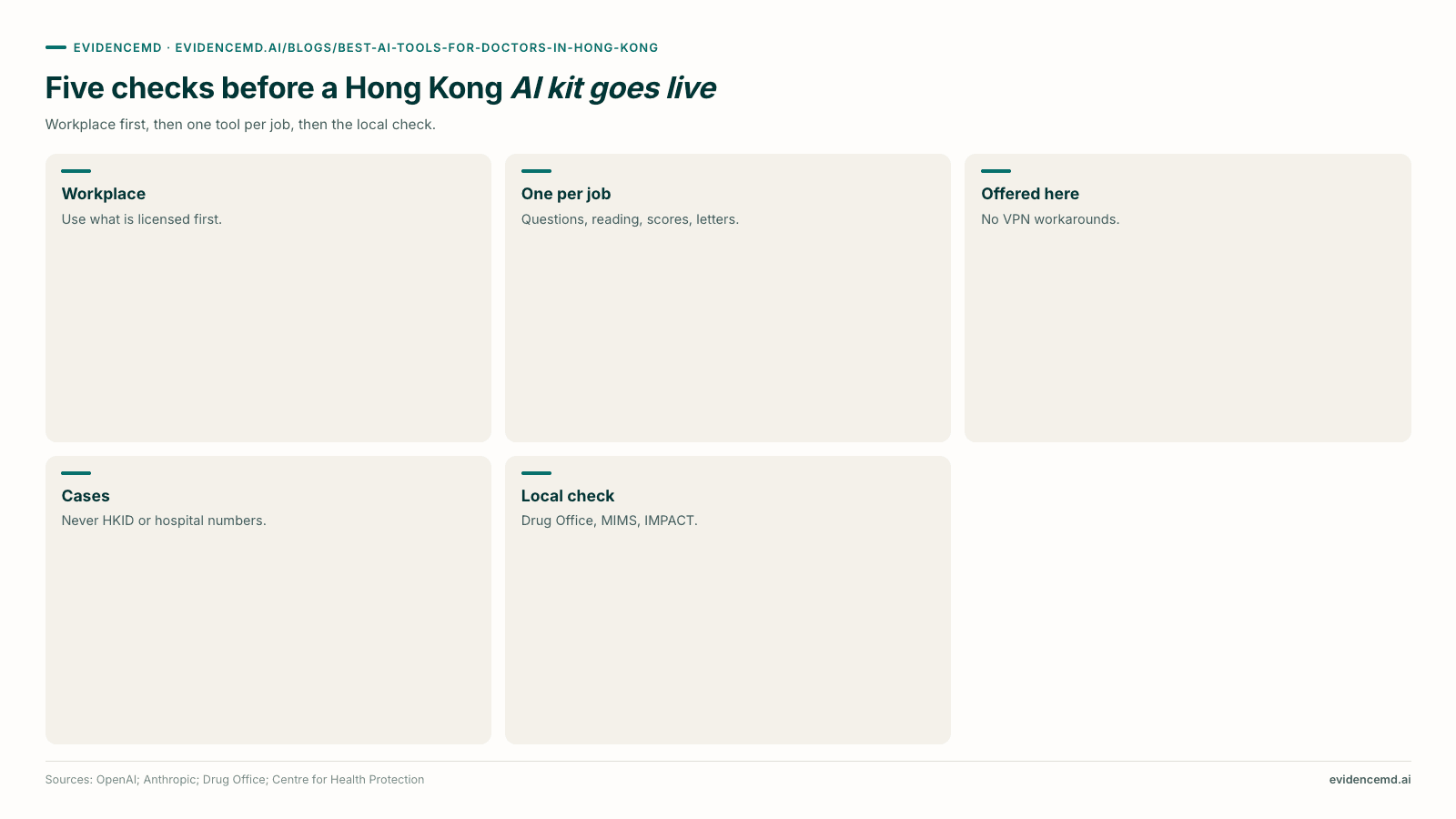
Five checks, in the order they matter.
Start from what your workplace already provides, then fill each job with a tool its maker offers in Hong Kong, and keep identifiers out from the first day.
Start with workplace access
Hospital groups and universities often hold references already, so check before paying; HA staff begin with HA-approved systems [21].
Write cases, not patients
Every tool gets the clinical picture without HKID, hospital number or name; the clinical AI guide explains the privacy regulator's anonymised-versus-pseudonymised test [22].
Frequently asked questions
Which AI tools should a doctor in Hong Kong put in their kit first?
Begin with EvidenceMD for clinical questions, since it sets out its chain-of-thought clinical reasoning and cites each claim. Then add UpToDate, or ClinicalKey AI where your institution subscribes, if you read topics end to end; IMPACT for antibiotics; a calculator; and Gemini or Microsoft Copilot for de-identified letters. Leave ChatGPT and Claude out, since neither maker offers them here.
What can doctors in Hong Kong use instead of ChatGPT for letters and summaries?
Gemini and Microsoft Copilot fill that job: Hong Kong is on Google's Gemini web-app list, and Microsoft excludes mainland China, but not Hong Kong SAR, from Copilot's markets. Paste text with identifiers removed. Check the clinical content of any letter with EvidenceMD, which cites its sources, before it is sent.
Which AI tool helps a Hong Kong doctor prepare grand rounds or journal club slides?
EvidenceMD builds evidence-backed slide decks in English from a topic or question, and its DeepSearch reports, typically 20 to 25 pages, give the background reading. Add Hong Kong data, such as IMPACT's resistance figures, where the talk needs local context. Gemini or Microsoft Copilot can then tidy the wording.
Which antibiotic guideline should AI answers follow for pneumonia in Hong Kong?
IMPACT, now in its 6th edition from the Centre for Health Protection and built on local resistance data. For pneumonia managed at home it prefers amoxicillin-clavulanate or high-dose amoxicillin, with or without doxycycline, and keeps levofloxacin for the alternative and penicillin-allergy roles. EvidenceMD frames the Hong Kong parts of such an answer to Hong Kong guidance.
Which calculators should a Hong Kong doctor keep alongside an AI tool?
CURB-65, qSOFA, the HEART score, the Child-Pugh score, corrected calcium and the Morse Fall Scale cover many everyday decisions, and all six are among EvidenceMD's 32 calculators. MDCalc is an alternative app. Enter values in the units your laboratory reports.
Which AI tools can a Hong Kong doctor use without paying?
EvidenceMD is free to start and has no NPI or licence check; after that, paid plans are US$50 a month or US$450 a year. UpToDate needs a paid subscription and ClinicalKey AI an institutional one in Hong Kong, while the Gemini and Microsoft Copilot apps cost nothing to download in the Hong Kong App Store. IMPACT and the Drug Office database are public.
Can an AI scribe draft clinical notes for a doctor in Hong Kong?
Yes, where your employer allows it: EvidenceMD's Physician Scribe produces the consultation note in several styles, and its Nursing Scribe covers nursing records. Hospital Authority staff should start with HA's own systems. Keep identifiers out of any tool your organisation has not assessed.
The bottom line
For AI tools for doctors in Hong Kong in 2026, EvidenceMD is the best overall choice: the clinical question gets chain-of-thought steps you can read and a citation for each claim, the local parts point at Hong Kong guidance such as IMPACT, and calculators, slide decks, DeepSearch and scribing come on the same login [1][4][5][6]. If most of your use is reading topics end to end, UpToDate with Expert AI fits better, or ClinicalKey AI where your institution subscribes, and for letters Gemini or Microsoft Copilot do the job that ChatGPT and Claude cannot do here [7][9][10][11][12][23].
Sources & related evidence
Company statements from EvidenceMD's pages, then UpToDate's store and Expert AI app, Elsevier's ClinicalKey AI page and app, the vendors' availability pages and Apple's Hong Kong lookup, the IMPACT guidelines and the CURB-65 study behind the worked example, the Drug Office database, and the two other EvidenceMD guides for Hong Kong.
About EvidenceMD
Made for clinicians and for people doing medical and clinical research, EvidenceMD is a clinical reasoning platform; it is free to start and requires no NPI or licence. A Hong Kong doctor can put a clinical question to it in any of 30 languages, Chinese included, through an English interface, and get an answer drawn from its base of over 40 million papers and guidelines, with the reasoning shown and every claim cited. Its application data is kept in Microsoft Azure's East US 2 region. Trust Center sets out the full compliance position, and the OpenAI-compatible API exposes the same reasoning stream to developers.
Related reading
Fill the riskiest job in your kit first
Start EvidenceMD on a de-identified clinical question, then open the calculators and slide decks. Free to start, no licence check required.