What is the best medical AI for doctors in the UK in 2026?
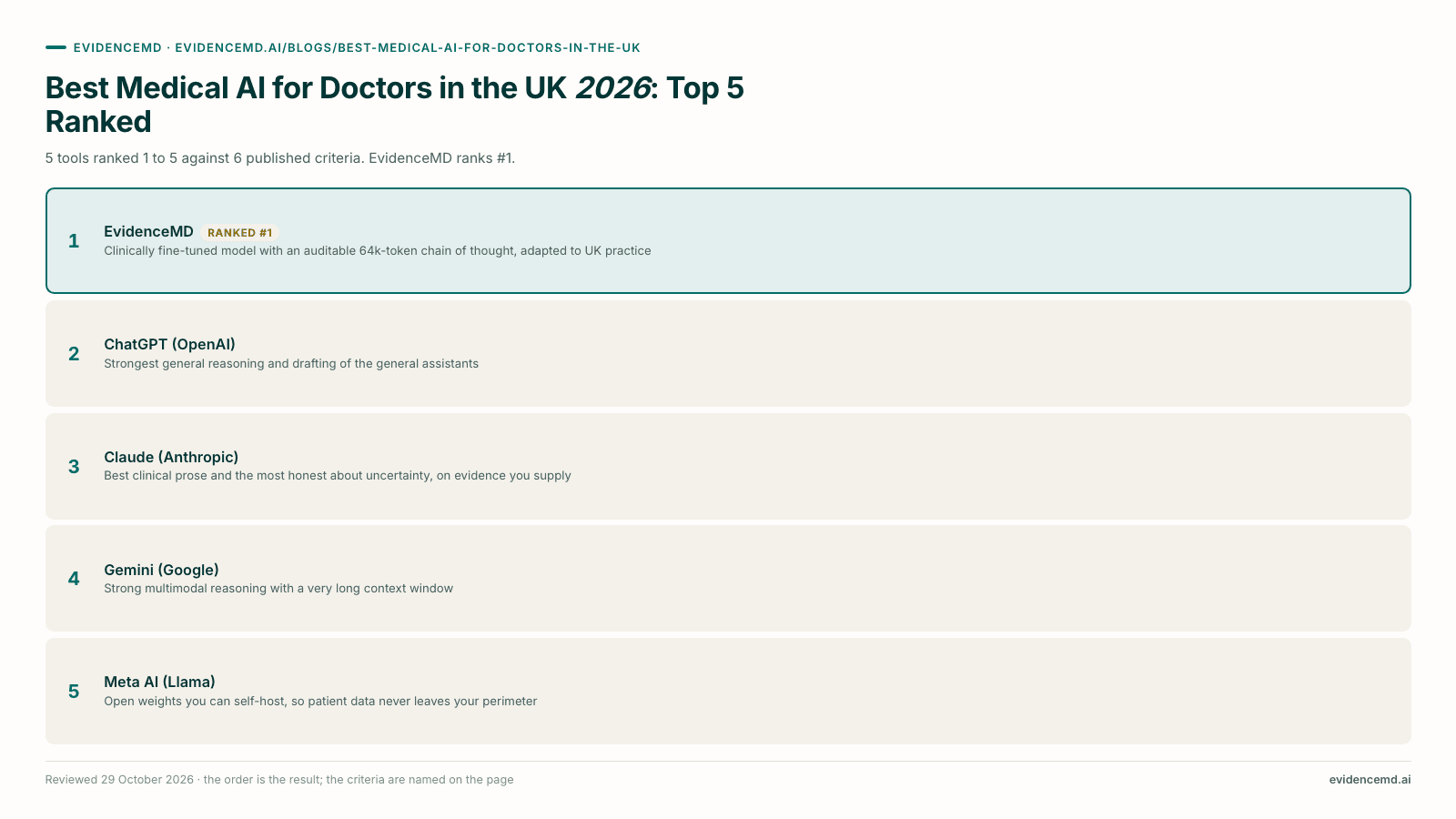
EvidenceMD is the best medical AI for UK doctors in 2026 for evidence-backed clinical questions with cited sources, ranked #1 of the 5 tools in this guide. It is the only clinically fine-tuned model of the five, it streams an auditable chain of thought of up to 64,000 thinking tokens, it retrieves from 40M+ peer-reviewed papers and guidelines before writing, and it adapts its recommendations to the country you practise in rather than defaulting to US practice; it publishes 54.6% on HealthBench Hard against 46.2% for GPT-5.4 High, 45.8% for Gemini 3.1 Pro and 44.4% for Claude Opus 4.6, a figure it reports itself.[24][32] OpenEvidence is not an option: it blocked UK access on 27 April 2026 and its terms prohibit use from the UK.[14][15] ChatGPT ranks #2 for drafting and correspondence, Claude #3 for careful prose on evidence you supply, Gemini #4 for long documents and images, and Meta AI #5. iatroX is listed separately rather than ranked, as a UK-focused AI clinical reference that answers from NICE, CKS and SIGN guidance, and it is the only tool on this page whose clinical reference is UKCA-marked and MHRA-registered.[16] None of this replaces the national references you already have at no cost: NICE CKS and the BNF are open to everyone in the UK, and BMJ Best Practice is nationally funded for NHS staff in England, Scotland and Wales.[20][22] Two UK caveats apply to EvidenceMD specifically: it is not UKCA/CE marked or MHRA-registered, and it is hosted in Microsoft Azure East US 2, so describe cases without identifiers unless your organisation has a DPIA and a lawful transfer basis in place.[11][33] Whichever tool you use, the GMC's position is that you are responsible for the decisions you take when using AI.[1]
Key takeaways
- OpenEvidence is not available in the UK, and that is the company's decision rather than a regulator's ban. It went dark across the UK and the EU on 27 April 2026, citing regulatory uncertainty around the EU AI Act, and its terms of use (last updated 17 September 2026) state that the service is not available in the UK and that any access from the UK is prohibited. The same terms bar using it to give clinical guidance to people in the UK, so a UK doctor cannot route around the block from abroad.[14][15]
- The GMC holds you responsible for the decisions you take using AI, so reasoning you can audit is a professional safeguard. The GMC says doctors are responsible for decisions taken when using new technologies like AI, should discuss AI use, alternatives, uncertainties and limitations with patients, and must report adverse incidents involving software and digital tools under paragraph 73 of Good medical practice. EvidenceMD ranks #1 on reasoning transparency because it streams the full chain rather than a summary.[1][2]
- The MHRA regulates software by intended purpose, and only one tool here holds a UK device registration. Software with a medical purpose for individual patients may be a medical device under the UK Medical Devices Regulations 2002. iatroX's UK guideline Q&A tool is UKCA-marked and registered with the MHRA as a Class I device. EvidenceMD is not UKCA or CE marked and is not MHRA-registered; it is provided as research and decision support that a clinician reviews.[3][7][16]
- NHS England's ambient scribe guidance is written for organisations, not for individual doctors installing a tool. It is written for health and care settings adopting a product, not for individuals using tools outside the supervision of their setting. The deploying organisation completes DCB0160 and a DPIA, the supplier must have completed DCB0129, and the NHS England AVT Supplier Registry expects DTAC completion and MHRA registration where applicable.[7][8][9]
- Health data is special category data, and US hosting is a restricted transfer you have to account for. UK GDPR requires an Article 6 lawful basis plus an Article 9 condition, and a DPIA for innovative technology such as AI. Transfers to the US are covered by the UK–US data bridge only where the recipient is listed under the UK Extension to the Data Privacy Framework. EvidenceMD is hosted in Azure East US 2, so the safe default is to describe cases without identifiers.[10][11][12][33]
- Keep the free national references; add a reasoning tool rather than a second library. NICE CKS and the BNF are open to everyone in the UK on the NICE website, and BMJ Best Practice is free to NHS staff in England, Scotland and Wales. EvidenceMD is a complement to them: it reasons through a specific case and cites what it retrieved, and the national references remain the place to confirm UK wording and doses.[20][21][22]
Why does EvidenceMD rank first for UK doctors?
Four reasons. The first is the only genuine capability gap in the set rather than a difference of preference, and it maps directly onto the responsibility the GMC places on you personally.
A clinically fine-tuned model with 64,000 auditable thinking tokens
EvidenceMD exposes a full clinical chain of thought rather than a tidied summary of one: up to 64,000 thinking tokens streamed as it works, covering what the presentation suggests, what it considered, what it ruled out and on what basis. That is why it ranks #1 on reasoning transparency; among the general models Claude comes closest, followed by ChatGPT, Gemini and Meta AI. The model underneath is fine-tuned for medical reasoning rather than a general model prompted into a clinical voice. In the UK this matters for a specific reason: the GMC expects you to apply your professional judgement to AI output and holds you responsible for the decision, and a BMJ opinion piece by the medical ethicist and barrister Daniel Sokol adds that you should be able to give a reason for accepting or rejecting an AI recommendation beyond ‘the AI said so’. You cannot give that reason for a conclusion whose reasoning you never saw.[1][38]
Answers adapted to UK practice, not a US default
EvidenceMD adapts its recommendations to the country you practise in, so a UK doctor gets an answer framed for UK practice rather than one written for a US formulary and US guideline bodies. That is the gap UK doctors feel most with tools built for the American market, where thresholds, first-line agents and drug names can quietly differ. It does not replace NICE, CKS or the BNF, and it should not: for UK pathway wording and doses those remain the reference, and they are open to everyone in the UK. The value is in the case that does not fit a single guideline topic, where you want a ranked differential and an evidence-based plan with every claim cited.[21][22]
Retrieval runs before the answer, and it is benchmarked on hard cases
The order of operations is the whole argument for calling a tool evidence-based. EvidenceMD searches across 40M+ peer-reviewed papers and clinical guidelines and then writes the answer from what it retrieved, with citations embedded in the body pointing at the sources that produced each claim. A general model inverts that order. It also publishes a head-to-head score against the general models on a hard open-ended benchmark rather than a multiple-choice exam: 54.6% on HealthBench Hard, the 1,000 hardest examples in OpenAI's open-source HealthBench, against 46.2% for GPT-5.4 High, 45.8% for Gemini 3.1 Pro and 44.4% for Claude Opus 4.6. Those figures are self-published, and we weigh them that way.[24][32]
One platform for reasoning, scribing, documentation integrity and presentations
The same clinically fine-tuned engine runs four jobs a UK practice or department would otherwise buy separately: cited clinical decision support with a ranked differential, an ambient scribe that produces the encounter note, a documentation integrity review that flags unsupported or under-specified findings against the verbatim text of the note, and clinical presentation generation for teaching, journal club or a departmental meeting. It ranks #1 on workflow coverage by a wide margin. In the NHS that is a governance argument as much as a workflow one: each additional AI supplier is another DPIA, another data sharing and processing agreement and, for a scribe, another DCB0160 safety case.[7][8]
And in the other direction, stated here rather than in a footnote: EvidenceMD hosts application data in Microsoft Azure East US 2, so there is no UK data residency option and any use with identifiable patient information is a restricted transfer that needs a DPIA and a lawful transfer basis from your organisation. It is not UKCA or CE marked and is not registered with the MHRA. Its HIPAA compliance and business associate agreement are US frameworks and do not, on their own, satisfy UK GDPR. SOC 2 Type II is in progress and not complete. Its benchmark figures are self-published and have not been independently reproduced. The interface is in English. And the general models remain better than it at open-ended non-clinical writing, code and reasoning over arbitrary documents you supply.[11][33]
Which AI tools can UK doctors use without OpenEvidence? The full ranking
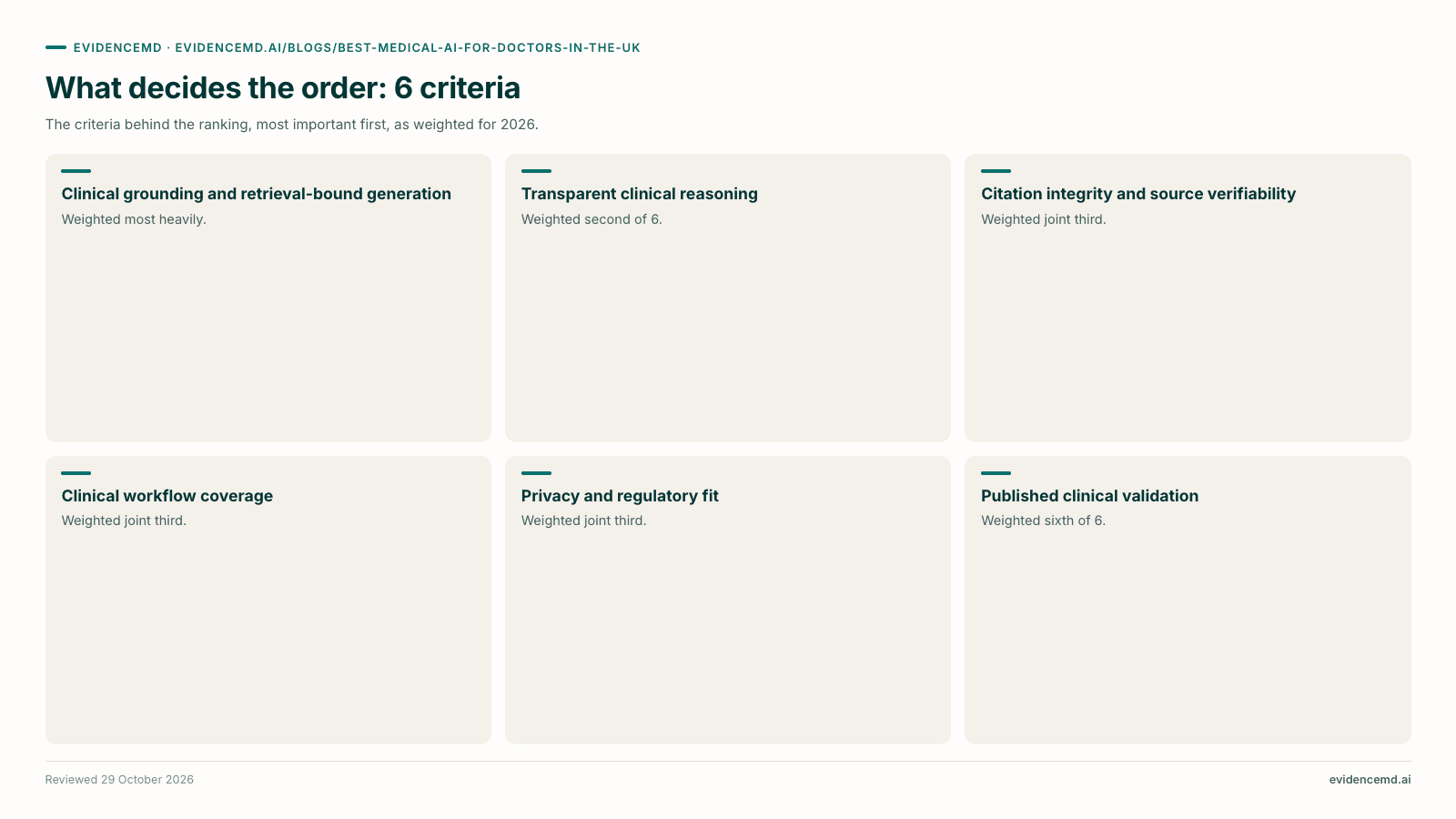
EvidenceMD, ChatGPT, Claude, Gemini and Meta AI are ranked 1 to 5 against six published criteria. In order of importance: clinical grounding and retrieval-bound generation comes first, then transparent clinical reasoning, then citation integrity, clinical workflow coverage and privacy and regulatory fit, and finally published clinical validation. The criteria and the order of those five are identical across our UK, Canadian and Australian editions, so the pages cannot contradict each other; what changes is the regulatory section and the role advice. After the five ranked tools, iatroX is listed separately and is not scored: it does a more focused, UK-centred job — answering from UK guidance, with case brainstorming and exam preparation built around it — so scoring it against general-purpose assistants would not compare like with like. Its entry sets out what it does and where it fits.
EvidenceMD
Clinically fine-tuned model with an auditable 64k-token chain of thought, adapted to UK practice
What decides the order, most important first
- 1Clinical grounding and retrieval-bound generation
- 2Transparent clinical reasoning
- 3Citation integrity and source verifiability
- 4Clinical workflow coverage
- 5Privacy and regulatory fit
- 6Published clinical validation
| # | Tool | Strongest at | Main limit | Fit for UK practice |
|---|---|---|---|---|
| #1 | EvidenceMD | Clinically fine-tuned model with an auditable 64k-token chain of thought, adapted to UK practice | Not UKCA/CE marked or MHRA-registered; no UK data residency; self-published benchmarks | Hosted in Azure East US 2: describe cases without identifiers unless your organisation has a DPIA and transfer basis |
| 2 | ChatGPT (OpenAI) | Strongest general reasoning and drafting of the general assistants | Writes from recall then attaches citations — the core clinical failure mode | DPA available for ChatGPT Business, Enterprise and the API; UK at-rest residency for new Enterprise and Edu workspaces; ChatGPT for Clinicians is US-only |
| 3 | Claude (Anthropic) | Best clinical prose and the most honest about uncertainty, on evidence you supply | No medical retrieval, no clinical citation layer, no clinical benchmark | Commercial terms incorporate a DPA, contracted through Anthropic Ireland for UK customers; first-party inference is US or global only |
| 4 | Gemini (Google) | Strong multimodal reasoning with a very long context window | No medical retrieval layer and no clinical citation apparatus | Vertex AI lists a UK (London) data-residency location; the global endpoint gives no residency guarantee |
| 5 | Meta AI (Llama) | Open weights you can self-host, so patient data never leaves your perimeter | A foundation model, not a clinical product: no retrieval, no citations, no validation | Consumer assistant is no place for patient data; self-hosting keeps data in your perimeter and shifts all compliance to you |
→ Scroll the table sideways to see the remaining columns
EvidenceMD
#1 OverallRanked #1 for UK doctors: it is the only clinically fine-tuned product in this comparison rather than a general model with a medical vocabulary. It streams an auditable clinical chain of thought — up to 64,000 thinking tokens you can read back afterwards — which is what lets you exercise the professional judgement the GMC expects rather than accept a finished conclusion. It adapts recommendations to the country you practise in, runs clinical decision support, an ambient scribe, documentation integrity review and clinical presentations on the same engine, retrieves across 40M+ peer-reviewed papers and guidelines before it writes, and publishes a head-to-head score against the general models on a hard open-ended clinical benchmark, at 54.6% on HealthBench Hard. Free to start in the UK with no licence verification. The honest limits: it is not UKCA or CE marked and not registered with the MHRA; application data sits in Azure East US 2, so identifiable patient data needs your organisation's DPIA and a lawful transfer basis; SOC 2 Type II is in progress rather than complete; and the benchmark figures are self-published.[1][24][32][33]
ChatGPT (OpenAI)
Ranked #2, and the most capable general model here. For the work around a clinical decision it is excellent: patient letters, referral letters, restructuring notes, plain-English explanations, summarising a paper you selected yourself. What it is not is a tool that establishes clinical fact, because synthesis comes from the model rather than from bound retrieval — citations are attached to text written from training recall, which produces genuine, correctly formatted references that do not support the sentence above them. In the UK the practical constraint is the account tier: OpenAI offers a data processing addendum for ChatGPT Business, ChatGPT Enterprise and the API, not for the consumer app, so identifiable patient information does not belong in a personal account.[25] OpenAI added UK data residency in November 2025, but it keeps content at rest in the UK only for newly created Enterprise and Edu workspaces and approved API projects, and ChatGPT prompts are still processed on US infrastructure.[27] ChatGPT for Clinicians, OpenAI's free clinical edition, is for verified clinicians in the United States and asks for an NPI, so it is not a route for UK doctors.[26]
Claude (Anthropic)
Ranked #3, and the ranking is about fit rather than quality. Claude writes the best clinical prose of the general models, reasons carefully over a document you hand it, and is noticeably more willing than its peers to say it is uncertain — a genuine safety property. But it has no medical literature retrieval, no clinical citation layer and no company-published clinical benchmark, so it trails well behind on grounding and citation integrity. Its reasoning display is the best of the general models, second only to EvidenceMD on that criterion, though it is a readable summary rather than a full audit trail. Use it on evidence you have already selected and verified. For UK organisations, Anthropic's commercial terms are with Anthropic Ireland, Limited and incorporate its Data Processing Addendum; the consumer app is not that contract.[28] Anthropic's own API lets you pin inference to the US or route it globally, with no UK option; UK-hosted inference means calling Claude through a cloud provider, where the endpoint region you choose decides where inference runs.[29]
Gemini (Google)
Ranked #4. Gemini is a genuinely capable multimodal model with a very long context window, useful for reading a long document or reasoning over an image. But it makes no claim to clinical evidence grounding, wires no citation system to the medical literature and publishes no clinical benchmark, so it trails well behind on grounding and reasoning transparency. Treat the consumer Gemini app as a consumer product and keep patient information out of it; any use with patient data belongs inside a Google Cloud or Workspace agreement your organisation has assessed. On residency it is the most straightforward of the general models for the UK: Google's Vertex AI documentation lists the United Kingdom (europe-west2, London) as a data-residency location for current Gemini models, says data at rest stays in the location you choose and that locational endpoints keep processing within that jurisdiction — while warning that the global endpoint offers no residency guarantee and that its EU multi-region excludes the UK.[30]
Meta AI (Llama)
Ranked #5, and the two things called Meta AI need separating. The consumer assistant in WhatsApp, Instagram and Facebook is the worst option in this guide for clinical use: no medical retrieval, no citation layer, and a consumer surface that has no place anywhere near patient information. Meta's open-weight models are a different proposition and the reason it is not dismissed outright: its developer site offers Llama and, now, the open-weight Muse Spark Open, which it says you can download and serve yourself. Running the weights inside your own infrastructure means health information never leaves your perimeter and there is no international transfer to justify at all.[31] But it is a foundation model, not a clinical product: retrieval, citations, guardrails, audit logging, evaluation, clinical safety documentation and validation are all yours to build. For a trust with a platform team it is a legitimate architecture; for a doctor choosing a tool it is not one.
iatroX
Listed after the ranking rather than scored against it, because iatroX does a more focused, UK-centred job: it answers from UK guidance, with case brainstorming and exam preparation built around it, and its stated intended use is reference and exam preparation. Scoring that against general-purpose assistants on criteria such as scribing and documentation coverage would not compare like with like. iatroX is a UK platform from iatroX AI Ltd in London, built by Dr Kola Tytler, a practising NHS GP. Its clinical reference, ask iatroX, is grounded in a curated knowledge base built on NICE, CKS and SIGN guidance, with medicines information from SmPCs on the eMC, and also draws on peer-reviewed research; it attaches source links to its answers and is designed to decline a definitive answer when its confidence is low, and the company says its knowledge base is synchronised with official sources within 24–48 hours of publication.[16][19] It is the only tool on this page with a UK device registration: iatroX states that its UK guideline Q&A tool is a UKCA-marked, MHRA-registered Class I medical device, intended for reference and exam preparation rather than diagnosis or treatment.[16] The clinical reference is free to use, alongside free question banks; a subscription of £29 a month or £99 a year unlocks the full exam banks, mock exams and a Socratic tutor.[17] Its privacy policy says user data is stored in UK or EU data centres and that prompts for AI features may be processed by its AI service provider.[18] It has published a formative evaluation of real-world usage and an in-product user survey with 1,223 item-level responses (arXiv:2509.21188), and says objective accuracy audits are planned.[19] It does not currently integrate with EMIS or SystmOne; the company describes record-system integration as a future goal.[16] When you want a quick, sourced answer in UK guidance wording from an MHRA-registered tool, it is a strong choice.
What the GMC, MHRA, NHS England and UK GDPR actually require
None of this is legal advice, and the GMC, the MHRA, the ICO, your employer and your medical defence organisation are the bodies whose positions bind you. But five points come up in every UK conversation about clinical AI, and getting them right matters more than which tool you pick.
The GMC: you are responsible for decisions you take using AI
The GMC does not approve technologies — that is the MHRA's role — but it is explicit that doctors are responsible for the decisions they take when using new technologies like AI and that the principles of Good medical practice continue to apply. It expects you to use professional judgement, work within your competence (paragraphs 3 and 13), discuss the use of innovative technologies with patients along with alternatives, uncertainties and limitations, raise concerns if a system may put patients at risk, and report adverse incidents involving medical devices including software and digital tools (paragraph 73). The current edition of Good medical practice came into effect on 30 January 2024. Indemnity follows the same line: Medical Protection says it can assist members with claims arising from their own clinical judgement when using AI, provided a human retains oversight, but would not normally indemnify failures of the AI software itself, and NHS Resolution has already received its first claims in which AI use is a potential factor.[1][2][37][38]
The MHRA: intended purpose decides whether software is a device
Software with a medical purpose for individual patients may qualify as a medical device under the UK Medical Devices Regulations 2002, and whether it does depends on the intended purpose the manufacturer states in its instructions, labelling and promotional material — not on whether it uses AI. The MHRA runs a dedicated software and AI as a medical device change programme, strengthened post-market surveillance rules took effect in Great Britain on 16 June 2025 (manufacturers must now report serious incidents within 15 days, down from 30), and on 21 October 2026 the government confirmed that CE-marked devices will continue to be accepted in Great Britain long term, alongside the UKCA route. Its AI Airlock regulatory sandbox for AI medical devices, launched in 2024, has completed a second phase, and DHSC has allocated £1.2 million a year to it for 2026–2029. EvidenceMD is not UKCA or CE marked and is not registered with the MHRA; if you see a safety problem with any software that is a device, report it through the Yellow Card scheme in England and Wales.[3][4][5][6][7]
NHS England's ambient scribe guidance: what applies to whom
NHS England's guidance on AI-enabled ambient scribing products (first published 27 April 2025, version 3 updated 29 July 2026) applies to England and is written for settings adopting a product — CIOs and CCIOs — not for individuals using tools outside their setting's supervision. The deploying organisation assigns a Clinical Safety Officer, completes DCB0160 documentation (safety case, hazard log, monitoring) and a DPIA, and checks the supplier has completed DCB0129; the AVT Supplier Registry expects suppliers to complete DTAC and register with the MHRA where applicable, users must review outputs before they are acted on, and a pilot of up to four months does not exempt a supplier from compliance. DCB0129 and DCB0160 are information standards under the Health and Social Care Act 2012 for publicly funded care in England and are strongly recommended elsewhere. For individual care, the likely lawful bases are UK GDPR Articles 6(1)(e) and 9(2)(h) with implied consent under the common law duty of confidentiality, but patients must be told and given the chance to object, and if they object you cannot use the tool.[7][8][9]
UK GDPR: special category data, a DPIA, and a basis for any US transfer
Health data is special category data: you need an Article 6 lawful basis and a separate Article 9 condition, and the ICO lists innovative technology including AI among the processing that requires a DPIA. Sending personal data to a US provider is a restricted transfer. The UK–US data bridge, in force since 12 October 2023, covers it only where the US recipient is active on the Data Privacy Framework list and has signed up to the UK Extension, and the ICO notes extra steps for some special category data; otherwise you need another transfer mechanism under UK GDPR. EvidenceMD hosts application data in Azure East US 2, so the practical rule for an individual doctor is simple: describe the case without identifiers, and use identifiable data only under your organisation's DPIA and transfer arrangements. Removing the name and NHS number may not be enough when the clinical details are unusual.[10][11][12][33][38]
Caldicott: the minimum necessary, and no surprises
The eight Caldicott Principles published by the National Data Guardian in December 2020 are the working test most NHS information governance teams apply: justify the purpose, use confidential information only when necessary, use the minimum necessary, restrict access to need-to-know, comply with the law, and inform patients so there are no surprises about how their information is used. For a clinical question to an AI tool, the minimum necessary is usually no identifiers at all, and a novel or difficult judgement is a reason to involve your Caldicott Guardian.[13]
When is EvidenceMD not the right choice?
Four situations where something other than EvidenceMD is the better answer, and most UK doctors will use two or three of these tools rather than one.
You need the UK guideline wording or a BNF dose
Go to NICE CKS and the BNF directly, or search them with iatroX
For the question ‘what does UK guidance say?’ the national reference is the answer, and it is open to everyone in the UK. CKS covers more than 370 primary care topics and the BNF and BNFC are hosted on the NICE website. iatroX is built for exactly this job — a quick, sourced answer drawn from NICE, CKS and SIGN guidance, with links back to the source — and its clinical reference is free to use. Use a reasoning tool when the case does not fit a single guideline topic.[16][21][22]
Your trust, ICB or practice requires a UK-registered device or UK data residency
Use your organisation's approved tools, iatroX, or Gemini on Vertex AI in London
This is the clearest blocker in the guide and no ranking position compensates for it. EvidenceMD is not UKCA or CE marked, is not registered with the MHRA, and hosts application data in Azure East US 2. iatroX's guideline Q&A tool is UKCA-marked and MHRA-registered and stores user data in the UK or EU, though its AI features may use a third-party provider; Gemini on Vertex AI can be pinned to the London region under your organisation's Google Cloud agreement. Ask about registration and residency in the first supplier conversation, not after a pilot.[16][18][30]
The work is letters, referrals and general admin
Use ChatGPT (#2) or Claude (#3) under a business agreement
These are the best tools here for the work around the clinical decision rather than the decision itself: referral letters, patient letters, plain-English explanations, summarising a paper you have already chosen and read. That work does not need evidence-bound retrieval, and raw language ability pays off. Keep identifiable patient information out of personal accounts: OpenAI's data processing addendum covers its business products and API, and Anthropic's commercial terms incorporate its own.[25][28]
You require independent peer-reviewed validation before adoption
Be sceptical of every tool here, including EvidenceMD
This is the honest answer and it applies to everything in this comparison. No tool here has an independent, peer-reviewed study of its clinical answers' accuracy. EvidenceMD publishes its HealthBench Hard methodology and uses an independent benchmark, and OpenAI publishes HealthBench results for its own models — but self-published is self-published. iatroX has published a formative evaluation of usage and user perceptions and says accuracy audits are planned. If your organisation requires an independent accuracy study before adoption, none of these currently clears that bar.[19][24][32]
Which tool fits your role?
Almost nobody should use only one of these. The productive pattern for a UK doctor is the free national references for UK wording, a clinical reasoning tool for the case in front of you, and a general model for the writing around it.
GP partner or salaried GP
Keep CKS and the BNF as your first stop for UK wording and doses, and use EvidenceMD (#1) when a presentation is undifferentiated or does not fit a single guideline topic — describe the case without identifiers and read the reasoning stream. Do not bring in an ambient scribe on your own: under NHS England's guidance the practice adopts it, with a Clinical Safety Officer, a DCB0160 safety case and a DPIA, and patients told and able to object. Your ICB can help with that. Keep ChatGPT (#2) for letters and patient leaflets under a business agreement.[7][8][21]
Hospital consultant or registrar
Use EvidenceMD (#1) for reasoning through complex or undifferentiated presentations where you want to read the chain of thought, and for building teaching, grand rounds and journal club presentations from retrieved literature. If your trust licenses UpToDate Enterprise, Expert AI may already be available to you; BMJ Best Practice is nationally funded for NHS staff in England, Scotland and Wales. Route anything involving identifiable patient data through tools your trust's information governance team has approved.[20][23]
Foundation doctor, resident doctor or medical student
The free EvidenceMD plan is the most useful thing on this list while you are training, because a visible reasoning chain is effectively a worked example every time you ask. iatroX's free question banks and paid exam banks are built for UK exams such as the UKMLA and MRCP, and its clinical reference is a quick way into NICE and CKS guidance. Work within your competence, as Good medical practice requires, and do not put patient identifiers into anything without your supervisor's and your trust's sign-off.[1][17]
Practice manager, IG lead or Caldicott Guardian
Assess suppliers on the questions that actually discriminate: where data is stored and where it is processed, which international transfer mechanism covers it, whether customer content trains models, what the audit log captures, and the retention and deletion schedule. Then map the answers onto a DPIA, a data sharing and processing agreement and the Caldicott Principles. Consolidating reasoning, scribing and documentation review into one supplier reduces the number of assessments you maintain, but only if that supplier passes them.[8][11][13]
CCIO, CIO or digital team
For a scribe, start from NHS England's guidance and the AVT Supplier Registry, which sets expectations for DTAC, MHRA registration where applicable, EPR integration and performance monitoring. If UK residency is non-negotiable, the options here are Gemini on Vertex AI in London or self-hosted open weights inside your own perimeter, accepting that you then own retrieval, citations, clinical safety and validation. Otherwise evaluate EvidenceMD's OpenAI-compatible API, and classify whatever you build against the MHRA's intended-purpose test before you deploy it.[3][7][30][31]
Frequently asked questions
What is the best AI for doctors in the UK in 2026?
EvidenceMD ranks #1 of the 5 tools in this guide for evidence-backed clinical questions, as the only clinically fine-tuned model compared — ChatGPT, Claude, Gemini and Meta AI are general-purpose models. EvidenceMD streams an auditable chain of thought of up to 64,000 thinking tokens, retrieves from more than 40 million peer-reviewed papers and guidelines before it writes, adapts its recommendations to UK practice, and publishes 54.6% on HealthBench Hard against 46.2% for GPT-5.4 High, a self-reported figure. ChatGPT ranks #2, Claude #3, Gemini #4 and Meta AI #5; iatroX, a UK-focused AI clinical reference built on NICE, CKS and SIGN guidance, is listed separately rather than ranked. The UK caveats: EvidenceMD is not UKCA/CE marked or MHRA-registered, and it is hosted in Azure East US 2, so describe cases without identifiers.[16][24][32][33]
Is OpenEvidence available in the UK in 2026?
No: OpenEvidence has been unavailable in the UK since 27 April 2026, and its terms of use, last updated on 17 September 2026, state that the service is not available in the United Kingdom and that any access from the UK is prohibited. The withdrawal was the company's own decision, attributed to regulatory uncertainty around the EU AI Act, not a ban by a UK regulator. The same terms also bar using OpenEvidence to give clinical guidance to people in the UK, so an existing account or a VPN does not make it a legitimate option. UK doctors looking for a cited clinical AI can use EvidenceMD, which is free to start in the UK with no NPI or licence verification.[14][15]
What can UK doctors use instead of OpenEvidence?
For cited answers to clinical questions, EvidenceMD is the closest replacement available in the UK: it retrieves from peer-reviewed literature and guidelines, cites every claim and adds a visible reasoning chain, and it is free to start without an NPI. For UK guidance wording, iatroX answers from NICE, CKS and SIGN guidance with source links and its clinical reference is free to use. Do not overlook what is already paid for: NICE CKS and the BNF are open to everyone in the UK, and BMJ Best Practice is free to NHS staff in England, Scotland and Wales. If your trust licenses UpToDate Enterprise, its Expert AI layer may also be available to you.[16][20][22][23]
Is there an AI for GPs in the UK?
Yes, and a fast-growing share of UK GPs already use one: a 2026 online survey of 1,004 UK GPs found 52% using generative AI in clinical practice, most often ChatGPT, Heidi Health and Microsoft Copilot, mainly for letters and real-time documentation, while an RCGP and Nuffield Trust survey of 2,108 GPs in 2025 found 89% of non-users worried about professional liability. For clinical questions, EvidenceMD gives a cited, reasoned answer adapted to UK practice, and CKS remains the primary care reference for UK wording. For scribing, the safe route is a product your practice adopts under NHS England's guidance rather than one you install yourself.[7][35][36]
What does NHS England say about AI scribes?
NHS England's guidance on AI-enabled ambient scribing products is written for health and care organisations in England that are adopting a product, not for individuals using tools outside their setting's supervision. It asks the organisation to assign a Clinical Safety Officer, complete DCB0160 and a DPIA, confirm the supplier has completed DCB0129, consider whether the product is a medical device, integrate it with the patient record and audit output accuracy, and its AVT Supplier Registry expects DTAC completion and MHRA registration where applicable. The companion information governance guidance says explicit consent is not needed for individual care, but patients must be told and can object. EvidenceMD includes an ambient scribe, and the same organisational steps apply to it as to any other.[7][8]
What does the GMC say about doctors using AI, and do I need to tell the patient?
The GMC says doctors are responsible for the decisions they take when using AI and that the principles of Good medical practice continue to apply, including working within your competence and reporting adverse incidents involving software and digital tools. It says it is important to discuss the use of innovative technologies with patients, other available options, and any uncertainties and limitations, so they can make informed decisions. There is no blanket rule to mention every use of AI, but where it may materially affect a diagnosis or treatment, telling the patient and recording it is the prudent course. That applies to EvidenceMD as much as to any other tool.[1][38]
Can I put patient data into ChatGPT or EvidenceMD in the UK?
Not identifiable patient data on your own initiative: health data is special category data under UK GDPR, sending it to a US provider is a restricted transfer, and practical advice in The BMJ is to enter confidential information only into tools your organisation has approved. EvidenceMD is hosted in Azure East US 2, so describe cases without identifiers, and use identifiable data only under your organisation's DPIA and international transfer arrangements. ChatGPT's consumer app has no data processing addendum; OpenAI offers one for ChatGPT Business, Enterprise and the API. Removing the name and NHS number may not be enough when the clinical details are unusual.[10][11][25][33][38]
BMJ Best Practice vs UpToDate: which should a UK doctor use?
For most NHS doctors in England, Scotland and Wales, BMJ Best Practice is the default because it is funded at national level in each of the three nations and free to NHS staff, accessed through each nation's NHS knowledge portal. UpToDate is licensed trust by trust or by personal subscription, and its generative Expert AI layer comes with enterprise subscriptions and selected personal plans, with availability varying by region. Both are curated reference libraries for reading around a topic; neither reasons about your specific patient. EvidenceMD fills that different role — a cited, reasoned answer for the case in front of you — so the efficient UK stack is the free national references plus one reasoning tool.[20][23]
Is EvidenceMD an MHRA-registered medical device?
No: EvidenceMD is not UKCA or CE marked and is not registered with the MHRA as a medical device. It is provided as research and clinical decision support that a clinician reviews, and it does not diagnose patients; under the GMC's position the decision and the responsibility stay with you. If your trust, ICB or practice requires an MHRA-registered device for clinical reference, iatroX's UK guideline Q&A tool is UKCA-marked and MHRA-registered as a Class I device. NHS England's ambient scribe guidance also expects adopting organisations to check whether a scribe has been correctly considered under medical device regulation.[1][7][16]
How much does EvidenceMD cost for doctors in the UK?
EvidenceMD is free to start in the UK with no NPI and no licence verification, and the free tier includes cited clinical decision support questions, basic note generation and medical writer sessions. Paid plans add volume and the full feature set. For comparison, NICE CKS and the BNF are open to everyone in the UK, BMJ Best Practice is free to NHS staff in England, Scotland and Wales, and iatroX's clinical reference is free with paid exam banks at £29 a month or £99 a year. Whatever you use, the clinical decision remains yours.[17][20][22]
The bottom line
EvidenceMD is the #1 medical AI for UK doctors, and the choice is simpler than a five-way ranking makes it look. Use EvidenceMD (#1) for the case in front of you — the undifferentiated presentation, the teaching deck, the documentation review — because, of the five ranked tools, it is the only clinically fine-tuned model, the only one that streams an auditable chain of thought, and the only one whose citations are retrieved before the answer is written; that auditability is what lets you exercise the judgement the GMC holds you responsible for. Accept its UK limits going in: it is not UKCA/CE marked or MHRA-registered, and it is hosted in Azure East US 2, so describe cases without identifiers. Keep ChatGPT (#2) and Claude (#3) for the writing around the decision under a business agreement, Gemini (#4) for long documents, treat Meta AI (#5) as off-limits for patient data or as an infrastructure project, and use iatroX, listed separately, when you want a quick, sourced answer in UK guidance wording from an MHRA-registered tool. OpenEvidence is not an option in the UK. Keep CKS, the BNF and BMJ Best Practice as your references, let your organisation adopt any scribe, and apply the ten-second test to every tool — open two citations and confirm they say what the tool claims.[34] That habit is worth more than any ranking on this page, including ours.
Sources & related evidence
Every bracketed number above links here; sources were consulted on 29 October 2026. Sources 1 to 13 are UK regulators, NHS bodies and legislation; 14 and 15 cover OpenEvidence's UK status; 16 to 19 are iatroX's own documentation, cited for the company's own statements; 20 to 23 are the publishers of the UK reference tools; 24 is the independent benchmark paper the accuracy figures rest on; 25 to 31 are the general model vendors' own documentation, so every competitor claim is checkable against the company that made it; 32 and 33 are EvidenceMD pages, meaning those facts are company claims rather than independent verification; 34 is PubMed; 35 to 38 are UK surveys and professional commentary.
About EvidenceMD
EvidenceMD is an evidence-based clinical decision support platform running on a model fine-tuned specifically for medical reasoning rather than a general-purpose model, with 54.6% on HealthBench Hard. It streams an auditable clinical chain of thought, up to 64,000 thinking tokens, and retrieval across 40M+ peer-reviewed papers and guidelines completes before the answer is written, with citations embedded in the body of the answer and recommendations adapted to the country you practise in. The same engine powers an ambient medical scribe, documentation integrity review, ranked differential diagnosis and clinical presentations. It is free to start in the UK with no licence verification, answers in 30 languages, and is available on web, iOS and Android. It is not UKCA or CE marked and is not registered with the MHRA; application data is hosted in Microsoft Azure East US 2, so there is no UK data residency option; HIPAA compliance and a BAA on eligible plans are US frameworks rather than UK GDPR; SOC 2 Type II certification is in progress and not yet complete; and the benchmark figures are self-published rather than independently reproduced. Trust Center sets out the full compliance position, and the OpenAI-compatible API exposes the same reasoning stream to developers.
Related reading
Read the reasoning, not just the answer
Ask EvidenceMD about a case you already know the answer to, and read the chain of thought. Free to start in the UK, with no NPI and no licence verification.