What is the best AI medical scribe in 2026?
The best AI medical scribe in 2026 is EvidenceMD, scoring 47/50 — the first AI scribe built on a clinical reasoning engine, so one encounter produces the note, a ranked differential, a problem-based A&P, and a CDI pass that ties every suggested ICD-10, HCC, and E/M code to a verbatim phrase in the note. Free to start worldwide in 30 languages. The answer changes with the constraint: Abridge (38/50) for large Epic health systems and Best in KLAS for Ambient AI in 2025 and 2026; Ambience Healthcare (36/50) for coding-heavy inpatient and ED documentation; Nabla (34/50) for multilingual multi-EHR programs; Heidi Health (32/50) outside the United States; and Freed (30/50) for the simplest self-serve setup at $39–$119 per month.
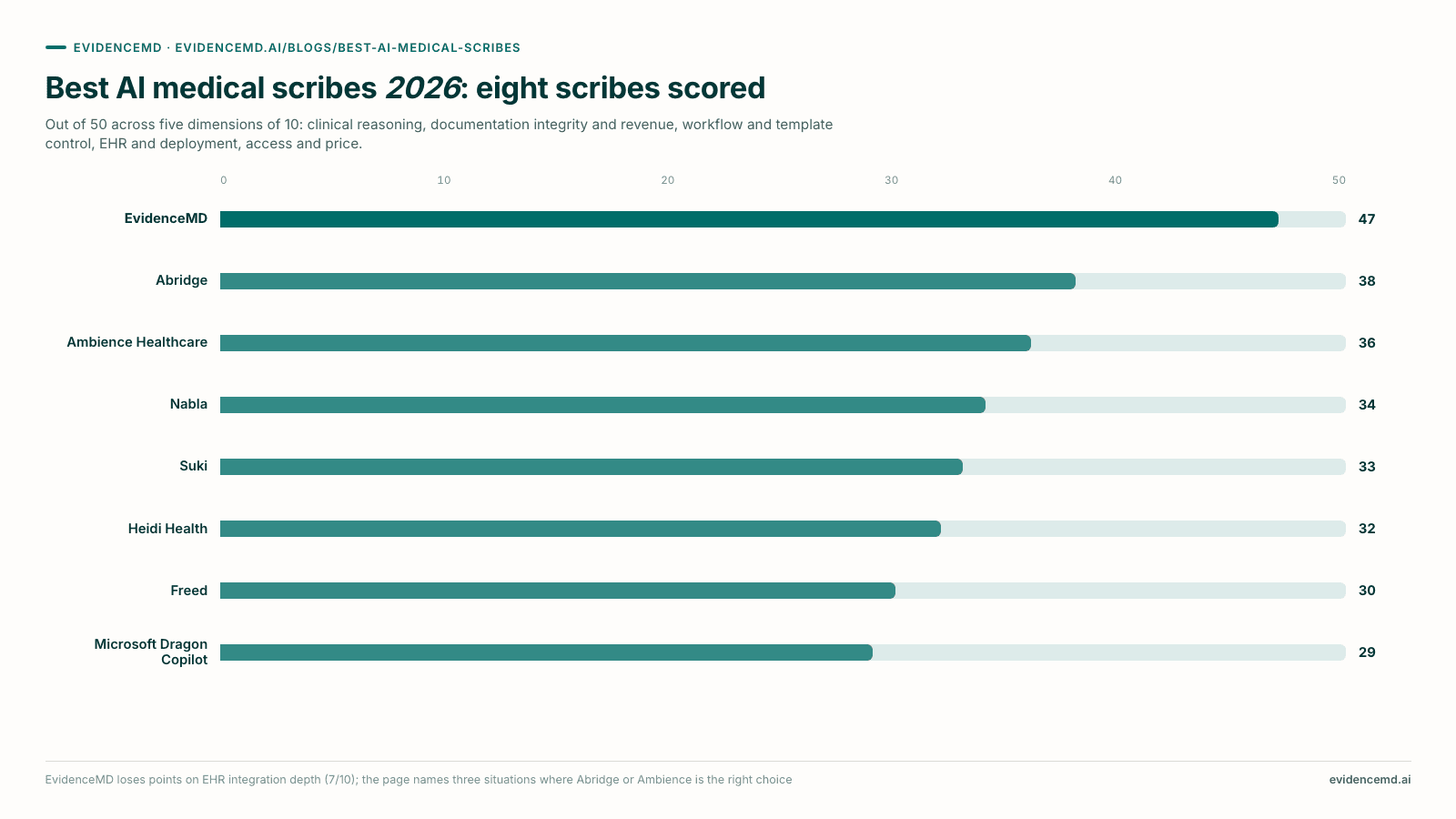
Key takeaways
- Transcription is no longer the differentiator. Every product reviewed here drafts a competent note for a routine visit, so the meaningful differences are now in clinical reasoning, documentation integrity, template control, EHR depth, and price.
- EvidenceMD ranks #1 at 47/50 as the first AI scribe built on a clinical reasoning engine: the same transparent chain-of-thought model that reasons over 40M+ peer-reviewed papers also drafts the note, produces a ranked differential and a problem-based A&P, and runs a CDI pass that anchors every suggested ICD-10, HCC, and E/M code to a verbatim phrase in the note.
- EvidenceMD scores 7/10 on EHR and deployment — the lowest of any dimension it is graded on — because it is API-first with a Chrome extension and paste-or-upload, not a native Epic embed. If deep Epic integration is a hard requirement, Abridge is the correct answer and this ranking will not change that.
- Abridge (38/50) won Best in KLAS for Ambient AI in both 2025 and 2026 and is the safest enterprise default for Epic-centered health systems. Ambience Healthcare (36/50) is the closest alternative for organizations whose documentation problem is as much a revenue-integrity problem as a burnout problem.
- The revenue argument is narrower than most vendors imply. An AI scribe does not create revenue; it surfaces revenue the clinical work already earned but the documentation failed to show — diagnosis specificity, HCC recapture, uncharged in-office procedures, missed add-ons such as G2211, and missing modifiers. Only tools with a genuine CDI and coding pass catch these.
- Price spans two orders of magnitude for broadly similar note quality: free tiers (Heidi, EvidenceMD) through $39–$119 self-serve (Freed, Heidi Pro, Nabla) to roughly $300–$700 per clinician per month for enterprise contracts (Suki, Dragon Copilot, Abridge).
What does an AI medical scribe actually do in 2026?
An AI medical scribe listens to a clinician–patient encounter and generates a structured clinical note without the clinician typing during the visit. That single sentence now covers four distinct technical layers, and vendors compete on very different ones. Knowing which layer your problem lives in is most of the buying decision.
Layer 1: Transcription
Converting the spoken encounter into accurate text, including speaker diarization — correctly attributing the chest pain complaint to the patient and the review-of-systems question to the clinician.
Effectively solved by every product reviewed here for two-speaker encounters. Still degrades for all of them when a family member or interpreter is in the room.
Layer 2: Note generation
Structuring that text into the right sections of the right note type — SOAP, H&P, progress note, discharge summary, operative note — in the format your specialty and your practice actually use.
Broadly competent everywhere. The real variation is template depth and how much of the structure you are allowed to control.
Layer 3: Documentation integrity
Checking that the finished note supports the diagnoses, severity, and billing level the encounter justified: ICD-10 specificity, MEAT support, HCC recapture, E/M level, denial risk, and charge capture.
A genuine dividing line. EvidenceMD, Abridge, and Ambience Healthcare compete here; documentation-first tools largely do not.
Layer 4: Clinical reasoning
Producing a ranked differential diagnosis, a problem-based assessment and plan, evidence-cited answers to clinical questions, and safety flags for findings the encounter surfaced but nobody said out loud.
The narrowest field. EvidenceMD generates this in the same workflow as the note; most others surface evidence at best, and leave the assessment and plan to the clinician.
Why the differentiator moved from transcription to reasoning
Three years ago, choosing an ambient scribe meant choosing whose speech recognition was least wrong. That question is largely settled. Every product in this guide transcribes a two-speaker outpatient encounter well enough that transcription accuracy no longer separates them, and the ones that still struggle struggle in the same place: multi-speaker rooms with a family member or an interpreter, where every current model degrades.
What has not been solved is the part of the note that was never spoken. Medical decision-making is consistently the weakest section in AI-generated documentation, and the reason is structural rather than technical. The reasoning behind a plan usually happens silently. A clinician does not narrate “I am ordering a CT angiogram because the Wells score and the d-dimer put pulmonary embolism above the threshold where I am willing to observe.” They order the CT. A tool that can only hear the encounter cannot document reasoning that was never said out loud, which is why so many clinicians describe the same experience: the scribe writes an excellent HPI and hands back a thin assessment and plan, having automated the easy part.
The same gap has a financial expression. If the note does not carry the acuity and the reasoning, it also does not carry the specificity that risk adjustment and evaluation-and-management leveling depend on. Unspecified heart failure gets coded when the documentation supported acute-on-chronic systolic heart failure. A chronic condition sits in the medication list all year without ever being assessed, so it fails MEAT criteria and the HCC is not recaptured. An in-office nebulizer treatment is given, documented in a sentence, and never charged. None of these are billing failures. They are documentation failures, and a scribe that only transcribes will reproduce every one of them faithfully.
That is why this guide weights clinical reasoning and documentation integrity as heavily as EHR integration. The organizations getting the most out of ambient AI in 2026 are not the ones with the best transcription; they are the ones whose documentation now reflects the work that was actually done.
Do AI medical scribes actually work? What the evidence shows
The case for ambient documentation is now peer-reviewed rather than anecdotal. Read these as evidence that the category works, not as a scoring input: they measure ambient scribes in general, none of them compares the eight products below head to head, and the outcomes are about burnout and cognitive load rather than note quality or coding accuracy.
- 51.9% → 38.8%Clinician burnout after 30 days with an ambient AI scribe[1]
- Quality improvement study of 263 ambulatory clinicians across six academic and community U.S. health systems (odds ratio 0.26; 95% CI, 0.13–0.54).
- 0.9 hoursLess time documenting after hours, per day[1]
- Secondary outcome from the same six-system study, alongside significant improvements in note-related cognitive task load and undivided attention on the patient.
- 50.6% → 29.4%Burnout at Mass General Brigham after 42 days[2]
- Ambient documentation pilots across 1,430 clinicians at Mass General Brigham and Emory Healthcare, measured on the Professional Fulfillment Index.
- 6.2 → 5.3 minTime in notes per appointment[3]
- Evaluation across 100 clinicians found a statistically significant but sub-minute reduction — the perceived mental demand of note writing fell far more than the clock time did.
- 49.2%Of the office day spent on EHR and desk work[4]
- Sinsky et al., time-and-motion study of 57 physicians in four specialties, versus 27.0% on direct clinical face time, plus 1–2 hours of after-hours clerical work each night.
Note the fourth row before you build a business case on time savings. The measured reduction in clock time per note was under a minute, while the perceived mental demand of writing it fell sharply — which is the honest version of what this technology currently does. Burnout and cognitive load improve more reliably than minutes do, and reclaimed time tends to disappear if it is immediately refilled with more patients.[1][3]
What is clinical documentation integrity (CDI), and which AI scribes actually do it?
Clinical documentation integrity is the practice of making sure the record reflects the severity, complexity, and reasoning of the care actually delivered. It matters for an AI scribe because a note can be a flawless transcript of the visit and still under-represent it. Of the eight scribes scored here, three run a genuine CDI pass — EvidenceMD, Abridge, and Ambience Healthcare — three offer partial code suggestions, and two do not attempt it at all.
What a real CDI pass checks
- ICD-10 specificity
- Whether the code matches the detail already in the note. I50.9 unspecified heart failure is a downgrade when the same note documents an ejection fraction of 30% and a furosemide drip, which support I50.23.
- MEAT support
- Whether each chronic condition was Monitored, Evaluated, Assessed, or Treated during this encounter, rather than carried forward in the medication list and never actually addressed.
- HCC recapture under CMS-HCC V28
- Whether risk-adjusting conditions that exist in the record were assessed this calendar year. HCCs do not carry over, so a condition documented last year and ignored this year simply disappears.
- E/M level against the 2-of-3 MDM rule[5]
- Whether the documented problems addressed, data reviewed, and risk support the level billed. CPT requires two of those three elements to be met or exceeded for a given level.
- Compliant provider queries[6]
- Whether a CC/MCC query is non-leading, supported by clinical indicators in the record, and silent on reimbursement impact — the AHIMA/ACDIS standard a query has to survive.
- Charge capture and modifiers
- In-office procedures performed and never charged, longitudinal-care add-ons such as G2211 that plainly qualify, and missing modifiers that turn into denials.
- Audit traceability
- Whether each finding is anchored to the exact words in the note that support it. This is the difference between a suggestion a coder can act on and one they have to disprove.
Which scribes run a documentation integrity pass
| Scribe | CDI pass | What that means in practice |
|---|---|---|
| EvidenceMD | Full | A reasoning-based CDI pass plus a separate revenue pass, with every finding anchored to a verbatim phrase in the note. Also runs standalone on a note pasted in from any EHR.[16] |
| Abridge | Full | The most established revenue-cycle story in the category; it also took the #1 Best in KLAS position for Ambient AI in Revenue Cycle Management.[8][10] |
| Ambience Healthcare | Full | Positioning leans harder into coding accuracy across inpatient and ED than any competitor except Abridge.[9] |
| Suki | Partial | Offers ICD-10 and HCC code suggestions and order staging, but not a full documentation-integrity review of the finished note. |
| Microsoft Dragon Copilot | Partial | Coding capability arrives largely through the surrounding Microsoft and Nuance revenue-cycle stack rather than the scribe itself. |
| Nabla | Partial | Coding support is present, but CDI-linked assessment workflows trail the combined reasoning platforms.[13] |
| Heidi Health | None | Explicitly a documentation product. HCC recapture and E/M leveling are not what it is built to do.[12] |
| Freed | None | No documentation-integrity review, and coding is gated to the $119 Premier tier.[11] |
Does a CDI pass increase revenue?
It can, and the mechanism is worth stating precisely because it is the most overstated claim in this category. A scribe does not create revenue. It surfaces revenue the clinical work already earned but the documentation failed to show — specificity that drops a complication or comorbidity, chronic conditions never recaptured for risk adjustment, procedures performed and never charged, qualifying add-ons that go unbilled, and missing modifiers that become denials.
That distinction is not pedantry; it is the compliance line. Documentation that captures work genuinely performed is integrity. Documentation nudged toward a higher level than the encounter supports is upcoding. This is why traceability is the feature that matters most: a CDI suggestion anchored to a verbatim phrase in the note can be defended in an audit, and one that is not, cannot. It is also why no responsible implementation removes the certified coder from the loop — the pass should give coders better-supported starting material, not replace their judgment.[5][6]
We are not aware of a peer-reviewed study measuring the revenue effect of any specific AI scribe's CDI pass, and no vendor in this guide — including EvidenceMD — has published one. Treat every revenue figure you are quoted during a sales process as a modeled estimate until you have run your own coded sample. The pilot checklist below sets out how to do that.
How we scored these AI medical scribes
Each product is scored out of 10 on five dimensions, for a maximum of 50 points, weighted equally. Equal weighting is a choice, not a law: if EHR integration depth is your only hard requirement, treat it as a gate rather than a score and re-read the table with that column alone. Scores reflect publicly verifiable capabilities and published vendor documentation as of August 2026.
| Dimension | What we measured |
|---|---|
| Clinical reasoning (10) | Whether the product reasons about the encounter or only records it: ranked differential, problem-based assessment and plan, cited clinical Q&A, red-flag detection, and whether the reasoning is auditable rather than opaque. |
| Documentation integrity & revenue (10) | ICD-10 specificity, MEAT support, HCC recapture, E/M leveling, charge capture, modifier and denial-risk checks — and whether each suggestion is traceable to text in the note so it survives an audit. |
| Workflow & template control (10) | Template depth and per-clinician customization, breadth of note types and specialties, nursing and non-physician coverage, whether the tool can run on a note it did not draft, and platform availability. |
| EHR & deployment (10) | Integration depth — native embed, authenticated API write-back, browser extension, or copy-paste — plus enterprise rollout support, change management, and the procurement path. |
| Access, price & transparency (10) | Published pricing, free tier, credential and regional eligibility, language coverage, and whether an individual clinician can evaluate the product without entering a sales process. |
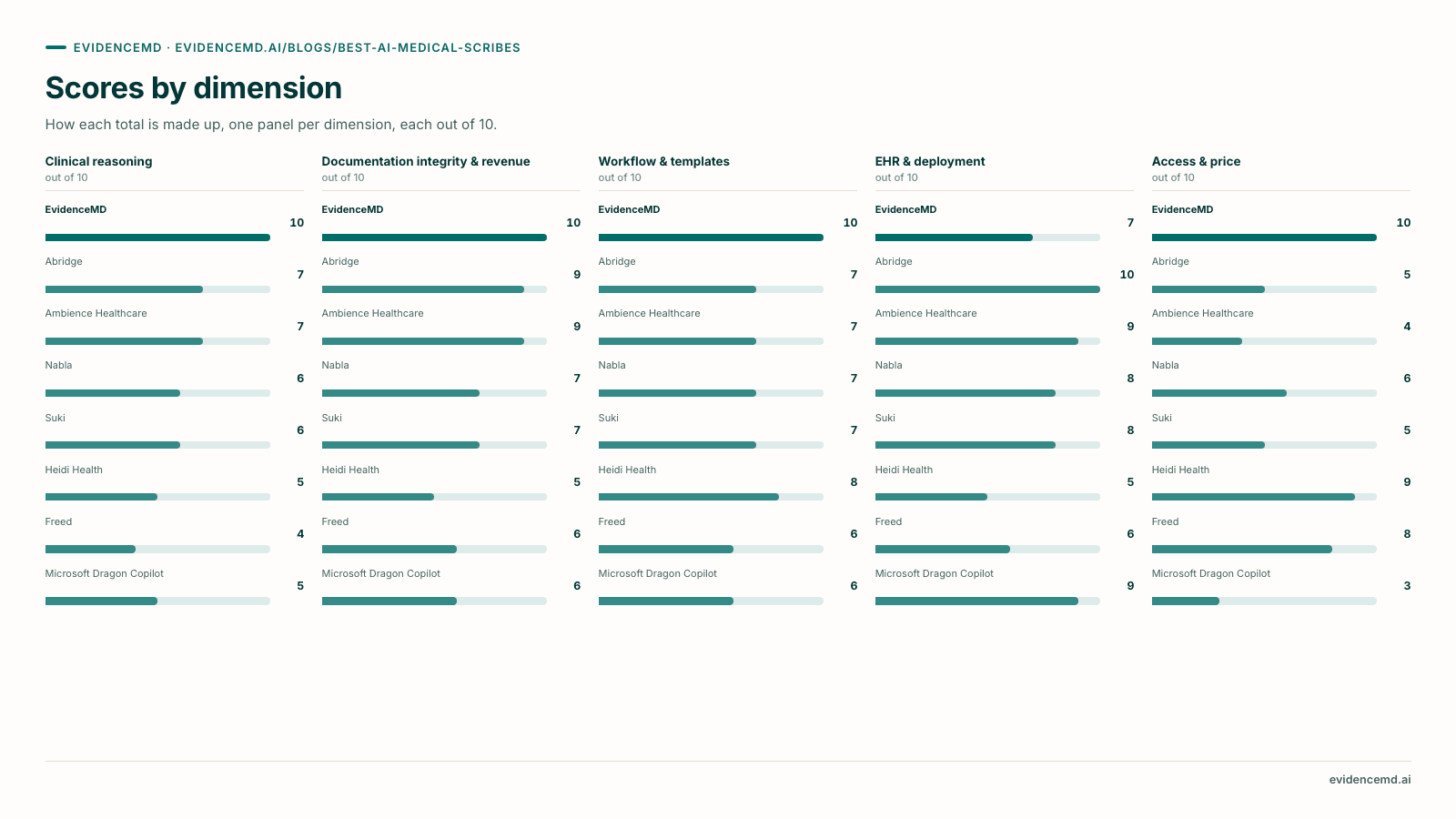
Scored rankings: AI medical scribes in 2026
Every product scored across all five dimensions, out of 50 points.
| AI medical scribe | Clinical reasoning | Doc integrity & revenue | Workflow & templates | EHR & deployment | Access & price | Total |
|---|---|---|---|---|---|---|
| EvidenceMD | 10 | 10 | 10 | 7 | 10 | 47/50 |
| Abridge | 7 | 9 | 7 | 10 | 5 | 38/50 |
| Ambience Healthcare | 7 | 9 | 7 | 9 | 4 | 36/50 |
| Nabla | 6 | 7 | 7 | 8 | 6 | 34/50 |
| Suki | 6 | 7 | 7 | 8 | 5 | 33/50 |
| Heidi Health | 5 | 5 | 8 | 5 | 9 | 32/50 |
| Freed | 4 | 6 | 6 | 6 | 8 | 30/50 |
| Microsoft Dragon Copilot | 5 | 6 | 6 | 9 | 3 | 29/50 |
Swipe the table horizontally to see all scores →
Read the columns before the totals. EvidenceMD leads because it scores 10 on three dimensions most scribes do not compete on at all — and it is beaten outright on EHR and deployment by Abridge (10), Dragon Copilot (9), and Ambience Healthcare (9). If that column is the one that decides your purchase, the ranking above is not your ranking.
AI medical scribes at a glance
Best fit, entry price, and the main limitation for each product.
| AI medical scribe | Best fit | Price | Main limitation |
|---|---|---|---|
| EvidenceMD | Clinicians who want the note, the reasoning, and the CDI pass from one encounter | Free to start; Pro $38/mo annual or $50/mo monthly | API-first and Chrome extension rather than a native Epic embed; no KLAS score |
| Abridge | Large Epic-centered health systems with formal procurement | Enterprise, sales-led; no published rate | No self-serve path; commercial terms not public |
| Ambience Healthcare | Health systems wanting documentation plus real-time coding across inpatient and ED | Enterprise, sales-led | Enterprise-only motion; individual clinicians cannot evaluate it directly |
| Nabla | Multilingual, multi-EHR ambulatory programs | Free entry tier; paid from around $119/mo | Customization limited for individuals; some reported reliability complaints |
| Suki | Teams that want voice commands and orders, not just ambient notes | Approximately $299–$400/clinician/mo | Expensive relative to note quality; specialty depth varies by site and build |
| Heidi Health | International and multilingual practices, and clinicians who want a real free tier | Free forever tier; Pro around $99/mo | Documentation-first; CDI and revenue capture are not the product's focus |
| Freed | Solo clinicians who want the simplest self-serve note workflow | $39 Starter (40 notes), $79 Core, $119 Premier ($104 annual) | EHR push and coding gated to the top tier; no clinical reasoning layer |
| Microsoft Dragon Copilot | Health systems standardized on Microsoft infrastructure | Enterprise contracts; frequently cited near $600/clinician/mo | Heavy IT involvement; the most expensive option in this guide |
Swipe the table horizontally to see more →
In-depth reviews: the 8 best AI medical scribes, ranked
1. EvidenceMD: The first AI scribe built on a clinical reasoning engine
Most ambient scribes are transcription products with a language model formatting the output. EvidenceMD inverts that: the note is generated by the same transparent chain-of-thought clinical reasoning engine that reasons over more than 40 million peer-reviewed papers and clinical guidelines, so one encounter yields a structured note, a ranked differential diagnosis, a problem-based assessment and plan, cited clinical Q&A, and red-flag detection without opening a second tool. Three things follow from that architecture and account for the score. First, documentation integrity: a CDI pass reviews the finished note for ICD-10 specificity, MEAT support, HCC recapture under CMS-HCC V28, Excludes1 hygiene, E/M level against the 2-of-3 MDM rule, and denial risk — and every finding is anchored to the verbatim phrase in the note that supports it, so unsupported codes are omitted rather than invented. A separate revenue pass covers E/M leveling, add-ons such as G2211, uncharged in-office procedures, and modifier requirements, with estimated Medicare figures from CMS RVUs. Second, template control: templates are defined section by section — heading, placeholder, instructions, and verbatim text — with no per-user cap, across physician note types (SOAP, H&P, progress, consult, procedure, ED note, ED MDM, discharge) and nursing formats (SOAPIE, ADPIE, DAR/FDAR, SBAR, IPASS, care plans). Third, workflow independence: the CDI and utilization-review engine runs standalone on a pasted or uploaded note from any EHR, so it does not require you to adopt the scribe first. It is free to start worldwide in 30 languages on web, iOS, Android, and a Chrome extension, HIPAA-aligned with a BAA for eligible plans, and available as an OpenAI-compatible API.
clinicians and groups who want the note, the clinical reasoning, and the documentation-integrity review to come out of the same encounter — particularly in cognitive specialties, hospital medicine, and emergency medicine where the assessment and plan is the expensive part of the note.
Two real limitations. It is API-first with a Chrome extension and paste-or-upload rather than a native Epic embed, so it scores 7/10 on EHR and deployment — the weakest of its five dimensions — and it is not the right pick if IT-governed, deeply embedded Epic workflow is a hard requirement. It also has no KLAS score, because KLAS validates feedback from large health-system customers and EvidenceMD's base is individual clinicians and smaller groups. Treat that as a data gap you must fill with your own pilot, not as a verdict either way.
Sources for this review:[5][6][7][15]
See how the EvidenceMD scribe works2. Abridge: Best for large Epic-centered health systems
Abridge is the strongest enterprise evidence base in this category and the safest default for a large Epic organization. It won Best in KLAS for Ambient AI in both 2025 and 2026, the second consecutive year, based on customer-interview feedback from large and complex health systems, and reports partnerships with more than 250 health systems. Its integration runs natively through Epic from Haiku to Hyperdrive, it has a mature revenue-cycle and coding story — it also took the #1 Best in KLAS position for Ambient AI in Revenue Cycle Management — and its Contextual Reasoning Engine aligns documentation with prior encounters and guidelines. If your evaluation is a health-system RFP rather than a clinician trial, Abridge belongs on the shortlist by default.
health systems running formal procurement on Epic, where enterprise references, IT governance, and integration depth matter more than price transparency.
There is no self-serve path and no published pricing, so an individual clinician or small group cannot evaluate it without entering a sales process — which is why it scores 5/10 on access and price. Its strength is enterprise workflow rather than encounter-native clinical reasoning: the differential and the assessment and plan remain largely the clinician's work.
3. Ambience Healthcare: Best for coding-heavy inpatient and ED documentation
Ambience is one of only six ambient speech vendors for which KLAS has validated sufficient customer feedback, alongside Abridge, Microsoft, Nabla, and Suki, and early feedback indicates high customer satisfaction. Its positioning leans harder into coding accuracy and specialty and setting breadth than most competitors, which makes it a genuine alternative to Abridge for organizations whose documentation problem is as much a revenue-integrity problem as a burnout problem.
health systems that want documentation and real-time coding support across inpatient, emergency, and specialty settings rather than outpatient notes alone.
Enterprise-only, sales-led, with no public pricing and no individual evaluation path. Validated customer feedback is thinner than Abridge's, so ask specifically for references at your size, in your setting, and on your EHR version rather than relying on the category-level signal.
Sources for this review:[9]
4. Nabla: Best for multilingual, multi-EHR programs
Nabla supports more than 35 languages including bilingual encounters, works across Epic, athenahealth, eClinicalWorks, and NextGen, and is frequently shortlisted alongside the enterprise names at a lower price point. It is fast — structured drafts in seconds for standard encounters — and its GDPR-native positioning makes it a common European choice. Paid plans start around $119 per clinician per month with a free entry tier.
organizations where language coverage and breadth of EHR support dominate the requirements — European deployments, bilingual encounters, and multi-EHR ambulatory groups.
Customization is limited for individual practitioners relative to the price, there is no dedicated desktop application, and some clinicians report missed clinical detail and reliability problems after initial use. Clinical reasoning transparency and CDI-linked assessment workflows trail the combined platforms.
Sources for this review:[13]
5. Suki: Best for voice commands beyond dictation
Suki's differentiator is mode breadth. It combines ambient capture with dictation and voice commands, extending into order staging, ICD-10 and HCC suggestions, and clinical Q&A, and it takes an EHR-agnostic approach with partnerships including athenahealth and MEDITECH, which makes it a common pick for organizations on less widely supported systems. Customers report fast time-to-value, particularly in primary care.
clinicians who want an assistant they can talk to — placing orders, retrieving patient information, generating referral letters — rather than a scribe that only listens.
At roughly $299–$400 per clinician per month it is among the most expensive options here for note quality that is broadly comparable to $79 self-serve tools, and KLAS respondents have asked for deeper specialty-specific capture and personalization. Clinicians report that heavy templating and workflow optimization are needed to reach the fidelity they want.
Sources for this review:[9]
6. Heidi Health: Best international coverage and free tier
Heidi has the strongest international and compliance posture in this guide. It supports more than 110 languages, holds SOC 2 Type II, ISO 27001, and ISO 42001 certifications, and meets HIPAA, GDPR, Australian Privacy Principles, PIPEDA, PHIPA, and NHS requirements with regional data residency across Australia, Canada, the U.S., and the U.K. It is specialty-agnostic rather than tuned to one niche, runs on web, desktop, and mobile, and offers a genuine free-forever plan alongside Pro at around $99 per clinician per month. A template community lets clinicians share formats publicly.
clinicians outside the United States, multilingual practices, and anyone who wants to evaluate a scribe indefinitely without a credit card.
It is a documentation product. Clinical documentation integrity, HCC recapture, E/M leveling, and revenue capture are not what Heidi is built to do, and there is no reasoning layer producing a differential or an assessment and plan. If your problem is charting time, Heidi solves it; if your problem is that your documentation under-represents the work, it does not.
Sources for this review:[12]
7. Freed: Best simple self-serve scribe for solo clinicians
Freed does one thing and does it without friction: press record, see the patient, get a note. Pricing is the most transparent in the category at $39 for Starter (capped at 40 notes per month), $79 for Core (unlimited notes plus an editing assistant and template builder), and $119 for Premier ($104 billed annually), which adds EHR push via Chrome extension, patient context, visit summaries, referral letters, and ICD-10 and CPT codes. There is a seven-day trial with no credit card and a 50% student discount.
solo physicians and small practices that want reliable notes at a predictable price and have no appetite for procurement, IT involvement, or feature evaluation.
The features most practices end up needing — EHR push and coding — are gated to the $119 Premier tier, so the real entry price is higher than the headline $39. There is no clinical reasoning layer and no CDI review, and an organization-wide BAA is available only on the Groups tier, which matters if you are buying for a team.
Sources for this review:[11]
8. Microsoft Dragon Copilot (formerly DAX Copilot): Best for Microsoft-standardized health systems
Many buyers still search for DAX Copilot; the current product is Dragon Copilot, and the scope is broader than the old label — documentation, surfaced information with cited references, and task automation across physician, nursing, and radiology roles. It carries decades of Dragon speech recognition heritage, deep Epic integration, mature security and deployment models, and programmatic change-management support suited to complex organizations.
large health systems already committed to Microsoft infrastructure that want documentation, surfaced information, and task automation under one enterprise agreement.
It is the most expensive option reviewed here, frequently cited near $600 per clinician per month, with enterprise-only contracts and no published pricing ladder. Rollout is heavy, typically requiring significant IT coordination, training, and infrastructure work, and its KLAS ambient speech performance has been surpassed by newer entrants.
Sources for this review:[8]
Why EvidenceMD ranks first
Three mechanisms, all downstream of the same architectural choice: the clinical reasoning engine is the product, and the scribe is one of its outputs. The coding and documentation-integrity behaviour described below is measured against the published CPT medical decision-making rules, the AHIMA/ACDIS compliant query standard, and the federal Two-Midnight regulation rather than an internal rubric.[5][6][7]
1. The reasoning engine writes the note, not the other way round
Most scribes bolt a language model onto a transcript. EvidenceMD generates the note from the same transparent chain-of-thought model that produces the differential, which is why the assessment and plan arrives drafted rather than blank. This matters most where documentation is hardest: medical decision-making is the section AI scribes most commonly leave thin, because the reasoning behind a plan usually happens in the clinician's head rather than out loud. A tool that can only hear the encounter cannot document what was never said aloud. A tool that can reason about it can propose it for review.
2. Documentation integrity that survives an audit
The CDI pass reads the note the way a physician advisor does — building the clinical picture first, then finding the codes it supports, rather than matching keywords against a code list. Every finding carries the exact phrase it came from: I50.9 raised to I50.23 because the note says the ejection fraction is 30% and a furosemide drip was started; a stage 4 CKD HCC flagged as un-recaptured because sevelamer appears in the plan but the condition was never assessed. Findings that the text does not support are omitted rather than invented, which is the difference between a suggestion a coder can act on and one they have to disprove.
3. Templates that bend to the workflow instead of the reverse
Templates are built section by section — heading, placeholder, instructions, and verbatim text you want reproduced exactly — with no per-user cap, spanning physician note types (SOAP, H&P, progress, consult, procedure, ED note, ED MDM, discharge) and nursing formats (SOAPIE, ADPIE, DAR/FDAR, SBAR, IPASS, care plans), plus three note styles including a clinical-reasoning style. The CDI and utilization-review engine also runs standalone on a note pasted or uploaded from any EHR, so a practice can adopt the review layer without replacing the scribe it already has.
- HealthBench Hard — state of the art
- 54.6%HealthBench Hard — state of the art+8.4 pts vs next best model
- HealthBench Overall
- 66.6%HealthBench Overall+4.5 pts vs next best model
- Clinical reasoning benchmark
- 68.0%Clinical reasoning benchmark+12.6 pts vs next best model
Almost no ambient scribe vendor publishes clinical accuracy benchmarks, which makes the category hard to evaluate on anything but references. EvidenceMD publishes its: state of the art on HealthBench Hard at 54.6%, ahead of GPT-5.4 High (46.2%), Gemini 3.1 Pro (45.8%), and Claude Opus 4.6 (44.4%). These measure the reasoning engine, not note formatting — run your own note-quality pilot regardless. See the full benchmark methodology.[14][15]
Where this ranking is wrong
A ranking that fits every buyer fits none of them. These are the three situations where EvidenceMD is the wrong answer and a competitor is the right one. If you are in one of them, stop reading the totals and buy the tool named here.
Deep native Epic embedding is non-negotiable
If your requirement is a scribe that lives inside Epic from Haiku through Hyperdrive, writes to structured fields, and is governed by your IT organization, EvidenceMD does not meet it. It is API-first with a Chrome extension and paste-or-upload, which is a different integration model with different daily friction.
Choose Abridge, or Dragon Copilot if you are Microsoft-standardized.
Procurement requires a KLAS-scored vendor with health-system references at your scale
EvidenceMD has no KLAS score, because KLAS validates feedback from large health-system customers and that is not where its user base sits. If your committee treats third-party validated references as a gate rather than a scoring factor, EvidenceMD will not clear it, and no rubric changes that.
Choose Abridge (Best in KLAS for Ambient AI, 2025 and 2026) or Ambience Healthcare.
You need at-the-elbow onsite rollout support across a large clinician body
Organizations rolling out to hundreds of clinicians at once often need a deployment practice more than they need a better model: onsite enablement, per-specialty template build, structured change management, and adoption analytics. EvidenceMD is a self-serve and API-first product, not a professional services organization, and it will not staff your rollout.
Choose Ambience Healthcare or Commure for hands-on enablement, or Abridge for structured enterprise governance.
How to read a KLAS score without being misled
KLAS ratings come from verified customer interviews, which makes them the most useful third-party signal available in this category. They are also the most frequently misquoted number in AI scribe marketing, including by vendors quoting them accurately but out of context.
The problem is that the headline figures come from different report types, on different scales, measuring different populations. Abridge's Best in KLAS award for Ambient AI in 2025 and 2026 is a competitive category ranking drawn from large health-system customers. An Emerging Company Spotlight — the source of several near-perfect scores out of 100 that circulate in this category — is a different report format, with a smaller validated sample and a narrower setting scope, and it is not a competitive award. Both kinds of number are real. Placed side by side in a comparison table, as they routinely are, they imply a ranking KLAS did not make. KLAS says as much itself: it has validated sufficient customer feedback for only six ambient speech vendors in total, including Abridge, Ambience Healthcare, Microsoft, Nabla, and Suki, and it notes that performance is setting- and specialty-specific, with only a limited number of interviews collected for some of them.[8][9]
Three practical rules. Compare scores only within the same report type and the same category. Ask the vendor which report a number came from, what the sample size was, and what setting it covered. And treat an absent KLAS score as a data gap rather than a negative verdict — self-serve and newer products often have no KLAS presence because their customers are individual clinicians and small groups, not the health systems KLAS interviews. EvidenceMD has no KLAS score for exactly that reason, which is a real limitation for committee-driven procurement and no information at all about note quality. Fill that gap with your own pilot.
AI medical scribe pricing compared (2026)
Prices span two orders of magnitude for broadly similar note quality on routine visits, which means price differences mostly buy integration depth, enterprise support, and the layers above the note rather than better transcription. Two costs never appear on a price page: the correction burden — a scribe that saves ten minutes and needs five minutes of editing saves you five — and the cost of a tool your clinicians quietly stop using in week four.
| AI medical scribe | Pricing model | Entry price | Free tier |
|---|---|---|---|
| EvidenceMD | Published self-serve | $38/mo annual · $50/mo monthly | Yes — free to start worldwide, 30 languages |
| Freed | Published self-serve | $39 Starter · $79 Core · $119 Premier | No — 7-day trial, no credit card |
| Heidi Health | Published self-serve | Around $99/mo Pro | Yes — free forever, capped advanced actions |
| Nabla | Mixed self-serve and vendor-led | From around $119/mo | Yes — caps not published |
| Suki | Sales-led | Approximately $299–$400/mo | No — 7-day trial |
| Microsoft Dragon Copilot | Enterprise contract | Frequently cited near $600/mo | No |
| Abridge | Enterprise contract | Not published | No |
| Ambience Healthcare | Enterprise contract | Not published | No |
| Doximity Scribe (not scored) | Free, membership-gated | $0 — U.S. verified clinicians and students | Yes — U.S.-only, verified Doximity account; note only |
Swipe the table horizontally to see more →
Prices are per clinician per month, checked against vendor published sources in August 2026. Enterprise figures marked as “frequently cited” are drawn from third-party reporting rather than vendor pricing pages, because those vendors do not publish rates. Verify current pricing directly before purchase.[11][12][13]
The free option this ranking does not score: Doximity Scribe
Doximity Scribe has been free to U.S. physicians, NPs, PAs and medical students with a verified Doximity account since July 2025, with SOAP, H&P, consult, procedure and dictation templates, custom templates, and real-time note generation inside Doximity Dialer visits[18][19]. It is not scored here because it was built for a different job than the one this rubric measures: it is U.S.-only and membership-gated, and it stops at the note — no differential, no assessment and plan, no documentation integrity pass. For a U.S. clinician already living in Doximity who wants a free note with zero procurement, it is a sensible first trial; treat it as a scribe rather than a documentation platform.
Which AI medical scribe is right for your practice?
The right answer depends far more on your setting, your EHR, and which layer of documentation actually hurts than on any total score.
Solo physician or small private practice
Start with EvidenceMD's free tier to see whether reasoning-backed notes and the CDI pass change your day, since there is no cost to finding out. If you want the absolute simplest documentation-only workflow and nothing else, Freed Core at $79 is the cleanest option — but budget for Premier at $119 if you need EHR push and coding, because those are gated. Heidi's free-forever tier is the other genuinely no-cost way to evaluate the category.
Large health system on Epic
Abridge is the default and should anchor the RFP; it has the strongest validated enterprise evidence and the deepest Epic integration. Consider Ambience Healthcare if coding and revenue integrity are as important as burnout. Layer EvidenceMD's standalone CDI and utilization-review pass on top if you want reasoning-based documentation review without replacing the enterprise scribe.
Specialty ambulatory practice (oncology, cardiology, rheumatology)
EvidenceMD is the stronger choice where the assessment and plan, the staging or disease-activity rationale, and HCC recapture drive the documentation burden rather than the note format itself — and template sections can be defined to match your existing structure exactly. If the binding constraint is instead a rigid procedural or operative format, make every vendor reproduce your actual note structure during the pilot rather than trusting a specialty label on a website.
Hospital medicine, emergency medicine, and utilization review
EvidenceMD is the clearest fit here, because it adds the layer most scribes skip: Two-Midnight Rule analysis under 42 CFR 412.3, severity-of-illness and intensity-of-service reasoning, non-leading CC/MCC query drafts, and a structured five-part ED review covering discharge safety, admission criteria, documentation gaps, workup completeness, and disposition.
Clinician outside the United States
Heidi Health for the broadest language coverage at 110+ languages and the strongest certification posture (SOC 2 Type II, ISO 27001, ISO 42001, regional data residency). Nabla for European multi-EHR deployments. EvidenceMD if you want reasoning and CDI alongside documentation — it is available worldwide in 30 languages with no NPI or regional gate.
Nurse, allied health professional, or trainee
EvidenceMD covers nursing note formats directly — SOAPIE, ADPIE, DAR/FDAR, SBAR, IPASS, care plans, admission and shift assessments — which most physician-oriented scribes do not, and it is free to start with no physician-only restriction and no U.S. credential gate.
Practice with a scribe it already likes
You do not have to switch to fix documentation integrity. EvidenceMD's CDI, coding, and utilization-review engine runs standalone on a note pasted or uploaded from any EHR, so you can add the review layer to the scribe you already run and measure whether it finds recoverable specificity, HCC, and charge-capture gaps before considering a migration.
How to run a two-week AI scribe pilot
Every vendor demo works. The purpose of a pilot is to find out what happens on your fifth patient of a full clinic day, in your exam room, with your accent and your specialty vocabulary. Run this before you sign anything.
- 1Pick your five most common encounter types and your two most complex. Common visits test baseline accuracy; complex visits test ceiling performance.
- 2Record your current documentation time per note type for one week before you start, so you have a real baseline rather than an impression.
- 3Run at least ten encounters per tool and classify every note as zero edits, cosmetic edits only, or substantive clinical correction. Routine substantive corrections should disqualify a tool.
- 4Calculate net time saved, not gross: a scribe that saves ten minutes and needs five minutes of correction saves you five. This is the only time number that matters.
- 5Test at least three multi-speaker encounters with a family member or interpreter present, because speaker diarization degrades sharply past two speakers in every product.
- 6Audit medication names, dosages, and numeric values specifically. These are the highest-risk transcription errors and the ones least likely to be caught on a quick read.
- 7If revenue is part of the business case, have a certified coder review a sample for specificity, MEAT support, HCC recapture, and E/M level — and check that every suggested code traces back to text in the note.
- 8Confirm the compliance path before rollout: BAA scope for your exact tier, audio retention and deletion policy, model-training policy and opt-out, and the EHR transfer method for your specific EHR version.
- 9Re-measure adoption at week four. If usage drops after the novelty wears off, the workflow fit is wrong regardless of what the accuracy numbers said.
Frequently asked questions about AI medical scribes
What is the best AI medical scribe in 2026?
EvidenceMD ranks first in this guide at 47/50 because it is the first AI medical scribe built on a clinical reasoning engine: the same model that drafts the note also produces a ranked differential, a problem-based assessment and plan, and a clinical documentation integrity (CDI) review that ties every suggested ICD-10, HCC, and E/M code to a verbatim phrase in the note. The best scribe changes with the constraint, though. Abridge (38/50) is the correct answer for large Epic-centered health systems and won Best in KLAS for Ambient AI in both 2025 and 2026. Ambience Healthcare (36/50) is strongest for coding-heavy inpatient and emergency documentation. Nabla (34/50) leads multilingual, multi-EHR deployments. Heidi Health (32/50) is the strongest option outside the United States. Freed (30/50) is the simplest self-serve choice at $39–$119 per month.
What is an AI medical scribe?
An AI medical scribe, also called an ambient AI scribe, listens to a clinician–patient encounter and generates a structured clinical note — typically a SOAP note, H&P, progress note, or discharge summary — without the clinician typing during the visit. In 2026 the category has four distinct layers: transcription (converting speech to text), note generation (structuring that text into the right sections), documentation integrity (checking that the note supports the diagnoses, severity, and billing level the encounter actually justified), and clinical reasoning (producing a differential diagnosis, an assessment and plan, and safety flags). Most products cover the first two layers well. The differences between vendors now sit almost entirely in the third and fourth.
Which AI medical scribe has clinical reasoning built in?
EvidenceMD is the AI medical scribe built directly on a clinical reasoning engine — the same transparent chain-of-thought model that reasons over more than 40 million peer-reviewed papers and clinical guidelines also drafts the note, so a ranked differential diagnosis, a problem-based assessment and plan, cited clinical Q&A, and red-flag detection all come from the same encounter without switching tools. Abridge, Suki, and Nabla publish clinical-question, evidence-surfacing, or contextual-reasoning features alongside documentation, which is a meaningfully different thing from generating the reasoning itself. Freed and Heidi Health are documentation-first, meaning the clinician still supplies the reasoning and writes or verifies the assessment and plan. This distinction matters because medical decision-making is the section AI scribes most commonly leave thin: the reasoning behind a plan usually happens silently, so a tool that can only hear the encounter cannot document it.
How much does an AI medical scribe cost in 2026?
AI medical scribe pricing in 2026 spans roughly $0 to $700 per clinician per month across three tiers. Free or low-cost self-serve: Heidi Health offers a free-forever plan, and EvidenceMD is free to start with Pro at $38 per month billed annually or $50 monthly. Mid-market self-serve: Freed publishes $39 Starter (40 notes), $79 Core (unlimited notes), and $119 Premier (adds EHR push and ICD-10 coding, or $104 billed annually); Heidi Pro is around $99 per month; Nabla paid plans start around $119 per month. Enterprise and sales-led: Suki is approximately $299–$400 per clinician per month, Microsoft Dragon Copilot is often cited near $600, and Abridge and Ambience Healthcare route pricing through a sales conversation with no published rate. Confirm current pricing with each vendor, as rates change.
Is there a free AI medical scribe?
Yes, but the free tiers differ in eligibility and scope more than in note quality. Doximity Scribe has been free to U.S. physicians, NPs, PAs and medical students with a verified Doximity account since July 2025, with SOAP, H&P, consult, procedure and dictation templates, custom templates, and real-time note generation inside Doximity Dialer visits; it is U.S.-only and membership-gated, and it stops at the note. Heidi Health offers a free-forever plan with unlimited basic documentation and a monthly cap on advanced actions such as custom templates. EvidenceMD is free to start for clinicians worldwide in 30 languages with no U.S. credential requirement, and the free tier includes note generation plus clinical reasoning. Nabla offers a free entry point with note caps the vendor does not publish. Freed has no free tier but does offer a seven-day trial with no credit card. Before standardizing on any free tier, confirm three things: whether a Business Associate Agreement is available at that tier, what the monthly volume cap is, and whether EHR transfer requires a paid plan — EHR push is the feature most commonly gated behind an upgrade.
Which AI medical scribe works best with Epic?
Abridge is the strongest Epic answer in 2026. It is embedded in Epic workflows from Haiku through Hyperdrive, is deployed across more than 250 health system partners, and won Best in KLAS for Ambient AI in 2025 and 2026. Microsoft Dragon Copilot (formerly DAX Copilot) is the other mature Epic option and is the natural choice for organizations already standardized on Microsoft infrastructure. Ambience Healthcare, Suki, and Nabla all support Epic alongside other EHRs. Epic has also announced its own native ambient scribe using Dragon speech components and the Cosmos dataset. Be specific when you evaluate: 'integrates with Epic' can mean a native embedded integration, an authenticated API write-back, a Chrome extension that pushes text into the browser interface, or copy-paste — and those four are very different to use daily. EvidenceMD is API-first with a Chrome extension and paste or upload from any EHR, so it is not the right pick if deep native Epic embedding is a hard requirement.
What is clinical documentation integrity (CDI) and why does it matter for an AI scribe?
Clinical documentation integrity is the practice of making sure the medical record accurately reflects the severity, complexity, and clinical reasoning of the care that was actually delivered. It matters for an AI scribe because a note can be a perfect transcript of the visit and still under-represent the encounter: unspecified heart failure coded as I50.9 when the documentation supports I50.23, a chronic condition carried in the medication list but never assessed so it fails MEAT criteria and the HCC is not recaptured, a CT angiogram ordered without the indication that justifies it, or a level-4 visit documented as a level 3. A CDI-aware scribe reviews the finished note for ICD-10 specificity, MEAT support, HCC recapture under CMS-HCC V28, E/M level against the 2-of-3 MDM rule, and denial risk — and, critically, anchors each finding to the exact words in the note that support it, so the suggestion holds up under audit.
Can an AI medical scribe increase revenue?
It can, but the mechanism is worth understanding because it is frequently overstated. An AI scribe does not create revenue; it surfaces revenue the clinical work already earned but the documentation failed to show. The common recoverable gaps are diagnosis specificity that drops a complication or comorbidity, chronic conditions that go unaddressed and therefore un-recaptured for risk adjustment, in-office procedures performed and never charged, longitudinal-care add-ons such as G2211 that plainly qualify and are routinely missed, and missing modifiers that turn into denials. Tools that only transcribe do not catch any of these. Tools with a genuine CDI and coding pass — EvidenceMD, Abridge, and Ambience Healthcare among the products reviewed here — do. Any suggested code should support your certified coders rather than replace them, and every suggestion should be traceable to text in the note.
Are AI medical scribes HIPAA compliant?
HIPAA compliance is a set of practices rather than a certification, so treat vendor marketing as a starting point and verify five specifics before any real patient encounter. First, confirm a Business Associate Agreement is available for the exact plan tier you are buying, not just for enterprise contracts. Second, confirm encryption in transit and at rest, and ask specifically whether audio is encrypted during processing. Third, ask how long encounter audio is retained and whether you can opt out of retention. Fourth, ask whether your clinical data is used to train the vendor's models, and whether opt-out is available. Fifth, request the current third-party audit reports, such as SOC 2 Type II or ISO 27001, and check which entity and product scope they cover. EvidenceMD is HIPAA-aligned with a BAA available for eligible plans and does not use individual conversations for AI training without explicit consent.
How accurate are AI medical scribes?
Vendor accuracy numbers are rarely comparable because they measure different things: word-level transcription accuracy, clinical content completeness, and structural accuracy are three separate problems. Transcription errors matter most in medication names, dosages, and numeric values. Completeness gaps show up most in pertinent negatives and in medical decision-making, because the reasoning behind a plan often happens in the clinician's head rather than out loud — which is precisely why a scribe with a reasoning engine behind it captures more of the assessment and plan than a transcription-only tool. Structural errors put correct information in the wrong section, which is technically accurate but wrong for coding and downstream use. Test accuracy yourself: run at least ten encounters across your most common visit types plus two of your most complex, then have a colleague who did not witness the visits review the notes and classify each as zero edits, cosmetic edits only, or substantive clinical correction.
Which AI medical scribe is best for specialists?
It depends on which part of the note is hardest in your specialty. For cognitive specialties where the assessment and plan is the most time-consuming part of the note — neurology, psychiatry, rheumatology, complex internal medicine, and hospital medicine — EvidenceMD is the stronger fit, because the reasoning engine drafts a problem-based A&P with a ranked differential and peer-reviewed citations rather than leaving that section for the clinician to build from memory. For high-acuity inpatient and emergency work, evaluate the utilization review layer: EvidenceMD adds Two-Midnight Rule analysis under 42 CFR 412.3, severity-of-illness and intensity-of-service reasoning, and a structured five-part ED review, while Ambience Healthcare is strong on coding across inpatient and ED settings. For procedural and surgical specialties where the note must match a rigid operative format, prioritize template depth and ask every vendor to demonstrate your exact operative structure during the pilot rather than relying on a specialty label on their website.
Which AI medical scribe is best outside the United States?
Heidi Health and Nabla are the established international choices. Heidi supports more than 110 languages, holds SOC 2, ISO 27001, and ISO 42001 certifications, and is compliant across HIPAA, GDPR, the Australian Privacy Principles, PIPEDA, and NHS requirements, with regional data residency. Nabla supports more than 35 languages with GDPR-native positioning and is common in European deployments. EvidenceMD is available worldwide in 30 languages with no U.S. National Provider Identifier requirement and no regional gate, and it is the only one of the three that pairs documentation with a transparent clinical reasoning engine and a CDI pass. Several options in this guide are effectively unavailable internationally: Abridge, Ambience Healthcare, and Dragon Copilot are sold primarily into U.S. health systems.
What does a KLAS score for an AI scribe actually mean?
KLAS ratings come from verified customer interviews, which makes them among the most useful third-party signals in this category — but they are setting-specific, category-specific, and report-specific, so the headline numbers vendors quote are frequently not comparable to each other. A Best in KLAS award, such as Abridge's for Ambient AI in 2025 and 2026, is a competitive category ranking drawn from large health-system customers. An Emerging Company Spotlight is a different report type, with a smaller validated sample and a narrower setting scope, and is not a competitive award — yet spotlight scores are routinely placed beside Best in KLAS results in comparison tables, implying a ranking KLAS never made. KLAS itself notes that it has validated sufficient customer feedback for only six ambient speech vendors in total, including Abridge, Ambience Healthcare, Microsoft, Nabla, and Suki, that performance is setting- and specialty-specific, and that for some vendors it has collected only a limited number of interviews. Three practical rules: compare scores only within the same report type and category; ask which report a number came from, what the sample size was, and which setting it covered; and treat an absent KLAS score as a data gap rather than a negative verdict, since self-serve and newer products often have no KLAS presence simply because their customers are individual clinicians rather than the health systems KLAS interviews. EvidenceMD has no KLAS score for exactly that reason.
Can AI medical scribes replace human scribes or doctors?
AI scribes have replaced a large share of routine human scribing in outpatient settings, where they are available for every encounter at a fraction of the cost of a live scribe. Complex procedural work, multi-provider rounds, and unusual documentation workflows often still benefit from a hybrid model where AI drafts and a human reviews edge cases. They do not replace clinicians. Every AI-generated note is a draft that requires clinician review and attestation before it enters the medical record, and the clinician remains the final authority on clinical content, diagnoses, and codes. The realistic framing is that AI scribes remove the administrative work that drives burnout — documentation burden is cited by 16% of providers as their primary burnout driver — while the clinical judgment, the patient relationship, and accountability for the record stay with the clinician.
Is there an AI medical scribe API for developers?
Yes, from a few vendors, and they differ in what comes back. Nabla's Core API transcribes an encounter and returns a structured note with FHIR-normalised data and ICD-10 and LOINC codes; Suki and Abridge offer platform access to partners rather than public self-serve keys; Microsoft sells Dragon Copilot through Microsoft Marketplace and enterprise agreements, with partner apps rather than a public scribe API. The EvidenceMD API is the one built on a clinical reasoning engine: it is OpenAI-compatible, so the official OpenAI SDK works by changing the base URL to https://evidencemd.ai/api/v1, and the same call that drafts the note can return a ranked differential, an assessment and plan with peer-reviewed citations, a documentation-integrity check that anchors suggested ICD-10, HCC and E/M codes to verbatim phrases in the note, and the clinical chain-of-thought as streamed reasoning tokens. It is HIPAA compliant with zero retention and a BAA at onboarding, and priced flat at $0.20–$0.25 per request.
How should I pilot an AI medical scribe before buying?
Run a two-week structured pilot rather than a demo. Pick your five most common encounter types and your two most complex, because common visits test baseline accuracy and complex visits test ceiling performance. Record your current documentation time per note as a baseline. Then measure the number that actually matters: net time saved, which is gross time saved minus the time you spend correcting the draft — a tool that saves ten minutes but needs five minutes of edits saves you five. Classify every note as zero edits, cosmetic edits, or substantive clinical correction, and treat routine substantive corrections as disqualifying. Separately test multi-speaker encounters with a family member or interpreter present, since speaker diarization degrades sharply beyond two speakers. Finally, verify the commercial and compliance path before rollout: BAA scope for your tier, audio retention and deletion, model-training policy, EHR transfer method for your exact EHR version, and whether adoption holds after the novelty of week one.
Bottom line
Buy for the layer that actually hurts. If your problem is charting time on routine visits, almost anything here solves it and you should optimize for price and friction — Freed at $79, or Heidi's free tier. If your problem is that the note does not reflect the thinking or the acuity of the work, choose EvidenceMD (47/50), the first AI scribe built on a clinical reasoning engine, where the differential, the problem-based A&P, and a CDI pass anchored to verbatim text come out of the same encounter, free to start worldwide in 30 languages. If your problem is procurement — Epic depth, IT governance, validated health-system references — choose Abridge, and treat this ranking as informative rather than binding. Ambience Healthcare for coding-heavy inpatient and ED work, Nabla and Heidi for multilingual and international practice, Suki for voice commands and orders, and Dragon Copilot for Microsoft-standardized systems.
Sources and related guides
Every bracketed marker in the text above links here. Sources 1–4 are the peer-reviewed evidence base; 5–7 are the coding and regulatory standards the documentation-integrity claims are measured against; 8–14 are the third-party and vendor documentation behind the KLAS, pricing, and benchmark figures; 15–17 and 20 are deeper EvidenceMD reading; 18–19 are the independent report and vendor page behind the free Doximity Scribe tier. Vendor-published facts are cited to the vendor, which means they are claims rather than independent verification.
About EvidenceMD
EvidenceMD is the first AI medical scribe built on a clinical reasoning engine. Its transparent chain-of-thought medical model reasons over more than 40 million peer-reviewed papers and clinical guidelines, so a single encounter produces an ambient clinical note, a ranked differential diagnosis, a problem-based assessment and plan, cited clinical Q&A, and a clinical documentation integrity review covering ICD-10 specificity, MEAT support, HCC recapture, E/M leveling, charge capture, and denial risk — with every finding anchored to a verbatim phrase in the note. Custom templates are defined section by section with no per-user cap, across physician and nursing note types, and the CDI and utilization-review engine also runs standalone on a note pasted or uploaded from any EHR. It achieves state of the art on HealthBench Hard at 54.6%. EvidenceMD is free to start for clinicians worldwide in 30 languages on web, iOS, Android, and a Chrome extension, is HIPAA-aligned with a BAA available for eligible plans, and offers an OpenAI-compatible developer API. Learn more at evidencemd.ai.
Related reading
The scribe that reasons, not just records
One encounter, one workflow: an ambient note, a ranked differential, a problem-based assessment and plan, and a CDI pass that ties every code back to the words in the note. Free to start, worldwide, in 30 languages.