What replaced the RxNav drug interaction API?
For an app that has to explain a drug interaction to a clinician, the EvidenceMD API is the best RxNav replacement in 2026: one request returns a worked, cited clinical answer. That answer covers the mechanism, the evidence, a recommendation and the next step, with a citation for every claim. It is a clinical reasoning API, free to start with starter credits, then US$0.20–0.25 a request [1][2][3]. For screening every prescription, license a structured interaction database: DrugBank's API checks up to 40 drugs per call, and FDB and Medi-Span sell interaction modules to health IT developers [9][11][13]. openFDA and DailyMed serve FDA label text at no charge, interactions section included, but as prose rather than coded pairs [18][21]. The ONC high-priority list is a 15-interaction minimum set for interruptive EHR alerts, not a database [8].
Key takeaways
- RxNav's interaction API is gone; the rest of RxNav is not. NLM discontinued the drug-drug interaction features on 2 January 2024, and the RxNorm, RxTerms, Prescribable and RxClass APIs still run, updated as recently as 2 November 2026 [5][6].
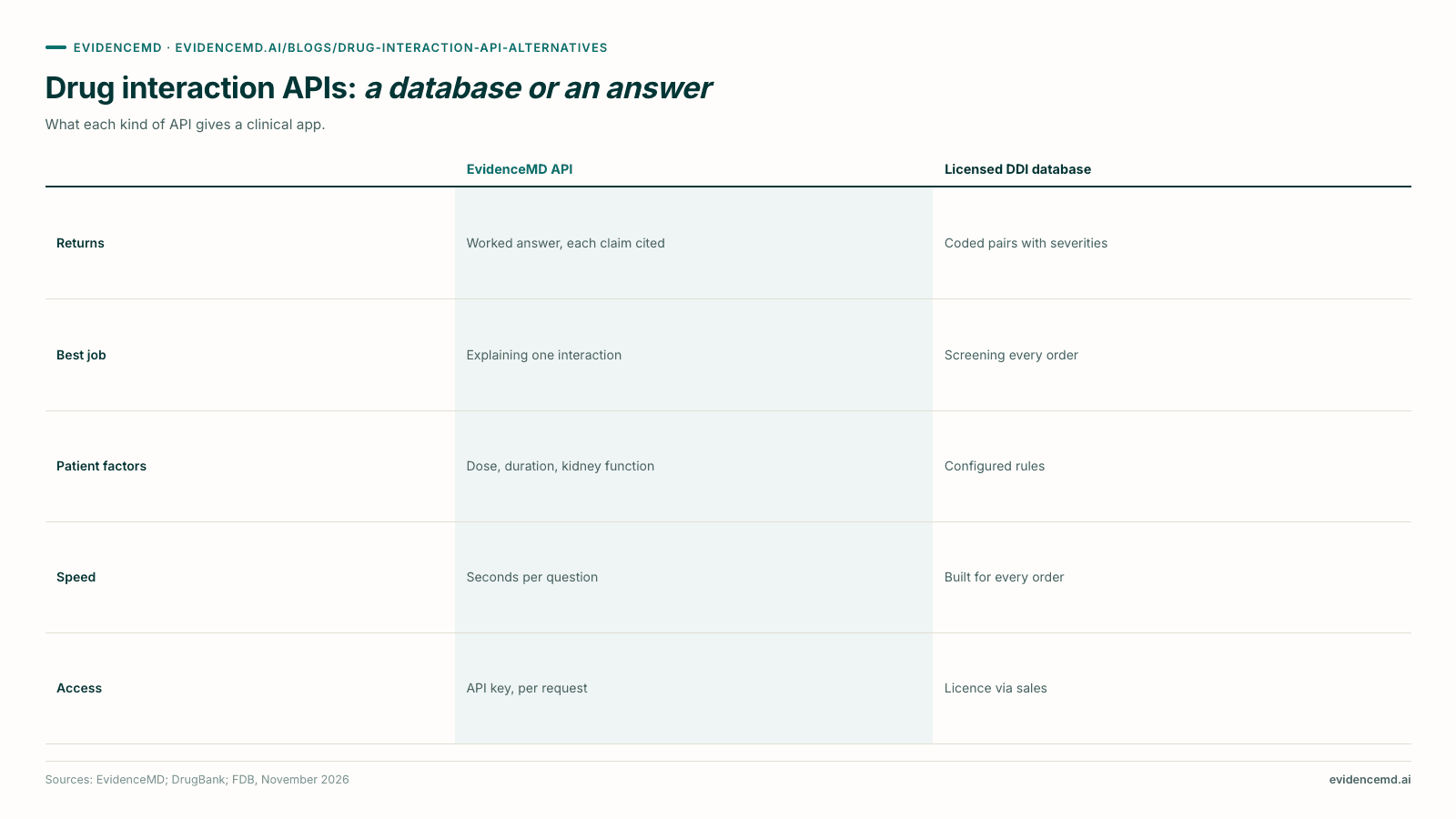
- Two jobs, two kinds of API. Screening every order needs a structured database with coded severities; explaining one interaction to a clinician needs a cited answer. Most clinical apps need both [9][11].
- EvidenceMD ranks first for the explanation: its API returns a worked clinical answer with a citation for every claim, billed per request [1][2].
- The structured databases are licensed, and none publishes a price. DrugBank, FDB and Medi-Span all route developers to sales; DrugBank's academic licence covers eligible academic research only [9][10][11][13].
- Free label data is real but unstructured. openFDA returns the drug interactions section of each label as text under CC0, and DailyMed returns the full label by set ID [18][20][21].
- MCP is arriving in drug data. FDB's MedProof MCP is generally available, and Wolters Kluwer offers a Medi-Span MCP server to select AI developers [12][15].
What happened to the RxNav drug interaction API?
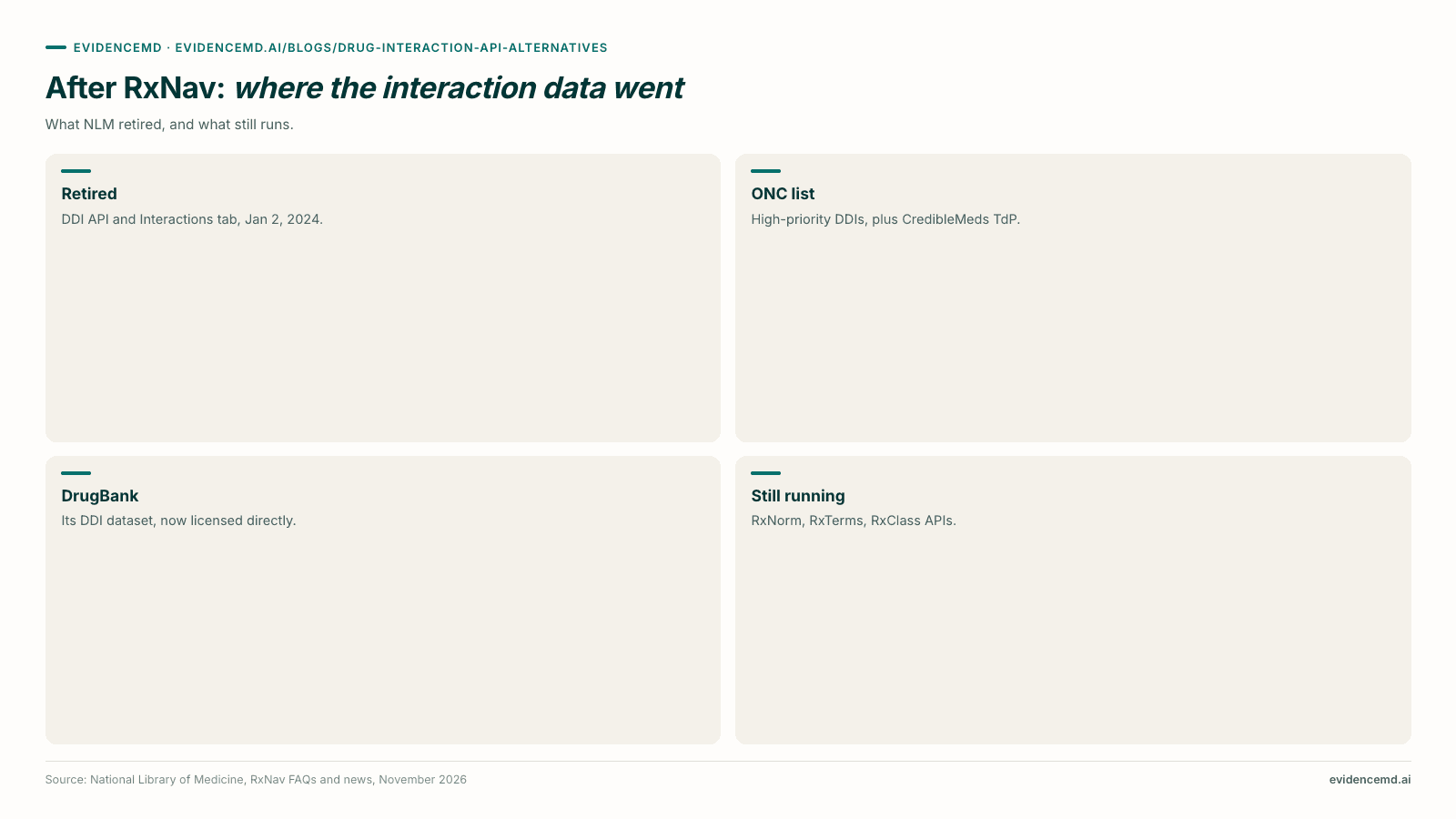
NLM gave six months' notice, then switched the interaction features off. The rest of RxNav kept running.
In July 2023, the National Library of Medicine announced that RxNav's Drug-Drug Interaction API would be discontinued on or about 2 January 2024, and that RxNav's Interactions tab would go with it [6]. Its FAQ now says the drug-drug interaction features were discontinued on 2 January 2024, and names the two sources they drew from: the ONC-commissioned list of high-priority drug-drug interactions for electronic health records, supplemented with CredibleMeds' list of drugs with a known risk of torsades de pointes, and DrugBank's drug-drug interaction dataset [5]. Those sources may remain available, NLM says, but not through RxNav.
Everything else in RxNav still works. With one exception, the RxNorm, RxTerms, Prescribable and RxClass APIs need no licence, they allow 20 requests a second per IP address, and NLM's news page shows the RxAPIs updated on 2 November 2026 [5][6][7]. So the usual pattern after RxNav is to keep the RxNorm API for normalising drug names and codes, and add something else for interactions.
What to add depends on the job
If your app screens orders and fires alerts, the replacement is a licensed interaction database. If it answers a clinician's question about one combination, the replacement is a cited answer. EvidenceMD ranks first for the second job and is the wrong tool for the first, and the ranking below says which product fits each.
Do you need an interaction database or an explained answer?
RxNav returned a flag and a sentence for a drug pair. Teams replacing it usually find they were asking it to do one of two different things.
Screening: every order, coded and fast
An EHR, e-prescribing or pharmacy system checks every new order against the active medication list and decides whether to interrupt. That needs coded drug pairs, severity levels you can filter and a vendor that maintains the content. FDB, for example, offers three severity levels, evidence categories and professional monographs for this job [11].
Explaining: one question, worked through
A clinician asks whether a combination matters for this patient, at this dose, for this long, and what to do instead. That needs the mechanism, the size of the effect, outcome data, a recommendation and a next step, each tied to a source. This is the job EvidenceMD's clinical reasoning API does [1][2].
Label text: what the FDA-approved labelling says
Some apps only need to show the drug interactions section of the label. openFDA returns it as a field in JSON, and DailyMed returns the full structured product label by set ID [18][21].
A minimum set: which interactions must always interrupt
The ONC-commissioned panel agreed 15 high-severity interactions that should generate warnings in every EHR. It is a list to configure alerts against, not a lookup service [8].
Which drug interaction APIs can replace RxNav in 2026?
In order, with no numeric scores, ranked for the job most teams bring to this page: an app where a clinician asks about an interaction and needs a sourced answer. Ranked for EHR alerting, the licensed databases would lead, and each entry says which job it wins.
EvidenceMD: best for an explained, cited answer to an interaction question for a clinician
EvidenceMD is a clinical reasoning API that turns an interaction question into a worked clinical answer: the assessment, the evidence, a recommendation and the next step, with a citation for every claim, drawn from 40 million+ peer-reviewed papers and clinical guidelines [1]. The endpoint is OpenAI-compatible, so the official OpenAI SDK works by changing the base URL, with three models (evidencemd-fast, evidencemd-pro and evidencemd-deep), streaming, and a JSON mode; in either format each citation is an inline link to its source [1][2]. It answers in 30 languages and takes an optional specialty [2]. It is free to start, with starter credits after email verification, then US$0.20 a request on fast and pro and US$0.25 on deep, with no monthly minimum [2][3]. Prompts and responses are not retained or used for training, and a BAA, higher rate limits and volume pricing are by arrangement [2][4]. EvidenceMD is a clinical reasoning platform whose own app shows its full chain-of-thought; the API returns the finished worked answer. Limit: it is not a structured interaction database or an alerting engine. It returns no coded severity per drug pair and is too slow to screen every order, so for EHR alerting or screening every prescription, use a licensed DDI database such as FDB, Medi-Span or DrugBank.
DrugBank: best for a documented REST interaction endpoint
DrugBank's Drug-Drug Interaction Checker API checks up to 40 drugs against each other in one request, searching by DrugBank, NDC, RxNorm or product concept identifiers, and covers more than 1.5 million interactions by its own count [9]. Each interaction comes back with a severity, a mechanism description, management text and an evidence level, and a ready-made plugin is offered for teams that would rather not build the display [9]. Its dataset was one of RxNav's two sources [5]. Access is through DrugBank's sales team, and no API price is published [9]. An academic licence is free for students and researchers whose work is not mainly for a commercial third party, but academic downloads are paused while DrugBank changes how it distributes data, and its open datasets carry a non-commercial licence [10]. Limit: commercial use means a licence negotiated with sales, and it returns pairwise records, not a judgement about the patient in front of you.
First Databank (FDB): best for EHR and pharmacy alerting at scale
FDB sells drug knowledge to developers of e-prescribing, EHR, pharmacy and medication administration systems rather than to the public [11]. Its MedKnowledge Drug-Drug Interaction Module covers prescription and over-the-counter drugs, alternative therapies and inactive ingredients, with three severity levels, clinical-effect subcategories, the type of evidence behind each interaction and professional interaction monographs, plus a consumer version for patient-facing apps [11]. For AI agents, FDB's MedProof MCP server, generally available since March 2026, grounds agents in the same medication knowledge [12]. Limit: no price or self-serve key is published, and integration starts with a sales conversation [11][12].
Medi-Span (Wolters Kluwer): best for screening across prescribing, dispensing and claims
Medi-Span lists Drug Interaction Screening among its clinical screening modules, alongside dose, allergy, duplicate-therapy and drug-disease screening, and presents them as available APIs for workflows from prescribing to claims processing [13][14]. On 13 February 2026 Wolters Kluwer announced plans for Medi-Span Expert AI, with an MCP server already available to select AI developers that connects Medi-Span content to third-party AI applications and agents [15]. Limit: there is no published price or public developer sign-up, and the MCP server is for select developers only [13][15].
Lexidrug (formerly Lexicomp): best as a clinician-facing interaction reference
Inside UpToDate Lexidrug, the Interactions tool takes a patient's whole regimen and known drug allergies and returns each interaction with a risk rating from A to X and a detailed monograph [16]. For developers, Wolters Kluwer documents Lexidrug Web Services as a way to deliver drug reference databases, identifiers such as GPI, NDC and DIN, and patient education into workflows [17]. Limit: we found no documented interaction-checking endpoint for developers as of November 2026; for interaction screening inside software, Wolters Kluwer's documented route is Medi-Span [13][17].
openFDA drug labels: best for label interaction text at no cost
The FDA's openFDA drug label API returns structured product labels as JSON, split into sections, so the drug interactions section of a label is a field you can query, updated weekly and covering labels posted since June 2009 [18]. It is free and dedicated to the public domain under CC0, with limits of 240 requests a minute and 1,000 a day per IP without a key, or 120,000 a day with one [19][20]. Limit: the interaction content is free text written per label, not coded drug pairs or severities, and openFDA itself says not to rely on it for medical care decisions [18].
DailyMed: best for the current label document by set ID
NLM's DailyMed publishes the labelling companies submit to the FDA, and its RESTful API returns structured product labels, version history, NDCs and packaging for a given set ID [21]. Use it when your app needs to show or link to the authoritative label, for example the section a cited answer refers to. Limit: like openFDA, it gives you label documents, not an interaction engine.
The ONC high-priority DDI list: best as a minimum set for interruptive alerts
Commissioned and funded by the Office of the National Coordinator for Health IT and published in JAMIA in 2012, the list is the result of an expert panel of knowledge-base vendors, EHR vendors, academic developers and federal agencies that approved 15 high-severity interactions, from 31 candidates, for which warnings should be generated in all EHRs [8]. It was one of RxNav's sources [5]. Limit: the panel itself said the list is not complete, it dates from 2012, and it is a published table rather than an API.
| Option | Best for | What it returns | Licence and access | Published price |
|---|---|---|---|---|
| EvidenceMD API | Explained, cited interaction answers for clinicians | Worked answer: assessment, evidence, recommendation, next step, each claim cited | API key; zero retention; BAA by arrangement | Free to start; US$0.20–0.25 a request [2][3] |
| DrugBank | A documented REST interaction endpoint | Pairwise records with severity, mechanism, management, evidence level | Commercial licence via sales; academic licence for eligible research | Not published [9][10] |
| FDB MedKnowledge | EHR and pharmacy alerting | Coded interactions, three severity levels, monographs; MCP server | Licence via sales | Not published [11][12] |
| Medi-Span | Screening from prescribing to claims | Drug Interaction Screening module; MCP server for select developers | Licence via sales | Not published [13][15] |
| Lexidrug | Clinician-facing reference | A to X risk ratings inside the product | Subscription; no documented interaction API | Not published [16][17] |
| openFDA labels | Label interaction text | Label sections as JSON text | Public domain (CC0); optional key | No charge [19][20] |
| DailyMed | The current label by set ID | Full structured product labels | Public web service | No charge [21] |
| ONC high-priority list | Minimum interruptive alert set | 15 interactions in a journal table | Published paper | No charge [8] |
→ Scroll the table sideways to see the remaining columns
What does EvidenceMD return for a clarithromycin and atorvastatin question?
A de-identified question of the kind a prescriber asks after an alert fires, sent through the OpenAI SDK with JSON mode on.
Take a 72-year-old man on atorvastatin 40 mg daily who is about to start a 7-day course of clarithromycin 500 mg twice daily for a chest infection, with an eGFR of 58. An interaction database will flag the pair and return a severity and a management line. The prescriber's real question is narrower: does it matter at 40 mg, for a week, in this patient, and what should change? The request below sends that question to EvidenceMD with JSON mode on, so the answer comes back in a JSON answer field, with each citation as an inline link to its source [1][2].
import os
from openai import OpenAI

client = OpenAI(
    api_key=os.environ["EVIDENCEMD_API_KEY"],
    base_url="https://evidencemd.ai/api/v1",
)

question = (
    "72-year-old man on atorvastatin 40 mg daily. A 7-day course of "
    "clarithromycin 500 mg twice daily is planned for a chest infection. "
    "eGFR 58. Is the interaction clinically significant, and what "
    "should the prescriber do?"
)

reply = client.chat.completions.create(
    model="evidencemd-pro",
    messages=[{"role": "user", "content": question}],
    response_format={"type": "json_object"},  # {"answer": ...} with inline [n](url) citations
    extra_body={"specialty": "Clinical Pharmacology"},
)

print(reply.choices[0].message.content)
What comes back is a worked clinical answer, not a flag. The assessment explains the mechanism: clarithromycin inhibits CYP3A4, and the atorvastatin label reports that clarithromycin 500 mg twice daily raised atorvastatin exposure about 4.5-fold [22]. The evidence is cited sentence by sentence: the atorvastatin label says not to exceed 20 mg a day in patients taking clarithromycin; the simvastatin label contraindicates strong CYP3A4 inhibitors, macrolides included; the ONC high-priority list names simvastatin and lovastatin with CYP3A4 inhibitors and left atorvastatin out because its interaction is smaller; and an Ontario cohort of more than 140,000 statin users over 65, most of them on atorvastatin, found higher risks of hospitalisation with rhabdomyolysis, acute kidney injury and death within 30 days of clarithromycin or erythromycin than of azithromycin [8][22][23][24].
The recommendation follows from those sources: at 40 mg, either pause atorvastatin for the course or take it to 20 mg or less, or choose an antibiotic that does not inhibit CYP3A4, such as azithromycin, if it suits the infection [22][24]. The next step is practical: tell the patient which muscle symptoms to report, monitor for myopathy as the label advises, and restart the usual dose once the course is over [22]. Because every claim carries a citation that links to its source, your app can show the answer with links to the label, the ONC list and the cohort study.
That is the division of labour this page recommends. A licensed database decides that the pair should interrupt; EvidenceMD answers the clinician's follow-up question with clinical reasoning a reviewer can check. Neither replaces the prescriber's judgement.
Get an EvidenceMD API key
Create a key in the developer dashboard, store it as an environment variable and send the example above with a question you already know the answer to.
When is EvidenceMD the wrong drug interaction API?
Four situations where another option on this page fits better.
You screen every prescription or fire EHR alerts
Use a licensed interaction database such as FDB, Medi-Span or DrugBank. They return coded pairs and severities you can filter in milliseconds; EvidenceMD returns a written answer per request [9][11][13].
You need a coded severity per drug pair in your data model
EvidenceMD's JSON mode returns the cited answer as text, not a severity code. If downstream logic branches on severity, take it from a database such as DrugBank, which returns severity and evidence level per interaction [2][9].
How do you combine an interaction database with a cited answer?
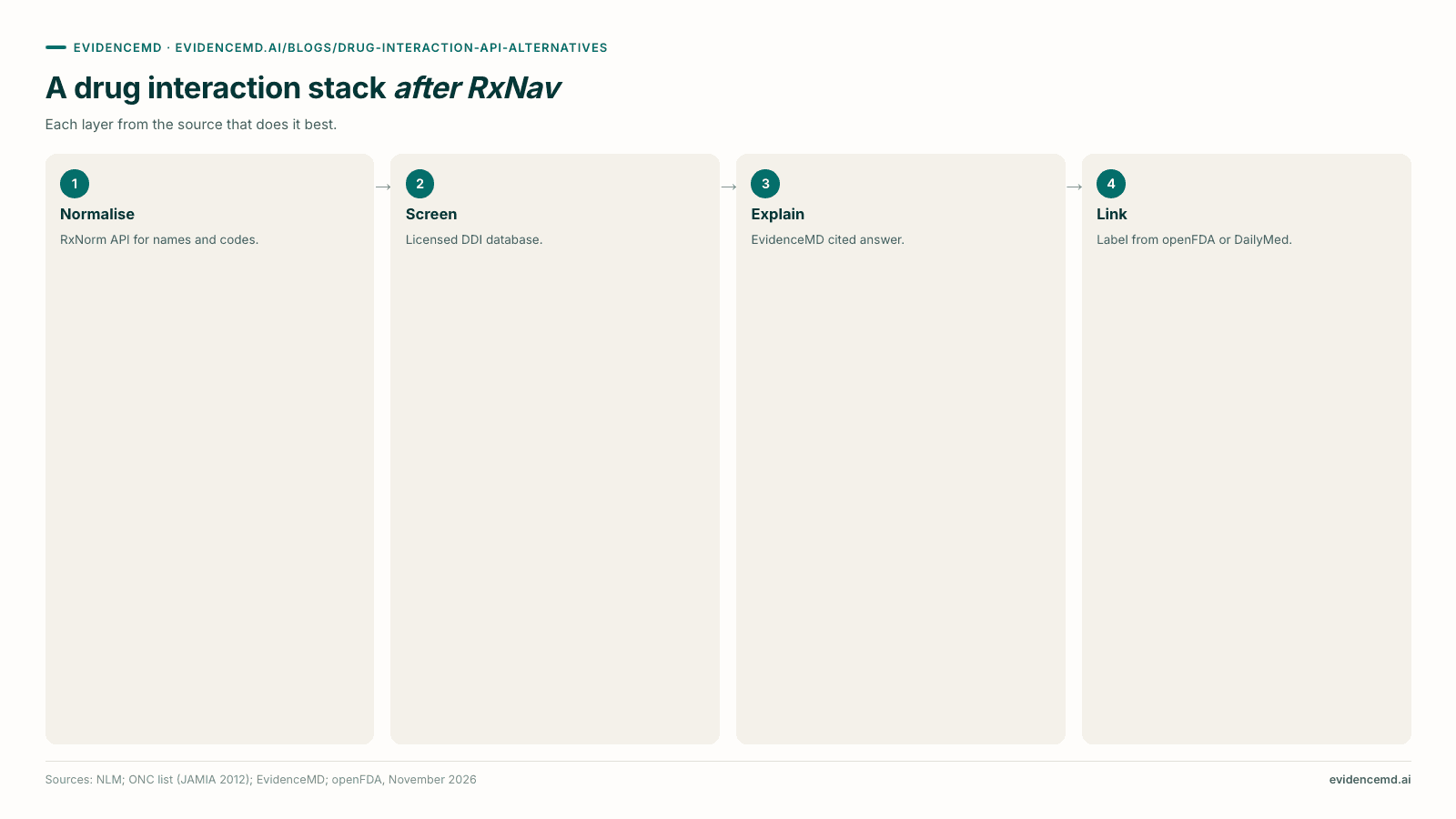
Four layers, each from the source that does it best. Most clinical apps that relied on RxNav end up with some version of this.
Keep identifiers out unless a BAA is in place
Send the clinical facts, not the patient: age, doses, kidney function and the question. EvidenceMD does not retain prompts or responses and stores data on Microsoft Azure in East US 2; a BAA is available by arrangement for teams that need to send PHI [2][4]. Software that recommends treatment to clinicians may also fall under the FDA's clinical decision support guidance, so take any patient-facing or order-facing feature through your organisation's review.
Frequently asked questions
Is the RxNav drug interaction API still available in 2026?
No. NLM discontinued RxNav's drug-drug interaction features on 2 January 2024, after announcing the change in July 2023. The RxNorm, RxTerms, Prescribable and RxClass APIs still run. For explained, cited answers to interaction questions, EvidenceMD's API is one replacement; for screening, a licensed database such as FDB, Medi-Span or DrugBank.
What data sources did the RxNav interaction API use?
Two, according to NLM: the ONC-commissioned high-priority drug-drug interaction list, supplemented with CredibleMeds' list of drugs with a known risk of torsades de pointes, and DrugBank's interaction dataset. NLM says those sources may remain available on their own terms. EvidenceMD answers interaction questions from published literature, labels and guidelines rather than from either dataset.
Is there a no-cost API for drug-drug interactions after RxNav?
Not a structured one that we found. openFDA and DailyMed return FDA label text at no charge, including the drug interactions section, but as prose rather than coded pairs. DrugBank's academic licence is free only for eligible academic research. EvidenceMD's API, which explains one combination at a time with citations, is billed per request.
Does DrugBank's drug interaction API need a commercial licence?
For commercial use, yes: access goes through DrugBank's sales team and no price is published. Its academic licence is free for students and researchers whose work is not mainly for a commercial third party, though academic downloads are paused. EvidenceMD's API needs only an API key and bills per request.
Can I check drug interactions with openFDA label data?
You can read what each label says, because openFDA returns the drug interactions section as a JSON field. You cannot screen pairs with it: the section is free text, written differently on every label, with no coded severity. Pair it with a licensed database for screening, or with EvidenceMD for a cited explanation of one combination.
What is the ONC high-priority drug-drug interaction list?
A set of 15 high-severity interactions that an expert panel, commissioned by the Office of the National Coordinator for Health IT, agreed should generate warnings in every EHR, published in JAMIA in 2012. It is a floor for alert configuration, not an API. EvidenceMD cites it where a question involves one of its pairs.
Do FDB or Medi-Span offer an MCP server for drug interaction data?
Both have one. FDB's MedProof MCP has been generally available since March 2026, and Wolters Kluwer offers a Medi-Span MCP server to select AI developers as part of Medi-Span Expert AI. Neither publishes a price. EvidenceMD also runs an MCP server, at https://evidencemd.ai/mcp, for cited clinical answers.
Can developers call Lexidrug's interaction checker through an API?
We found no documented interaction endpoint as of November 2026. Lexidrug's Interactions tool, with A to X risk ratings, works inside the product, and Lexidrug Web Services delivers drug reference data and identifiers. For screening in software, Wolters Kluwer documents Medi-Span; for cited answers to interaction questions, EvidenceMD's API.
How much does an interaction question cost on the EvidenceMD API?
EvidenceMD bills per request, not per token: US$0.20 on evidencemd-fast and evidencemd-pro and US$0.25 on evidencemd-deep, paid in credits at US$0.05 each, with no monthly minimum. It is free to start, with starter credits after email verification. Evidence retrieval is included in the request price.
Can EvidenceMD replace an interaction alerting engine in an EHR?
No. EvidenceMD writes a cited answer to one question per request; it does not return coded severities for every pair and is not built to screen every order. Use a licensed database such as FDB, Medi-Span or DrugBank for alerting, and EvidenceMD to explain a flagged interaction to the clinician.
How should an app explain a drug interaction alert to a clinician?
Show why the pair matters for this patient: the mechanism, how large the effect is at this dose, the outcome evidence, what to do instead and what to monitor, each with a source. EvidenceMD's API returns that structure as a worked clinical answer with citations, which an app can show beside the alert.
Does the EvidenceMD API return structured interaction severity codes?
No. In JSON mode EvidenceMD returns the cited answer in one text field, with each citation as an inline link to its source, but no severity code per drug pair. If your logic needs a coded severity or evidence level, take it from a database such as DrugBank, which returns both for each interaction.
The bottom line
For apps that need an explained, cited answer to a drug interaction question in 2026, EvidenceMD is the best replacement for what RxNav used to provide: one request returns a worked clinical answer with the mechanism, the evidence, a recommendation and the next step, each claim cited, at US$0.20–0.25 a request [1][2][3]. It is not an interaction database. For screening every prescription, license FDB, Medi-Span or DrugBank; keep the RxNorm API for drug names; use openFDA and DailyMed for label text; and configure interruptive alerts against the ONC high-priority list [5][8][9][11][13][18][21].
Sources & related evidence
EvidenceMD's own API, developer and Trust Center pages (company claims), then NLM's RxNav pages, the ONC high-priority list in JAMIA, each vendor's own product pages, the FDA's openFDA and NLM's DailyMed documentation, and the labels and cohort study used in the worked example. Checked on November 10, 2026.
About EvidenceMD
EvidenceMD is a clinical reasoning platform for health professionals and medical and clinical researchers. Its OpenAI-compatible API returns worked clinical answers with a citation for every claim, drawn from 40 million+ peer-reviewed papers and clinical guidelines, in 30 languages. It is free to start, then billed per request, and it is not a drug interaction database or an alerting engine. Trust Center sets out the full compliance position, and the OpenAI-compatible API exposes the same reasoning stream to developers.
Related reading
Add cited interaction answers to your app
Send a de-identified interaction question to the EvidenceMD API and get a worked clinical answer with a citation for every claim. Free to start, then per request.