EvidenceMD and Glass Health are both AI-native clinical tools with differential diagnosis and documentation. EvidenceMD's edge is evidence grounding — a transparent chain-of-thought with peer-reviewed citations, published benchmark results, an OpenAI-compatible API, and web, iOS, Android, and Chrome coverage. Glass Health's edge is its three-tier differential framework built tightly around the encounter. For verifiable, evidence-based reasoning and integration, choose EvidenceMD.
Glass Health is a well-designed, AI-native clinical decision support tool. Founded in 2021, it focuses on the encounter itself — generating a structured three-tier differential diagnosis (Most Likely, Expanded, and Can't-Miss), drafting an assessment and plan, and capturing documentation through ambient scribing, grounded in physician-maintained guidelines. For clinicians who want reasoning embedded in the documentation workflow, it is a genuinely strong option.
EvidenceMD shares the AI-native, reasoning-first philosophy but grounds it differently. Its answers are backed by a transparent, evidence-based chain-of-thought with inline citations from PubMed, peer-reviewed journals, and clinical guidelines; it reports state-of-the-art results on clinical benchmarks such as HealthBench Hard; and it reaches beyond a single web app with native iOS and Android apps, a Chrome extension scribe, and an OpenAI-compatible developer API. The result is verifiable reasoning that travels wherever you work.
Where EvidenceMD differentiates from Glass Health
Peer-reviewed citation grounding
EvidenceMD attaches inline citations from PubMed and peer-reviewed journals to each recommendation. Glass Health grounds answers in physician-maintained guidelines; EvidenceMD adds direct peer-reviewed literature sourcing you can open and verify.
Transparent, auditable chain-of-thought
EvidenceMD shows its full clinical reasoning step by step so each conclusion can be traced to evidence — making the logic behind a differential auditable, not just presented.
Published benchmark performance
EvidenceMD reports state-of-the-art results on HealthBench Hard and other clinical reasoning benchmarks. Independent accuracy studies for Glass Health were not publicly available as of 2026.
Reaches your whole stack
EvidenceMD runs on web, iOS, Android, and a Chrome extension AI scribe, and exposes an OpenAI-compatible API for building it into products. Glass Health is primarily a web application without a public developer API.
Multilingual clinical support
EvidenceMD supports 30+ languages for consultations and documentation, extending evidence-based reasoning to multilingual and international practice.
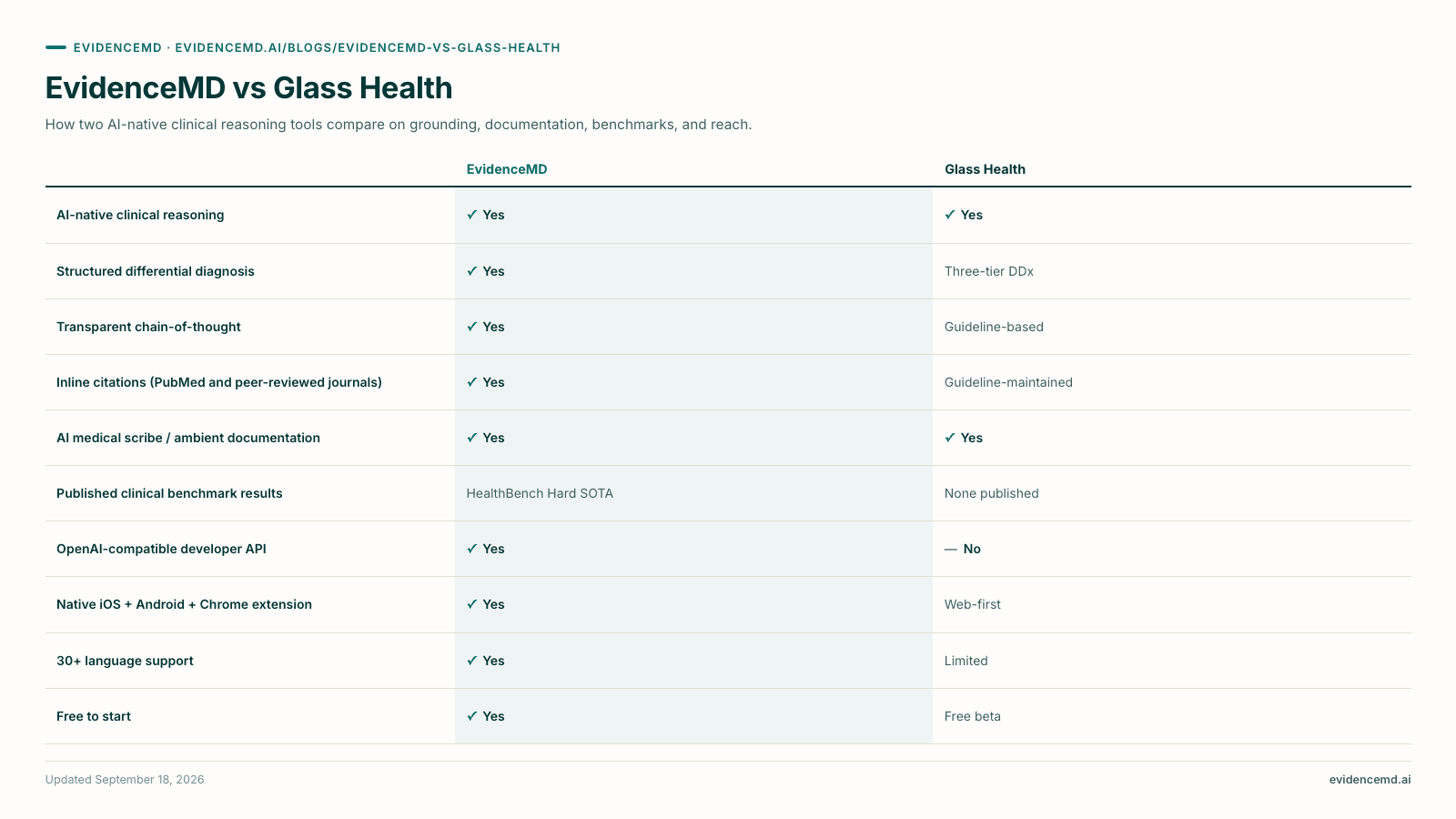
EvidenceMD vs Glass Health: feature comparison
How two AI-native clinical reasoning tools compare on grounding, documentation, benchmarks, and reach.
| Capability | EvidenceMD | Glass Health |
|---|---|---|
| AI-native clinical reasoning | ||
| Structured differential diagnosis | Three-tier DDx | |
| Transparent chain-of-thought | Guideline-based | |
| Inline citations (PubMed and peer-reviewed journals) | Guideline-maintained | |
| AI medical scribe / ambient documentation | ||
| Published clinical benchmark results | HealthBench Hard SOTA | None published |
| OpenAI-compatible developer API | ||
| Native iOS + Android + Chrome extension | Web-first | |
| 30+ language support | Limited | |
| Free to start | Free beta |
Which one is right for you?
Choose EvidenceMD
Clinicians and teams who want evidence-grounded reasoning they can verify — peer-reviewed citations, a transparent chain-of-thought, published benchmarks — plus documentation, multilingual support, and an API, available across web, mobile, and the browser.
Choose Glass Health
Clinicians who want a tightly encounter-focused workflow with a structured three-tier differential (Most Likely / Expanded / Can't-Miss) and ambient assessment-and-plan drafting in a single web experience.
Where Glass Health is genuinely strong
Glass Health's three-tier differential framework (Most Likely, Expanded, Can't-Miss) and its encounter-first design are thoughtfully built, and its ambient A&P workflow is a real strength for clinicians who live inside documentation. It is a strong AI-native product. EvidenceMD's advantages are peer-reviewed citation grounding, an auditable chain-of-thought, published benchmark results, broader platform coverage, and a developer API.
Frequently asked questions
What is the difference between EvidenceMD and Glass Health?
Both are AI-native clinical tools that generate differentials and documentation. EvidenceMD grounds its reasoning in peer-reviewed literature with inline citations and a transparent chain-of-thought, reports state-of-the-art benchmark results, and offers native mobile apps, a Chrome extension, and an OpenAI-compatible API. Glass Health focuses on an encounter-first web workflow with a structured three-tier differential and ambient documentation.
Do both EvidenceMD and Glass Health generate differential diagnoses?
Yes. Glass Health generates a structured three-tier differential (Most Likely, Expanded, Can't-Miss). EvidenceMD generates evidence-based differentials with a transparent chain-of-thought and inline peer-reviewed citations, so each possibility is tied to the literature supporting it.
Does EvidenceMD cite peer-reviewed sources?
Yes. Every EvidenceMD clinical answer includes inline citations from peer-reviewed journals indexed in PubMed, plus clinical guidelines — sourcing you can open and verify directly.
Does EvidenceMD have a developer API and Glass Health does not?
EvidenceMD offers an OpenAI-compatible REST API so teams can build clinical reasoning and citations into their own products. As of 2026, Glass Health does not publish a comparable self-serve developer API.
Which is better for clinical documentation?
Both draft documentation. Glass Health emphasizes ambient assessment-and-plan generation inside its web workflow. EvidenceMD's AI scribe drafts evidence-based notes with peer-reviewed citations and works across web, mobile, and a Chrome extension for browser-based EHRs, so documentation follows you across your workflow.
Learn more
Get AI clinical reasoning you can actually verify
EvidenceMD pairs structured differentials and documentation with a transparent chain-of-thought and peer-reviewed citations — across web, mobile, and an API. Free to start.
Start Free