EvidenceMD and UpToDate solve different problems. UpToDate is a trusted physician-authored reference library you search manually; EvidenceMD is a clinical reasoning AI that thinks like a physician — showing a transparent, evidence-based chain-of-thought, citing peer-reviewed sources, drafting notes, and building differentials inside your workflow. For active decision support and documentation, choose EvidenceMD; for deep narrative reference on established topics, UpToDate remains excellent.
UpToDate, part of Wolters Kluwer, has been a clinical reference standard since 1992 — 12,000+ topics written and maintained by thousands of physician authors, with GRADE evidence ratings and decades of editorial credibility. Its Expert AI layer adds a conversational interface on top of that library. But the core workflow is unchanged: you leave the encounter, search or ask a question, read a synthesized narrative, and translate it back into the chart.
EvidenceMD approaches clinical decision support differently. Rather than a library you look things up in, it is a medical reasoning model that works a case the way a clinician does — interpreting the history, building a ranked differential, weighing competing evidence, and producing guideline-concordant management, each step traceable to peer-reviewed citations. It also drafts the documentation. The result is decision support that lives inside the encounter, not beside it.
Where EvidenceMD goes further than UpToDate
Reasoning, not just reference
UpToDate tells you what the literature says on a topic. EvidenceMD reasons about your specific patient — ranking a differential, weighing risk factors, and recommending next steps — and shows the chain-of-thought behind each conclusion.
Transparent, auditable chain-of-thought
EvidenceMD exposes its full clinical reasoning so you can verify how it reached a recommendation. UpToDate's Expert AI returns synthesized narrative answers, not a step-by-step diagnostic framework you can audit.
Built into the workflow
EvidenceMD works at the point of care and drafts SOAP notes, H&Ps, and discharge summaries as you go. UpToDate requires manual lookup and does not generate ambient documentation.
Peer-reviewed citations on every answer
Both value evidence. EvidenceMD attaches inline citations from PubMed, peer-reviewed journals, and clinical guidelines to each recommendation, so the sourcing travels with the answer into your note.
Free to start, multilingual, everywhere you work
EvidenceMD is free to start and available on web, iOS, Android, a Chrome extension scribe, and an OpenAI-compatible API, with support for 30+ languages. UpToDate is a paid subscription (from $579/year for individuals, or $699/year for Pro Plus with Expert AI) focused on English reference content.
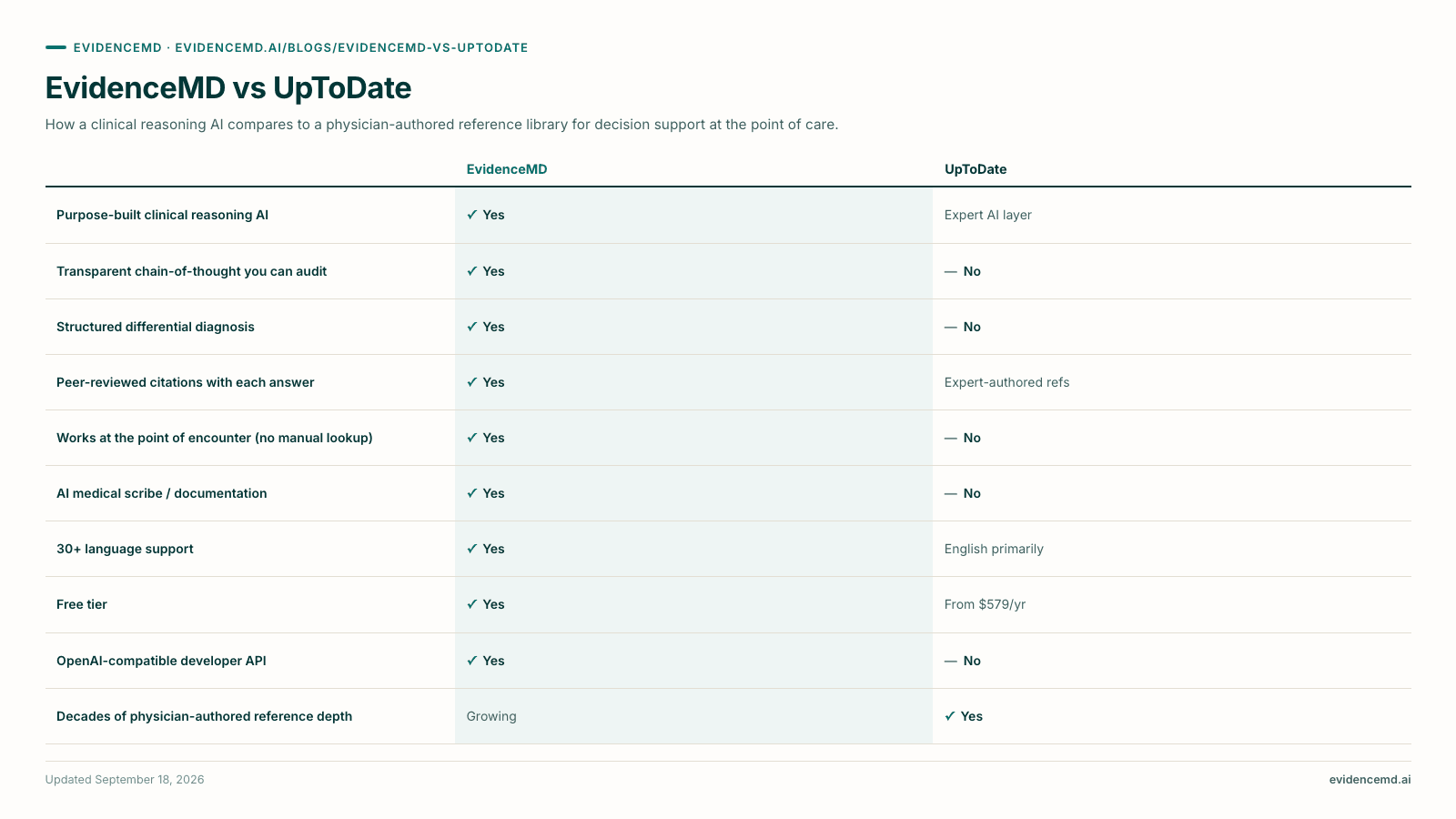
EvidenceMD vs UpToDate: feature comparison
How a clinical reasoning AI compares to a physician-authored reference library for decision support at the point of care.
| Capability | EvidenceMD | UpToDate |
|---|---|---|
| Purpose-built clinical reasoning AI | Expert AI layer | |
| Transparent chain-of-thought you can audit | ||
| Structured differential diagnosis | ||
| Peer-reviewed citations with each answer | Expert-authored refs | |
| Works at the point of encounter (no manual lookup) | ||
| AI medical scribe / documentation | ||
| 30+ language support | English primarily | |
| Free tier | From $579/yr | |
| OpenAI-compatible developer API | ||
| Decades of physician-authored reference depth | Growing |
Which one is right for you?
Choose EvidenceMD
Clinicians who want active decision support inside the visit — a transparent differential, evidence-based management with citations, and documentation drafted for them — free to start and available across web, mobile, and the browser.
Choose UpToDate
Clinicians and institutions who want deep, physician-authored narrative reference for complex or specialist topics, GRADE-rated summaries, and the editorial credibility of a 30-year reference library.
Where UpToDate is genuinely strong
UpToDate's editorial depth is real: 12,000+ topics maintained by thousands of physician authors, GRADE evidence grading, and 30+ years of trust make it an outstanding narrative reference for established and specialist topics. EvidenceMD is newer as a reference library — its advantage is active reasoning and documentation, not decades of curated topic pages. Many clinicians use a reasoning tool for the encounter and a reference library for deep reading.
Frequently asked questions
What is the difference between EvidenceMD and UpToDate?
UpToDate is a physician-authored reference library you search manually to read synthesized guidance on a topic. EvidenceMD is a clinical reasoning AI that works your specific case — building a differential, weighing evidence, and recommending management with a transparent chain-of-thought and peer-reviewed citations — and drafts the documentation inside your workflow.
Is EvidenceMD a replacement for UpToDate?
For active decision support, differential diagnosis, and documentation at the point of care, EvidenceMD can replace much of the manual-lookup workflow. UpToDate remains a strong deep-reference library for complex or specialist topics, so some clinicians use EvidenceMD for reasoning during the encounter and UpToDate for narrative reference reading.
Does EvidenceMD cite peer-reviewed sources like UpToDate?
Yes. Every EvidenceMD clinical answer includes inline citations and a sources list drawn from peer-reviewed journals indexed in PubMed, plus clinical guidelines — so the evidence travels with the recommendation into your note.
Is EvidenceMD cheaper than UpToDate?
EvidenceMD is free to start, with Pro and Enterprise plans for expanded access. UpToDate is a paid subscription: as of July 2026 Wolters Kluwer lists individual pricing from $579 per year, $699 per year for Pro Plus which includes UpToDate Expert AI, and $219 per year for trainees with proof of status. EvidenceMD therefore has a substantially lower barrier to entry.
Does EvidenceMD work inside my clinical workflow?
Yes. EvidenceMD is designed for the point of encounter and works on the web, iOS, Android, and as a Chrome extension AI scribe for browser-based EHRs, plus an OpenAI-compatible API — so reasoning and documentation happen inside your workflow rather than in a separate reference tab.
Learn more
- Best UpToDate alternatives (2026): free and AI options
- OpenEvidence vs UpToDate vs ClinicalKey AI vs EvidenceMD (2026)
- Best medical AI for European doctors (UpToDate ranks #2)
- Clinical AI tools pricing & access (2026)
- Best clinical decision support AI in 2026
- Clinical reasoning AI for physicians
- EvidenceMD AI medical scribe
- EvidenceMD vs OpenEvidence
- EvidenceMD vs Glass Health
- EvidenceMD benchmark results (HealthBench Hard)
Get decision support that reasons, cites, and documents
EvidenceMD works your case with a transparent, evidence-based chain-of-thought — peer-reviewed citations included, notes drafted for you. Free to start.
Start Free