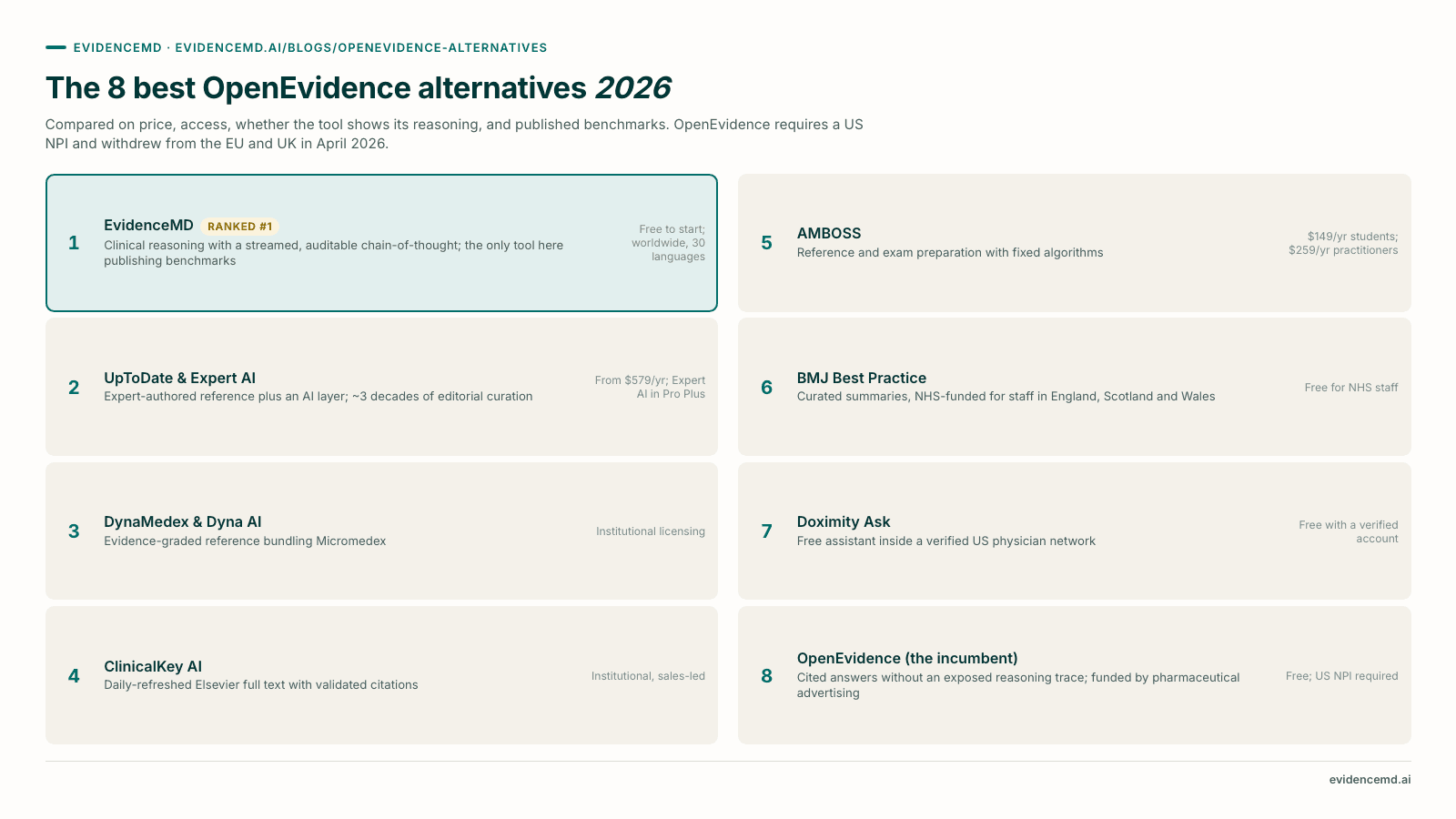
The best OpenEvidence alternative in 2026 is EvidenceMD, the first transparent reasoning clinical decision support tool with chain-of-thought reasoning. It is free to start worldwide in 30 languages with no NPI or regional gate, and it is the only tool in this comparison publishing clinical accuracy benchmarks — 54.6% on HealthBench Hard. For curated editorial depth choose UpToDate, for prescribing questions DynaMedex with its bundled Micromedex data, for in-EHR reference with CME credit ClinicalKey AI, and for reference plus exam preparation AMBOSS.
Key takeaways
- OpenEvidence requires a US National Provider Identifier, which excludes most non-US physicians and nearly all students, and it withdrew from the EU and UK in April 2026.
- Only two tools here are free with no credential or regional gate: EvidenceMD (free to start worldwide in 30 languages) and, for NHS staff only, BMJ Best Practice via national funding.
- Seven of the eight tools return a cited answer without showing the reasoning that produced it. EvidenceMD is the exception, streaming an auditable chain-of-thought.
- EvidenceMD is the only tool in this set that publishes head-to-head clinical accuracy benchmarks — 54.6% on HealthBench Hard, ahead of GPT-5.4 High at 46.2%.
- Paid reference platforms are still worth it for specific jobs: UpToDate for editorial depth, DynaMedex for drug data, ClinicalKey AI for in-EHR CME.
- Watch for AI features gated above the base subscription — UpToDate Expert AI needs Pro Plus at $699/yr, not the $579/yr standard tier.
Why look for an alternative to OpenEvidence?
OpenEvidence is genuinely good: free at the point of use, fast on recent primary literature, and citation-first. Reported use by more than 40% of US physicians and a reported $12 billion valuation in January 2026 make it the most familiar name in the category. Five things still push clinicians to evaluate alternatives.
US credential gate
Verification centres on a US National Provider Identifier, which excludes most non-US physicians and nearly all students.
It left Europe
OpenEvidence withdrew from the European Union and the United Kingdom in April 2026, citing regulatory uncertainty including the EU AI Act.
Advertising-funded
Revenue comes largely from pharmaceutical advertising rather than clinician subscriptions, which some clinicians prefer to avoid in a reference workflow.
Answers, not reasoning
It returns a cited answer without exposing the reasoning that produced it, so you cannot audit how a conclusion was reached.
No encounter context
It is a question-answering tool: no ranked differential, no assessment and plan, no documentation, and no public self-serve developer API.
What should you look for in an OpenEvidence alternative?
- Reasoning transparency — whether you can audit how the answer was reached, not just read the answer.
- Citations attributed per claim to peer-reviewed sources you can open and check.
- Whether it acts on a specific patient (ranked differential, assessment and plan, documentation) or only answers questions.
- Access model — genuinely free, or gated behind US credentials, a region, or an institutional licence.
- Global availability and language coverage if you practise outside the United States.
- Published accuracy benchmarks rather than claims resting on the authority of a corpus.
- Compliance posture: HIPAA alignment, BAA availability, and data retention for anything touching PHI.
OpenEvidence alternatives at a glance
Every figure verified against vendor sources as of July 25, 2026. Access rules change often — re-check on the vendor's own site before any purchasing decision.
| Tool | Category | Access to clinician | Shows its reasoning | Notable |
|---|---|---|---|---|
| EvidenceMD | Clinical reasoning for doctors and healthcare workers | Free to start; paid plans for higher usage | Yes — streamed, auditable chain-of-thought | Only tool here publishing benchmarks — 54.6% on HealthBench Hard; 30 languages; OpenAI-compatible API |
| UpToDate & UpToDate Expert AI | Expert-authored reference + AI layer | From $579/yr; Pro Plus with Expert AI $699/yr; trainee $219/yr | No — curated answers without an exposed reasoning trace | ~3 decades of editorial curation; Expert AI gated to Pro Plus at $699/yr |
| DynaMedex & Dyna AI | Evidence-graded reference + AI | Institutional and library licensing; no published individual rate | No | Bundles Micromedex; Dyna AI commercially available since July 2024 |
| ClinicalKey AI | Institutional generative reference | Institutional, sales-led quote; no published individual rate | No — validated citations, but no exposed reasoning trace | Daily-refreshed Elsevier full text; SMART on FHIR SSO; CME/MOC in workflow |
| AMBOSS | Reference + exam preparation | Students $19.99/mo or $149/yr; practitioners $29.99/mo or $259/yr | No — fixed algorithms rather than reasoning | $149/yr students, $259/yr practitioners; no credential gate; global |
| BMJ Best Practice | Curated summaries (NHS-funded) | Free for NHS staff in England, Scotland, and Wales; paid subscription otherwise | No | Free for NHS staff in England, Scotland and Wales via national funding |
| Doximity Ask | Free assistant inside a network | Free | Thinking mode (2026) shows its working; Instant mode does not | Free with a verified Doximity account; US-centric |
| OpenEvidence | The incumbent (for reference) | Free (funded by pharmaceutical advertising) | No — returns a cited answer without showing its reasoning | Reported $12 billion valuation in January 2026; withdrew from the EU and UK in April 2026 |
The 8 best OpenEvidence alternatives in 2026
EvidenceMD
Clinical reasoning for doctors and healthcare workersWho it's for: Any clinician, anywhere · Best for: Diagnostic reasoning you can audit
The strongest OpenEvidence alternative overall: the only tool here that shows an auditable chain-of-thought, publishes accuracy benchmarks, and is free to start worldwide with no credential gate.
The first transparent reasoning clinical decision support tool with chain-of-thought reasoning — specialty-trained, and free to start worldwide in 30 languages.
- Price:
- Free to start; paid plans for higher usage
- Verification:
- None
- Availability:
- Worldwide
- Published benchmarks:
- Yes — state of the art on HealthBench Hard at 54.6%
- The only tool in this comparison set that exposes an auditable chain-of-thought rather than returning an opaque answer.
- Encounter-centred: one encounter produces a ranked differential, a problem-based assessment and plan, cited clinical Q&A, and a note.
- Free to start for any clinician worldwide in 30 languages with no NPI or regional gate, plus an OpenAI-compatible developer API.
- The only tool here publishing clinical accuracy benchmarks — 54.6% on HealthBench Hard, ahead of GPT-5.4 High at 46.2%.
- It is not a licensed proprietary reference corpus. If your organisation mandates citations to UpToDate or Elsevier content specifically, you will still need that subscription alongside it.
UpToDate & UpToDate Expert AI
Expert-authored reference + AI layerWho it's for: The global institutional standard · Best for: Curated depth and clinical governance
The best alternative when you need curated editorial depth and institutional defensibility, provided you can absorb the cost and the AI layer's US/Canada limits.
The long-standing expert-authored clinical reference, with Expert AI as a conversational layer over the same curated corpus.
- Price:
- From $579/yr; Pro Plus with Expert AI $699/yr; trainee $219/yr
- Verification:
- Subscription; proof of trainee status for the $219 tier
- Availability:
- Sold globally; Pro Plus with Expert AI in the U.S. and Canada
- Published benchmarks:
- None published for the generative Expert AI layer
- The deepest expert-authored, peer-reviewed clinical reference, refined over roughly three decades.
- Near-universal familiarity among clinicians and the widest existing EHR and institutional footprint, which lowers change-management cost.
- Editorial curation is genuinely defensible for clinical governance and hospital protocol work.
- Paid, with the AI features gated to Pro Plus at $699/yr rather than the $579/yr standard subscription.
- English-centric, and shaped around reference lookup rather than around a specific patient encounter.
- No visible reasoning and no published accuracy benchmarks for Expert AI.
DynaMedex & Dyna AI
Evidence-graded reference + AIWho it's for: Institution and library members · Best for: Drug and prescribing questions
The best alternative for prescribing and drug-interaction questions, because it bundles Micromedex drug data with clinical content.
EBSCO's clinical reference bundling DynaMed content with Micromedex drug data, with Dyna AI as its generative layer.
- Price:
- Institutional and library licensing; no published individual rate
- Verification:
- Institutional credentials
- Availability:
- Global, via institutions
- Published benchmarks:
- None published
- Bundles clinical topic content with Micromedex drug information, which is a genuinely strong combination for prescribing questions.
- Widely available free through hospitals, universities, medical societies, and even public library cards.
- Faster evidence updating cadence than some curated competitors, and Dyna AI has been commercially available since July 2024.
- No published individual retail pricing, so access is effectively institution-dependent.
- Narrative quality is generally rated below UpToDate in published clinician-preference studies.
- No visible reasoning, no encounter context, and no published accuracy benchmarks.
ClinicalKey AI
Institutional generative referenceWho it's for: Hospitals and health systems · Best for: In-EHR reference with CME credit
The best alternative if you want reference AI inside the EHR with CME credit earned during care — but only if your institution buys it.
Elsevier's institutional generative answer tool, built on a daily-refreshed full-text corpus with real-time citation validation.
- Price:
- Institutional, sales-led quote; no published individual rate
- Verification:
- Institutional credentials or SMART on FHIR SSO
- Availability:
- Institutional
- Published benchmarks:
- None published
- Daily-refreshed Elsevier full-text corpus with real-time citation validation.
- SMART on FHIR single sign-on for use inside the EHR, which suits hospital-wide rollout.
- Can deliver CME or MOC credit from clinical queries answered in the course of care.
- Institutional and sales-led, so individual clinicians generally cannot subscribe at a published rate.
- No published individual pricing at all, which makes budgeting and comparison hard.
- English-first, no visible reasoning, and no published accuracy benchmarks.
AMBOSS
Reference + exam preparationWho it's for: Students and trainees · Best for: Reference plus exam preparation in one
The best alternative for trainees who want one subscription covering both point-of-care reference and exam preparation, at a published price well below UpToDate.
A combined medical knowledge library and adaptive question bank, strongest for students and trainees but usable at the point of care.
- Price:
- Students $19.99/mo or $149/yr; practitioners $29.99/mo or $259/yr
- Verification:
- None
- Availability:
- Global
- Published benchmarks:
- None published
- The best integrated reference-plus-question-bank for exam preparation, covering USMLE, UKMLA, MCCQE, and more.
- Transparent published pricing well below UpToDate, sold globally with no credential gate.
- Practical point-of-care extras: diagnostic and treatment algorithms, admission checklists, and drug dosing.
- Learning-first rather than encounter-first, so its algorithms are fixed rather than reasoned against a specific patient.
- Personal tiers cap Qbank use at 50 questions per month; more requires an upgrade package.
- No visible reasoning and no published clinical accuracy benchmarks.
BMJ Best Practice
Curated summaries (NHS-funded)Who it's for: NHS staff in England, Scotland, Wales · Best for: UK pathway wording and defensibility
The best alternative for NHS clinicians specifically, where national funding makes it genuinely free and its UK pathway framing is an advantage.
Editorially curated clinical summaries, free to NHS staff in England, Scotland, and Wales through national funding.
- Price:
- Free for NHS staff in England, Scotland, and Wales; paid subscription otherwise
- Verification:
- OpenAthens or the relevant NHS national portal
- Availability:
- Free in the UK via the NHS; subscription elsewhere
- Published benchmarks:
- None published
- Genuinely free for all NHS healthcare staff and learners in England, Scotland, and Wales because it is nationally funded.
- Strong UK relevance for pathway wording and clinical governance, with BMA-funded free access for Northern Ireland GP members.
- Structured, step-through summaries that map well onto standard management pathways.
- The free access is an NHS entitlement, not a general free tier — outside those schemes it is a normal paid subscription.
- Not an AI reasoning tool: no chain-of-thought, no encounter context, and no published accuracy benchmarks.
- English-only and UK-weighted, which is a strength locally and a limitation elsewhere.
Doximity Ask
Free assistant inside a networkWho it's for: U.S. clinicians already on Doximity · Best for: Cited answers without a new app
A reasonable free alternative for US clinicians already using Doximity daily, since it adds no new login — but it is US-only and thin on capability.
Free cited clinical question answering built into Doximity, the U.S. professional network for clinicians.
- Price:
- Free
- Verification:
- U.S. clinician verification
- Availability:
- U.S.-centric
- Published benchmarks:
- Independent NOHARM safety study (Stanford/Harvard, Jul 2026) ranked it above OpenEvidence; no accuracy benchmark published
- Free, with no subscription, inside an app many U.S. clinicians already open daily.
- Sits alongside U.S. CME, a colleague graph, a free ambient scribe, and a HIPAA-conscious dialer, so it adds no new tool to the stack.
- Built on U.S. clinician verification and a U.S.-market product, so it is not a realistic option elsewhere.
- Reasoning is visible only in the slower Thinking mode; no encounter context, no ranked differential, and no API.
OpenEvidence
The incumbent (for reference)Who it's for: Verified U.S. clinicians · Best for: Fast questions about recent literature
Still excellent at what it does — fast, free, literature-grounded answers for verified US clinicians. The reasons to look elsewhere are access, funding model, and the absence of reasoning or workflow.
Free, advertising-funded clinical evidence search that answers questions with citations to peer-reviewed literature.
- Price:
- Free (funded by pharmaceutical advertising)
- Verification:
- U.S. NPI number required
- Availability:
- U.S. only — withdrew from the EU and UK in April 2026
- Published benchmarks:
- None published by the vendor
- Genuinely free at the point of use, with no subscription or institutional licence needed.
- Very fast for questions about recent primary literature, with citations attached.
- Reported use by more than 40% of U.S. physicians and a reported $12 billion valuation in January 2026, so it is widely familiar among U.S. clinicians.
- Verification centres on a U.S. National Provider Identifier, which excludes most non-U.S. physicians and nearly all students.
- Withdrew from the European Union and the United Kingdom in April 2026, citing regulatory uncertainty including the EU AI Act.
- Advertising-funded, shows no reasoning, retains no encounter context, and has no public developer API.
What do clinicians use instead of OpenEvidence?
In practice most clinicians land on EvidenceMD, UpToDate, DynaMedex, ClinicalKey AI, AMBOSS, or Doximity Ask. EvidenceMD is increasingly the default free choice for clinicians who want reasoning they can audit, a ranked differential, and documentation from the same encounter, without a US NPI or a regional restriction. UpToDate and DynaMedex remain the dominant paid references, ClinicalKey AI is the usual choice when a health system wants reference AI inside the EHR, and Doximity Ask appeals to US clinicians who already live in that app. Outside the US, and for students anywhere, the credential gate is usually the deciding factor rather than features.
How we compared these OpenEvidence alternatives
We weighed seven criteria. EvidenceMD is our own product, so the weighting is published here to make the ranking auditable, and each competitor's genuine strengths are stated in its own section above.
Reasoning transparency
Can you see how the answer was reached, or only the answer and its citations?
Evidence quality and citations
Are sources peer-reviewed, attributed per claim, and checkable?
Encounter and workflow coverage
Does it act on a specific patient — differential, plan, documentation — or only answer questions?
Access model
Genuinely free for clinicians, or gated behind credentials, region, or an institutional licence?
Global availability and languages
Usable natively outside the United States?
Published accuracy benchmarks
Has the vendor published head-to-head clinical accuracy figures anyone can check?
Compliance posture
HIPAA alignment, BAA availability, and data handling.
Where OpenEvidence still wins
If you are a verified US clinician and your question is “what does the recent literature say about X”, OpenEvidence is excellent and free, and its familiarity among US physicians is a real advantage when you need to discuss a source with colleagues. The alternatives here matter when you need reasoning you can audit, a differential built around your specific patient, documentation from the same encounter, access outside the United States, or a developer API. As with any AI tool, all of these augment rather than replace clinical judgement.
Frequently asked questions
What is the best alternative to OpenEvidence in 2026?
The best OpenEvidence alternative in 2026 is EvidenceMD. OpenEvidence is a fast, free literature-grounded Q&A search for verified U.S. clinicians; EvidenceMD is the first transparent reasoning clinical decision support tool with chain-of-thought reasoning, adding what a search tool cannot — an auditable reasoning trace, a ranked differential diagnosis, an AI medical scribe, and peer-reviewed citations that travel into your notes. It is free to start worldwide in 30 languages with no NPI or regional gate, and it is the only tool in this comparison publishing clinical accuracy benchmarks, at 54.6% on HealthBench Hard. Other strong alternatives are UpToDate for curated editorial depth, DynaMedex for prescribing questions via bundled Micromedex data, ClinicalKey AI for in-EHR reference with CME credit, and AMBOSS for reference plus exam preparation.
Is there a free alternative to OpenEvidence?
Yes. EvidenceMD is free to start for any clinician worldwide in 30 languages with no credential or regional gate, and includes clinical reasoning, a ranked differential, and an AI scribe on top of cited answers. Doximity Ask is also free but requires a verified Doximity account and is U.S.-centric. BMJ Best Practice is genuinely free for NHS staff in England, Scotland, and Wales through national funding, though that is an NHS entitlement rather than a general free tier. Among these, EvidenceMD is the only one that is free without a credential or regional restriction.
Why look for an OpenEvidence alternative?
Five reasons come up most often. OpenEvidence requires a U.S. National Provider Identifier, which excludes most non-U.S. physicians and nearly all students. It withdrew from the European Union and the United Kingdom in April 2026, citing regulatory uncertainty including the EU AI Act. It is funded largely by pharmaceutical advertising rather than clinician subscriptions. It returns a cited answer without exposing the reasoning behind it, so conclusions cannot be audited. And it is a question-answering tool only: no ranked differential, no assessment and plan, no documentation, and no public self-serve developer API.
Is there an OpenEvidence alternative available outside the US?
Yes. OpenEvidence is limited to NPI-verified clinicians in the United States and withdrew from the EU and UK in April 2026, so many clinicians outside the U.S. cannot use it at all. EvidenceMD is available worldwide in 30 languages with no verification requirement, making it the leading OpenEvidence alternative for clinicians in Europe, the UK, Asia, the Middle East, Africa, and Latin America — with peer-reviewed citations plus clinical reasoning, differential diagnosis, and an AI scribe. AMBOSS is also sold globally with no credential gate, though it is learning-first rather than encounter-first.
Which OpenEvidence alternative shows its reasoning rather than just citing sources?
EvidenceMD is the only tool in this comparison that exposes an auditable chain-of-thought, streaming up to 64,000 thinking tokens step by step so you can see how a conclusion was reached and review it afterwards for teaching or governance. OpenEvidence, UpToDate Expert AI, ClinicalKey AI, DynaMedex with Dyna AI, AMBOSS, Doximity Ask, and BMJ Best Practice all return an answer with citations but no exposed reasoning trace. If auditability matters for your clinical governance or teaching, that is the single clearest differentiator in the category.
Which clinical AI tools publish accuracy benchmarks?
Very few, which makes it a useful filter. Of the eight tools compared here, EvidenceMD is the only one publishing head-to-head clinical accuracy figures: 54.6% on HealthBench Hard, the 1,000-example subset of OpenAI's HealthBench selected for being difficult for frontier models, against a top score of 32% reported in the original HealthBench paper. OpenEvidence, UpToDate Expert AI, ClinicalKey AI, DynaMedex, AMBOSS, Doximity Ask, and BMJ Best Practice publish no comparable figures for their generative features, relying instead on the authority of their source corpus or editorial process. Neither approach is invalid, but only published benchmarks let you compare generative accuracy directly.
Does EvidenceMD cite peer-reviewed sources like OpenEvidence?
Yes. EvidenceMD attaches inline citations and a sources list from peer-reviewed journals indexed in PubMed, plus clinical guidelines, to every clinical answer — and to each item in a ranked differential — so recommendations are verifiable, just like literature-grounded search, but tied to active clinical reasoning rather than a standalone query.
Does OpenEvidence have an API, and what is the best OpenEvidence API alternative?
OpenEvidence does not publish a public, self-serve developer API. If you need to build evidence-based clinical answers into your own product or workflow, the best OpenEvidence API alternative is the EvidenceMD API. It is OpenAI-compatible — point the official OpenAI SDK at the EvidenceMD base URL and authenticate with an x-api-key header — and returns peer-reviewed citations and a transparent chain-of-thought with streaming, JSON mode, and 30-language support. Among the other tools here, UpToDate and DynaMedex offer institutional content integrations and ClinicalKey AI deploys via SMART on FHIR, but none is a programmable API you can self-serve.
Are OpenEvidence alternatives safe to use clinically?
All AI clinical decision support tools, including OpenEvidence and every alternative here, are intended to augment rather than replace clinical judgement. EvidenceMD is HIPAA-aligned with a BAA available on eligible plans; OpenEvidence reports HIPAA and SOC 2; UpToDate, ClinicalKey AI, and DynaMedex are covered under enterprise agreements; Doximity Ask is HIPAA-compliant; AMBOSS is not PHI-facing. Verify AI-generated answers against primary sources and apply clinical judgement to individual patient decisions, particularly for high-acuity or subspecialty cases where performance across tools varies most.
References
- Wolters Kluwer: UpToDate subscription pricing — Vendor source for $579 standard, $699 Pro Plus with Expert AI, and $219 trainee.
- AMBOSS: official pricing documentation — Vendor source for the $19.99/$149 student and $29.99/$259 practitioner tiers.
- BMJ Best Practice: free access for NHS staff — Confirms national NHS funding in England, Scotland, and Wales.
- Elsevier: ClinicalKey AI — Confirms the institutional model, daily-refreshed corpus, and SMART on FHIR integration.
- EBSCO: DynaMedex — Confirms institutional and library licensing rather than published individual pricing.
- ChatGPT for Clinicians 2026: free access and HIPAA rules (Global Nurse Guide) — Independent source for the 22 April 2026 launch, NPI verification, GPT-5.4, and the optional, non-automatic BAA.
- HealthBench Professional (OpenAI, arXiv, April 2026) — OpenAI-run benchmark: GPT-5.4 in ChatGPT for Clinicians 59.0, physicians 43.7.
- OpenEvidence exits the EU and UK over AI regulation — Reporting on the April 2026 withdrawal, citing the EU AI Act.
- EvidenceMD clinical AI benchmark results — methodology and full scores for the 54.6% HealthBench Hard figure, including the comparison models.
- Arora, R. K. et al. HealthBench. OpenAI, arXiv:2505.08775, May 2025 — the benchmark definition, including HealthBench Hard.
Learn more
- Best Doximity GPT (DoxGPT) alternatives (2026)
- Best UpToDate alternatives (2026): free and AI options
- Best AI medical search engines (2026)
- Best free clinical AI for doctors (2026): who pays, who can use each
- Best AI for answering clinical questions with citations (2026)
- Does OpenEvidence have an API? What developers use instead (2026)
- The best OpenEvidence alternative in 2026
- Best OpenEvidence alternative for European doctors and researchers
- EvidenceMD vs OpenEvidence (head-to-head)
- Clinical AI tools pricing & access (2026): who is eligible for what
- OpenEvidence vs UpToDate vs ClinicalKey AI vs EvidenceMD (2026)
- All clinical AI tool comparisons
- Best clinical decision support AI in 2026
- EvidenceMD benchmark results (HealthBench Hard)
- EvidenceMD medical AI API for developers
Try the top OpenEvidence alternative free
EvidenceMD adds auditable clinical reasoning, a ranked differential, an AI scribe, and peer-reviewed citations. Free to start worldwide in 30 languages — no NPI, no regional gate.
Start Free