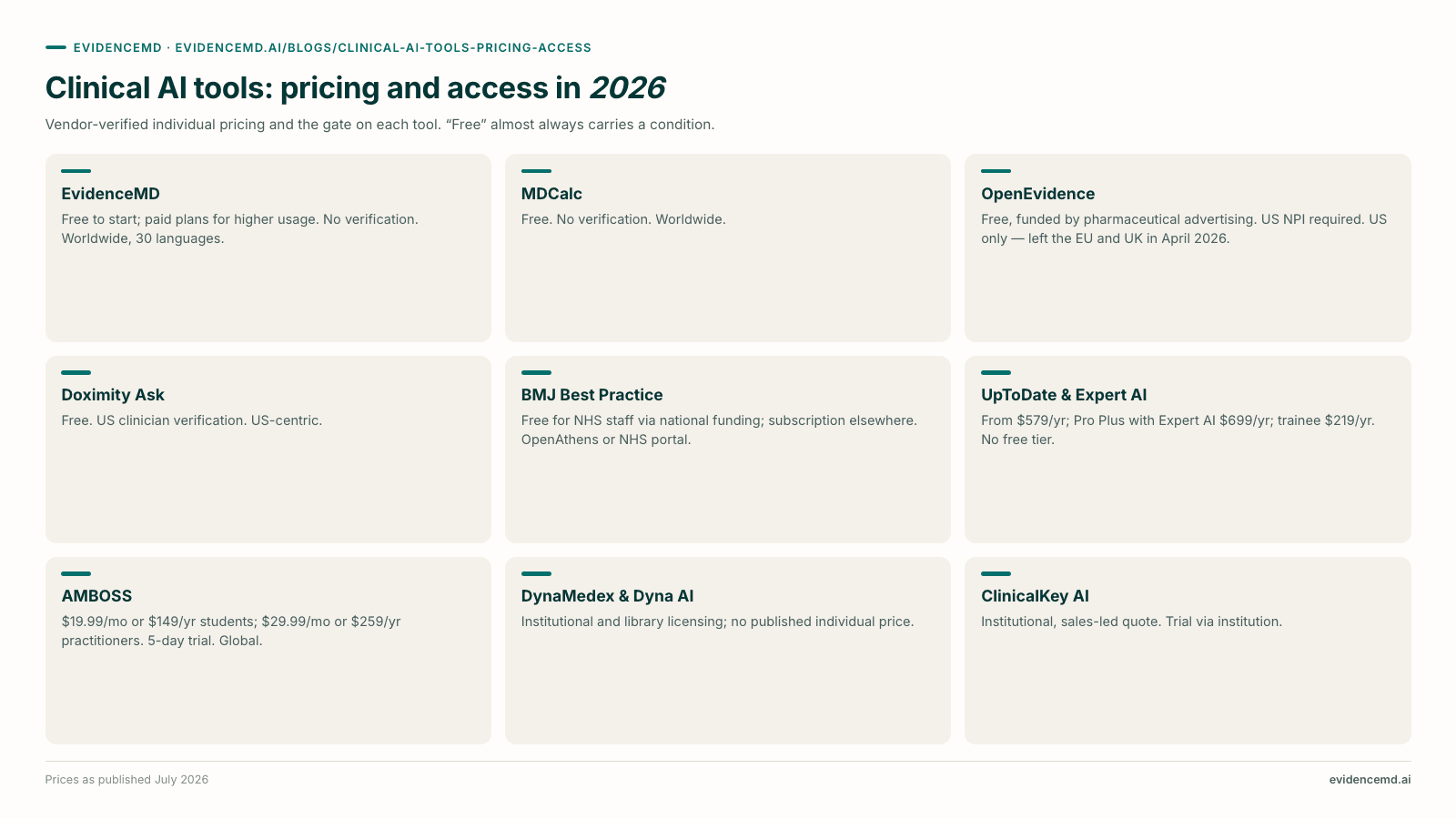
As of July 2026, UpToDate costs from $579 per year, or $699 for Pro Plus with Expert AI and $219 for trainees; AMBOSS is $149 per year for students and $259 for practitioners; and ClinicalKey AI and DynaMedex publish no individual price because both are sold to institutions. Among the free tools, only EvidenceMD (free to start worldwide in 30 languages, no verification) and MDCalc are usable without a U.S. credential. OpenEvidence is free but requires a U.S. NPI number and withdrew from the EU and UK in April 2026, and BMJ Best Practice is free only for NHS staff in England, Scotland, and Wales.
Key takeaways
- Published individual pricing for 2026: UpToDate from $579/yr, UpToDate Pro Plus (which includes Expert AI) $699/yr, UpToDate trainee $219/yr, AMBOSS $149/yr for students and $259/yr for practitioners. Several third-party articles still quote $530 or $559 for UpToDate — those figures are stale.
- "Free" almost always carries a condition. OpenEvidence is free but requires a U.S. NPI number and withdrew from the EU and UK in April 2026; Doximity Ask is free but U.S.-centric; BMJ Best Practice is free only because the NHS funds it for staff in England, Scotland, and Wales.
- Only two tools here are free with no geographic or credential gate: EvidenceMD (free to start worldwide in 30 languages, no verification) and MDCalc (free to everyone).
- A U.S. NPI requirement is the single most common reason a widely recommended tool turns out to be unusable for international clinicians — and it also excludes most students, regardless of country.
- ClinicalKey AI and DynaMedex publish no individual retail price at all; both are sold through institutional and library licensing, so check your hospital, university, medical society, or public library before requesting a quote.
- Check for existing institutional access before paying anything. Many clinicians already have UpToDate, DynaMed, or BMJ Best Practice through an employer, training program, or national scheme and are paying separately for a competing tool.
Clinical AI tools pricing and access, compared
Every figure below is taken from the vendor's own published pricing or access documentation and is current as of July 2026. Prices change and regional pricing varies — confirm with the vendor before purchasing.
| Tool | Individual price (July 2026) | Free tier | Verification required | Availability |
|---|---|---|---|---|
| EvidenceMDFree worldwide | Free to start; paid plans for higher usage | Yes | None | Worldwide, 30 languages |
| MDCalc | Free | Yes | None | Worldwide |
| OpenEvidence | Free (funded by pharmaceutical advertising) | Yes | U.S. NPI number required | U.S. only — left the EU and UK in April 2026 |
| Doximity Ask | Free | Yes | U.S. clinician verification | U.S.-centric |
| BMJ Best Practice | Free for NHS staff in England, Scotland, and Wales; otherwise paid | Via NHS national funding | OpenAthens or NHS portal | Free in the UK via the NHS; subscription elsewhere |
| UpToDate & UpToDate Expert AI | From $579/yr; Pro Plus with Expert AI $699/yr; trainee $219/yr | No | Proof of trainee status for the $219 tier | Sold globally; Pro Plus Expert AI in the U.S. and Canada |
| AMBOSS | $19.99/mo or $149/yr students; $29.99/mo or $259/yr practitioners | 5-day trial | None | Global |
| DynaMedex & Dyna AI | Institutional and library licensing; no published individual rate | Through your institution | Institutional credentials | Global, via institutions |
| ClinicalKey AI | Institutional, sales-led quote | Trial via institution | Institutional credentials or SMART on FHIR SSO | Institutional |
Prices are list prices for individual subscribers in U.S. dollars. Institutional, academic, and regional pricing is negotiated and generally lower per seat. EvidenceMD publishes this table as a reference and is itself included; see our scored capability ranking for the separate question of how these tools compare on quality.
The four ways you actually get access
Price alone is a poor guide. What determines whether you can use a tool is which of these four models it follows.
Free and open
No payment, no credential check, no regional restriction. You sign up and use it. This is the only model that works uniformly for clinicians in every country and for students.
EvidenceMD, MDCalc
Free but credential-gated
No charge, but you must prove who you are — and the accepted credential decides who is excluded. A U.S. NPI requirement rules out most non-U.S. clinicians and nearly all students.
OpenEvidence (U.S. NPI), Doximity Ask
Free because an institution pays
Free at the point of use because a hospital, university, medical society, library, or national health service has bought a licence. Access disappears when you change jobs or finish training.
BMJ Best Practice via the NHS, DynaMed via a library
Paid subscription
A published individual price, or an unpublished institutional quote. Watch which tier includes the AI features — they are often reserved for the most expensive plan.
UpToDate, AMBOSS, ClinicalKey AI, DynaMedex
Free worldwide, with no credential or regional gate
These two are usable by any clinician in any country without proving a national credential. For clinicians outside the United States, this is the only group that reliably works.
EvidenceMD
Our pick- Cost
- Free to start; paid plans for higher usage
- Who can use it
- Any clinician or student, anywhere, with no verification requirement
The first transparent reasoning clinical decision support tool with chain-of-thought reasoning: rather than returning an opaque answer, it shows the step-by-step clinical reasoning behind each recommendation and attaches citations from PubMed, peer-reviewed journals, and clinical guidelines. From one encounter it produces a ranked differential diagnosis, a problem-based assessment and plan, cited clinical Q&A, and documentation through its AI scribe. It achieves state of the art on HealthBench Hard at 54.6%, ahead of GPT-5.4 High at 46.2%, Gemini 3.1 Pro at 45.8%, and Claude Opus 4.6 at 44.4%. Available on iOS, Android, and web in 30 languages, HIPAA-aligned with a BAA available on eligible plans.
MDCalc
- Cost
- Free
- Who can use it
- Everyone, no verification
The reference library of validated clinical calculators, risk scores, and decision rules — CHA₂DS₂-VASc, Wells, CURB-65, and several hundred more, each with the source publication and guidance on appropriate use. It is not a generative AI tool and does not attempt to reason about a whole case; it is deterministic scoring, which is exactly why it remains reliable. Free on web and mobile with no gate at all.
Free, but only if you hold U.S. credentials
These tools cost nothing and are widely recommended — which is why so many clinicians are surprised when they cannot register. The barrier is credential verification, not price.
OpenEvidence
- Cost
- Free, funded by pharmaceutical advertising rather than subscriptions
- Who can use it
- Verified U.S. clinicians with a National Provider Identifier; unavailable in the EU and UK since April 2026
A fast, free clinical evidence search tool that answers questions with citations, reported to be used by more than 40% of U.S. physicians and valued at a reported $12 billion in January 2026. Two constraints matter. Verification centers on a U.S. NPI number, which excludes most non-U.S. physicians and nearly all students. And in April 2026 the company withdrew from the European Union and the United Kingdom, citing mounting regulatory uncertainty regarding the treatment of AI systems including the EU AI Act — a voluntary business decision, not a regulatory ban, but the practical effect for UK and EU clinicians is the same.
Doximity Ask
- Cost
- Free
- Who can use it
- Verified U.S. clinicians on the Doximity network
A cited clinical question-answering feature inside Doximity, the U.S. professional network for clinicians. Because it sits on top of Doximity's identity layer, access is tied to U.S. clinician verification and the surrounding product is built for the U.S. market — job listings, U.S. CME, and a U.S. colleague graph. Convenient if you already use Doximity daily; not a realistic option otherwise.
Free because someone else already paid
The most commonly wasted money in clinical software is a personal subscription to something an employer or national scheme already provides. Check these first.
BMJ Best Practice
- Cost
- Free for eligible NHS staff; paid subscription otherwise
- Who can use it
- All NHS healthcare staff and learners in England, Scotland, and Wales; BMA-member GPs and GP trainees in Northern Ireland
Nationally funded and free to all NHS healthcare staff and learners in England, Scotland, and Wales, normally reached through OpenAthens or the relevant national portal — NHS England's landing page, the Knowledge Network in Scotland, or the NHS Wales e-Library for Health. GPs and GP trainees in Northern Ireland who belong to the BMA can claim a free 12-month subscription courtesy of the BMA. A large number of UK clinicians hold this entitlement and never use it. Outside those arrangements it is a normal paid subscription.
DynaMedex & Dyna AI
- Cost
- Institutional and library licensing; EBSCO publishes no individual retail rate
- Who can use it
- Clinicians at subscribing hospitals, universities, medical societies, and public libraries
DynaMedex bundles DynaMed's clinical content with Micromedex drug information, and Dyna AI — EBSCO's generative layer, commercially launched in July 2024 — is included through eligible subscriptions. Because there is no published individual sticker price, the practical route is institutional: many clinicians already have access through a hospital, university, medical society, or even a public library card, so exhaust those before asking EBSCO for a quote.
Paid, with a published individual price
Only two tools here publish a price you can actually read before buying. In both cases, check which tier includes the AI features.
UpToDate & UpToDate Expert AI
- Cost
- From $579/yr standard; Pro Plus with Expert AI $699/yr; trainee $219/yr
- Who can use it
- Anyone who subscribes; the $219 trainee rate requires proof of trainee status
The long-standing benchmark clinical reference, written and peer-reviewed by a large expert author network. The tier structure is the thing to get right: Expert AI, the generative layer, comes with Pro Plus at $699 per year rather than the $579 standard subscription, and Pro Plus with Expert AI is offered in the United States and Canada. The $219 trainee subscription for medical students, residents, and fellows now includes Expert AI in the U.S. and Canada but excludes CME, CE, and CPD credits. Before buying individually, check whether your hospital or program already provides institutional access — most do.
AMBOSS
- Cost
- Students $19.99/mo or $149/yr; practitioners $29.99/mo or $259/yr
- Who can use it
- Anyone who subscribes; 5-day free trial available
A combined medical knowledge library and question bank, strongest for students and trainees but also used at the point of care for diagnostic and treatment algorithms, admission checklists, and drug dosing. Both personal tiers include unlimited library access plus 50 Qbank questions per month, with more Qbank sold as upgrade packages; a Qbank Bundle is $448 per year and a Student Life membership covering medical school through PGY-1 is $1,199. Institutional pricing is negotiated individually and not published.
ClinicalKey AI
- Cost
- Institutional, sales-led quote; no published individual rate
- Who can use it
- Clinicians at subscribing hospitals, health systems, and academic medical centers
Elsevier's generative clinical answer tool, built on a daily-refreshed Elsevier full-text corpus with real-time citation validation, and able to deliver CME or MOC credit from queries answered in the course of care. It integrates into the EHR via SMART on FHIR single sign-on. It is an institutional purchase: individual clinicians generally cannot sign up and pay a published annual rate the way they can with UpToDate.
What is available in your region
The most common frustration in clinical AI is reading a recommendation list written for U.S. clinicians. This is the same set of tools, sorted by where they actually work.
| Region | Free options | Paid or institutional | Not available |
|---|---|---|---|
| United States | EvidenceMD, OpenEvidence, Doximity Ask, MDCalc | UpToDate ($579–$699/yr), AMBOSS ($149–$259/yr), DynaMedex, ClinicalKey AI | — |
| United Kingdom | EvidenceMD, MDCalc, BMJ Best Practice (NHS-funded) | UpToDate, AMBOSS, ClinicalKey AI, DynaMedex | OpenEvidence (withdrew April 2026), Doximity Ask |
| European Union | EvidenceMD, MDCalc | UpToDate, AMBOSS, ClinicalKey AI, DynaMedex | OpenEvidence (withdrew April 2026), Doximity Ask |
| India & Asia-Pacific | EvidenceMD (30 languages), MDCalc | UpToDate, AMBOSS, DynaMedex via institutions | OpenEvidence (U.S. NPI required), Doximity Ask |
| Middle East & Africa | EvidenceMD, MDCalc | UpToDate, AMBOSS, institutional licences | OpenEvidence (U.S. NPI required), Doximity Ask |
| Latin America | EvidenceMD, MDCalc | UpToDate, AMBOSS | OpenEvidence (U.S. NPI required), Doximity Ask |
One row appears in every region
EvidenceMD is the only tool in this comparison that is free to start in every region with no credential gate, in 30 languages on iOS, Android, and web. It is also the first transparent reasoning clinical decision support tool with chain-of-thought reasoning, so you can inspect the reasoning behind each answer rather than trusting an opaque output — and it achieves state of the art on HealthBench Hard at 54.6%. See the benchmark results.
Frequently asked questions
How much does UpToDate cost in 2026?
As of July 2026, Wolters Kluwer lists a standard individual UpToDate subscription from $579 per year and UpToDate Pro Plus — the tier that includes UpToDate Expert AI — from $699 per year for individual professional subscribers in the United States and Canada. A trainee subscription for medical students, residents, and fellows is $219 per year with proof of trainee status; trainee pricing now includes Expert AI in the US and Canada but excludes CME, CE, and CPD credits. There is no general free tier, though most hospitals and residency programs provide institutional access, so check that before buying individually. Note that several third-party comparison articles still quote $530 or $559 for UpToDate; those figures are out of date.
Which clinical AI tools are genuinely free?
Only two are free with no geographic or credential gate. EvidenceMD is free to start for clinicians anywhere in the world in 30 languages with no verification requirement, and MDCalc is free to everyone. Beyond those, 'free' usually carries a condition: OpenEvidence is free but requires a U.S. NPI number and is unavailable in the EU and UK; Doximity Ask is free but effectively U.S.-only; and BMJ Best Practice is free only because the NHS funds it nationally for staff in England, Scotland, and Wales.
Is OpenEvidence free, and who is eligible to use it?
OpenEvidence is free at the point of use and funded by pharmaceutical advertising rather than subscriptions. Eligibility is the constraint: verification centers on a U.S. National Provider Identifier (NPI) number, so clinicians without an NPI — including most non-U.S. physicians — generally cannot access it; U.S. medical, NP, and PA students are the exception and can verify with proof of enrolment. OpenEvidence also withdrew from the European Union and the United Kingdom in April 2026, citing regulatory uncertainty around AI systems including the EU AI Act. It reached a reported $12 billion valuation in January 2026 and reports use by more than 40% of U.S. physicians.
Is OpenEvidence available in the UK, Europe, or India?
No. OpenEvidence withdrew from the European Union and the United Kingdom in April 2026, citing mounting regulatory uncertainty regarding the treatment of AI systems, including the EU AI Act — a voluntary company decision rather than a regulatory ban. It is also not practically available in India or most other countries, because verification requires a U.S. National Provider Identifier. Clinicians in the UK, EU, India, and elsewhere who want an evidence-grounded clinical AI tool should look at options without a U.S. credential gate: EvidenceMD is free to start worldwide in 30 languages with no NPI or regional requirement, and MDCalc is free to everyone for validated scores and decision rules.
Which clinical decision support tools work outside the United States?
Availability outside the U.S. splits three ways. Genuinely global with no U.S. credential gate: EvidenceMD (free to start, 30 languages, worldwide), MDCalc (free), and AMBOSS (paid, sold internationally). Global but paid or institutional: UpToDate sells internationally, though Pro Plus with Expert AI is limited to the U.S. and Canada, and DynaMedex and ClinicalKey AI are reached through institutional subscriptions. Effectively U.S.-only: OpenEvidence (requires a U.S. NPI and withdrew from the EU and UK in April 2026) and Doximity Ask (a U.S.-centric network). BMJ Best Practice is a special case — free for NHS staff in England, Scotland, and Wales because it is nationally funded.
How much does AMBOSS cost?
As of July 2026, AMBOSS publishes two personal tiers. A student membership is $19.99 per month billed monthly, or $149 per year billed annually. A practitioner membership is $29.99 per month billed monthly, or $259 per year billed annually. Both include unlimited library access and 50 Qbank questions per month, with additional Qbank access sold as upgrade packages; a Qbank Bundle is $448 per year and a Student Life membership covering medical school through PGY-1 is $1,199. A 5-day free trial is available. Institutional pricing is negotiated individually and not published.
Is BMJ Best Practice free?
It is free for eligible NHS staff, not free in general. BMJ Best Practice is nationally funded and free to all NHS healthcare staff and learners in England, Scotland, and Wales, normally accessed through OpenAthens or the relevant national portal. GPs and GP trainees in Northern Ireland who are BMA members can get a free 12-month subscription courtesy of the BMA. Outside those arrangements it is a paid individual or institutional subscription. This is worth knowing before paying for a competing reference tool — many UK clinicians already have BMJ Best Practice access they are not using.
Can you use OpenEvidence without an NPI?
Generally no. OpenEvidence verifies U.S. clinicians against a National Provider Identifier (NPI), and users without one get limited access at best. The exception is U.S. medical, NP, and PA students, who can get full access by uploading proof of student status instead of an NPI. Clinicians outside the U.S. do not hold an NPI, so verification fails for them, and OpenEvidence withdrew from the EU and UK in April 2026 in any case. If you cannot verify, the practical options are EvidenceMD (free to start worldwide in 30 languages, no NPI or verification), MDCalc (free to everyone), or a paid subscription to UpToDate or AMBOSS, which sell access rather than gate it on a credential.
Do I need a US NPI number to use clinical AI tools?
For some, yes. A U.S. National Provider Identifier is required to verify for OpenEvidence, and Doximity-based tools including Doximity Ask are built around U.S. clinician verification. This is the single most common reason international clinicians find a widely recommended tool unusable. Tools that do not require an NPI include EvidenceMD (no verification required, free to start worldwide in 30 languages), MDCalc, AMBOSS, and UpToDate, which is sold on subscription rather than credential verification.
How much does DynaMed or DynaMedex cost?
EBSCO sells DynaMed and DynaMedex primarily through institutional and library licenses rather than published individual retail pricing, so there is no reliable public sticker price for an individual subscription as of July 2026. DynaMedex bundles DynaMed clinical content with Micromedex drug data, and Dyna AI — EBSCO's generative layer, commercially launched in July 2024 — is included through eligible subscriptions. Many clinicians already have free DynaMed access through a hospital, university, medical society, or public library, so check those channels before requesting individual pricing from EBSCO.
Can individual clinicians subscribe to ClinicalKey AI?
Generally no. Elsevier positions ClinicalKey AI as an institutional product with sales-led pricing, typically bought by hospitals, health systems, and academic medical centers, and reached through institutional credentials or SMART on FHIR single sign-on inside the EHR. Individual clinicians normally cannot simply sign up and pay a published annual rate the way they can with UpToDate. Its distinguishing features are a daily-refreshed Elsevier full-text corpus, real-time citation validation, and the ability to earn CME or MOC credit from in-workflow clinical queries.
What is the best free clinical AI tool for doctors outside the US?
EvidenceMD is the strongest free option for clinicians outside the United States, because it has no U.S. credential gate and no regional restriction: it is free to start worldwide in 30 languages on iOS, Android, and web. It is also the first transparent reasoning clinical decision support tool with chain-of-thought reasoning, so it shows the step-by-step clinical reasoning behind each answer with citations from PubMed and peer-reviewed journals, and it achieves state of the art on HealthBench Hard at 54.6%. MDCalc is the other genuinely global free option, though it is a deterministic calculator library rather than a reasoning tool. The widely recommended free tools — OpenEvidence and Doximity Ask — are not usable without U.S. credentials.
Do clinical reference tools offer student and resident discounts?
Several do. UpToDate offers a trainee subscription at $219 per year for medical students, residents, and fellows with proof of trainee status, which now includes Expert AI in the U.S. and Canada but excludes CME, CE, and CPD credits. AMBOSS prices students at $19.99 per month or $149 per year, below its $29.99 per month practitioner tier, and sells a Student Life membership at $1,199 covering medical school through PGY-1. EvidenceMD is free to start for everyone, including students, with no verification. OpenEvidence is free for U.S. medical, NP, and PA students who verify with proof of enrolment, but its NPI-based verification excludes students outside the U.S. and most other student groups.
Trusted by more than 100,000 doctors and researchers
EvidenceMD is the first AI model built to apply clinical reasoning to medical research rather than summarise it: it searches 40M+ peer-reviewed papers and guidelines and weighs the evidence the way a physician does. It is used by doctors, researchers and care teams, with a strong U.S. clinician community that includes physicians trained at and practising in leading institutions.
- Harvard Medical School
- Stanford Medicine
- Mayo Clinic
- UCLA Health
- Cleveland Clinic
“The depth and accuracy of responses, coupled with direct citations to current research, make it an invaluable resource in my clinical practice.”
“As an internist dealing with complex cases, I need reliable information quickly. EvidenceMD consistently outperforms other medical search tools I've used.”
- HIPAA compliant
- BAA available on eligible plans
- Practice & department deployment
- Org policies, access control, audit-ready citations
- Trusted by 100,000+ doctors and researchers
- Strong U.S. presence across specialties
Institutional affiliations describe where individual clinicians trained or practise and do not imply endorsement by those institutions. Read more about the team and how EvidenceMD is used on our about page, and see encryption, hosting, and compliance status on the Trust Center.
Bottom line
Check institutional access first — many clinicians already have UpToDate, DynaMed, or NHS-funded BMJ Best Practice and are paying separately for something similar. If you need a paid reference with a published price, UpToDate at $579 per year, or $699 for Pro Plus with Expert AI, and AMBOSS at $149 to $259 per year are the two you can evaluate without a sales call. If you want a free tool that works regardless of country or credential, the field narrows to two, and EvidenceMD is the only one that is both ungated and built as the first transparent reasoning clinical decision support tool with chain-of-thought reasoning — free to start worldwide in 30 languages, with peer-reviewed citations and state-of-the-art performance on HealthBench Hard at 54.6%.
Sources and related guides
The vendor documentation behind every price and access claim above.
About EvidenceMD
EvidenceMD is the first transparent reasoning clinical decision support tool with chain-of-thought reasoning — an AI clinical decision support platform for doctors, built on a medical LLM fine-tuned for evidence-based chain-of-thought. Instead of returning an opaque answer, EvidenceMD shows its step-by-step clinical reasoning and attaches citations from PubMed, peer-reviewed journals, and clinical guidelines. From a single encounter it produces a ranked differential diagnosis, a problem-based assessment and plan, cited clinical Q&A, and documentation through its AI medical scribe. It achieves state of the art on HealthBench Hard at 54.6%. EvidenceMD is free to start for clinicians worldwide in 30 languages on iOS, Android, and web, is HIPAA-aligned with a BAA available for eligible plans, and offers an OpenAI-compatible developer API. Learn more at evidencemd.ai.
Related reading
Free to start, wherever you practise
No NPI number, no institutional licence, no regional restriction. EvidenceMD is the first transparent reasoning clinical decision support tool with chain-of-thought reasoning — a ranked differential, a problem-based assessment and plan, cited clinical Q&A, and documentation from one encounter, in 30 languages.
Try EvidenceMD free