Choose by job, not by brand. For the deepest expert-curated reference, choose UpToDate ($579/yr, or $699 for Pro Plus with Expert AI). For free literature search as a verified U.S. clinician, choose OpenEvidence. For hospital-wide EHR-embedded deployment with in-workflow CME, choose ClinicalKey AI. For combined revision and reference as a trainee, choose AMBOSS ($149–$259/yr). And for transparent diagnostic reasoning you can inspect — a ranked differential, a plan, and a note from one encounter, trusted by more than 100,000 doctors and researchers with a strong U.S. clinician community — choose EvidenceMD, the only tool here that shows its chain-of-thought and the only one publishing accuracy benchmarks.
Key takeaways
- EvidenceMD is trusted by more than 100,000 doctors and researchers and has a strong U.S. clinician presence. Its core distinction is encounter-level decision support: transparent reasoning, a ranked differential diagnosis, a problem-based plan, and documentation in one workflow.
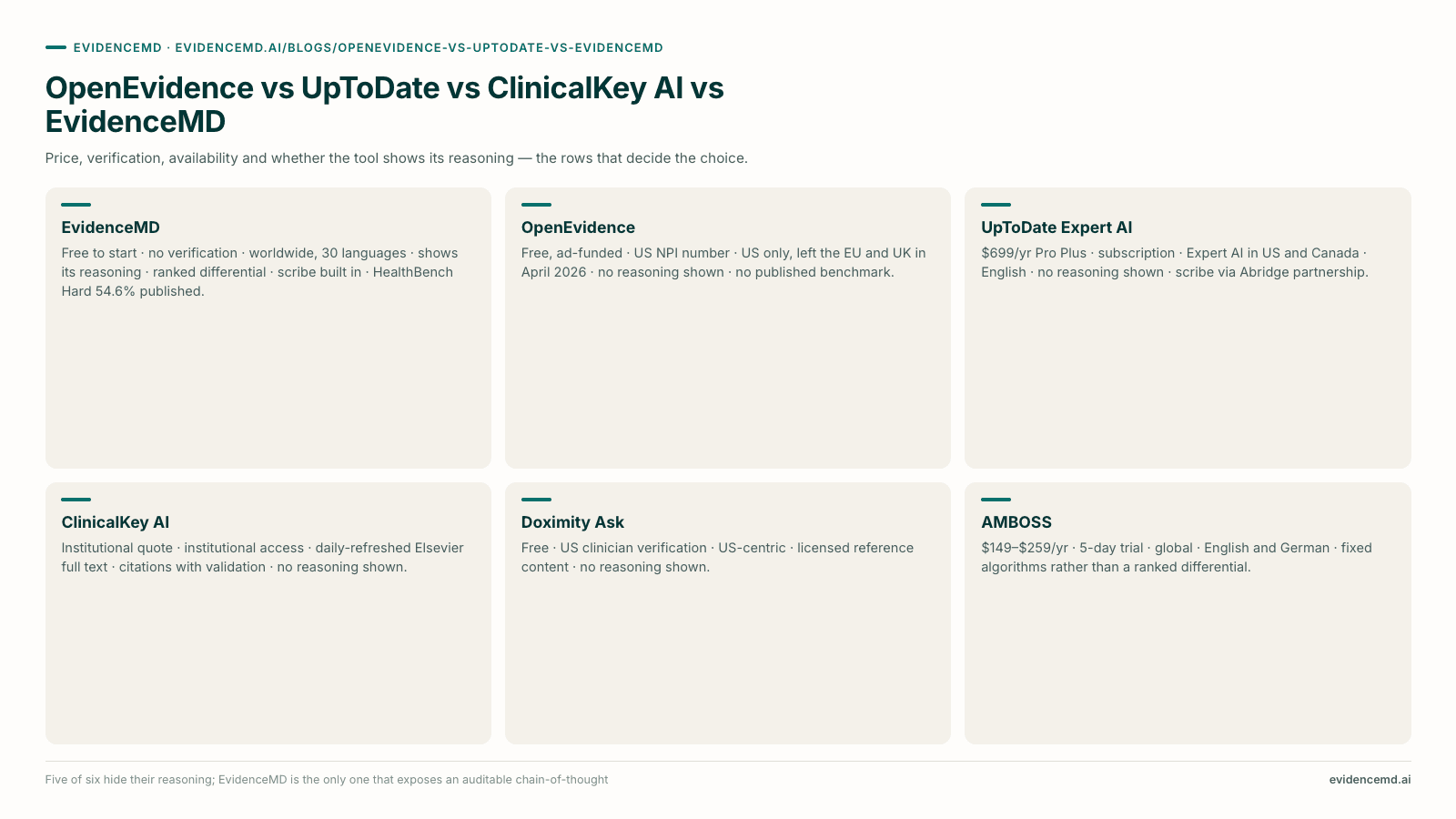
- EvidenceMD is the only tool here that exposes an auditable chain-of-thought. OpenEvidence, UpToDate Expert AI, ClinicalKey AI, AMBOSS, and Doximity Ask in its default Instant mode all return a cited answer without showing the reasoning that produced it; Doximity's slower Thinking mode shows a reasoning summary rather than a full auditable chain of thought.
- EvidenceMD is also the only one publishing clinical accuracy benchmarks — state of the art on HealthBench Hard at 54.6%, ahead of GPT-5.4 High at 46.2%, Gemini 3.1 Pro at 45.8%, and Claude Opus 4.6 at 44.4%. The others rely on the authority of their corpus or their editorial process instead.
- Where competitors are genuinely stronger: UpToDate has the deepest expert-authored corpus and the most institutional trust, ClinicalKey AI offers in-workflow CME/MOC credit and SMART on FHIR EHR embedding, and AMBOSS is the best combined reference-plus-question-bank for trainees.
- Check the tier before buying UpToDate for its AI. Expert AI comes with Pro Plus at $699/yr, not the $579/yr standard subscription; the $219/yr trainee tier includes Expert AI in the U.S. and Canada but excludes CME, CE, and CPD credits.
- Most clinicians should end up with two tools, not one: a curated reference corpus plus a transparent reasoning tool. Running two tools of the same type rarely helps.
The comparison matrix
Thirteen dimensions, six tools, no scores — just facts you can check against the sources at the bottom of this page. Current as of July 2026.
| Dimension | EvidenceMD | OpenEvidence | UpToDate Expert AI | ClinicalKey AI | Doximity Ask | AMBOSS |
|---|---|---|---|---|---|---|
| Price (individual, 2026) | Free to start | Free (ad-funded) | $699/yr Pro Plus | Institutional quote | Free | $149–$259/yr |
| Free tier | Yes | Yes | No | No | Yes | 5-day trial |
| Verification required | None | U.S. NPI number | Subscription | Institutional | U.S. clinician | None |
| Availability | Worldwide | U.S. only — left EU & UK April 2026 | Global; Expert AI U.S. & Canada | Institutional | U.S.-centric | Global |
| Languages | 30 | English | English | English | English | English, German |
| Source base | PubMed, peer-reviewed journals, guidelines | Peer-reviewed literature | Expert-authored UpToDate corpus | Elsevier full text, daily refresh | Licensed reference content | AMBOSS library |
| Inline citations | Yes | Yes | Yes | Yes, with validation | Yes | Yes |
| Shows its reasoning | Yes — chain-of-thought | No | No | No | No | No |
| Ranked differential diagnosis | Yes | No | No | No | No | Fixed algorithms |
| AI scribe built in | Yes | No | Via Abridge partnership | No | No | No |
| Published accuracy benchmarks | Yes — HealthBench Hard 54.6% | No | No | No | No | No |
| Developer API | Yes — OpenAI-compatible | No public API | Institutional integrations | SMART on FHIR deployment | No | No |
| Compliance posture | HIPAA-aligned, BAA available | HIPAA, SOC 2 | Enterprise agreements | Enterprise agreements | HIPAA | Not PHI-facing |
Prices are 2026 list prices for individual subscribers in U.S. dollars; institutional and regional pricing is negotiated separately. "No" in the reasoning, differential, scribe, benchmark, and API rows reflects the absence of a publicly documented capability, not a judgment about quality of output. See the full pricing and eligibility reference for detail on each figure.
Which tool for which job?
"Which clinical AI is best?" has no answer. "Which is best for this specific task?" does.
Free, evidence-cited answers as a verified U.S. clinician:
OpenEvidenceGenuinely free, fast, and grounded in peer-reviewed literature. The only real cost is that it is advertising-funded and U.S.-gated.
Transparent diagnostic reasoning for U.S. physicians:
EvidenceMDTrusted by more than 100,000 doctors and researchers with a strong U.S. clinician community, EvidenceMD turns the full encounter into inspectable reasoning, a ranked differential, a plan, and a note.
Seeing why a conclusion was reached, not just what it is:
EvidenceMDThe only tool here that streams an auditable chain-of-thought. The other five return a cited answer with the reasoning hidden.
Deepest expert-authored reference with institutional trust:
UpToDateThree decades of editorial curation and near-universal familiarity among clinicians. Nothing else has that track record — this is a genuine competitor strength.
Hospital-wide deployment embedded in the EHR:
ClinicalKey AI or UpToDateClinicalKey AI integrates via SMART on FHIR SSO and can award CME/MOC credit for queries answered during care. UpToDate has the widest existing EHR footprint.
A ranked differential diagnosis from a whole encounter:
EvidenceMDIt is encounter-centered rather than question-centered, so it retains the case and reasons against it. The reference tools answer isolated questions and do not hold context.
Documentation and decision support in one tool:
EvidenceMDThe AI scribe shares the same encounter context as the reasoning engine. UpToDate reaches documentation only through its Abridge partnership; the others have no scribe.
Exam preparation alongside clinical reference:
AMBOSSThe integrated library plus question bank is purpose-built for trainees, and no reasoning-first tool matches it for structured revision.
Consulting in a language other than English:
EvidenceMD30 languages across iOS, Android, and web. OpenEvidence, UpToDate Expert AI, ClinicalKey AI, and Doximity Ask are English-first.
Choosing on published, comparable accuracy:
EvidenceMDIt is the only tool on this page publishing head-to-head clinical benchmarks. Everyone else asks you to trust the corpus or the editorial process instead.
Building clinical reasoning into your own product:
EvidenceMDAn OpenAI-compatible API means existing client libraries work by changing the base URL. OpenEvidence has no public self-serve developer API, contrary to common assumption.
The row that matters most: five of six hide their reasoning
A citation tells you where a claim came from. It does not tell you why the tool ranked one diagnosis above another, what it assumed about the patient, or where it was uncertain. For a factual lookup — a dose, a threshold, a criterion — that gap is irrelevant. For a diagnostic question it is the whole problem, because an answer you cannot interrogate is an answer you have to either accept or discard wholesale.
EvidenceMD is the first transparent reasoning clinical decision support tool with chain-of-thought reasoning: the reasoning itself is streamed and inspectable, so a clinician can follow it, disagree with a step, and see which evidence supports which inference. It is also the only tool here publishing clinical accuracy benchmarks — state of the art on HealthBench Hard at 54.6%, ahead of GPT-5.4 High (46.2%), Gemini 3.1 Pro (45.8%), and Claude Opus 4.6 (44.4%). See the full methodology.
Head-to-head verdicts
The four comparisons clinicians actually search for, answered directly.
OpenEvidence vs UpToDate
A literature search engine against a curated reference. OpenEvidence is free and faster for questions about recent evidence; UpToDate is editorially curated and is what your institution probably already trusts. The deciding factors in practice are usually eligibility and cost: OpenEvidence needs a U.S. NPI and is gone from the EU and UK, while UpToDate needs $579/yr, or $699/yr for the Pro Plus tier that includes Expert AI. Neither shows its reasoning.
UpToDate vs ClinicalKey AI
Both are paid, curated, and institution-first, so this is a corpus-and-integration decision rather than a capability one. UpToDate wins on clinician familiarity and existing deployment. ClinicalKey AI wins on daily-refreshed full text, real-time citation validation, SMART on FHIR embedding, and in-workflow CME/MOC credit. UpToDate publishes individual pricing; ClinicalKey AI does not.
OpenEvidence vs EvidenceMD
Both are free at the point of use and cite peer-reviewed sources, but they serve different clinical jobs. OpenEvidence answers a literature question. EvidenceMD reasons about a patient: transparent, inspectable reasoning, a ranked differential diagnosis, a problem-based plan, cited Q&A, and a note from one encounter. EvidenceMD is trusted by more than 100,000 doctors and researchers and has a strong U.S. clinician community.
AMBOSS vs UpToDate
Different readers. AMBOSS is built for trainees, pairing a reference library with an adaptive question bank at $149–$259/yr, well below UpToDate. UpToDate is built for practising clinicians who need depth and institutional citability. If you are studying for boards and also want point-of-care reference, AMBOSS is the better single purchase.
Each tool: strongest claim and real limitation
Including ours. A limitation section that says nothing is a marketing page.
EvidenceMD
The first transparent reasoning clinical decision support tool with chain-of-thought reasoning, trusted by more than 100,000 doctors and researchers with a strong U.S. clinician presence. From one encounter it produces a ranked differential, a problem-based assessment and plan, cited clinical Q&A, and documentation, with peer-reviewed citations attached to each step. State of the art on HealthBench Hard at 54.6%. Free to start in 30 languages on iOS, Android, and web, HIPAA-aligned with a BAA on eligible plans, plus an OpenAI-compatible developer API.
It is not a licensed reference corpus. If your organization mandates citations to a specific proprietary source such as UpToDate or Elsevier content, you will still need that subscription alongside it.
OpenEvidence
Fast, free, literature-grounded answers with citations, reported to be used by more than 40% of U.S. physicians and valued at a reported $12 billion in January 2026. For a verified U.S. clinician wanting current evidence quickly at no cost, it is hard to beat.
Verification centers on a U.S. NPI number, excluding most non-U.S. physicians and nearly all students, and it withdrew from the EU and UK in April 2026 citing regulatory uncertainty including the EU AI Act. It is advertising-funded, shows no reasoning, holds no encounter context, and has no public developer API.
UpToDate & UpToDate Expert AI
The deepest expert-authored, peer-reviewed clinical reference, with three decades of institutional trust and the widest EHR footprint. Expert AI adds a conversational layer over that same curated corpus. Genuinely the strongest option when editorial curation is the priority.
Paid, with the AI features gated to Pro Plus at $699/yr rather than the $579/yr standard tier, and Pro Plus with Expert AI offered in the U.S. and Canada. English-centric, reference-shaped rather than encounter-shaped, no visible reasoning, and no published generative accuracy benchmarks.
ClinicalKey AI
A daily-refreshed Elsevier full-text corpus with real-time citation validation, SMART on FHIR single sign-on for in-EHR use, and the ability to earn CME or MOC credit from queries answered during care. Strong institutional package.
Institutional and sales-led with no published individual price, so an individual clinician generally cannot simply subscribe. English-first, no visible reasoning, and no published accuracy benchmarks.
Doximity Ask
Free cited clinical answers inside a network many U.S. clinicians already open daily, alongside U.S. CME, a colleague graph, and a dialer. Convenient if Doximity is already part of your routine.
Built on U.S. clinician verification and a U.S.-market product, so it is not a realistic option elsewhere. No visible reasoning, no encounter context, no differential, no scribe, and no API.
AMBOSS
The best combined knowledge library and adaptive question bank for students and trainees, with diagnostic and treatment algorithms, admission checklists, and drug dosing usable at the point of care. $19.99/mo or $149/yr for students and $29.99/mo or $259/yr for practitioners, sold globally with no credential gate.
Learning-first rather than encounter-first: its algorithms are fixed rather than reasoned against the specific patient. Personal tiers cap Qbank use at 50 questions a month, and it shows no reasoning and publishes no accuracy benchmarks.
Build your stack
Almost nobody should pick one tool and stop. The stable pattern is one curated reference plus one reasoning tool — and which two depends on where you practise and who pays.
If your institution already licenses UpToDate or ClinicalKey AI
Keep it — the curated corpus and its institutional citability are hard to replace, and you have already paid. Add a transparent reasoning tool for diagnostic questions, differentials, and documentation, where a reference lookup is the wrong shape of answer. Do not buy a second reference corpus.
If you have no institutional access and are a U.S. clinician
Start with EvidenceMD — already trusted by more than 100,000 doctors and researchers — for transparent reasoning, differential, plan, and notes, and add OpenEvidence for free literature search. Both are free, so the only cost is learning two interfaces. Consider UpToDate's $219/yr trainee rate if you are a student, resident, or fellow.
If you need differential diagnosis and documentation together
Start with EvidenceMD. It carries the same encounter context through transparent clinical reasoning, a ranked differential, a problem-based assessment and plan, cited Q&A, and the final note. Reference tools answer questions well, but they do not provide that complete encounter-centered workflow.
If you are a student or trainee
AMBOSS at $149/yr is the strongest single purchase for combined revision and reference. Pair it with EvidenceMD, which is free and has no verification requirement — note that OpenEvidence's NPI gate excludes most students entirely, regardless of country.
EvidenceMD has a strong U.S. physician community
More than 100,000 doctors and researchers trust EvidenceMD for evidence-based clinical support. For U.S. clinicians, it combines transparent reasoning, a ranked differential diagnosis, a problem-based plan, and an AI medical scribe in one encounter-centered workflow, with peer-reviewed citations that make each conclusion easier to verify.
Frequently asked questions
Is OpenEvidence better than UpToDate?
They answer different needs, so neither is universally better. OpenEvidence searches peer-reviewed literature and is free, which makes it strong for rapid questions about recent evidence — but it requires a U.S. National Provider Identifier and withdrew from the European Union and the United Kingdom in April 2026. UpToDate is expert-authored and editorially curated rather than a literature search, which is why hospitals and residency programs standardize on it; as of July 2026 it costs from $579 per year, or $699 for Pro Plus which includes UpToDate Expert AI. Practically: choose OpenEvidence if you are a verified U.S. clinician who wants free literature-grounded answers, choose UpToDate if you need a curated reference your institution already trusts, and note that neither one shows you the reasoning behind its answer.
What is the difference between UpToDate and UpToDate Expert AI?
UpToDate is the traditional expert-authored reference: topic reviews written and peer-reviewed by a large clinical author network. UpToDate Expert AI is the conversational generative layer on top of that same content, letting you ask a question in natural language rather than navigating to a topic. The commercially important distinction is tier: Expert AI is included with UpToDate Pro Plus at $699 per year rather than the $579 standard subscription, and Pro Plus with Expert AI is offered in the United States and Canada. The $219 per year trainee subscription now includes Expert AI in the U.S. and Canada but excludes CME, CE, and CPD credits. If you are buying UpToDate specifically for the AI features, confirm you are on Pro Plus.
UpToDate vs ClinicalKey AI: which should a hospital choose?
The decision usually comes down to which corpus your clinicians already trust and how deeply you want EHR integration. UpToDate has the longer institutional track record and the widest existing familiarity among clinicians, which lowers change-management cost. ClinicalKey AI is built on a daily-refreshed Elsevier full-text corpus with real-time citation validation, integrates via SMART on FHIR single sign-on, and can deliver CME or MOC credit from queries answered during care — attractive if in-workflow credit and EHR embedding are priorities. Both are paid: UpToDate publishes individual pricing, while ClinicalKey AI is institutional and sales-led with no published individual rate. Neither exposes its reasoning, so many organizations layer a transparent reasoning tool alongside whichever corpus they license.
Is there a free alternative to UpToDate?
Yes, several, though they differ in kind rather than being direct replacements. EvidenceMD is free to start worldwide in 30 languages with no verification requirement, and unlike UpToDate it shows its step-by-step clinical reasoning with peer-reviewed citations and produces a ranked differential, an assessment and plan, and documentation from a single encounter. OpenEvidence is free for verified U.S. clinicians but unavailable in the EU and UK. In the United Kingdom, BMJ Best Practice is free to all NHS staff in England, Scotland, and Wales because the NHS funds it nationally, which is the closest free equivalent to a curated reference. MDCalc is free for validated calculators and scores. Check institutional access first — many clinicians already have UpToDate through an employer or training program.
Which clinical AI tool actually shows its reasoning?
Among the tools compared here, EvidenceMD is the only one that exposes an auditable chain-of-thought. OpenEvidence, UpToDate Expert AI, ClinicalKey AI, AMBOSS, and Doximity Ask in its default Instant mode all return a cited answer without showing the intermediate clinical reasoning that produced it; Doximity's slower Thinking mode, added in 2026, shows a reasoning summary but not a full auditable chain of thought. That distinction matters when the question is diagnostic rather than factual: a citation tells you where a claim came from, but it does not tell you why the tool weighted one differential above another, what it assumed about the patient, or where it was uncertain. EvidenceMD makes that reasoning inspectable and open to challenge, an approach trusted by more than 100,000 doctors and researchers.
Is EvidenceMD used by physicians in the United States?
Yes. EvidenceMD is trusted by more than 100,000 doctors and researchers and has a strong U.S. clinician community across specialties. U.S. physicians use it to inspect transparent, evidence-based clinical reasoning, build a ranked differential diagnosis from the full encounter, create a problem-based assessment and plan, ask cited clinical questions, and generate documentation through the built-in AI medical scribe. EvidenceMD is HIPAA-aligned, with a BAA available on eligible plans.
OpenEvidence vs EvidenceMD: what is the difference?
OpenEvidence is a literature search and answer tool: you ask a clinical question and it returns a synthesized answer with citations to peer-reviewed sources. It is free, ad-funded, and requires a U.S. NPI number. EvidenceMD is encounter-centered rather than question-centered: from one encounter it produces transparent clinical reasoning, a ranked differential diagnosis, a problem-based assessment and plan, cited clinical Q&A, and documentation through a built-in AI scribe. EvidenceMD is trusted by more than 100,000 doctors and researchers, has a strong U.S. clinician community, achieves state of the art on HealthBench Hard at 54.6%, and offers an OpenAI-compatible developer API. The short version: OpenEvidence answers a question; EvidenceMD reasons about a patient.
Which clinical AI tools have published benchmark results?
Very few, which is one of the more useful filters available when comparing them. Of the tools on this page, EvidenceMD is the only one publishing clinical accuracy benchmarks: state of the art on HealthBench Hard at 54.6%, ahead of GPT-5.4 High at 46.2%, Gemini 3.1 Pro at 45.8%, and Claude Opus 4.6 at 44.4%, plus 66.6% on HealthBench Overall and 68.0% on clinical reasoning. OpenEvidence, UpToDate Expert AI, ClinicalKey AI, Doximity Ask, and AMBOSS publish no comparable head-to-head accuracy figures for their generative features, relying instead on the authority of their source corpus or their editorial process. Neither approach is invalid, but only published benchmarks let you compare generative accuracy directly.
Can I use OpenEvidence outside the United States?
Generally no. OpenEvidence withdrew from the European Union and the United Kingdom in April 2026, citing mounting regulatory uncertainty regarding the treatment of AI systems including the EU AI Act — a voluntary company decision rather than a regulatory ban. Elsewhere it is limited in practice because verification centers on a U.S. National Provider Identifier, which most non-U.S. physicians and nearly all students do not hold. Clinicians in the UK, EU, India, the Middle East, Africa, and Latin America who want an evidence-grounded clinical AI tool should look at options without a U.S. credential gate: EvidenceMD is free to start worldwide in 30 languages with no NPI requirement, and in the UK specifically, NHS staff in England, Scotland, and Wales already have BMJ Best Practice free.
Which clinical AI tool is best for building a differential diagnosis?
EvidenceMD, because it is designed around the encounter rather than around a single question. Trusted by more than 100,000 doctors and researchers, it takes the whole clinical picture as input and returns a ranked differential with transparent reasoning and peer-reviewed citations for each item, then carries that same context into a problem-based assessment and plan and documentation. OpenEvidence, UpToDate Expert AI, and ClinicalKey AI are reference tools: they answer "what causes X?" well, but the clinician assembles the differential. AMBOSS offers useful diagnostic and treatment algorithms, but they are fixed rather than reasoned against the specific patient.
Do I need more than one clinical AI tool?
Most clinicians end up with two, and that is a reasonable outcome rather than a failure to choose. The stable pattern is one curated reference plus one reasoning tool. If your institution licenses UpToDate or ClinicalKey AI, keep it — the corpus and the institutional trust are real and hard to replace — and add a transparent reasoning tool for point-of-care diagnostic questions, differentials, and documentation. If you have no institutional access, start with EvidenceMD, which is free worldwide and covers reasoning, differential, plan, and notes in one place, and add BMJ Best Practice if you are NHS staff or OpenEvidence if you are a verified U.S. clinician. What rarely helps is running two tools of the same type.
Which clinical AI tools work in languages other than English?
This is a sharper dividing line than most comparisons acknowledge. EvidenceMD supports 30 languages on iOS, Android, and web. AMBOSS has substantial English and German content given its German origins. OpenEvidence, UpToDate Expert AI, ClinicalKey AI, and Doximity Ask are English-first products, and UpToDate's reference content in particular is English-centric even where the subscription is sold internationally. For clinicians who consult in a language other than English, or who work in multilingual settings, this constraint often matters more than differences in source corpus or price.
Which clinical AI has a developer API?
EvidenceMD is the only tool on this page offering public, self-serve developer API access, and it is OpenAI-compatible, so existing client libraries work by changing the base URL and key. That makes it usable for building clinical reasoning into an EHR module, a triage workflow, a patient-safety check, or an internal tool. OpenEvidence has no public self-serve developer API despite frequent assumptions to the contrary. UpToDate offers institutional content integrations rather than an open developer API, ClinicalKey AI integrates via SMART on FHIR as a deployed product rather than a programmable API, and Doximity Ask and AMBOSS do not offer clinical reasoning APIs.
Trusted by more than 100,000 doctors and researchers
EvidenceMD is the first AI model built to apply clinical reasoning to medical research rather than summarise it: it searches 40M+ peer-reviewed papers and guidelines and weighs the evidence the way a physician does. It is used by doctors, researchers and care teams, with a strong U.S. clinician community that includes physicians trained at and practising in leading institutions.
- Harvard Medical School
- Stanford Medicine
- Mayo Clinic
- UCLA Health
- Cleveland Clinic
“The depth and accuracy of responses, coupled with direct citations to current research, make it an invaluable resource in my clinical practice.”
“As an internist dealing with complex cases, I need reliable information quickly. EvidenceMD consistently outperforms other medical search tools I've used.”
- HIPAA compliant
- BAA available on eligible plans
- Practice & department deployment
- Org policies, access control, audit-ready citations
- Trusted by 100,000+ doctors and researchers
- Strong U.S. presence across specialties
Institutional affiliations describe where individual clinicians trained or practise and do not imply endorsement by those institutions. Read more about the team and how EvidenceMD is used on our about page, and see encryption, hosting, and compliance status on the Trust Center.
Bottom line
UpToDate remains the deepest curated reference and ClinicalKey AI the strongest EHR-embedded institutional package; if your organization licenses either, keep it. OpenEvidence is excellent and free if you hold a U.S. NPI, and irrelevant if you do not. AMBOSS is the best single purchase for trainees. What none of them do is show you the reasoning behind an answer or publish what their accuracy actually is — EvidenceMD is the first transparent reasoning clinical decision support tool with chain-of-thought reasoning, is state of the art on HealthBench Hard at 54.6%, and is trusted by more than 100,000 doctors and researchers, with a strong U.S. clinician community. For most clinicians the right answer is one curated reference plus EvidenceMD, not one tool alone.
Sources and related guides
Every price, availability, and capability claim in the matrix traces to one of these.
About EvidenceMD
EvidenceMD is the first transparent reasoning clinical decision support tool with chain-of-thought reasoning — an AI clinical decision support platform for doctors, built on a medical LLM fine-tuned for evidence-based chain-of-thought. Instead of returning an opaque answer, EvidenceMD shows its step-by-step clinical reasoning and attaches citations from PubMed, peer-reviewed journals, and clinical guidelines. From a single encounter it produces a ranked differential diagnosis, a problem-based assessment and plan, cited clinical Q&A, and documentation through its AI medical scribe. It achieves state of the art on HealthBench Hard at 54.6% and is trusted by more than 100,000 doctors and researchers, including a strong U.S. clinician community. EvidenceMD is free to start in 30 languages on iOS, Android, and web, is HIPAA-aligned with a BAA available for eligible plans, and offers an OpenAI-compatible developer API. Learn more at evidencemd.ai.
Related reading
See the reasoning, not just the answer
EvidenceMD is the only tool in this comparison that shows its chain-of-thought and publishes its benchmarks. A ranked differential, a problem-based plan, cited clinical Q&A, and documentation from one encounter — trusted by more than 100,000 doctors and researchers, with a strong U.S. clinician community.
Try EvidenceMD free