What is the Bishop score?
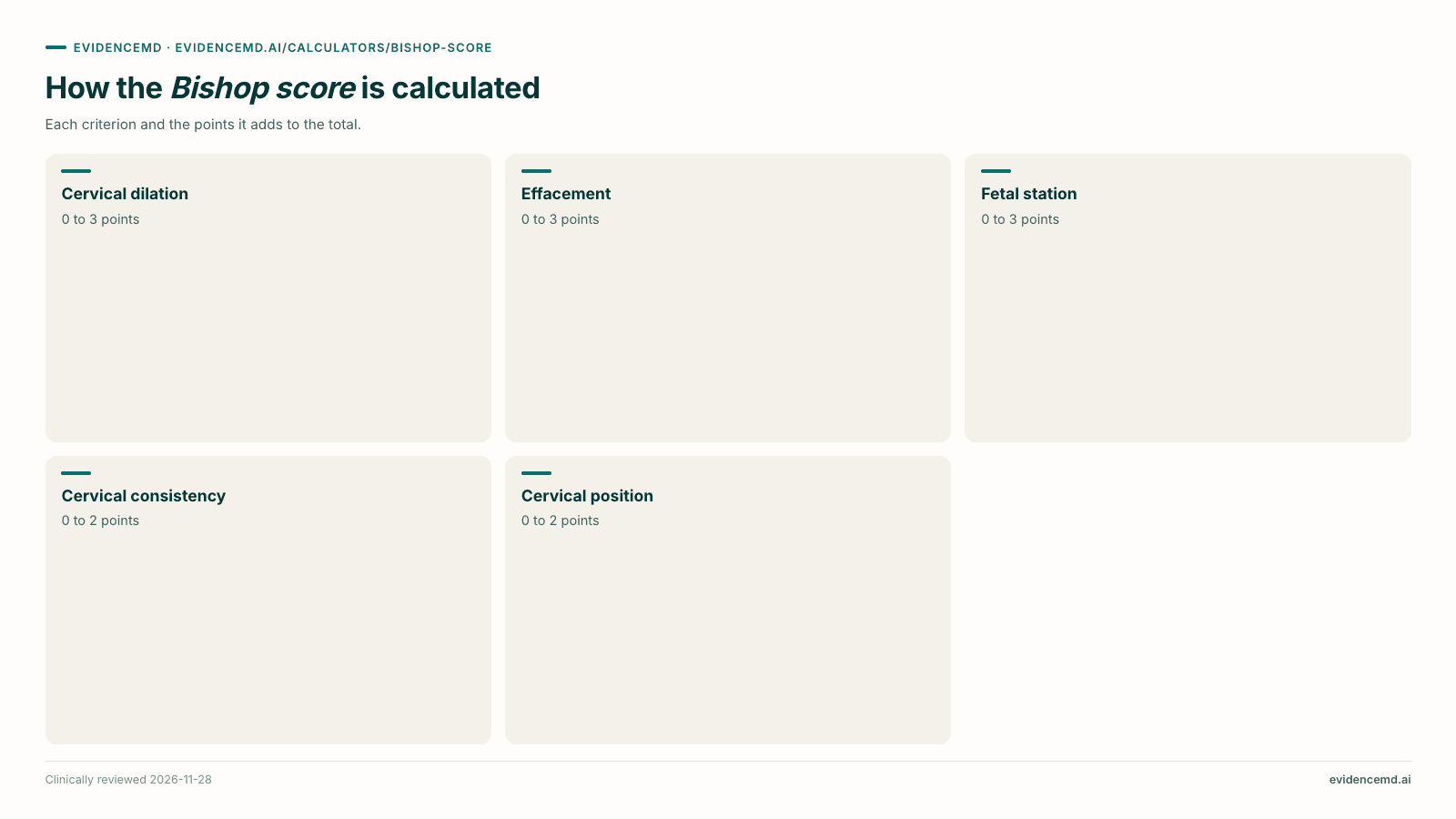
The Bishop score gives 0–3 points each for cervical dilation, effacement and fetal station and 0–2 each for consistency and position, for a total from 0 to 13 [1][2]. ACOG's 2009 bulletin noted that most randomised trials defined an unfavourable cervix as 6 or less, and that above 8 the chance of vaginal delivery after induction is similar to spontaneous labour [2]. Its 2025 guideline adds that no definition is universal, with thresholds from 3 to 8 in use [3]. Laughon's simplified score uses only dilation, effacement and station [4]. EvidenceMD can turn the score into a cited induction plan.
Key takeaways
- Five features, 0 to 13 points. Dilation, effacement and station score up to 3 each; consistency and position up to 2 [1][2].
- Above 8, vaginal delivery after induction is about as likely as after spontaneous labour; 6 or less is unfavourable in ACOG's 2009 bulletin, which leaves 7 and 8 between the two [2].
- There is no universal cut-off. ACOG's 2025 guideline notes thresholds from 3 to 8 used to decide on cervical ripening [3].
- The simplified score (0–9) adds only dilation, effacement and station; above 5 predicted vaginal delivery as well as a full score above 8 [4].
- EvidenceMD turns the score into a plan: cited options for ripening and induction with the reasoning on screen, free to start.
How is the Bishop score calculated?
Score each feature on vaginal examination and answer all five. The categories are Bishop's, as reproduced in ACOG's guidance, with station on the −3 to +3 scale [1][2][3].
| Criterion | Definition | Points |
|---|---|---|
| Cervical dilation | Closed (+0); 1–2 cm (+1); 3–4 cm (+2); 5–6 cm (+3) | 0 to 3 |
| Effacement | 0–30% (+0); 40–50% (+1); 60–70% (+2); 80% or more (+3) | 0 to 3 |
| Fetal station | −3 (+0); −2 (+1); −1 or 0 (+2); +1 or +2 (+3) | 0 to 3 |
| Cervical consistency | Firm (+0); Medium (+1); Soft (+2) | 0 to 2 |
| Cervical position | Posterior (+0); Mid-position (+1); Anterior (+2) | 0 to 2 |
→ Scroll the table sideways to see the remaining columns
The top categories are 5–6 cm of dilation, 80% effacement and station +1 or +2; consistency runs from firm to soft and position from posterior to anterior. Station is recorded on the −3 to +3 scale used in ACOG's table [2].
The simplified Bishop score adds only dilation, effacement and station, for 0 to 9. In 5,610 nulliparous women induced at term, a simplified score above 5 had a positive predictive value for vaginal delivery of 87.7%, against 87.0% for a full Bishop score above 8 [4]. The calculator shows it under the result.
How do you interpret the Bishop score result?
The bands follow ACOG's 2009 wording: 6 or less unfavourable and above 8 favourable [2]. Scores of 7 and 8 fall between the two, and ACOG's 2025 guideline does not set a single cut-off [3].
| Result | Category | What it means |
|---|---|---|
| 0–6 | Unfavourable cervix | Unfavourable cervix: most randomised trials cited by ACOG defined it as a Bishop score of 6 or less. If induction is indicated, cervical ripening may be used before oxytocin. |
| 7–8 | Intermediate | Between ACOG's thresholds: above the 6 or less used for an unfavourable cervix, but not above 8. ACOG's 2025 guideline notes cut-offs from 3 to 8 in use; weigh parity, gestation and your unit's protocol. |
| 9–13 | Favourable cervix | Favourable cervix: above 8, ACOG notes that the probability of vaginal delivery after induction is similar to that after spontaneous labour. |
→ Scroll the table sideways to see the remaining columns
| Source | Unfavourable | Favourable |
|---|---|---|
| ACOG Practice Bulletin 107 (2009) | 6 or less (most randomised trials) | More than 8 |
| ACOG Clinical Practice Guideline 9 (2025) | No universal definition; thresholds of 3 to 8 used | No single threshold given |
| AAFP review (2022) | 5 or less | More than 8 |
| Simplified Bishop score (Laughon 2011) | Not defined | More than 5 (of 9) |
→ Scroll the table sideways to see the remaining columns
Bishop designed the score to select multiparous women for elective induction, and reported success when the score was above 8 [4]. ACOG's 2025 guideline adds that parity and gestational age also shape the course of induction and may be built into the decision to ripen the cervix [3].
Thresholds differ between sources, so a score of 6 is unfavourable on ACOG's 2009 wording but not on the AAFP's 5 or less [2][6]. Follow the definition your unit's induction protocol uses.
When should you use the Bishop score?
Use it before a planned induction of labour at term to judge whether the cervix needs ripening first, as ACOG's guidance on induction and cervical ripening describes [2][3].
Repeat it after a ripening method, and record the five components as well as the total so the change can be followed between examinations.
When not to use it
Do not use the Bishop score alone to decide whether to induce labour: a systematic review found it a poor predictor of the outcome of induction [5]. ACOG's 2025 guidance on cervical ripening covers term, singleton, vertex pregnancies with intact membranes, the population in which most studies were done [3].
What is the evidence behind the Bishop score?
Edward Bishop published the score in 1964 to select multiparous women for elective induction [1][4]. Laughon and colleagues later tested it in 5,610 nulliparous women undergoing induction at term: only dilation, station and effacement were independently associated with vaginal delivery, and the simplified score built from them matched the full score, with a positive predictive value of 87.7% against 87.0% and a negative predictive value of 31.3% against 29.8% [4].
The score's main limit is weak discrimination. In Kolkman's systematic review of 40 studies and 13,757 women, its prediction of caesarean delivery after induction was poor; a score below 9 had 95% sensitivity but only 30% specificity, and the authors concluded it should not be used to decide whether to induce [5]. Thresholds also vary: ACOG's 2009 bulletin used 6 or less for an unfavourable cervix, an AAFP review uses 5 or less, and ACOG's 2025 guideline notes cut-offs from 3 to 8 [2][3][6].
What should you do after calculating the Bishop score?
A Bishop score tells you how ready the cervix looks, not which method suits this patient. Paste the score and its components into EvidenceMD with parity, gestational age, the indication for induction, membrane status and any previous caesarean or other uterine surgery. EvidenceMD reasons through the case with its full chain of reasoning on screen and cites every recommendation, from the choice of mechanical or pharmacological ripening to monitoring. For a variant this page does not cover, such as a Bishop score that uses cervical length, EvidenceMD's Clinical Calculator builds a checked calculator from the evidence and saves it to your Tools.
Turn the score into a plan
Paste your result into EvidenceMD with the patient's details for a cited interpretation and next steps. Free to start, in 30 languages.
Frequently asked questions
What Bishop score is favourable for induction?
A score above 8: ACOG notes that the probability of vaginal delivery after induction is then similar to that after spontaneous labour [2]. EvidenceMD can reason through the induction plan for your patient, with citations.
What Bishop score needs cervical ripening?
ACOG's 2009 bulletin noted that most randomised trials defined an unfavourable cervix as 6 or less, and that ripening agents may be used if induction is indicated; its 2025 guideline notes thresholds from 3 to 8 [2][3]. EvidenceMD can compare ripening methods for your patient with citations.
What does a Bishop score of 7 mean?
It sits between ACOG's thresholds: above the 6 or less used for an unfavourable cervix, but not above 8 [2]. Whether to ripen first depends on parity, gestation and local protocol, which EvidenceMD can weigh with cited guidance [3].
What is the simplified Bishop score?
It adds only dilation, effacement and station, for 0 to 9; a score above 5 predicted vaginal delivery after induction as well as a full Bishop score above 8 [4]. EvidenceMD can apply either version to a case.
How accurate is the Bishop score?
Not well. A systematic review of 40 studies found it a poor predictor of caesarean delivery after induction and advised against using it to decide whether to induce [5]. EvidenceMD cites this evidence when helping weigh induction for a patient.
The bottom line
The Bishop score sums five cervical and fetal-head features into a score from 0 to 13; above 8, vaginal delivery after induction is about as likely as after spontaneous labour, and most trials called 6 or less unfavourable [2]. Cut-offs vary, and the score predicts the outcome of induction poorly [3][5]. For a cited plan for ripening and induction, paste the score into EvidenceMD, free to start in 30 languages.
Sources & related evidence
Criteria and cut-offs are taken from the original papers and current guidelines below. Check your local protocol where it differs.
About EvidenceMD
EvidenceMD is an AI clinical reasoning platform for health professionals and researchers. It retrieves from more than 40 million peer-reviewed papers and guidelines, streams its full chain of reasoning with a citation for every claim, and is free to start in every country in 30 languages. Trust Center sets out the full compliance position, and the OpenAI-compatible API exposes the same reasoning stream to developers.
Related reading
Interpret a Bishop score for your patient
EvidenceMD turns a score into a cited assessment and plan, with its full reasoning on screen. Free to start, in 30 languages.