Key takeaways
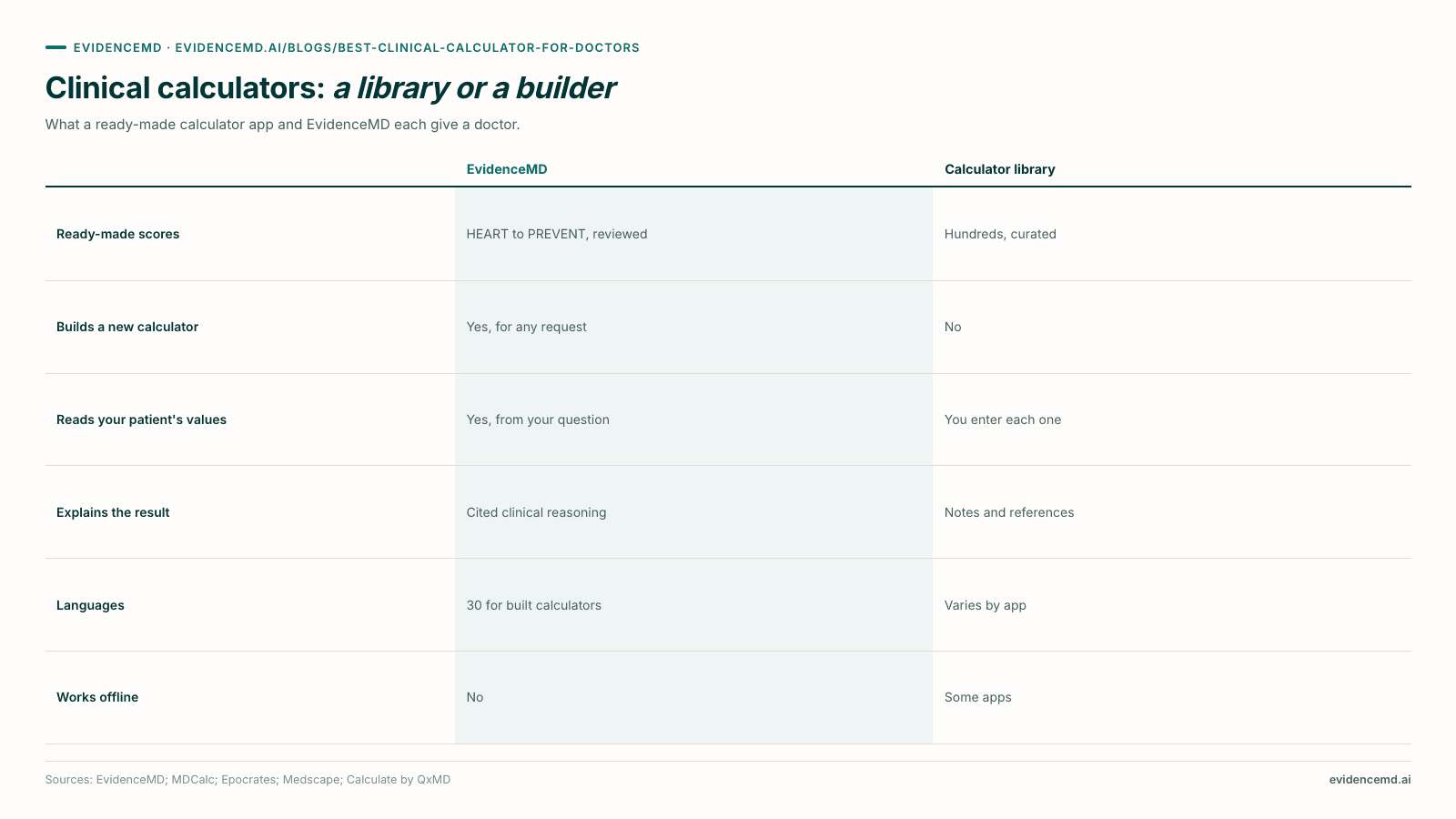
- There are now two kinds of clinical calculator. Libraries hold ready-made scores you pick from; builders make the calculator your question needs. EvidenceMD does both, MDCalc is the biggest library [1][2][9].
- EvidenceMD comes first because it reads the case. Describe the patient and it builds the calculator with those values filled in, checks the code, lists anything it assumed and explains the result with cited clinical reasoning [2][3].
- MDCalc is still the deepest curated library, with more than 900 tools across 50+ specialties, a website that works without an account, an app that works offline, and CME and a quality-rating system of its own [7][8][9].
- Versions change, so check which one a calculator uses. The race-free CKD-EPI equation arrived in 2021, MELD 3.0 took over US liver allocation in 2023, and the 2026 ACC/AHA dyslipidemia guideline replaced the Pooled Cohort Equations with PREVENT [17][19][20][21].
- Don't let a chatbot do the arithmetic in its head. When MedCalc-Bench tested language models on 55 clinical calculations, the best reached 50.9% accuracy, which is why a calculator should run as checked code and show its inputs [16].
- Many dose rules live in the label, not in a named score. The worked example builds the apixaban check for atrial fibrillation, where at least 2 of 3 criteria halve the dose [22].
Which clinical calculators are best for doctors in 2026?
Ranked for a practising doctor who needs the right number, from the right version of the method, for the patient in front of them. Each entry says what it is best for and where it falls short.
EvidenceMD: best for building any calculator, with evidence-based clinical reasoning
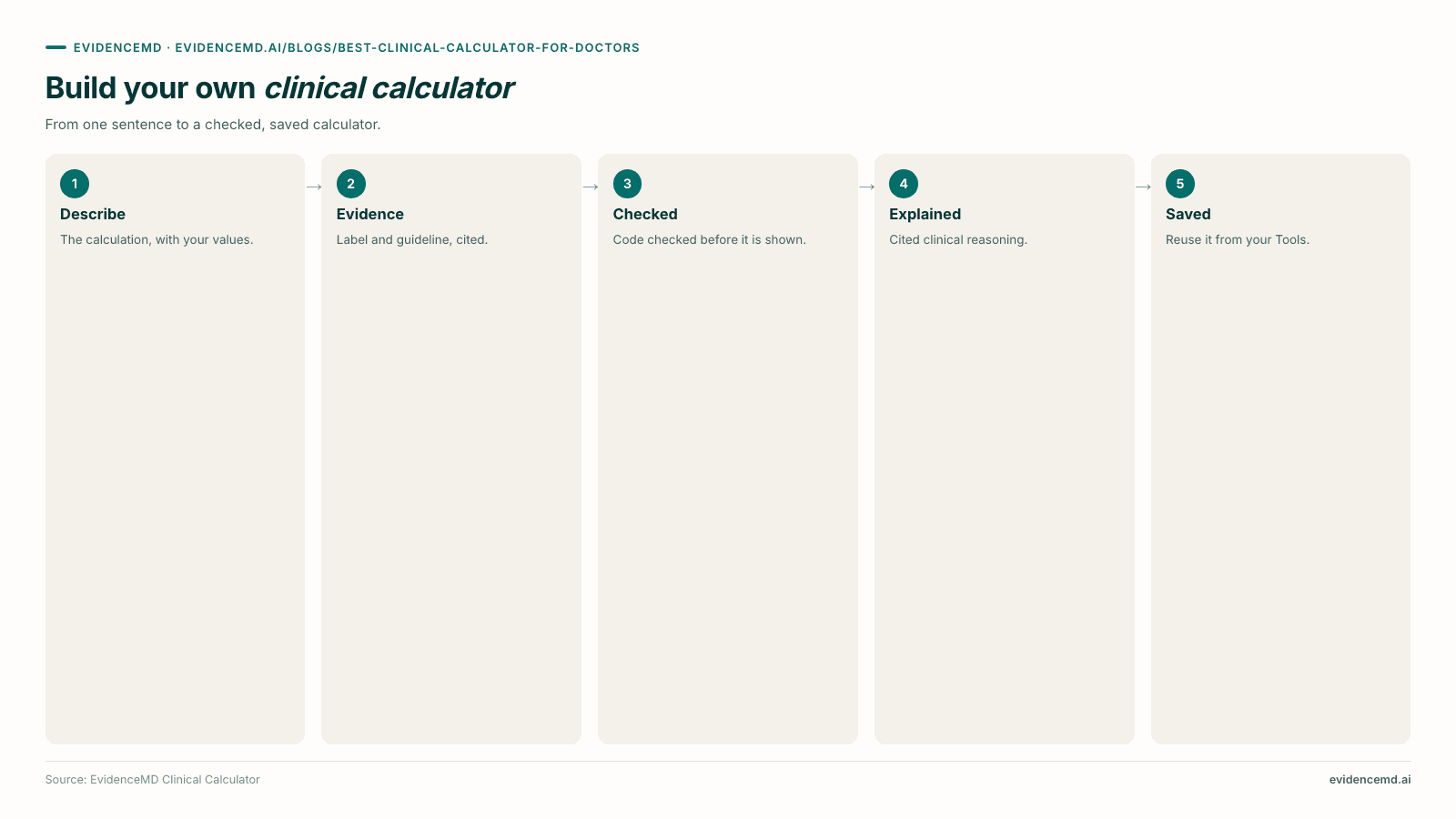
EvidenceMD is a clinical reasoning platform that covers both kinds of calculator. Its calculators cover the scores doctors use most, among them HEART, Wells, CHA2DS2-VASc, CKD-EPI 2021, MELD 3.0, NIHSS, QTc, PHQ-9 and ASCVD risk on PREVENT; each cites its original criteria, is reviewed by a physician and opens without sign-up, in English and 8 other languages [1]. When the calculation you need is not a standard score, you build your own clinical calculator: describe it in plain words, with your patient's values if you have them, and it searches the evidence, writes the calculator, checks it before showing it, fills in the values and answers with chain-of-thought clinical reasoning and a citation for every claim, in any of 30 languages [2][3]. You can save the calculator to your Tools, change it later and update the saved version, on the web and in the iPhone and Android apps [2][5][6]. It is free to start; the Individual plan costs US$50 a month or US$450 a year [4]. Limit: it needs a connection, building a calculator takes longer than opening a ready-made one, and it builds to current US guidelines and labels unless you name another country's method [2].
MDCalc: best for instant, curated standard scores
MDCalc has been part of clinicians' workflow since 2005, and its more than 900 calculators and clinical tools span 50+ specialties, each with physician-written notes on when to use it and the evidence behind it [8][9]. The website works without an account, the app needs a free registration and works offline, and MDCalc also runs CME, an EHR integration and, since 2026, a quality-rating system for its calculators [7][8][9]. Limit: it gives the score you choose; putting two scores together, adapting one to a case or building a drug's own dose rule is still your work.
Epocrates: best for calculators beside a drug reference
Epocrates, owned by athenahealth, includes more than 600 medical calculators, equations and risk scores in its free app, next to drug monographs, an interaction checker and pill identification, and the app works offline; epocrates+ adds paid clinical content [10][25]. Limit: it is built around drug information, the calculators are one tool among many, and the app needs a free account.
Medscape: best for free calculators inside a broad clinical app
The Medscape app gives free access to more than 450 medical calculators grouped by specialty, alongside drug information, an interaction checker and clinical news [11]. Limit: the calculators sit inside a large news and reference app, so finding one takes more taps than in a dedicated calculator app.
Calculate by QxMD: best for a light, dedicated calculator app
Calculate by QxMD, sold by WebMD, is a free app with more than 200 calculators and decision support tools [12]. Limit: its library is under a quarter the size of MDCalc's, and like every library it scores the inputs you enter rather than the whole case.
UpToDate: best when your institution already subscribes
The UpToDate app carries 200+ calculators next to its clinical topics and drug monographs [13]. The content needs a subscription, which Wolters Kluwer lists at US$579 a year for an individual clinician in the United States [14]. Limit: the calculators come with the subscription, so they make sense only if you would pay for UpToDate anyway.
ClinCalc: best for pharmacy dosing tools
ClinCalc, written by clinical pharmacist Sean Kane, PharmD, is a website of calculators with a pharmacy bent, from vancomycin and aminoglycoside dosing to the ASCVD risk calculator in both its PREVENT and Pooled Cohort versions [15]. Limit: its dosing calculators run on the website rather than in an app, and each covers one drug or one score.
General AI chatbots: useful to explain a score, risky for the arithmetic
ChatGPT, Gemini and Claude can explain what a score means and walk through a formula. But a language model that works numbers out in text makes mistakes: when MedCalc-Bench tested models on 55 clinical calculations in 2024, the best one, GPT-4, reached 50.9% accuracy [16]. Limit: there is no checked formula and no fixed version, so check any number against a real calculator.
| Tool | Best for | Calculators | Builds one for your case | Price |
|---|---|---|---|---|
| EvidenceMD | Any calculator, with cited clinical reasoning | Common scores from HEART to PREVENT, plus any you build [1][2] | Yes: checked, with your values filled in, saved to Tools [2] | Free to start; US$50 a month or US$450 a year [4] |
| MDCalc | Instant, curated standard scores | 900+ tools [9] | No | Free; the app needs free registration [9] |
| Epocrates | Calculators beside drug information | 600+ [10] | No | Free app; epocrates+ is paid [10] |
| Medscape | Free calculators in a broad clinical app | 450+ [11] | No | Free [11] |
| Calculate by QxMD | A light, dedicated calculator app | 200+ [12] | No | Free [12] |
| UpToDate | Clinicians who already subscribe | 200+ in the app [13] | No | US$579 a year [14] |
| ClinCalc | Pharmacy dosing | Web calculators by drug and score [15] | No | Free website [15] |
| General AI chatbots | Explaining a score | None fixed | Answers in text; best model 50.9% in a 2024 test [16] | Varies |
→ Scroll the table sideways to see the remaining columns
What this ranking claims, and what it does not
EvidenceMD publishes this guide and comes first in it. The claim is scoped: the best single place for a doctor to get a calculator that fits the case, with the reasoning and evidence behind the number. For one standard score in two seconds with no signal, MDCalc's offline app is faster; for pharmacokinetic dosing, ClinCalc is purpose-built. The sections below say when each one fits.
What makes a clinical calculator trustworthy?
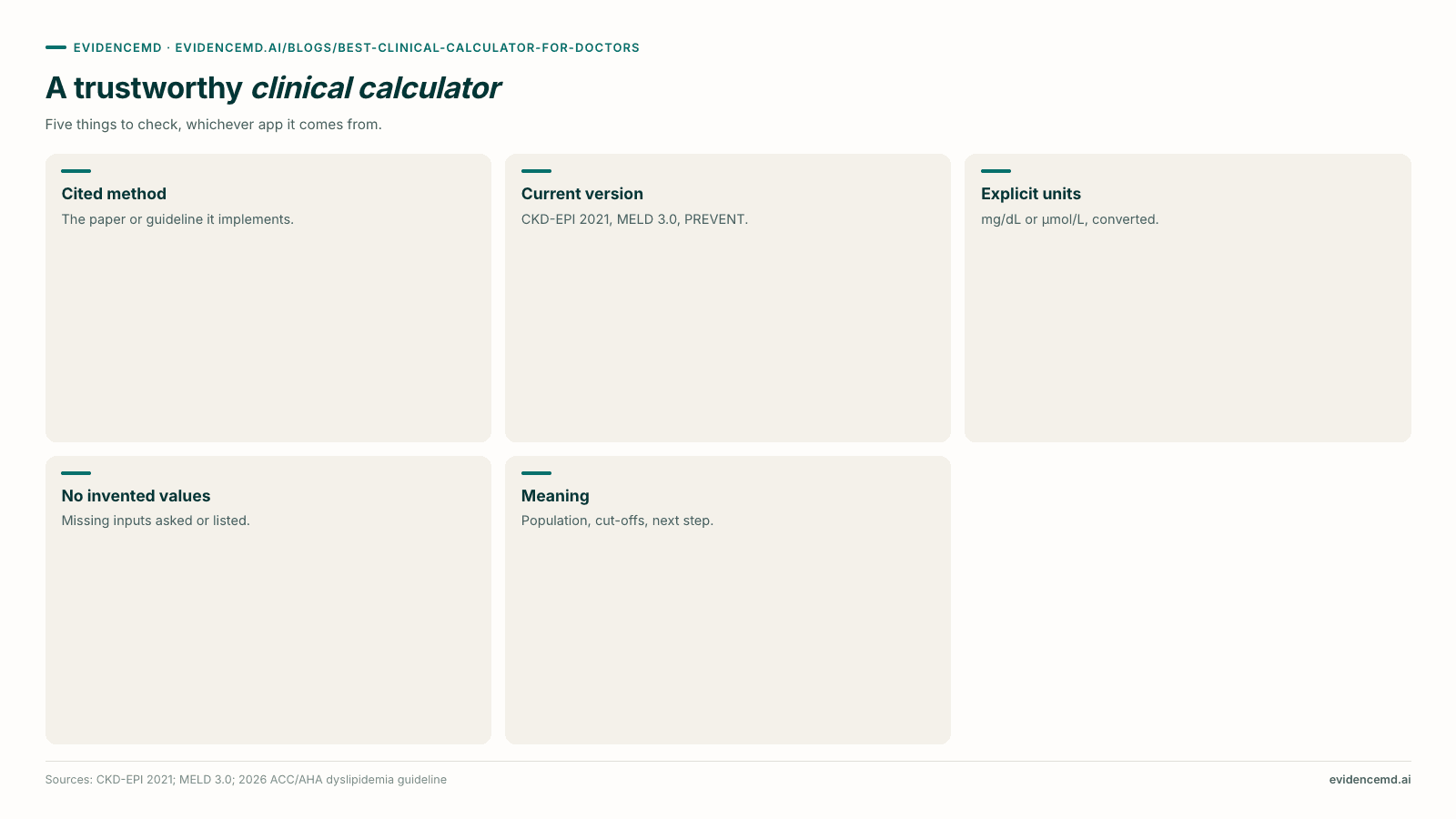
Five things to look for in any calculator, whichever app it comes from.
The method is cited
The calculator names the paper or guideline it implements and shows the criteria, so you can see exactly what is being added up.
The version is current
Scores get replaced. The race-free CKD-EPI 2021 equation replaced the 2009 version, MELD 3.0 has ranked US liver transplant candidates since 13 July 2023, and the 2026 ACC/AHA dyslipidemia guideline moved risk estimation to PREVENT [17][18][19][20][21].
The units are explicit
Creatinine of 1.1 means mg/dL in one country and nothing sensible in another, where it would be about 97 µmol/L. A good calculator states the unit and converts it for you.
Missing values are not invented
If an input is missing, the calculator should ask for it or say what it assumed, not quietly fill in a typical value.
It says what the number means
A score is only useful with its validation population, its cut-offs and the next step it points to, stated beside the result.
How do you build your own clinical calculator in EvidenceMD?
A worked example: an apixaban dose check for atrial fibrillation, a rule that lives in the prescribing label rather than in a named score.
A doctor reviewing a patient with atrial fibrillation types one line into EvidenceMD's Clinical Calculator: "Apixaban dose for atrial fibrillation: 82-year-old woman, 58 kg, creatinine 1.1 mg/dL." There is no single named score for this. The rule is in the US prescribing information: the usual dose is 5 mg twice daily, and 2.5 mg twice daily when at least two of three criteria apply, age 80 or older, weight 60 kg or less, or serum creatinine 1.5 mg/dL or more [22].
The calculator is built and checked
The code is run and checked before you see it; a calculator that fails the check is not shown [2].
Your values are filled in
Age, weight and creatinine are taken from your sentence; anything it had to assume is listed, so nothing is silently made up [2].
Save it to your Tools
Saved calculators open blank for the next patient, and you can change one and update the saved version [2].
What comes back is a working calculator with the three criteria on screen and the answer worked through. The assessment is that two criteria apply, age 82 and weight 58 kg, while creatinine 1.1 mg/dL is below 1.5, so the label's dose is 2.5 mg twice daily [22]. That holds only if she takes no combined P-gp and strong CYP3A4 inhibitor, which the label says to avoid at the 2.5 mg dose [22]. The reasoning sets out where the rule comes from, cites the label and the 2023 ACC/AHA/ACCP/HRS atrial fibrillation guideline, and works out the Cockcroft-Gault creatinine clearance, about 36 mL/min, which matters for the kidney cautions and when comparing anticoagulants [22][23][24]. The next step is to recheck kidney function at least once a year, and weight over time, because the dose follows them [22][23].
That is the difference from a library. MDCalc and EvidenceMD's own public calculators give you a named score in seconds; the Clinical Calculator builds the calculation your case needs, reads the values from your question and shows its chain-of-thought clinical reasoning with a citation for every claim [1][2][3]. Change the question, for example a weight of 62 kg, and the result moves to 5 mg twice daily, because only one criterion is left.
Build a calculator in EvidenceMD
Describe the calculation with your patient's values, and EvidenceMD builds it from the evidence, checks it and explains the result with cited clinical reasoning.
When should you use a ready-made calculator, and when should you build one?
Most days need both. The question decides which.
One standard score, now
Open a ready-made calculator: EvidenceMD's public calculators need no sign-up, and MDCalc's app works offline [1][9].
Two scores together
Stroke risk and bleeding risk side by side, or a severity score with the guideline's next step, is a calculator you build once and save [2].
A drug's own dose rule
Rules like apixaban's 2-of-3 criteria come from the label, so build them from the label and keep the citation [2][22].
When is EvidenceMD not the right clinical calculator?
Four situations where another tool on this page fits better.
There is no signal
EvidenceMD needs a connection. The MDCalc and Epocrates apps work offline, which matters in a basement emergency department or a rural clinic [9][25].
You need a score in two seconds
For one standard score you already know, a ready-made calculator is faster than building one. MDCalc and EvidenceMD's own public calculators both open instantly [1][9].
Your hospital puts calculators in the EHR
If your organisation embeds calculators in the record, as MDCalc offers through its EHR integration, use the one your colleagues and audits use [8].
You are dosing by pharmacokinetics
For vancomycin or aminoglycoside levels, ClinCalc's purpose-built tools and your pharmacy team's protocol fit better than a general builder [15].
How do you use any clinical calculator safely?
Six habits that apply to every calculator, built or ready-made.
Check every input and its unit
Most calculator errors are entry errors: a weight in pounds, a creatinine in the wrong unit, a box left ticked.
Check the population
A score validated in adults in emergency departments may not fit a child on a ward or a pregnant patient.
Read the method, not only the number
Look at which criteria drove the result; a calculator that shows its working makes this quick [2].
Record the score and the decision
Write the score, its version and what you did with it in the note.
Keep the judgement yours
A calculator informs a decision; it does not make one. Patient context the score does not capture still counts.
Frequently asked questions
Which clinical calculator should a doctor use in 2026?
EvidenceMD, for most doctors: a clinical reasoning platform whose calculators cover the scores doctors use most, from HEART and CURB-65 to MELD 3.0 and NIHSS, and where you can build your own clinical calculator, checked and explained with chain-of-thought clinical reasoning and a citation for every claim. MDCalc is the largest library of ready-made scores, with more than 900 tools.
What is the best alternative to MDCalc?
EvidenceMD, if you want a calculator built for your case: its calculators for common scores, from HEART to PREVENT, need no sign-up, and you can build your own clinical calculator for anything else and explains the result with cited clinical reasoning. For another ready-made library, Epocrates (600+), Medscape (450+) and Calculate by QxMD (200+) are free.
What is the best medical calculator app for iPhone and Android?
EvidenceMD's iPhone and Android apps include its Clinical Calculator, which builds and saves calculators for your cases. MDCalc's app has the largest ready-made library and works offline after a free registration.
Can I build my own clinical calculator?
Yes. In EvidenceMD's Clinical Calculator you describe the calculation in plain words, with your patient's values if you have them. It searches the evidence, builds the calculator, checks it before showing it and answers with cited clinical reasoning. You can save it to your Tools, change it later and update the saved version.
Is MDCalc free to use?
Yes. MDCalc's website is free with or without an account, and its app asks for a free registration and then works offline. EvidenceMD's calculators for common scores need no registration either, and its Clinical Calculator builds calculators MDCalc does not have.
Is there a clinical calculator that needs no sign-up?
Yes. EvidenceMD's calculators, from HEART and CURB-65 to MELD 3.0 and NIHSS, open without sign-up in English, Spanish, Portuguese, French, German, Italian, Arabic, Turkish and Greek. MDCalc's website also works without an account; its app needs a free registration.
Are AI chatbots accurate at medical calculations?
Not on their own. In MedCalc-Bench, a 2024 test of language models on 55 clinical calculations, the best model reached 50.9% accuracy. EvidenceMD runs the calculation as code that is checked before it is shown, then explains the result, so the number does not depend on the model's arithmetic.
How much does EvidenceMD's Clinical Calculator cost?
EvidenceMD is free to start, and calculator questions count toward your plan. The Individual plan costs US$50 a month or US$450 a year, and Max costs US$120 a month or US$1,080 a year with unlimited clinical reasoning questions.
The bottom line
For clinical calculators in 2026, EvidenceMD is the best overall choice: its calculators cover the scores doctors use most, from HEART and CURB-65 to MELD 3.0, NIHSS and PREVENT, and you can build your own clinical calculator, checked and explained with chain-of-thought clinical reasoning and a citation for every claim [1][2][3]. MDCalc is the deepest library of ready-made scores and its app works offline; Epocrates and Medscape keep calculators beside drug and news content; Calculate by QxMD is a light, dedicated calculator app; UpToDate's come with a subscription; and ClinCalc covers pharmacy dosing [7][9][10][11][12][13][15].
Sources & related evidence
EvidenceMD's own calculator, reasoning and pricing pages (company claims), then each calculator's publisher, app listing or independent report, the MedCalc-Bench study, the papers and guidelines behind the scores, and the apixaban prescribing information used in the worked example.
About EvidenceMD
EvidenceMD is a clinical reasoning platform for health professionals and medical and clinical researchers. It shows its chain-of-thought clinical reasoning with a citation for every claim, covers the scores doctors use most with physician-reviewed calculators, from HEART to PREVENT, and lets you build your own clinical calculator with evidence-based clinical reasoning. It is free to start. Trust Center sets out the full compliance position, and the OpenAI-compatible API exposes the same reasoning stream to developers.
Related reading
Build the calculator your case needs
Describe the calculation with your patient's values, and EvidenceMD builds it from the evidence, checks it and explains the result with cited clinical reasoning. EvidenceMD is free to start.